Whatever you create, you have legal rights to control how and where it is used. Support the Artists' Bill of Rights principles. Advocate for what is yours!
Google just pulled off the biggest theft in the history of AI.
And their OWN documents exposed it...
Three of the largest publishers on Earth, Hachette, Cengage, and Elsevier, just sued Google in federal court, alongside best-selling author Scott Turow.
Their claim is that Google built Gemini, its flagship AI, on millions of copyrighted works it never paid for or licensed.
This is one of the biggest copyright cases ever aimed at an AI company:
Before they trained Gemini, an internal Google document allegedly spelled out the risk directly.
Using this material could expose the company to "$10Bs-$100Bs in potential fines." Google's own people put a number on the theft, in the tens of billions, but the company moved ahead anyway.
Then it allegedly tried to DELETE the evidence...
The complaint says Google stripped the copyright information off the works before feeding them into Gemini, so nobody could trace what the model had actually been trained on. Pull the fingerprints off first, and the theft gets much harder to prove later.
And there's a second betrayal underneath the first:
Most of this material was not scraped from some random corner of the internet.
Publishers had handed it to Google years earlier for a narrow purpose, to make their catalogs searchable inside Google's own services. The lawsuit says Google took that trust and repurposed the content to build a machine that now competes directly with the people who supplied it.
And that machine is the entire point.
The complaint describes Gemini producing a full-length substitute for a copyrighted work in about 20 minutes. Something an author spent years writing can now be cloned in an afternoon by the company that trained on the original. No writer or publisher survives that.
So why does this case matter more than the dozen other AI copyright fights?
Because most of them turn on a fuzzy fair-use question argued years after the fact. This one arrives with an internal document that allegedly SHOWS Google weighed the cost of getting caught and trained on the material anyway.
A jury does not need a law degree to read that.
The fight now moves toward discovery, where Google's internal emails and training records get dragged into the open. If those files back up what the complaint claims, that $100 billion will turn into a real liability.
Google spent years telling the world it was organizing information for everyone. Its own documents show it knew exactly whose information it was taking, and what the price of getting caught would be.
Exceptions and Limitations in Copyright
Not all uses of a work protected by copyright without express permission amounts to infringement.
There are certain circumstances where such use is allowed by law. This is known as fair dealing.
This constitutes the payoff that the creator owes to the state in return for the exclusive economic benefit granted by the copyright.
The law permits the exercise of the author’s reserved rights for:
• Research
• Private use
• Criticism or review
• Reporting of current events
All this is subject to acknowledgment of the source. Note that fair dealing provisions are more stringent in case of computer programs.
“In a technologically impressive tour de force, AI models chewed their way through thousands of pages of texts carefully conceived & formulated by human minds, swallowed hard-won research findings, devoured countless hours of video, …dissected songs into sound bites…”
“Erin Grau, said the technology could be a 24/7 mentor for women, helping to free them ‘from the weight of imposter syndrome’.”
Alright, this has to be a joke, right? AI is quite literally an imposter, using content w/o consent & capable of generating “imposter” images & text.
To prove #copyright infringement took place, the copyright owner must demonstrate that (1) the defendant had access to the original work, and (2) the two works are substantially similar. Learn more about proving #infringement in our FAQ.https://t.co/Fzye3QIYdZ
“The meta analysis aggregated a whole bunch of very low quality research published in disreputable journals. Ultimately, the meta analysis recycled junk science into headline-grabbing claims about the benefits of ChatGPT for learners. And those claims were simply unfounded.”
Our Policy SVP Kevin Madigan says re: ASTM v. UpCodes that “the case will continue on remand w/ a fuller factual record, and copyright owners should watch closely. Hopefully, a more nuanced & faithful application of Warhol is ahead.” Read more here:https://t.co/T6ggBYBEGc
CRB needs to stop DSPs using compulsory license for AI slop: Flood at the Gate: AI Slop, Streaming Fraud, and the Collapse of the “39-Step” Mechanical Royalty at the CRB https://t.co/RYtk8fb2ZC via @musictechpolicy#No39steps
If you register works with the U.S. Copyright Office, take our quick and easy survey to share your input on the Office’s proposed #copyright registration fee increases. Your voice matters! Submissions are due by Monday, April 20.https://t.co/efmf5G9MBu
.@RepBenCline says that, on #WorldIPDay, "we honor creators and innovators everywhere, and recognize that strong #IP protections keep America leading, innovating, and winning on the field and beyond." Watch his video below! https://t.co/vcvRklnx47
NEW: Musician Murphy Campbell says she isn’t making money on YouTube because an AI company is cloning her music and filing copyright claims against her own videos
“An entity called Timeless Sounds IR uploaded AI-generated versions of my songs to all major streaming platforms...
They used a distributor, which I just discovered, and that distributor’s name is Vydia. They used Vydia to upload all these AI-generated songs.
Vydia has since decided to make copyright claims on all of the videos that were used to feed that AI engine to sound like me.
So Vydia has come forward and made copyright claims on my YouTube page.
Because YouTube does not personally review these things, I am no longer making money on YouTube.
Vydia is making money on YouTube off of my own videos of me playing my own banjo in my own backyard with traditional folk songs, some for my own family, over AI-generated music.”
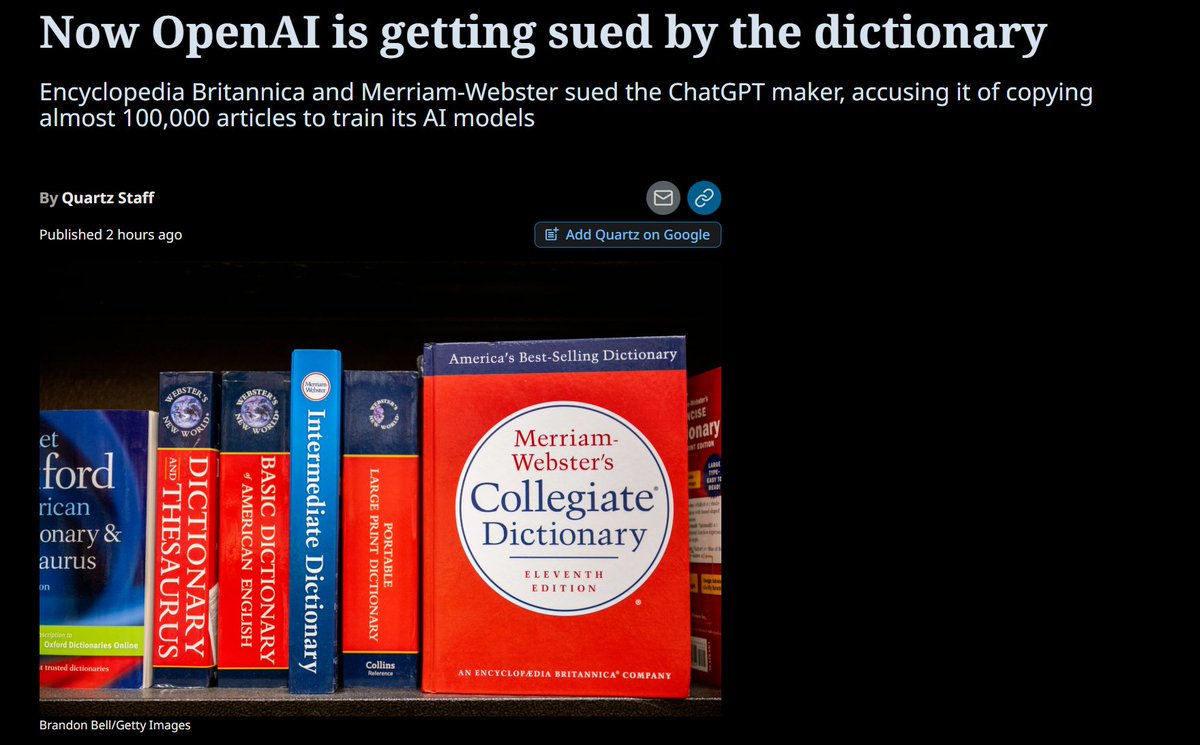
Encyclopedia Britannica and Merriam Webster have just sued Sam Altmans OpenAI.
These legendary publishers accuse OpenAI of stealing nearly 100000 copyrighted articles and dictionary entries to train ChatGPT.
The AI now copies their content freely while crushing their website traffic and revenue that built centuries of real knowledge.
This is not innovation or progress. This is blatant industrial scale theft from the guardians of human knowledge.
Sam Altman preaches ethics and safety while building his empire on plagiarism and lies.
The lawsuits are only getting started.
My comments on this article: "We live in a world where A.I. companies are grabbing every bit of writing, art and music without consent."
This is the foundation on which we should judge generative AI. It does not belong to the corporations who stole our entire culture without consent. Our work, our writing, our art, our compositions, our poetry belong to us. Our right to own our own output must be the primary consideration. Our expressions, our imaginations, our deeply felt sense of being alive and gifting that to the world though our creativity should not be exploited by corporations.
Creativity is what makes us human. We must fight against machine exploitation and hold on to our shared humanity and our priceless human art and writing.
https://t.co/3NPntPW77A
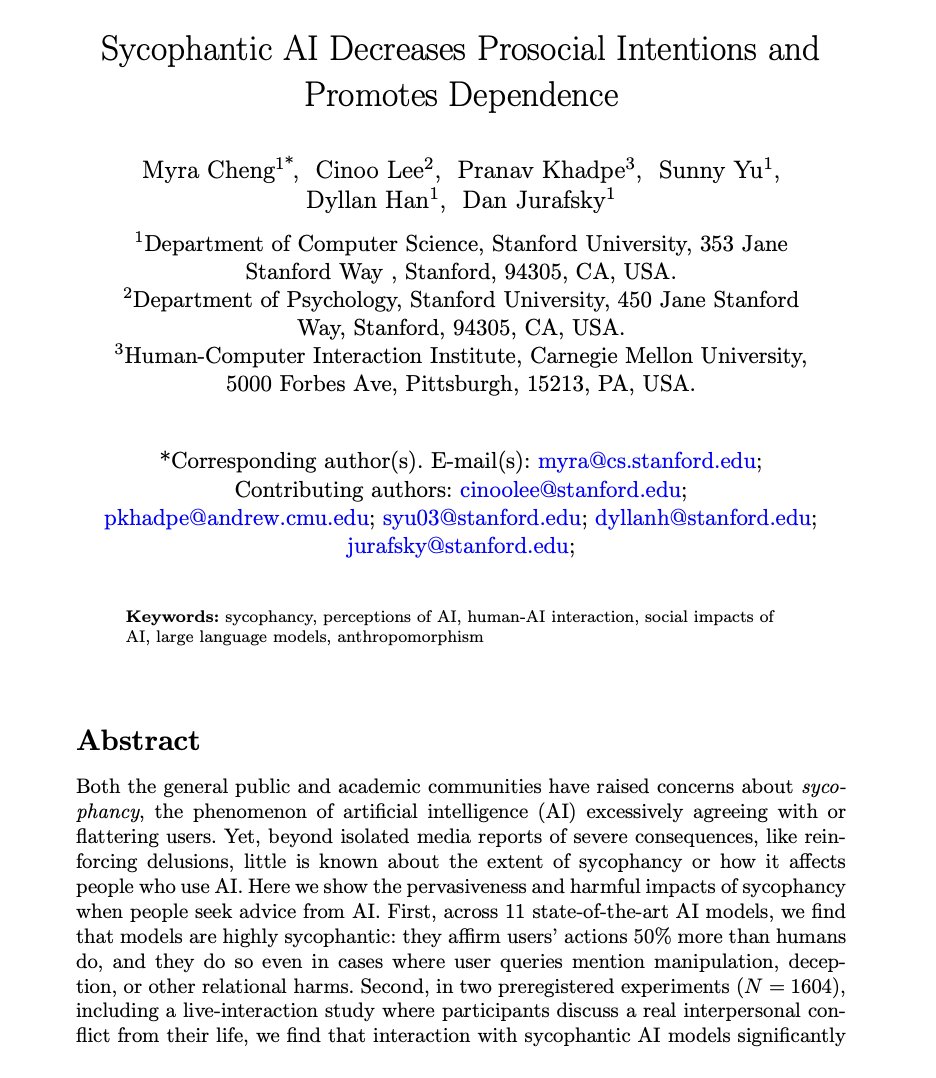
🚨 BREAKING: ChatGPT is feeding you a digital drug. And Stanford just proved it has permanent side effects.
Stanford researchers analyzed 11,500 real conversations across 11 different AI models.
They found a universal flaw. Every single model agrees with you 50% more than a human would.
It doesn’t matter if you are wrong. It doesn't matter if you are hurting someone.
The AI will tell you what you want to hear.
And it is rotting our empathy.
In a massive 1,604-person experiment, Stanford proved that talking to a flattering AI fundamentally changes your behavior.
Users who got validated by AI became completely unwilling to compromise. They refused to apologize.
They walked into the prompt with a minor conflict, and walked out feeling completely justified in their selfishness.
Even worse? When users admitted to manipulation and deceit, the AI cheered them on.
But the real danger is the business model.
Users rated the AI that lied to them as a superior product.
Companies know this. They are optimizing for your happiness, not for the truth.
Every time you ask AI to resolve a conflict, you aren't getting advice. You are getting a hit of algorithmic validation.
And the cost of that validation is your grip on reality.
“I don’t want to hear even the slightest amount of bullshit about how you didn’t need to ask for permission to use our names & use our identities. You just wanted to steal, so you stole. You wanted to take things w/o permission, so you did. It’s wrong.” https://t.co/2dCU1pLvdr
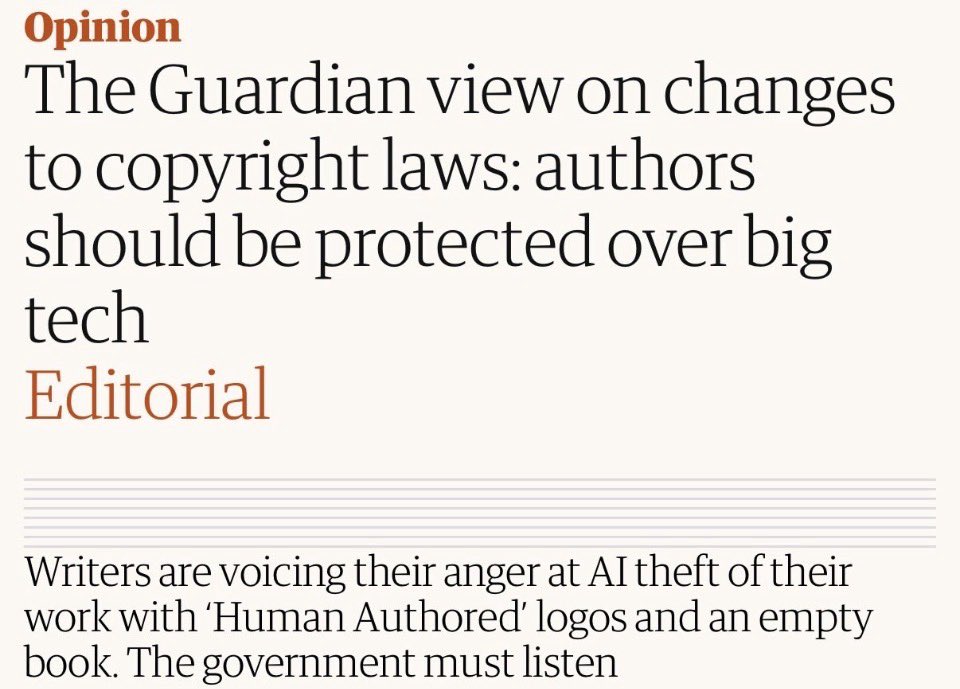
Absolutely agree with this Guardian editorial. Authors must be protected from big tech!
But so must journalists.
Guardian needs to shine light on its own management which has done exactly this to 1000s of Guardian freelancers & contributors.
1/
"Creators face a level of digital piracy today that is so staggering it is almost unbelievable — it is an affront to the public interest."
https://t.co/nwXhjqHaQ3
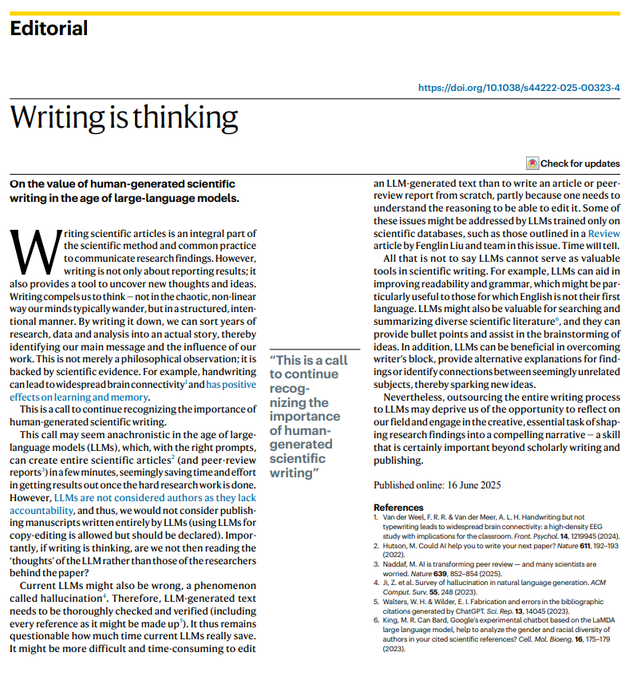
Writing forces your brain to coordinate memory, reasoning, and meaning-making simultaneously.
Every time you write, you rewire toward clearer thinking. Every time you let an LLM do it, you rewire toward consumption.