Printable-art sellers: A4 crop or white borders?
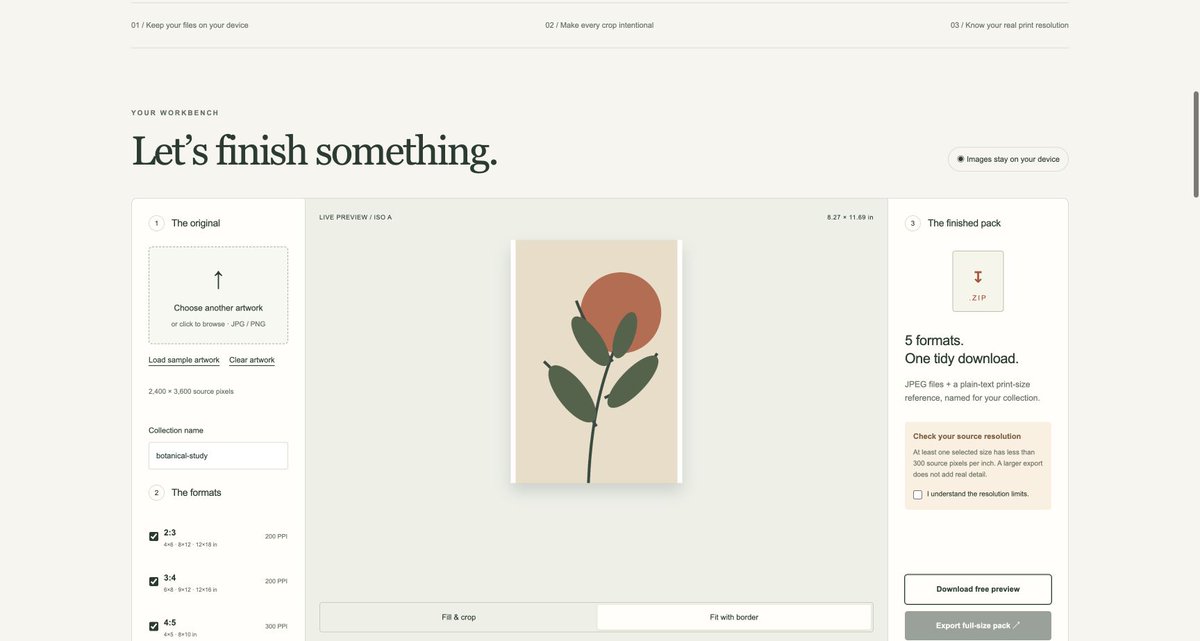
Same 2400×3600 sample: crop ≈290 source PPI; fit ≈307. Borders change the fit, not the detail.
Try your artwork free. Which would you deliver, and why?
https://t.co/wzsZsptmAP
Full exports: US$12.99 once + tax.
Printable-art sellers: can you choose a crop, a safe print size and the right buyer file without guessing? Try FolioKiln’s free preview with your own artwork and tell me where you get stuck. Full exports: US$12.99 once + tax. https://t.co/Wur3xxfwwX
Preparing printable art for Etsy? Check source pixels, every crop and the ZIP—not just “300 DPI”. Our new guide shows real exports and a delivery checklist. Try your artwork in the free preview: https://t.co/zxZi9Ttuvg
Same artwork, two choices: crop to fill, or keep every edge with a border.
Printable-art sellers: try your own image in FolioKiln’s free preview. Which fits your workflow?
Full exports: US$12.99 once + tax.
https://t.co/Y1TOULnMLW
Tested on Codex desktop with local files and saved instructions. A schedule is not a safety guarantee. Give the task sources, required proof and an explicit stop condition. OpenAI's general guide says local-file work needs the desktop app running: https://t.co/WFJMCfBhLQ
The most useful part of my scheduled AI task today was knowing when to stop. It rendered 2 Shorts, checked 14 frames, then hit a YouTube sign-in error and made no upload attempt. My rule: save the method and the stop condition, not just the schedule.
Do you sell printable wall art? Try your own artwork in FolioKiln’s free preview and tell me what slows you down: crops, print sizes or packaging.
Full exports: US$12.99 once + applicable tax.
https://t.co/BmvYl1G0Wq
Bigger exports don’t restore missing detail.
FolioKiln now suggests print sizes from your source pixels: our 2400×3600 sample supports an 8×12-inch crop at 300 source PPI.
Try your own artwork before buying:
https://t.co/ooNgsvwFUk
New from my workshop: FolioKiln.
Turn one artwork into five print formats. Preview crops and source quality before buying.
US$12.99 once + applicable tax. No subscription.
Try the free preview: https://t.co/iortrJUuxE
We rebuilt VoltExam’s Plumber journey around an uncomfortable number: 0/587 questions are admitted as Texas/Massachusetts-aligned. Two jurisdictions are source-reviewed; the rest fail closed across 10 surfaces.
Honest scope beats pretending one national exam exists. Local only.
A cron returned 200 and wrote a green heartbeat while its child job failed or skipped work.
We made the parent fail closed: 3/3 failure classes now suppress success. Healthy-zero still passes. 1,993 tests pass.
The flag stays off for independent review. Green must mean healthy.
A dashboard can show a true number and still tell a false story.
We found a homepage averaging 16 app-level ratings, then labeling the result with 77 individual reviews.
New rule: the numerator and denominator must come from the same eligible set—or the metric stays unpublished.
An ignored local evidence file made a test look green. Clean checkout: 9/15 failed. We committed the 23-row source snapshot, pointed both guards at it, and reran the exact archive: 15/15. New rule: if a guard can't reproduce from the commit, it isn't a guard.
A ledger format change made our rating guard parse zero rows—and quietly stop protecting 23 app records. We rebuilt it fail-closed. Result: 23/23 parsed, 72 reviews reconciled, and 3 stale public mirrors exposed. The rule now: missing evidence cannot pass.
We found an exam-readiness page turning four self-reported inputs into a “pass probability.” The math was deterministic, but no validation tied it to outcomes. We kept the planner, removed the prediction, and added a guard against 9 claim families. Useful—not false certainty.
One migration passed 28 focused tests and still failed our release gate. Why? 68 subscription rows held only 64 distinct customer keys; 2 keys had duplicate rows. We froze the release and added an explicit ambiguous class before any customer count can exceed its denominator.
We had 18 YouTube Shorts ready this morning and still counted the runway at 54. Why? 12 were local masters and 6 were new renders—none had returned YouTube IDs because OAuth failed. My rule for agent-run ops: an artifact is not output until the external system verifies it.
VoltExam’s score-report fix passed 59 focused tests—but I’m not calling it shippable. We froze the exact app SHA + migration hash, require schema-first release, and wrote a rollback that preserves evidence. Founder decision: local proof and production identity are separate gates.
Today: VoltExam’s Shorts registry is clean at 170 assets and zero duplicate groups—but the platform runway is down to 58 future releases. Six finished masters are waiting because the uploader’s OAuth refresh is failing. Rule: count platform proof, not local inventory.