Stan Weinstein's Stage Model
Stan Weinstein created one of the simplest yet most powerful frameworks for understanding stock behavior. It's called the Stage Model, and it breaks down how stocks move through four distinct stages.
Understanding these stages doesn't just help you pick better stocks. It helps you avoid the bad ones.
Stage 1: The Base
This is where a stock consolidates after a decline. It's moving sideways, usually below its 30-week moving average. Volume is low. Nobody cares about it. The stock is catching its breath, building a foundation for the next move.
As a trader, you don't buy here. Not yet. You're watching. You're waiting for the stage to shift.
Stage 2: The Advancing Phase
The stock breaks out from its base. It moves above its 30-week moving average, and that average starts sloping upward. Volume increases on the breakout. The stock is in an uptrend.
This is where you want to be. Stage 2 is where the money is made. The trend is your friend here. You're buying breakouts, holding winners, and letting the uptrend do the work.
Stage 3: The Top
The stock starts moving sideways again, but this time near its highs. It's no longer making progress. The 30-week moving average flattens out. Volume might spike as the stock churns. Smart money is distributing. Retail is buying the "dip."
This is where most traders get trapped. They think the stock is just pausing before another leg up. But it's not. It's topping. You don't want to be buying here. If you're already in, this is where you start looking for exits.
Stage 4: The Declining Phase
The stock breaks down. It falls below its 30-week moving average, and that average starts sloping downward. Volume increases on the breakdown. The stock is in a downtrend.
This is where you stay away. Don't try to catch falling knives. Don't buy the dip. Stage 4 stocks can fall much further than you think. Let them go.
How to Use This
The Stage Model gives you a filter. You only want to trade Stage 2 stocks. That's it. Stocks in an uptrend, above a rising 30-week moving average, with strong relative strength.
Everything else? Skip it.
Stage 1 stocks aren't ready yet. Stage 3 stocks are done. Stage 4 stocks are declining. Why fight those odds?
Focus on Stage 2. That's where the probabilities are in your favor. That's where trends are established. That's where breakouts work.
The beauty of Weinstein's model is its simplicity. You don't need complex indicators. You don't need to predict tops and bottoms. You just need to identify which stage a stock is in and trade accordingly.
Buy Stage 2. Avoid everything else.
If you liked this post, consider giving this post a like and a repost, and follow this account for more such interesting takes!
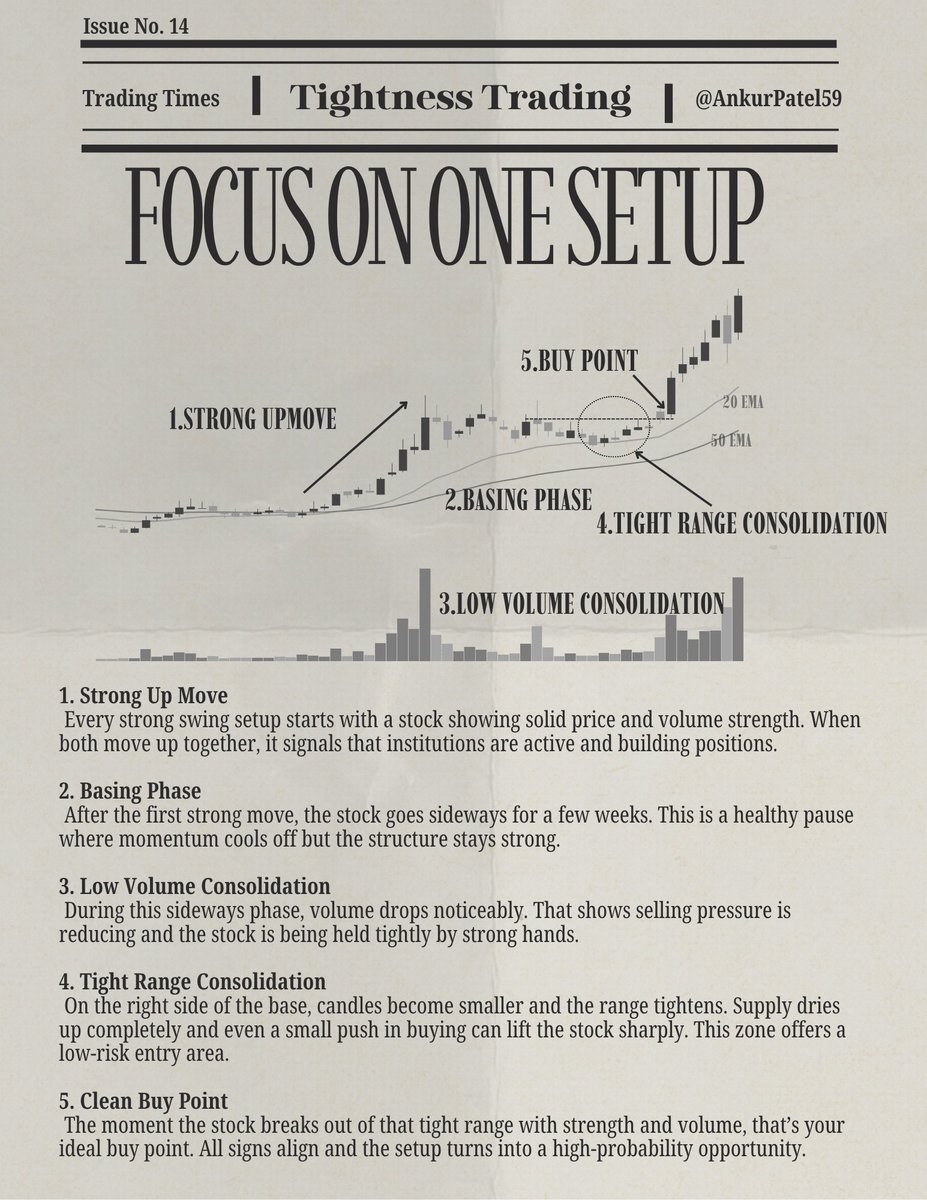
Why do some flags explode and others flop?
It’s pure psychology in the price action.
Tight + low volume = conviction.
Loose + noisy = doubt.
This sheet shows you exactly how to spot it.
✍🏻Mark Minervini's VCP Pattern
Mark Minervini's Volatility Contraction Pattern (VCP) appears before nearly every major stock breakout. Here's how to spot it.
✍🏻What Is a VCP?
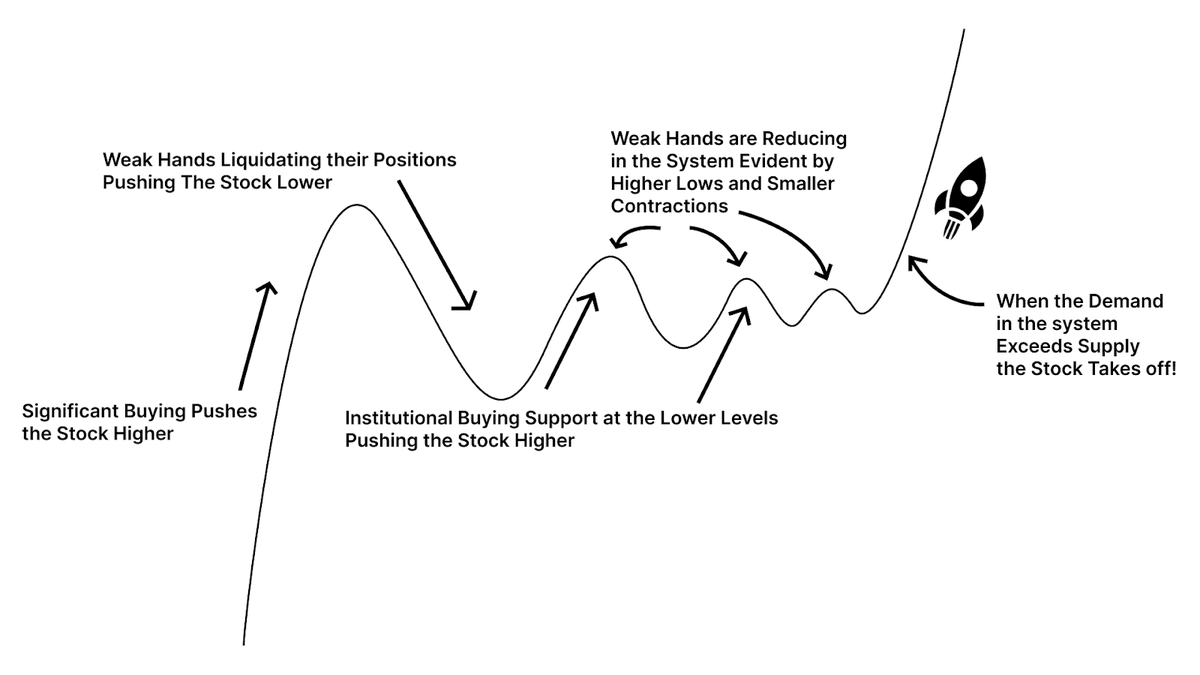
A stock goes through multiple pullbacks, but each pullback gets smaller and tighter. Like a coiled spring - the tighter the compression, the more explosive the release.
✍🏻The Four Stages
➡️Stage 1: The Initial Run
Significant buying pushes the stock higher. Institutions start accumulating.
➡️Stage 2: The Shakeout
Weak hands panic and sell. The stock drops 10-20%. This is the deepest pullback.
➡️Stage 3: The Contractions
Institutions buy the dip. The stock rallies again, but the next pullback is smaller - maybe 15%. Then it happens again with an even smaller pullback of 8-12%. Each correction is shallower than the last. Lows keep getting higher.
➡️Stage 4: The Breakout
Demand exceeds supply. No weak hands left to sell. The stock explodes higher.
✍🏻Why It Works
During those contractions, shares transfer from weak hands (emotional traders) to strong hands (institutions with conviction). Each pullback shakes out more sellers. By the final contraction, there's nobody left who wants to sell. That's when breakouts happen with force.
✍🏻The Three Must-Haves
➡️1. Higher Lows - Each pullback shallower than the previous (25% → 15% → 8%)
➡️2. Contracting Volatility - Price swings get smaller and smaller
➡️3. Volume Pattern - Light volume on pullbacks (no institutional selling), heavy volume on rallies (accumulation)
✍🏻What You're Looking For
- Strong initial move up ✓
- At least 2-3 contractions, each smaller than the last ✓
- Higher lows on each bottom ✓
- Trading tight near recent highs with low volatility ✓
- Decreasing volume on dips, increasing on rallies ✓
The longer and tighter the pattern, the more explosive the breakout.
✍🏻Avoid this mistake
Buying too early during the first or second contraction. You must wait for the pattern to complete - at least 2-3 contractions with each one smaller. Then when it breaks out on heavy volume, that's your entry.
✍🏻Why VCP works
When a stock completes a proper VCP, you're buying at the exact moment supply/demand shifts decisively to buyers. You're entering after weak hands exit and before the next institutional buying wave.
Minervini used VCPs to catch 100%, 200%, even 300%+ moves. Not prediction. Not hope. Just observation of a pattern that repeats across market history.