Hot from the lab. our preprint showing that embryo implantation requires #inflammation that is controlled by HOXA10, and dysregulation of the HOXA10-inflammation axis is associated with #miscarriage
https://t.co/rrmUn7mb2T
@ponsankaran_r@Sharmishth38157 @icmrnirrch @ICMRDELHI
Thrilled to share our discovery of the genetic switch that creates a hybrid EMT state in the uterus for the first step in embryo implantstion.
A fantastic team work with @mkjolly15 and @shrutihansda to discover the teams
@icmrnirrch @iiscbangalore
https://t.co/7aGZx5MVqb
Have you ever wondered why embryo implantation should be a (sort of) inflammatory process? This paper compares implantation in marsupials and three haemochorial eutherian mammals to try to answer that question.
https://t.co/aBN793rvwd
Glad to share our study on placental changes during maternal SARS-CoV-2 infection, done in collaboration with @VirusesImmunity and led by @aliceluculligan.
@OliGriffith@AJ_Pask@DevoEvoMed @CharlieFeigin @EvoDevoPanAm This is probably already on your radar, but Quirks of Human Anatomy by Lewis Held has nice case studies of evo-devo of human anatomy.
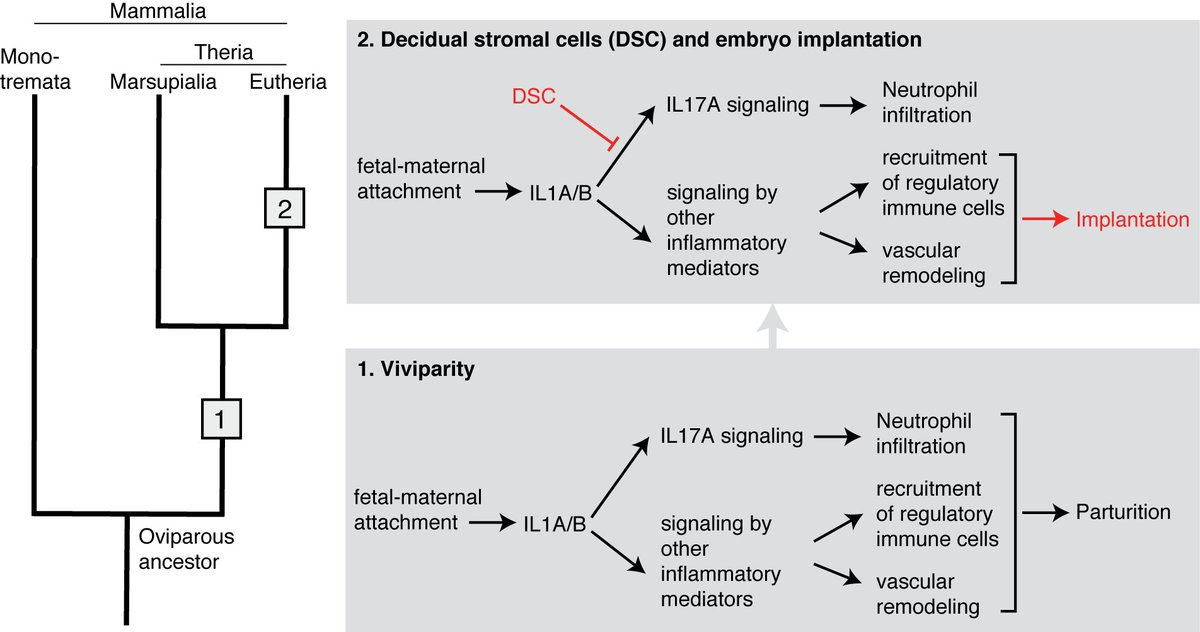
We show how embryo implantation evolved in placental mammals via modification of an ancestral mucosal inflammatory response; & that this was enabled by decidual cells, a cell type that originated in the placental lineage. Now out in MBE of @OfficialSMBE: https://t.co/mPJrx72pXE
One module of inflammation (neutrophil recruitment by cytokine IL17A) was turned off in placental mammal pregnancy; and this was enabled by a novel placental mammal cell type, decidual cells. – with @OliGriffith, @JamieMaziarz, @LeeKoren2, and others.
The latest from the Leys lab: in situ recordings show that glass sponges stop pumping - like holding one's breath - when exposed to sediment in the sponge reefs. https://t.co/OkKecYDvOG