India’s Great Mineral Offensive Under Prime Minister @narendramodi.
The Critical Mineral Map. 👇
In 24 months, India wired 35 nations into a single-grid for Rare Earth, Critical Minerals and Chips.
People around the world may not know: India is opening an airport or terminal every 75 days. Some 80 airports have been built in the last 10 years, more than what India has built in the preceding 7 decades since independence. And the airports look like this.
India just did something the rest of the world hasn't. On June 26 at Kalpakkam, we switched on the world's first plant that makes hydrogen from nuclear heat. Not electricity. Heat. Built at home. Here's why that's a bigger deal than it sounds
Tuchel and James are said to speak and message regularly, and it is believed Tuchel put James’s mind to rest about his inclusion in the World Cup squad well ahead of the official announcement. [telegraph] https://t.co/q8AKahSkKO
🇮🇳 India’s Reef Relief: First 3D-Printed Modules Enter Rameswaram Waters
Developed by ICAR-CMFRI with Chennai-based startup TVASTA, the modules are India’s first 3D-printed artificial reefs deployed in coastal waters.
The project aims to restore marine habitats and boost coastal resilience off Tamil Nadu’s Rameswaram coast.
📷 @ICAR_CMFRI
The DS identified this man as a major threat to their easy manipulation of India very early on. They desperately tried to stop him from ever leading the country.
The moment he became CM, they ignited issues, branded him with every possible label, attempted to sanction him, and even revoked his visas.
They unleashed tens of thousands of pages of propaganda reports against him, both inside India and abroad. They weaponised the opposition and the courts to flood him with cases from every direction.
Yet he overcame it all. To become the PM of the world’s largest democracy. Despite all the hit jobs, sabotage, and propaganda, he remains the most popular leader on the planet.
He has turned every adversity into an advantage. "Being Anti-fragile" is his mantra. And he has made India anti-fragile too. We have seen the nation emerge stronger from every crisis thrown at it.
I believe he will also resolve the infowar crisis. The main force behind it will be weakened and broken by him. It will be a fitting feather in his cap before he retires as not only India’s longest serving PM, but its most impactful one.
History will remember him as the one who transformed India not just in infrastructure and development, but forged a confident, self-reliant nation that stands proud on the global stage.
Every single one of the points are a real problem.
But your understanding is broken, let me explain. :)
Norway has 55 lakh people. Total. That’s smaller than the population of Pune. Their entire country has fewer citizens than India’s 25 smallest cities individually. Norway also has 1.2 trillion dollars in sovereign wealth from oil reserves, accumulated over 50 years.
They have $250,000 per citizen sitting in the fund. India has roughly $3,400 per citizen in forex reserves.
Norway is what you get when a small population sits on top of one of the largest per-capita oil discoveries in human history.
The right comparison is other low-income, high-population, post-colonial democracies. Brazil. Indonesia. Nigeria. Bangladesh. Pakistan. Egypt. Mexico. South Africa. Vietnam. Philippines.
Compare on these and India isn’t doing badly. It’s doing better than most.
UPI is the world’s largest real-time payments system.
Aadhaar is the world’s largest biometric identity system.
We absorbed the global pandemic, the Ukraine war, the West Asia conflict, Trump’s tariffs, the Iran war, and a rupee fall without going into recession.
Most of those countries above did. Pakistan went to the IMF 24 times. Sri Lanka collapsed. Bangladesh is unstable. Egypt needed emergency Gulf bailouts. Argentina has 60% inflation. We stayed standing.
India is the only country in human history to add a trillion dollars of GDP every 18 months. We added our first trillion in 2007. Our second in 2017. Our third in 2024. Our fourth coming in 2026.
The problems you mentioned exist in every large, low-income, high-density country on earth.
Mexico City’s pollution is worse than Delhi’s.
Manila’s traffic is worse than Mumbai’s.
Lagos has worse road quality than Delhi.
Jakarta has worse air than Delhi.
Cairo has worse adulteration.
Karachi has more corruption.
Hanoi has higher pollution.
None of these countries are run by Modi. They’re all dealing with the same impossible math.
Industrialising a country of 145 crore people during a global energy transition, with limited natural resources, while keeping democracy intact, is the single hardest governance challenge in human history.
> China did it without democracy.
> South Korea did it with a population one-tenth our size.
> Japan did it with no major religious or linguistic diversity.
> Singapore did it with 50 lakh people total.
Nobody has done it at India’s scale, with our diversity, in democratic conditions.
So when someone asks “why hasn’t Modi built one city like Norway,” the answer is because building one Norway requires not having 144.5 crore other Indians to look after.
This is not a "real story". This is just a story.
Indians earn, save, and spend in INR. This sort of misrepresentation, coming from a professor, seems purposefully creating fear, uncertainty, and doubt.
The USD itself has lost ~32% of its purchasing power in the last 15 years. This is because of inflation.
Controlled inflation (under 5-6%) is considered normal and even healthy for a growing economy. A fast growing economy like India tends to have higher inflation naturally.
In fact, central bankers and finance ministers get worried if inflation drops too low. Focusing only on the nominal USD rate without this context is purposefully misleading.
So while INR has lost its purchasing power, it is natural just like the USD has lost its purchasing power. Someone's savings in India, to be used in India, suddenly doesn't become 50% less due to USD/INR rate increase.
One day in the coming time, INR will suddenly start appreciating against the USD quickly. Then what will they say? They will change the attack to "inflation" then. These are the same people talking about de-dollarization and USD "crashing soon" as well.
So assuming they are right, if suddenly we wake up to 1 USD = 50 INR, did every Indian become twice as rich in the night? Because its GDP and GDP per capita is suddenly 2x now in USD terms? No.
The real story is, for those who can understand these things and see the pattern, there's an orchestrated attempt from a large network of anti-establishment types to fear monger and incite Indians to try cause political and economic instability in India.
This is a completely incorrect way of looking how currencies should be compared. Every Indian needs to know this.
Let me explain.
So yes, mathematically the rupee has weakened against all three. But Pakistan, Bangladesh, and Sri Lanka are NOT showing currency strength.
They’re showing currency death.
Their currencies stopped falling because there’s nothing left to fall.
Pakistan went from 105 to 280 over seven years. Sri Lanka went from 180 to 365 during their 2022 bankruptcy. Bangladesh has been on IMF watch.
When a currency hits rock bottom, it stops moving because the floor has been reached. The IMF steps in. Capital controls get imposed. Imports get restricted. The economy contracts to fit the currency.
That’s why their currencies look “stable” right now. Not because they’re strong. Because they’re frozen at distressed levels propped up by IMF bailouts and capital controls.
India still has a floating, market-determined currency in an actively trading economy of 1.4 billion people.
When the dollar strengthens globally, the INR moves. That’s how healthy currencies behave.
Imagine two patients. Patient A has fever moving from 99 to 101. Patient B is in a coma at body temperature 95. You don’t say “Patient B is healthier because their temperature isn’t rising.” Patient B is closer to dead.
The right comparison is with active, market-determined economies of similar scale.
INR has fallen 12% vs USD. Korean won fell 8%. Brazilian real fell 11%. Indonesian rupiah fell 6%. Japanese yen fell 9%.
We’re middle of the pack among countries that are actually functioning normally.
The Pakistan, Bangladesh, Sri Lanka comparison is the equivalent of “I’m losing weight faster than the corpses in the morgue.”
Technically true. Completely meaningless.
Whenever it is about animals in India, it is always "shrinking habitat" and "human encroachment", programming Indians too to think we are doing something nasty.
It is never "increasing population", "successful conservation", "great efforts to protect nature in-spite of low per capita and high population."
There's an agenda here. In Europe, they over centuries killed all the dangerous wild animals like bears and wolves, then when their population makes a slight recovery now, when a bear or wolf visits them in their habitation, they shoot them dead. https://t.co/mkS64fHvcG
https://t.co/o8VWdPRGPN
https://t.co/379vjVwWKi
In the US, they organize hunts of bears and definitely shoot them dead if they come into human inhabited areas. It is never "shrinking habitat" if two bears are found on the highway in the US, dead and run over by SUVs. https://t.co/5SfVTB2sN5
In Australia, humans will go into the sea, into the habitat of sharks, and if a shark attack happens, they will go hunt the shark down. https://t.co/9zS7541ebT
But it is always India which will be lectured. Indians will be programmed to think we are killing our own animals and destroying their habitats, when:
In-spite of the need to grow and develop, India's forested areas have increased, numbers of endangered animals have exploded, and even species of animals made extinct hunted by western colonizers, like Cheetas, have been successfully reintroduced.
All I can say is, we can't change their attitudes. But India needs to do more to fight this propaganda programming Indians to turn them into protest weapons to derail India.
And Indians need to start thinking for themselves before falling for such propaganda, exploiting our politics and ideology, that's all over the media and social media.
The West poured $50 billion into fast breeder nuclear reactors and abandoned every single one. India poured $900 million and just achieved criticality on the first commercially viable one outside Russia.
The US spent $15 billion. Gave up. Japan spent $12 billion. Their Monju prototype had one sodium fire in 1995 and never recovered. The UK spent $8 billion. Germany spent $6 billion. France, Italy, all walked away. Six of the richest nations on Earth concluded this technology was too hard and too expensive to pursue.
India started building in 2004 with an initial budget of $420 million. Twenty-two years, a dozen missed deadlines, and a cost doubling later, the Prototype Fast Breeder Reactor at Kalpakkam just sustained a controlled fission chain reaction. The reactor is now alive.
The reason India never quit is a constraint most people have never thought about. India has only 1-2% of the world's uranium reserves. For a country of 1.4 billion people trying to build energy independence, that's a death sentence if you're running conventional nuclear.
But India has 25% of the world's thorium. The single largest national reserve on Earth.
The problem: you can't just burn thorium the way you burn uranium. A physicist named Homi Bhabha designed a three-stage nuclear program in the 1950s specifically to solve this. Stage 1: burn natural uranium in heavy water reactors, collect plutonium as a byproduct. Stage 2: feed that plutonium into fast breeder reactors, where it breeds MORE plutonium AND converts thorium into fissile uranium-233. Stage 3: burn thorium directly at scale.
India just entered Stage 2. Seventy years after Bhabha drew it up on paper.
The math on the thorium endgame is wild. At current energy consumption rates, India's thorium reserves could power the country for over 700 years. Most nuclear nations are playing a uranium game with maybe 80-100 years of runway. India is playing a completely different game with a 7x longer fuel supply.
The West quit because uranium stayed cheap and sodium coolant is terrifying. It catches fire on contact with air. It explodes on contact with water. Russia's BN-600 had 27 sodium leaks and 14 sodium fires between 1980 and 1997. And Russia kept going anyway because Russia doesn't quit nuclear projects. India watched all of that and kept going too.
When you have 1% of the uranium but 25% of the thorium, the engineering difficulty stops being a reason to quit. It becomes the price of admission to a 700-year energy supply that nobody else can access.
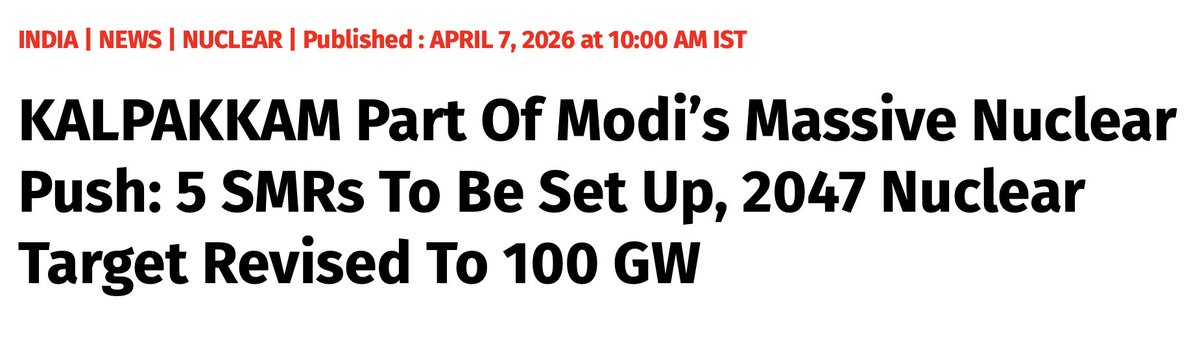
Perhaps one of the most heartening announcements to have come out in recent times is @narendramodi's push for nuclear. India's goal of 500 GW clean power cannot be realised without it.
A single nuclear plant powers 700,000 homes while emitting less CO₂ than a hybrid car.
Climate Change is real. But activism must be rescued from the talons of the loony Left.
1. (Nuclear plants) and Nuclear power as share of total power consumed:
France (58): 71.7%
Sweden (8): 40.3%
Switzerland (5): 37.7%
USA (99): 19.3%
Russia (37): 17.9%
India (22): 3.0%.
3.0% is pitiful. We must make it 15% by 2030.
2. Power generation is the single largest contributor (~30%) to global emissions. Nuclear power as share of total power consumed:
France: 71.7%
India: 3.0%
Carbon footprint as share of total world footprint: France: 1% (292 MMT)
India: 7% (2076 MMT)
It's a no contest. A push for developed India is incomplete without a push for nuclear.
Seeing the video of Robert Sanchez telling the Chelsea fans to relax as it was only half time, made me want to talk about something that has been on my mind for a while: why football stadiums are becoming more impatient, more toxic and polarised.
The pandemic changed our routines and it accelerated a transformation that was already happening in society: overnight, our lives moved onto screens. We watched sport through devices, we debated online, we consumed information in fragments and, importantly for this point, we lived inside a constant stream of opinions.
And with that, something else grew stronger: extremisation.
We have become less able to accept what doesn’t match our own perception. The world has turned into a place where difference is a threat and disagreement feels personal.
Even when those opinions are built on incomplete information, we treat them as unquestionable truths. The most important voice is no longer the most informed one, but the loudest one, the strongest in the moment.
And football, as always, reflects society.
In stadiums now, we increasingly see impatience that would have been unthinkable years ago. Fans protesting a team even before half-time. Whistling after one mistake, even teams that are top of the table. Demanding changes immediately, as if football were a video game and not a complex sport shaped by confidence, form (both appearing in waves during a campaign), injuries, personalities, the limits of a squad or the finances.
We forget that coaches work every day with these players. That they know the realities behind the scenes. That progress is not always instant. But patience has become rare, because the modern world trains us to expect immediate solutions.
What’s worse is that creating a toxic atmosphere no longer feels like a problem for many supporters. The priority becomes: “I want what I want, and I want it now.” Even if it damages the team. Even if it poisons the environment. Even if it turns the stadium into a place of tension instead of support. I cannot think of anything worse than your own fans chanting, “you are going to be sacked in the morning.”
This phenomenon is particularly noticeable in England right now, where protests and frustration inside grounds are becoming more common. Perhaps it is less frequent in Spain, where there is still — sometimes — a different relationship with suffering, with time, with process, with football clubs and the role of fans. At Real Madrid, the whistling to the team lasted a game and it was a protest against the sacking of Xabi Alonso, or a message to the players. The following game, they had moved on. I feel that is legitimate. But the trend is spreading.
The truth is hardly any club lives in happiness anymore. And I feel it is not because football has changed dramatically, but surely because society has.
The modern fan experience is shaped by constant noise, constant judgement, constant outrage. And football, which used to be an escape, has become another space where people project frustration and impatience.
It’s not really about the manager. Or the player. Or even the result. What we are hearing is basically about the world we have become. Although I do feel there is another way.
I know none of this is new. But how about if we thought we might not be right. Someone else might be. Or changing an opinion. Or listening a bit more. Or considering we might not know everything. And respect our differences.
Chelsea representative on @WeAreTheOverlap
“With Chelsea there’s almost like this post mortem after we beat these teams, oh PSG were knackered, oh Barcelona aren’t that good, oh Arsenal were depleted, maybe it’s just Chelsea making them look that bad”
I'm not sure anyone outside of #CFC really understood how big a blow it was for the club for Reece James to miss so much football with injury. Today served as another reminder just how good he is. #CHEARS
Next month will clock Arteta's 6th year as Arsenal manager. He has managed to make it work eventually and could finally win the PL title this season "AFTER 6 YEARS".
The fact that Chelsea are talked about in the same breath as Arsenal is down to the work Maresca has done in less than 18 months in charge of Chelsea.
Of course, he won two titles in his first season already and could add to it this season. The point is, Arsenal deserve to be where they are after 6 years of work while Chelsea are punching above their weight at the moment.
Now, imagine Chelsea under Maresca in 6 years. But I think we will definitely start competing serious for titles next season. That has been my prediction and it still looks like it.