College Principals Lose Appointment Powers as Odisha Govt Revamps Recruitment System
Bhubaneswar: In a significant administrative reform, the Odisha Government has withdrawn the appointment powers of principals of government colleges and vested them with the Regional Directors of Education for the recruitment of non-teaching staff.
According to an order issued by the Higher Education Department, the Regional Directors of Education will now serve as the Appointing Authority for non-cadre Group-B, Group-C and Group-D posts in Government Colleges and Teachers' Education Institutions falling under their administrative jurisdiction. The decision has come into force with immediate effect.
With the issuance of the new order, the appointment powers that were previously exercised by principals of government colleges and teachers' education institutions for these non-teaching posts have been withdrawn. Henceforth, all appointments to the specified categories will be made by the respective Regional Directors of Education.
The Higher Education Department stated that the decision has been taken after careful consideration and supersedes all previous instructions issued on the subject. The move is expected to streamline the recruitment process by bringing appointments under a uniform administrative framework across government higher education institutions. However, the order does not specify the reasons behind the policy change.
𝗢𝗱𝗶𝘀𝗵𝗮 𝗗𝗶𝗿𝗲𝗰𝘁𝘀 𝗗𝗶𝘀𝘁𝗿𝗶𝗰𝘁𝘀 𝘁𝗼 𝗣𝘂𝘀𝗵 𝗔𝗹𝘁𝗲𝗿𝗻𝗮𝘁𝗶𝘃𝗲 𝗙𝗲𝗿𝘁𝗶𝗹𝗶𝘀𝗲𝗿𝘀 𝘁𝗼 𝗧𝗮𝗰𝗸𝗹𝗲 𝗗𝗔𝗣, 𝗨𝗿𝗲𝗮 𝗦𝗵𝗼𝗿𝘁𝗳𝗮𝗹𝗹
Bhubaneswar: Anticipating supply constraints of key fertilisers during the ongoing kharif season, the Odisha Government has asked district administrations to actively promote alternative nutrient sources to ensure farmers do not face disruptions in agricultural operations.
The Department of Agriculture and Farmers' Empowerment directed all Collectors and District Magistrates to encourage the use of complex fertilisers as an alternative to DAP and ammonium sulphate in place of Urea. The move follows the Centre's strategy to optimise fertiliser availability amid reduced DAP supplies.
According to the department, the Government of India has planned a substantial supply of ammonium sulphate, containing 20.5 per cent nitrogen and 23 per cent sulphur. Besides meeting the nitrogen requirement of crops, the fertiliser is expected to improve soil health by addressing sulphur deficiency, a critical nutrient for plant growth.
The letter further points out that DAP availability has been affected this year, prompting the Centre to consistently advocate the use of complex fertilisers as a suitable substitute. To streamline distribution, the Odisha State Cooperative Marketing Federation (MARKFED) has been entrusted with lifting 60 per cent of the fertiliser allocation received by each district.
District-level MARKFED officials have been instructed to place advance indents for complex fertilisers and ammonium sulphate in accordance with district-wise allocations so that adequate stocks remain available for farmers throughout the cropping season.
The directive has also been circulated to all Chief District Agriculture Officers for immediate implementation and to the Registrar of Cooperative Societies, who has been asked to facilitate the lifting and distribution of the substitute fertilisers across the State.
Treating the matter as urgent, the Agriculture Department has called for coordinated action by all concerned agencies to ensure timely availability of fertilisers and minimise the impact of DAP and Urea shortages on agricultural activities.
Ganjam Suspends GP-Level Public Grievance Hearings Amid SIR Exercise
Brahmapur: The Ganjam district administration has temporarily suspended all Gram Panchayat-level public grievance hearings across the district in view of the ongoing Special Intensive Revision (SIR) exercise.
According to an official order issued by the Collector and District Magistrate, all Block Development Officers (BDOs) have been instructed to keep the Gram Panchayat-level grievance hearings in abeyance until further orders. The authorities have also been directed to inform the public and concerned officials about the decision to prevent any inconvenience.
The order, however, clarifies that the joint public grievance hearings conducted by the Collector and the Superintendents of Police (SPs) will continue as per the existing schedule. The directive has been marked as urgent and circulated to all Sub-Collectors, Tahasildars, police officers and line department officials for necessary action.
High-Level Committee on Teachers’ Demands Gets Six-Month Extension
Bhubaneswar: The Odisha Government has extended the tenure of the High-Level Committee constituted to examine the long-pending demands of teachers and employees by another six months.
In a notification issued by the School and Mass Education Department under the orders of the Governor, the committee has been granted additional time to complete its comprehensive review of the issues raised by various teachers' and employees' associations.
The committee was constituted on the directions of Chief Minister Mohan Charan Majhi to examine service-related grievances and policy demands submitted by teachers, professors and non-teaching employees. Its mandate covers personnel serving in Government, Fully Aided and Block Grant (Unaided Private) educational institutions under the School and Mass Education Department as well as the Higher Education Department.
The extension is intended to enable the committee to undertake a detailed assessment of the representations received from different stakeholders and formulate well-considered recommendations on service conditions and other policy matters.
According to the notification, copies of the order have been forwarded to the Chief Minister's Office and the offices of the Ministers for School and Mass Education and Higher Education for necessary action.
With the extension, the committee is expected to complete its deliberations and submit its final recommendations to the State Government for consideration.
𝗢𝗱𝗶𝘀𝗵𝗮’𝘀 ‘𝗣𝗮𝗻𝗶 𝗣𝗮𝗻𝗰𝗵𝗮𝘆𝗮𝘁’ 𝘁𝗼 𝗙𝗲𝗮𝘁𝘂𝗿𝗲 𝗶𝗻 𝗡𝗮𝘁𝗶𝗼𝗻𝗮𝗹 𝗪𝗮𝘁𝗲𝗿 𝗖𝗼𝗻𝘀𝗲𝗿𝘃𝗮𝘁𝗶𝗼𝗻 𝗖𝗼𝗺𝗽𝗲𝗻𝗱𝗶𝘂𝗺
Bhubaneswar: Odisha has been asked to submit details of its successful water conservation initiatives for inclusion in a national compendium being prepared by the National Water Mission under the Union Ministry of Jal Shakti. The compendium, titled "State Best Practices in Water Conservation", aims to document and showcase innovative, traditional, community-led and large-scale water conservation models from across the country for knowledge sharing and replication.
Acting on a communication from the National Water Mission, the Odisha Water Resources Department has directed the Engineer-in-Chief to furnish updated information and supporting materials by July 28 for appraisal by the Principal Secretary before the state's submission to the Centre. The National Water Mission has sought inputs from all States and Union Territories by July 31.
The Centre has requested states to review and update information on practices already identified for the compendium, including recent achievements, implementation scale, impact, innovations, photographs and other relevant details. States have also been encouraged to propose additional best practices in areas such as groundwater recharge, water-use efficiency, traditional water systems, drinking water security and community participation that may not have been included in the preliminary list.
For every initiative, the National Water Mission has asked states to provide a one- to two-page write-up covering objectives, key features, achievements and impact, along with relevant statistics, data and high-resolution photographs. The exercise is intended to create a comprehensive repository of successful water conservation models and promote cross-learning among states.
The preliminary list for the compendium already features Odisha's Pani Panchayat under community-based water governance and the state's traditional Bandhas system under indigenous water conservation practices. It also includes notable initiatives from several other states in areas such as irrigation efficiency, groundwater recharge, watershed development, water body restoration and integrated water resource management.
The proposed compendium is expected to serve as a national reference document highlighting successful water conservation practices and encouraging their replication across different regions of the country.
The Odisha Higher Education Department has carried out a major administrative reshuffle in the state's non-government aided degree colleges by transferring 80 Readers and assigning them the additional responsibility of Principal-in-Charge-cum-Secretary of their newly allotted institutions. The move is aimed at strengthening the administrative functioning of aided colleges across the state.
All transferred Readers have been directed to join their new places of posting with immediate effect and positively by July 20, 2026.
Odisha Unveils Vision 2036 Highway Master Plan; 7,290 km Road Network to be Upgraded
Bhubaneswar: The Odisha government has prepared an ambitious long-term roadmap to transform the state's highway infrastructure as part of its 'Viksit Odisha 2036' vision. The master plan proposes the augmentation of 7,290 kilometres of road network to meet the projected traffic demand by 2047, while also improving connectivity, logistics efficiency and balanced regional development.
In a letter to all District Collectors, Works Department Principal Secretary Sanjay Kumar Singh said the state has formulated the Vision 2036 framework in alignment with the Government of India's Vision 2047. The Works Department has been entrusted with preparing the long-term highway development strategy to strengthen transport infrastructure, improve logistics, promote regional equity and accelerate Odisha's economic and social growth.
The master plan, titled "Vision 2036 for Highways Network in the State of Odisha," has been prepared by A.T. Kearney Consulting (India) Pvt. Ltd. after extensive consultations with stakeholders. It identifies the road corridors that need to be upgraded or developed to improve connectivity between industrial hubs, consumption centres and economically backward regions.
According to the report, the proposed network includes 3,300 km of National Highway main corridors, 2,000 km of non-NH main corridors, 760 km of inter-corridors and coastal corridors, and 1,230 km of high-priority National Highway stretches that have already been approved or are under development by the Ministry of Road Transport and Highways (MoRTH).
To strengthen first- and last-mile connectivity, the report also recommends developing 25–30 per cent additional feeder roads, with each proposed to have a minimum four-lane configuration. These feeder corridors are expected to improve access to industrial clusters, commercial centres and rural areas, ensuring seamless movement of goods and people.
The plan further proposes urban decongestion and bypass solutions in 31 major towns and cities across the state. In addition, 850 km of intra-district road augmentation has been identified across 11 districts to improve regional connectivity and ease traffic movement.
The Works Department has directed District Collectors to keep the Highway Network Master Plan in view while planning and implementing future infrastructure projects so that all road development initiatives remain aligned with Odisha's long-term transport vision. The government believes the proposed network will play a key role in supporting industrial expansion, reducing travel time, improving freight movement and driving inclusive economic growth across the state.
𝗙𝗮𝗸𝗲 𝗣𝗿𝗼𝗺𝗼𝘁𝗶𝗼𝗻 𝗢𝗿𝗱𝗲𝗿 𝗖𝗶𝗿𝗰𝘂𝗹𝗮𝘁𝗲𝗱 𝗶𝗻 𝗡𝗮𝗺𝗲 𝗼𝗳 𝗢𝗱𝗶𝘀𝗵𝗮 𝗣𝗥&𝗗𝗪 𝗗𝗲𝗽𝗮𝗿𝘁𝗺𝗲𝗻𝘁; 𝗖𝘆𝗯𝗲𝗿 𝗣𝗿𝗼𝗯𝗲 𝗢𝗿𝗱𝗲𝗿𝗲𝗱
Bhubaneswar: The Odisha Panchayati Raj and Drinking Water (PR&DW) Department has issued a statewide alert after a forged promotion order, purportedly issued in the department's name, surfaced on social media. The department has categorically clarified that the document is fake and that no such promotion order has been issued.
In a letter addressed to all Collectors and District Magistrates, Special Secretary Surya Narayan Dash stated that a fabricated order bearing No. PR-PDO-ESTT-0223-2023-17409, dated July 3, 2026, has been widely circulated online. The forged document falsely claims the promotion of several Gram Panchayat Development Officers (GPDOs) and Progress Assistants (PAs) to the post of Block Development Officer (BDO). The department has confirmed that the order is entirely fake and has no official sanction.
The department has directed all subordinate offices, District Panchayat Officers, Block Development Officers and field-level officials to disregard the forged communication and ensure that it is not acted upon under any circumstances. District administrations have also been instructed to prevent any further circulation of the fake document and to issue clarifications wherever necessary to public representatives and field officials.
To counter misinformation, the department said a separate public clarification will be issued through the Information and Public Relations Department. Simultaneously, the matter has been referred to the Home Department for registration of an FIR and initiation of an investigation by the Cyber Crime Cell to identify those responsible for creating and circulating the forged order.
The PR&DW Department has urged officials and the public not to rely on or share the fake promotion order, reiterating that only communications issued through official government channels should be treated as authentic.
𝗢𝗱𝗶𝘀𝗵𝗮 𝗢𝗿𝗱𝗲𝗿𝘀 𝗦𝘁𝗮𝘁𝗲𝘄𝗶𝗱𝗲 𝗦𝘂𝗿𝘃𝗲𝘆 𝗼𝗳 ��𝗻𝗮𝗽𝗽𝗿𝗼𝘃𝗲𝗱 𝗦𝗽𝗲𝗰𝗶𝗮𝗹 𝗦𝗰𝗵𝗼𝗼𝗹𝘀 𝗥𝘂𝗻 𝗯𝘆 𝗡𝗚𝗢𝘀
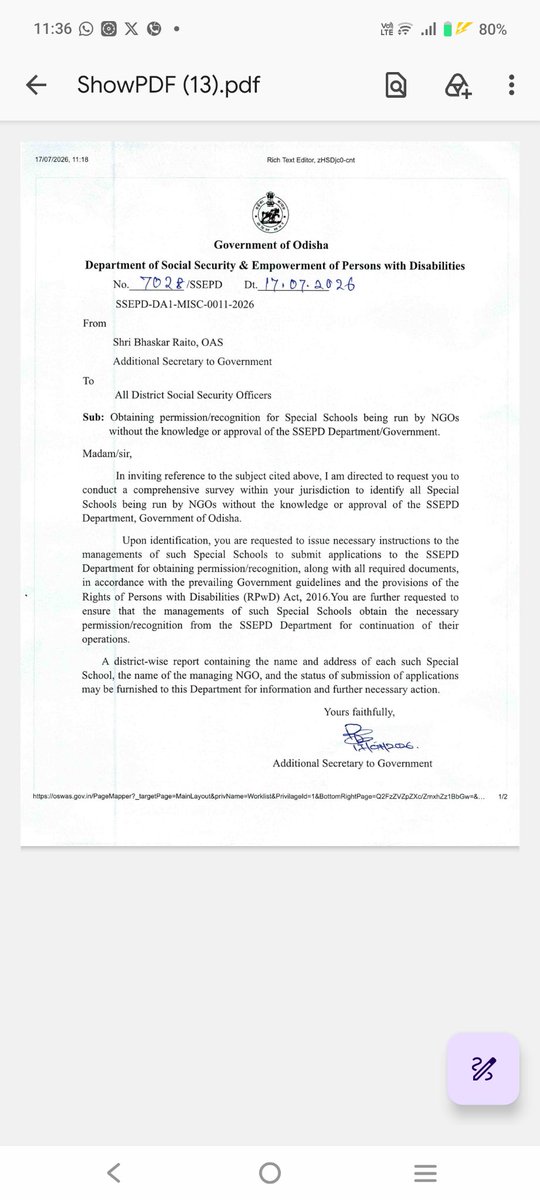
Bhubaneswar: The Odisha government has launched a statewide drive to identify Special Schools being run by non-governmental organisations (NGOs) without the knowledge, permission or recognition of the Department of Social Security and Empowerment of Persons with Disabilities (SSEPD). The department has directed all District Social Security Officers (DSSOs) to conduct a comprehensive survey and ensure that such institutions obtain the mandatory approval from the government.
In a letter issued by Additional Secretary Bhaskar Raito, the department asked district officials to identify all Special Schools operating without the approval of the SSEPD Department. Once identified, the managements of these schools must be instructed to apply for permission and recognition by submitting all required documents in accordance with the prevailing government guidelines and the provisions of the Rights of Persons with Disabilities (RPwD) Act, 2016.
The department has also directed district authorities to ensure that these institutions secure the necessary permission and recognition from the SSEPD Department to continue their operations. The move is aimed at bringing all Special Schools under a uniform regulatory framework and ensuring compliance with statutory norms for the welfare and education of children with disabilities.
Further, the DSSOs have been asked to submit a district-wise report to the department, detailing the name and address of each unapproved Special School, the name of the managing NGO, and the status of submission of applications for recognition. The information will be used by the department for further action and monitoring of compliance.
The Directorate of Higher Secondary Education (DHSE), Odisha, has directed all 488 category Non-Government Aided Higher Secondary Schools across the state to submit updated details of vacant teaching and non-teaching posts. The move is expected to help the state government assess the actual staffing gaps in aided higher secondary schools, which could facilitate administrative planning and future recruitment decisions.
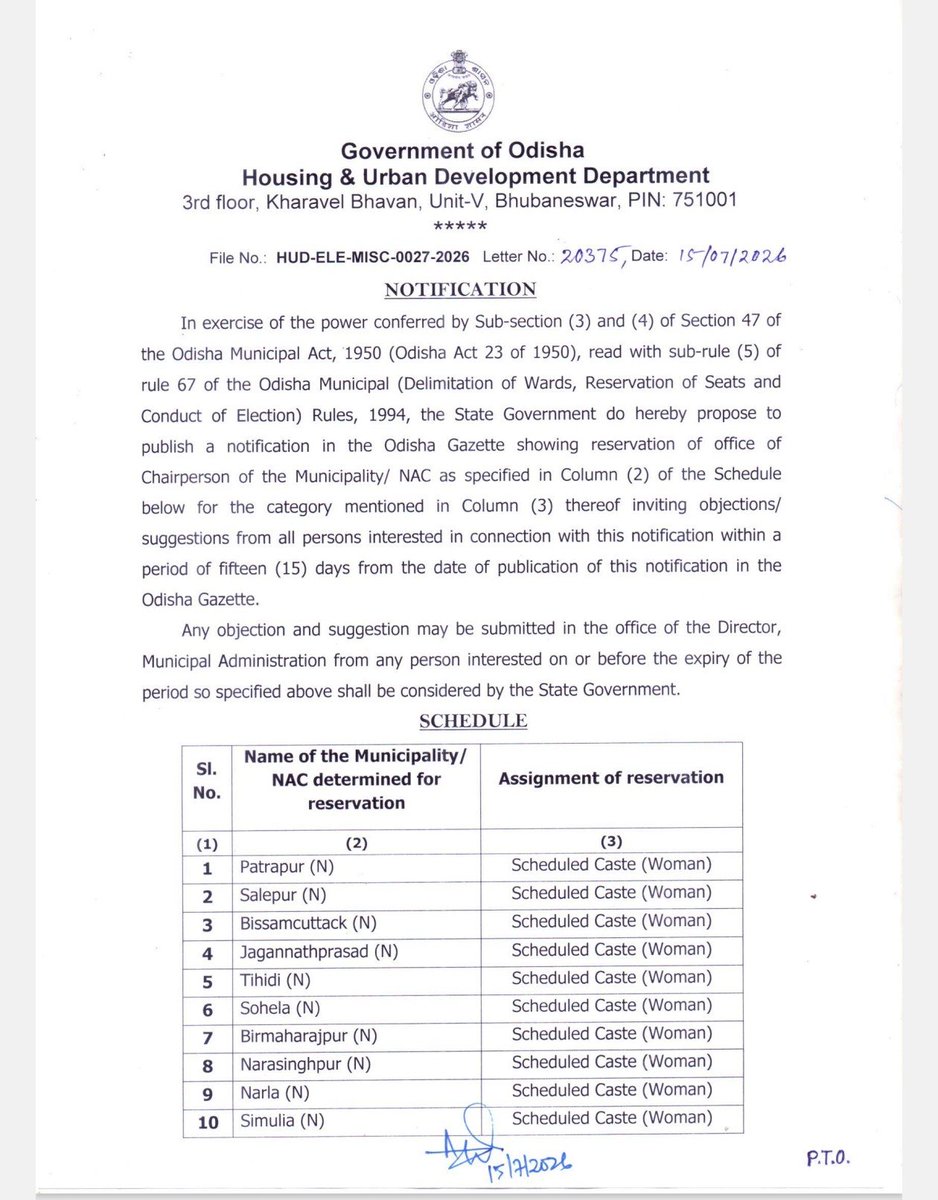
The Odisha Housing & Urban Development Department has issued a draft notification proposing reservation of the offices of Chairpersons in 35 Municipalities and NACs across the state ahead of the urban local body elections. The proposed reservations cover categories including Scheduled Caste (Women), Scheduled Caste, Scheduled Tribe (Women), Scheduled Tribe, Women and Unreserved. The State Government has invited objections and suggestions from the public within 15 days from the date of publication of the notification in the Odisha Gazette. All representations will be considered before the reservations are finalised.
𝗖𝗠 𝗣𝗿𝗼𝗽𝗼𝘀𝗲𝘀 𝗦𝘁𝗮𝘁𝗲 𝗦𝗽𝗲𝗰𝗶𝗮𝗹 𝗖𝗲𝗹𝗹 𝗳𝗼𝗿 𝗦𝗰𝗶𝗲𝗻𝘁𝗶𝗳𝗶𝗰 𝗜𝗻𝗳𝗿𝗮𝘀𝘁𝗿𝘂𝗰𝘁𝘂𝗿𝗲 𝗣𝗹𝗮𝗻𝗻𝗶𝗻𝗴 𝗶𝗻 𝗢𝗱𝗶𝘀𝗵𝗮
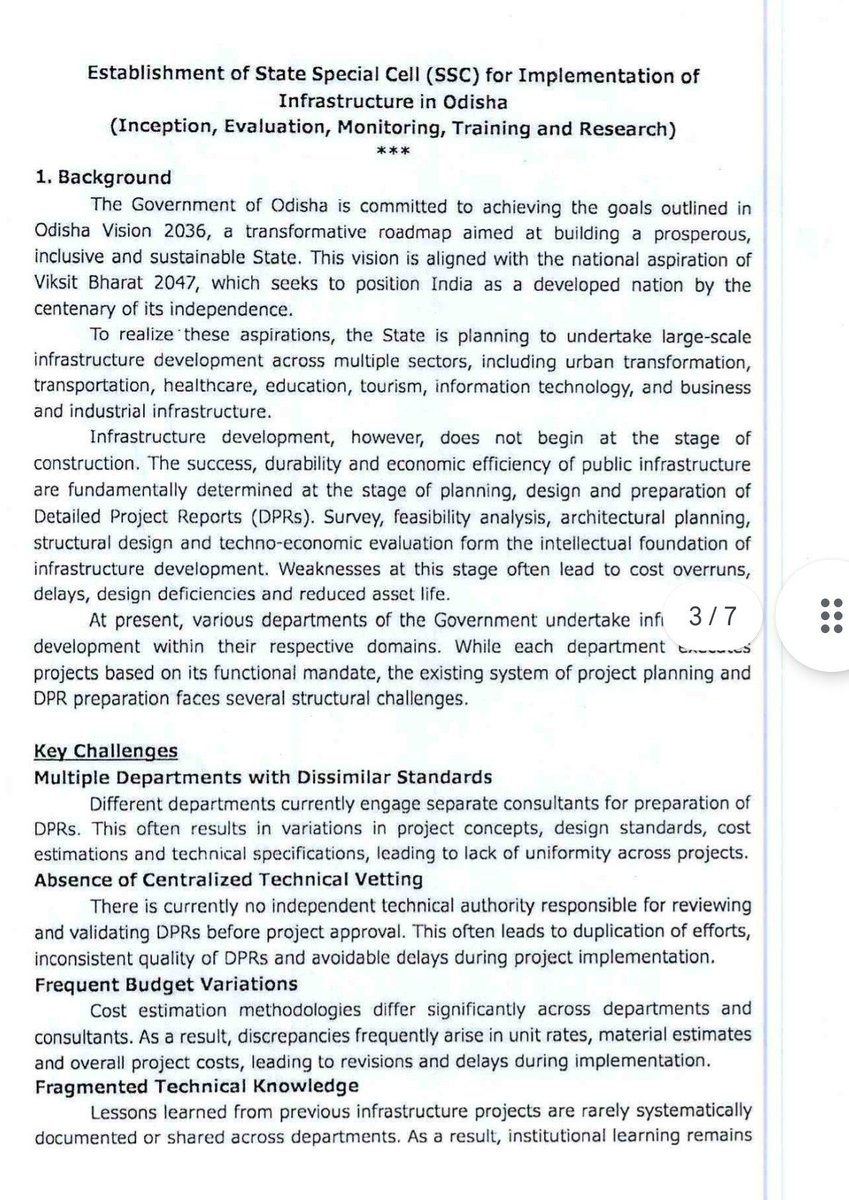
Bhubaneswar: Chief Minister Mohan Charan Majhi has proposed the establishment of a State Special Cell (SSC) to strengthen planning, technical evaluation, monitoring, training and research for infrastructure projects across Odisha. The proposed Centre of Excellence aims to improve project quality, reduce delays and cost overruns, and standardise infrastructure planning across government departments.
The proposal, aligned with Odisha Vision 2036 and Viksit Bharat 2047, seeks to address shortcomings such as non-uniform DPRs, lack of centralized technical vetting, inconsistent design standards and limited use of advanced technologies like GIS, Building Information Modelling (BIM) and AI in project planning.
The SSC will function as the State's nodal technical body for preparing and reviewing DPRs, validating designs, monitoring implementation, developing standard cost and design frameworks, and promoting sustainable, climate-resilient infrastructure. It will also strengthen in-house engineering capacity and reduce dependence on external consultants.
The proposed Cell will have six specialised wings covering planning, architecture, DPR review, structural design, training, and research & development. It will collaborate with institutions such as IIT Bhubaneswar, NIT Rourkela, BPUT, OUTR and the School of Planning and Architecture to promote innovation and capacity building.
According to the proposal, the initiative is expected to improve infrastructure planning, enhance inter-departmental coordination, ensure technical excellence and accelerate the timely execution of major public infrastructure projects across the State.
𝗘𝘅𝗶𝘀𝘁𝗶𝗻𝗴 𝗲-𝗞𝗬𝗖 𝘃𝗲𝗿𝗶𝗳𝗶𝗲𝗱 𝗠𝗚𝗡𝗥𝗘𝗚𝗔 𝗷𝗼𝗯 𝗰𝗮𝗿𝗱𝘀 𝘁𝗼 𝘀𝗲𝗿𝘃𝗲 𝗮𝘀 𝘁𝗲𝗺𝗽𝗼𝗿𝗮𝗿𝘆 𝗚𝗥𝗚𝗖𝘀 𝘂𝗻𝘁𝗶𝗹 𝗳𝗶𝗻𝗮𝗹 𝗰𝗮𝗿𝗱𝘀 𝗮𝗿𝗲 𝗽𝗿𝗶𝗻𝘁𝗲𝗱
Bhubaneswar: The Odisha Government has directed all district administrations to begin issuing Interim Gramin Rozgar Guarantee Cards (GRGCs) to eligible rural households under the newly introduced Viksit Bharat–Guarantee for Rozgar and Ajeevika Mission (Gramin) Act, 2025. The move is aimed at ensuring uninterrupted access to employment benefits while the final Gramin Rozgar Guarantee Cards are under preparation.
In a letter dated July 14, Director (Special Projects) Siddharth Shankar Swain instructed all Collectors-cum-District Programme Coordinators, Chief Development Officers-cum-Executive Officers of Zilla Parishads and Block Development Officers to implement the interim arrangement immediately.
The VB-G RAM G Act, which came into force on July 1, 2026, guarantees 125 days of wage employment every financial year to rural households willing to undertake unskilled manual work. Since printing and distribution of the permanent GRGCs will take time, the Ministry has approved issuance of Interim GRGCs to ensure that eligible households are not deprived of employment or statutory benefits.
Under the Standard Operating Procedure (SOP), existing MGNREGA job cards of households with completed e-KYC will automatically be treated as Interim GRGCs. Fresh Interim GRGCs will also be issued to newly registered households, families whose existing job cards have become damaged or unusable, households that have exhausted the space available in their job cards for employment entries, and other eligible households approved by the competent authority.
The SOP provides that Gram Panchayats will receive applications, verify eligibility, complete e-KYC, and register beneficiaries through the VB-G RAM G Soft portal. Interim cards will be generated digitally, printed only by authorised Gram Panchayat or Block-level officials, signed by the competent authority, and handed over to beneficiaries against proper acknowledgement.
The interim cards will remain valid until the final Gramin Rozgar Guarantee Cards are issued. Once the permanent cards are distributed, the existing MGNREGA job cards or Interim GRGCs will be cancelled and replaced.
The SOP also assigns responsibility to State Governments, District Programme Coordinators, Programme Officers and Gram Panchayats to ensure that no willing rural household is denied employment or other entitlements due to the non-availability of the final GRGC.
Odisha Orders Quality Audit of All Works Projects Above ₹10 Crore
Bhubaneswar: The Odisha Government has initiated a statewide quality audit of all ongoing infrastructure projects under the Works Department with an estimated cost of more than ₹10 crore. The move follows directions issued during a high-level review meeting chaired by the Minister for Law, Works and Excise on July 8.
In a communication issued, the Chief Engineer, Research, Development and Quality Promotion (R&D), Works Department, directed all Superintending Engineers of the Quality Control (R&B) Divisions to prepare the final list of eligible projects and submit a tentative schedule for the quality audit within seven days.
According to the letter, the Principal Secretary of the Works Department had instructed that every ongoing infrastructure project costing more than ₹10 crore should undergo a quality audit to assess construction standards and ensure adherence to prescribed specifications. The latest communication is aimed at implementing that decision.
The Chief Engineer has asked the Quality Control divisions to verify the preliminary lists of projects received from the offices of the Engineer-in-Chief (Civil), Roads-I and Roads-II in coordination with the respective Works (R&B) divisions. After verification, the divisions have been asked to prepare the final list of projects along with a proposed audit schedule and forward it to the department for submission to the government.
The directions have been issued to the Quality Control (R&B) Divisions at Bhubaneswar, Kataka, Sambalpur, Rayagada, Keonjhar and Brahmapur. Copies have also been forwarded to the Principal Secretary, Works Department, the Engineer-in-Chief and other senior engineers concerned.
The quality audit is expected to cover major roads, bridges, government buildings and other infrastructure projects undertaken by the Works Department. The exercise is intended to verify whether construction has been carried out in accordance with approved standards and specifications, and to identify any deficiencies requiring corrective action.
𝗢𝗱𝗶𝘀𝗵𝗮 𝘁𝗼 𝗦𝗲𝘁 𝗨𝗽 𝗔𝗻𝗴𝗮𝗻𝘄𝗮𝗱𝗶 𝗠𝗮𝗻𝗮𝗴𝗲𝗺𝗲𝗻𝘁 𝗖𝗼𝗺𝗺𝗶𝘁𝘁𝗲𝗲𝘀 𝗮𝘁 𝗘𝘃𝗲𝗿𝘆 𝗖𝗲𝗻𝘁𝗿𝗲 𝗯𝘆 𝗝𝘂𝗹𝘆 31
Bhubaneswar: In a major initiative to strengthen community participation and improve accountability in Anganwadi services, the Odisha government has directed the formation of Anganwadi Management Committees (AMCs) in every Anganwadi Centre across the state by July 31, 2026. The directive has been issued by the Department of Women and Child Development to all District Collectors for immediate implementation under the Saksham Anganwadi and Poshan 2.0 programme.
The newly constituted committees are aimed at ensuring greater public participation, transparency, and effective monitoring of Anganwadi services at the grassroots level. They will oversee the functioning of Anganwadi Centres, including nutrition services, preschool education, immunisation, health check-ups, growth monitoring, hygiene, and the delivery of benefits to pregnant women, lactating mothers, and children.
According to the government order, each committee will be headed by the Anganwadi Supervisor, while the Anganwadi Worker will serve as the Member-Convenor. Other members will include the ASHA worker attached to the centre, two mothers of children aged 3–6 years enrolled in the Anganwadi, a woman representative from a Self-Help Group (or a local NGO/CSO where an SHG member is unavailable), and a woman teacher from a nearby government primary school.
In a state-specific addition to the Centre's guidelines, the Odisha government has decided to include one adolescent girl pursuing higher secondary or college education and one beneficiary of the Subhadra Scheme (other than an SHG member) in every committee. The move is expected to broaden community representation and ensure that the voices of young women and beneficiaries are reflected in the functioning of Anganwadi Centres.
The committees will meet once every two months at the Anganwadi Centre. Minutes of every meeting must be submitted to the concerned Child Development Project Officer (CDPO) within seven days. The CDPO will also review the performance of each committee at least twice a year based on indicators such as regularity of meetings, attendance, community participation, service review, follow-up actions, and record maintenance.
The AMCs have been entrusted with a wide range of responsibilities. These include reviewing infrastructure and sanitation facilities, monitoring food quality and supplementary nutrition, tracking child growth, identifying and referring malnourished children, conducting household surveys, promoting Poshan Vatikas, supporting community outreach activities, facilitating awareness campaigns on maternal and child nutrition, and ensuring timely redressal of grievances. The committees will also work to strengthen coordination among the Health, Education, Panchayati Raj Institutions, Urban Local Bodies, Self-Help Groups, and other grassroots stakeholders.
The department has further decided to replace the existing Anganwadi Level Monitoring and Support Committee (ALMSC) with the newly formed AMC, as both bodies have similar objectives. The AMC will now function as the primary community-level institution for monitoring, feedback, support, and participatory oversight of Anganwadi services across the state.
The initiative follows the Union Ministry of Women and Child Development's guidelines issued under Mission Saksham Anganwadi and Poshan 2.0, which emphasise community ownership and participatory governance to improve the quality, responsiveness, and accountability of Anganwadi services across the country.
𝗙𝗼𝗿𝗺𝗲𝗿 𝗦𝗖𝗘𝗥𝗧 𝗗𝗶𝗿𝗲𝗰𝘁𝗼𝗿 𝗔𝗿𝗿𝗲𝘀𝘁𝗲𝗱 𝗶𝗻 𝗢𝗱𝗶𝘀𝗵𝗮 𝗧𝗲𝘅𝘁𝗯𝗼𝗼𝗸 𝗦𝗰𝗮𝗺; 𝗖𝗿𝗶𝗺𝗲 𝗕𝗿𝗮𝗻𝗰𝗵 𝗔����𝗹𝗲𝗴𝗲𝘀 175 𝗖𝗿𝗼𝗿𝗲 𝗟𝗼𝘀𝘀
Bhubaneswar: The Odisha Crime Branch on Tuesday arrested former Director of the State Council of Educational Research and Training (SCERT), Manoj Kumar Padhy, in connection with the alleged irregularities in the preparation, approval and publication of school textbooks for Classes I to VIII under the National Education Policy (NEP)-2020.
According to a press release issued by the Crime Branch, the investigation is being conducted under CID CB PS Case No. 08 dated July 13, 2026, registered under Sections 316(5), 201, 61(2) and 3(5) of the Bharatiya Nyaya Sanhita (BNS), 2023.
The investigating agency alleged that Padhy, while serving as Director of TE & SCERT, was responsible for supervising, coordinating, monitoring and approving the textbook development process. However, he allegedly failed to discharge his official responsibilities and approved print-ready manuscripts for publication without ensuring proper verification of their factual, scientific, geographical, translation and pictorial content.
The Crime Branch claimed that these lapses led to the publication and distribution of erroneous textbooks across the state, resulting in an estimated loss of around ₹175 crore to the State exchequer and causing significant damage to public interest.
Investigators said they have found prima facie evidence indicating criminal negligence and dereliction of duty on the part of the former SCERT Director.
Padhy, 57, a resident of Nehru Nagar in Brahmapur, was arrested on Tuesday and is scheduled to be produced before the JMFC-III Court in Kataka later in the day.
The Crime Branch said the investigation is continuing and further action will be taken based on the evidence collected during the probe.
𝗢𝗱𝗶𝘀𝗵𝗮 𝗚𝗼𝘃𝘁 𝗦𝗲𝗲𝗸𝘀 𝗥𝗧𝗜 𝗗𝗮𝘁𝗮 𝗳𝗿𝗼𝗺 𝗔𝗹𝗹 𝗗𝗲𝗽𝗮𝗿𝘁𝗺𝗲𝗻𝘁𝘀 𝗳𝗼𝗿 2025–26 𝗔𝗻𝗻𝘂𝗮𝗹 𝗥𝗲𝗽𝗼𝗿𝘁
Bhubaneswar: The Odisha Government has initiated the process of preparing the Annual Report on the implementation of the Right to Information (RTI) Act, 2005 for the year 2025–26. The Information and Public Relations (I&PR) Department has directed all government departments to submit consolidated RTI-related information by August 31, 2026.
In a communication issued by Additional Chief Secretary Hemant Sharma, all Additional Chief Secretaries, Principal Secretaries and Commissioner-cum-Secretaries have been asked to furnish department-wise data in the prescribed format. The information will be compiled for the Odisha Information Commission's Annual Report, which is required to be laid before the Odisha Legislative Assembly under Section 25(1) of the RTI Act, 2005.
The departments have been instructed to collect and consolidate RTI-related information from all offices functioning under their administrative control. The data is expected to include details such as RTI applications received, disposed of, rejected, pending cases, appeals and other information required for the preparation of the statutory annual report.
The I&PR Department has emphasised that timely submission of accurate data is essential for preparing an error-free report. It has asked all departments to ensure that the information reaches the department by the stipulated deadline.
Apart from the annual report, the departments have also been directed to submit an updated list of all Public Authorities under their administrative control, from the State level down to the field level. The list will be used to update and integrate the State RTI Portal, enabling better implementation of the RTI Act and improving public access to information.
The Odisha Cabinet is scheduled to hold an important meeting today under the chairmanship of Chief Minister Mohan Charan Majhi. The meeting will begin at 4:00 PM and is expected to deliberate on several key policy matters.
𝗢𝗱𝗶𝘀𝗵𝗮 𝗗𝗶𝗿𝗲𝗰𝘁𝘀 𝗗𝗶𝘀𝘁𝗿𝗶𝗰𝘁 𝗖𝗼𝗹𝗹𝗲𝗰𝘁𝗼𝗿𝘀 𝘁𝗼 𝗘𝗻𝘀𝘂𝗿𝗲 𝗦𝗺𝗼𝗼𝘁𝗵 𝗥𝗼𝗹𝗹𝗼𝘂𝘁 𝗼𝗳 𝗕𝗵𝗮𝗿𝗮𝘁𝗡𝗲𝘁 𝗣𝗿𝗼𝗷𝗲𝗰𝘁
Bhubaneswar: The Odisha government has issued detailed guidelines to all District Collectors to ensure the effective implementation of the Amended BharatNet Programme, aimed at strengthening high-speed broadband connectivity across rural areas. The Panchayati Raj and Drinking Water Department has instructed district administrations to provide adequate space for BharatNet equipment, ensure its security and maintenance, and facilitate uninterrupted access for implementing agencies.
BharatNet is the Government of India's flagship rural broadband initiative designed to connect all Gram Panchayats in the country through optical fibre networks. The project seeks to bridge the digital divide by enabling seamless delivery of e-governance services, online education, telemedicine, digital banking, and other internet-based public services in rural India.
The latest directions are based on decisions taken during a high-level meeting chaired by the Additional Chief Secretary of the Electronics & Information Technology Department on May 25 to expedite the implementation of the amended BharatNet programme. Following the meeting, the Panchayati Raj and Drinking Water Department has asked all District Collectors to ensure strict compliance with the revised operational guidelines.
According to the guidelines, BharatNet equipment should preferably be installed within Gram Panchayat office premises. If adequate space is unavailable, suitable accommodation should be provided free of cost within the Panchayat campus or in any nearby government building. The government has also directed that officials of BSNL, the Project Monitoring Agency (PMA), and the Project Implementing Agency (PIA) be provided round-the-clock access to the equipment for installation, operation, maintenance, and repair.
The government has assigned Gram Panchayats a key role in safeguarding the infrastructure. The designated Panchayat representative or responsible official will act as the custodian of BharatNet assets and will be responsible for maintaining asset records, ensuring the safety of equipment, and protecting it from theft, damage, or natural disasters.
The guidelines also emphasise the need for uninterrupted power supply to BharatNet infrastructure. Electricity connections will be provided as per government norms, with billing and monitoring to be carried out through the Mo Bidyut portal. In addition, the use of Optical Ground Wire (OPGW) fibre has been approved to improve network reliability and ensure uninterrupted broadband services in rural areas.
The department has directed all District Collectors to ensure immediate implementation of these measures and submit an Action Taken Report (ATR). Officials believe the initiative will significantly strengthen rural digital infrastructure and accelerate the delivery of digital public services across Odisha, bringing villages closer to the vision of a digitally connected India.
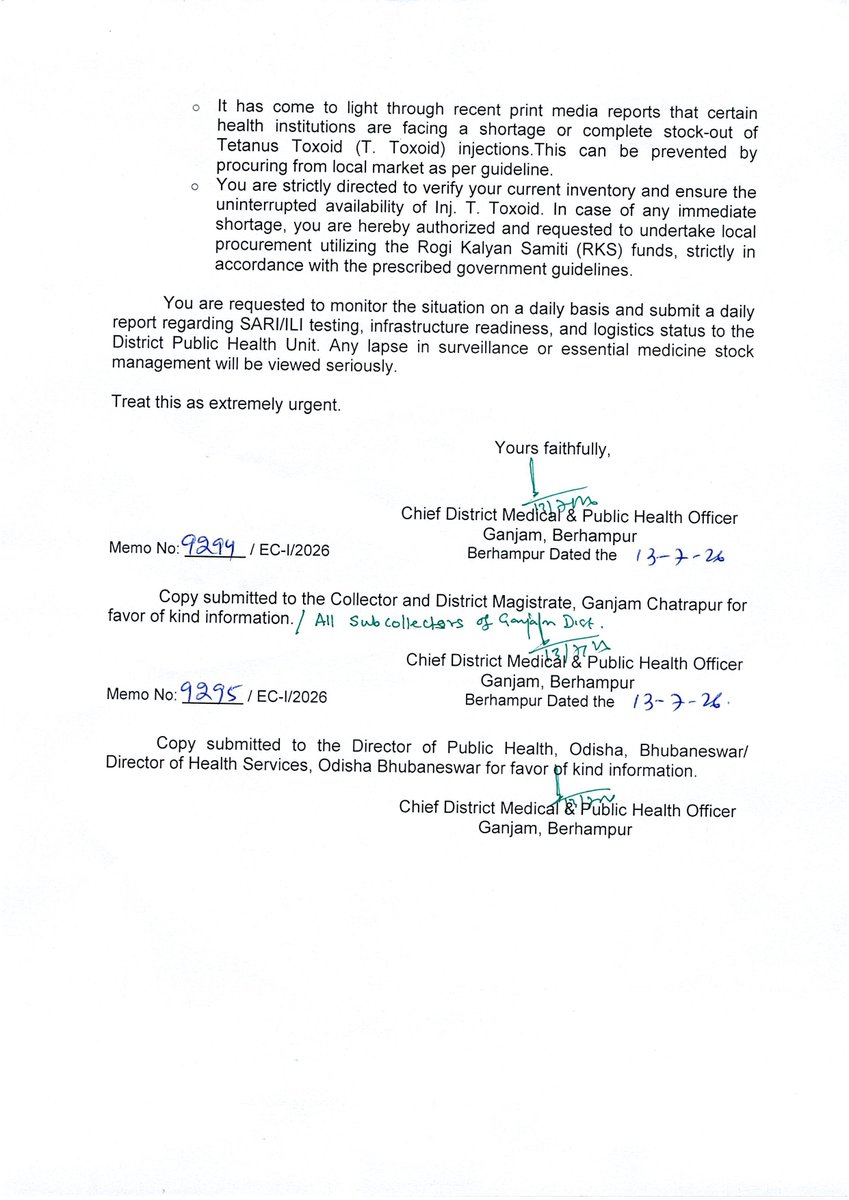
COVID Alert in Ganjam as Andhra Reports Fresh Cases, Health Department Orders Heightened Surveillance
Brahmapur: With neighbouring Andhra Pradesh reporting fresh COVID-19 cases and suspected fatalities, the Ganjam district administration has placed the health machinery on high alert and directed all government health institutions to strengthen surveillance and preparedness to prevent any possible spread of the virus into Odisha.
In a directive issued, Chief District Medical and Public Health Officer (CDM&PHO), Ganjam, instructed the Superintendent of City Hospital, all Sub-Divisional Hospitals (SDHs) and Community Health Centres (CHCs) to immediately implement enhanced COVID-19 surveillance measures in accordance with the latest guidelines of the Union Ministry of Health and the Odisha Health Department.
The order mandates compulsory COVID-19 testing for all patients suffering from Severe Acute Respiratory Illness (SARI). It also directs health facilities to conduct random COVID-19 tests on at least five per cent of patients reporting Influenza-Like Illness (ILI) symptoms to ensure early detection of infections.
Hospitals have been instructed to keep isolation wards fully operational and ensure readiness of oxygen-supported beds, oxygen plants, oxygen concentrators, cylinders and other essential medical logistics. The administration has also asked healthcare workers, including ASHA and ANM staff, to closely monitor their respective areas for any unusual clustering of fever or respiratory illness cases.
The district health authorities have further directed all medical institutions to maintain adequate stocks of essential medicines such as ORS, paracetamol, zinc, Vitamin-A, Vitamin-B2 supplements, respiratory medicines and azithromycin tablets. They have also been asked to verify the availability of Tetanus Toxoid (TT) injections. In case of shortages, hospitals have been authorised to procure the vaccines locally using Rogi Kalyan Samiti (RKS) funds as per government norms.
The CDM&PHO has instructed all health facilities to submit daily reports on SARI and ILI testing, infrastructure preparedness and medicine availability to the District Public Health Unit. The order warns that any lapse in surveillance or stock management will be viewed seriously.
The district administration has appealed to the public not to panic, while urging people with respiratory symptoms to seek medical attention promptly and continue following respiratory hygiene and other preventive measures.