Another big congratulations to Dr @AshleyJBasson on a stellar viva performance. Thanks to @Dr_JamesTaylor and Paz Munoz for putting him through his paces. Continue enjoying @LiverpoolChiro
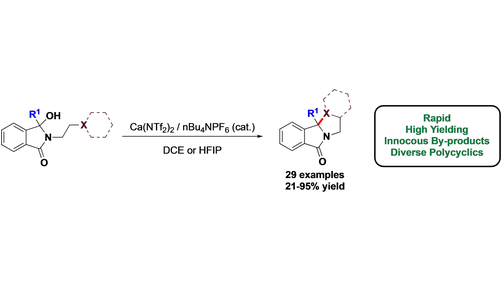
@ASU @andrewbissette @utrgv@resasco@pushingarrows Ashley Basson and @mml_researchlu show transition metals aren’t the only contributors, using abundant calcium as a Lewis-acid catalyst to create building blocks derived from N-acyliminium ions.
https://t.co/Lcv0Rtt9kC
A good start to 2023! Pleased to see the latest paper of my PhD work just published in @CellRepPhysSci reporting our latest study into calcium catalysis. It will feature in a special issue later in the year! @MML_ResearchLU @LancUniChem https://t.co/xRVnNeXUVH
@AshleyJBasson latest adventures in calcium is now out in @CellRepPhysSci. This time we report a lovely aza-Friedel Crafts reaction employing aniline derivatives.
https://t.co/3xqG8ENYmN
Amazing work by @NiamhOwen9, who has just published her MRes research in @OrgBiomolChem. https://t.co/jP1ltCWjT7
Luckily enough, Niamh has stayed on with us, so watch this space!
Delighted to see this work accepted in @ChemEurJ looking at intramolecular trapping of N-acyliminium ions using calcium/HFIP. First paper since moving to @LancUniChem! https://t.co/4baW0I76pM @MML_ResearchLU
Great way to start the bank holiday/finish the week. @AshleyJBasson latest foray into calcium catalysis, which produces a range of diverse polycycles.
https://t.co/ifhjUcFgMM
@MarkOndari @MML_ResearchLU @GPavaneli Thanks Mark! In MeCN the mass balance was unreacted SM. Co-ordinating solvents partially poison the catalyst in these systems. Preactivation with Tf2O is not something we have studied, however attempting a catalytic one-pot approach under our conditions results in side reactions
Here’s my #RSCPoster looking at using calcium catalysis to access functionalised heterocycles. Excited to see everyone’s posters! #RSCOrg#RSCCat @MML_ResearchLU
@Callum_Woof @MML_ResearchLU We can monitor formation of the on-cycle intermediate by 19F NMR. Addition of the acylacetal without a nucleophile results in the formation of a competing pathway whereby the bis-amide is formed along with partial hydrolysis to the amide and aldehyde (2/2)
@Callum_Woof @MML_ResearchLU Thanks Callum! Other groups have shown isolating similar catalyst systems to be difficult due to the weakly coordinating nature of the ligands and decomposition of the catalyst is observed - this is something we are looking into though. (1/2)
@mafernan9 @MML_ResearchLU Thank you and thanks for your question! Yes, we have added the compounds to our in-house fragment library and they are being screened against a range of targets by internal and external collaborators.
@ndchiappini @MML_ResearchLU We haven’t observed any Ca(OH)2 forming and earlier optimisation studies have shown that Ca(OH)2 doesn’t catalyse these transformations so would expect the reactions to become more sluggish if this was forming due to catalyst poisoning. Hope that helps and thanks again! (2/2)
@ndchiappini @MML_ResearchLU Thanks Nick, and thanks for your questions! We agree that this would be a nice route to imidazoles, however you are absolutely right that the SMs aren’t trivial and have had no such luck so far, with no existing reports on their preparation either (1/2)
@AmolMan95745679 @MML_ResearchLU Thanks for the question! The structure of 2a was verified using full characterisation by NMR and this was consistent with the literature