Normalize saying 'No' Without needing to Over explain yourself. If someone offended by your boundaries, that's their problem...
The best Weight you'll ever lose is the weight of other people's opinions of you.
Vitamin B12 is absorbed through two pathways. The first is intrinsic factor, a protein produced by parietal cells in the stomach. IF binds B12 in the small intestine and carries it across the gut wall via a receptor called cubilin in the distal ileum. This pathway is efficient but has a hard ceiling: it saturates at roughly 1.5 µg per dose. No matter how much B12 you swallow beyond that, IF cannot carry any more.
The second pathway is passive diffusion. About 1 to 2% of any oral dose diffuses across the intestinal lining without IF, and this occurs along the entire length of the gut. At dietary doses, this pathway is negligible. At supplement doses, it becomes the primary route of absorption.
Adams et al. (1971, Scand J Gastroenterol) measured whole body retention of radiolabeled cyanocobalamin at different doses. At 1 µg, roughly 50% was retained. At 5 µg, about 20%. At 25 µg, just over 5%. The NIH Office of Dietary Supplements reports approximately 2% absorption at 500 µg and 1.3% at 1,000 µg.
The fraction drops dramatically. But the total amount absorbed keeps rising. At 1 µg you absorb about 0.5 µg. At 1,000 µg you absorb roughly 13 µg total, of which approximately 10 µg comes from passive diffusion alone. The RDA is 2.4 µg. Even the backup pathway, working at 1% efficiency, delivers more than four times your daily requirement from a single pill.
This is the basis for high-dose oral B12 as an alternative to injections in patients who lack intrinsic factor. The NIH notes that high-dose oral supplementation "may be another treatment option" for pernicious anemia, though injections remain standard first-line therapy and the available randomized controlled trials comparing the two approaches are considered limited in quality.
One important nuance: absorbing B12 into your bloodstream is only the first step. After absorption, B12 must bind to a transport protein called transcobalamin to reach your cells. This complex, holotranscobalamin, is the biologically active fraction. It represents only about 20 to 30% of the total B12 circulating in your blood. The remaining 70 to 80% rides on a separate protein called haptocorrin, which does not deliver B12 to most tissues.
This is why serum B12 can be misleading as a status marker. A person can have a "normal" total serum B12 level while their holotranscobalamin, the fraction that actually delivers B12 to cells, is low. Methylmalonic acid is a more sensitive functional marker because it rises when cellular B12 is genuinely insufficient, regardless of what total serum B12 shows.
Absorption determines how much B12 enters your blood. Transport determines how much reaches your cells. Testing only total serum B12 measures neither of these processes accurately.
Adams et al., Scand J Gastroenterol, 1971
NIH Office of Dietary Supplements, 2024
Allen et al., J Nutr, 2018
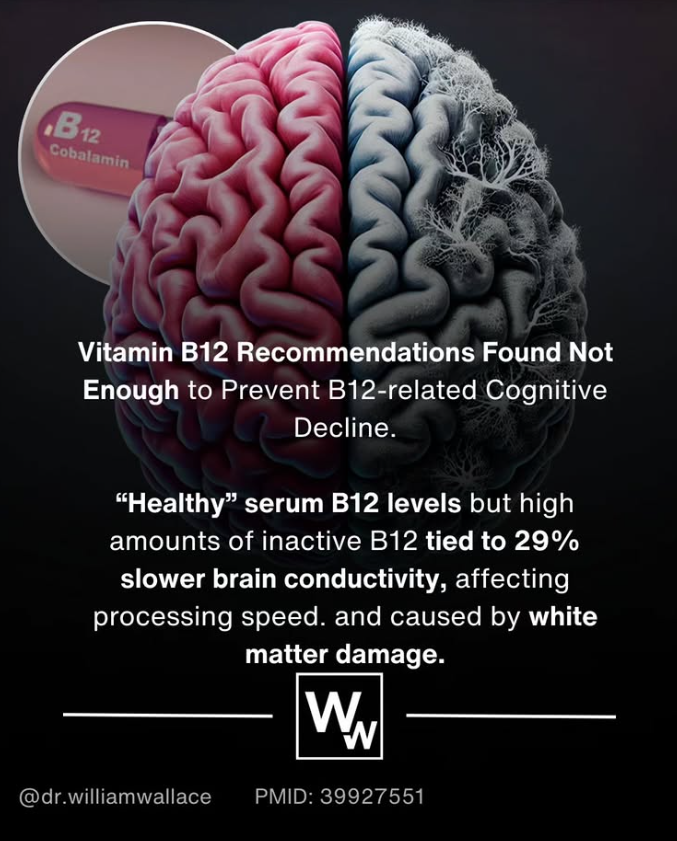
A recent study published in Annals of Neurology (PMID: 39927551) reveals that low levels of active Vitamin B12 (holotranscobalamin) are linked to reduced white matter integrity and poorer cognitive performance, while total B12 levels may not accurately reflect brain health.
Vitamin B12 is crucial for maintaining nerve function, brain health, and DNA synthesis. It exists in two forms:
- Active B12 (Holotranscobalamin): The bioavailable form directly utilized by cells.
- Inactive B12 (Haptocorrin-bound): Circulates in the bloodstream but is not available for cellular functions.
Traditional blood tests measure total B12, which includes both active and inactive forms, potentially masking deficiencies that could impact cognitive function.
Findings:
- Participants with low active B12 showed significant white matter breakdown and impaired cognitive function compared to those with adequate levels.
- The study demonstrates the importance of measuring active B12 for accurate brain health assessment.
This study highlights the need for a paradigm shift in Vitamin B12 testing and supplementation, emphasizing active B12 as a critical biomarker for brain health and cognitive function.
In the United States, Vitamin B12 deficiency is defined as a blood level below 148 pmol/L. The American Society for Nutrition criticized this approach, highlighting that over 5% of patients with symptoms of B12 deficiency and who respond to B12 supplementation have blood levels above this threshold. Studies suggest that B-vitamin supplementation benefits individuals with clinical signs of deficiency, regardless of their measured blood levels.