How is the U.S.-ROK alliance faring amidst geopolitical turmoil? ASPI’s May 28 conference takes a look. Panelists included Steve Biegun, Jong Kun Choi, Kathleen Stephens, Mark Lippert, Bee Yun Jo, Kuyoun Chung, Seongho Sheen, David Sanger, and Emma Chanlett-Avery.
How is the U.S.-ROK alliance faring amidst geopolitical turmoil? ASPI’s May 28 conference takes a look. Panelists included Steve Biegun, Jong Kun Choi, Kathleen Stephens, Mark Lippert, Bee Yun Jo, Kuyoun Chung, Seongho Sheen, David Sanger, and Emma Chanlett-Avery.
I am pleased to share that I have accepted an appointment as Non-Resident Honorary Fellow for Chinese Economy at the Center for China Analysis (CCA) of the Asia Society Policy Institute (@AsiaPolicy).
Founded by Kevin Rudd and Jing Qian, CCA has quickly become one of the world’s leading centers for evidence-based analysis of China, bringing together scholars, policymakers, business leaders, and practitioners to better understand the forces shaping China’s future and its impact on the global economy.
Over the past three years at Harvard University’s Fairbank Center for Chinese Studies, my work has focused on the evolving U.S.-China economic relationship and the opportunities emerging in what I have described as the post-engagement, post-decoupling era.
I plan to continue my affiliation with the Fairbank Center for Chinese Studies, Harvard University in the coming year. We look forward to remaining in Cambridge and continuing our engagement with the Harvard community.
At a time when consensus and quality of analysis often struggles to keep pace with the speed of change, institutions dedicated to rigorous, evidence-based understanding are more important than ever.
I look forward to contributing to CCA’s mission of advancing objective, pragmatic, and informed analysis of China’s economy and its role in the world. 🦉
Thursday, June 4, @AsiaPolicy hosts a discussion on the energy shocks and responses in South and Southeast Asia stemming from the U.S.-Iran-Israel conflict. With Atul Arya (@EnergySPG), @Kate_K_Logan, Sam Reynolds (@ieefa_institute), and @faamer. Register: https://t.co/61XbY69ZjY
Today, the inaugural Washington China Dialogues convenes in D.C.
Policymakers, analysts, technologists, and more—all in one room to discuss six hard questions about where U.S.-China competition is headed.
Asia Society's 16 locations around the world offer free online programs with different perspectives on #Asia. 🌏 This June, tune in to learn more about Japan's influence on global gastronomy, energy security in Asia, mental health in the age of AI, and more!
👉 Register: https://t.co/NgmLGDVM1d
The Brave New World Paradox: How Technology is Reshaping Geopolitical Strategy
The discussions were around the question: How do we secure strategic autonomy in an ecosystem that demands interconnection?
Here are my views and you are welcome to comment, add value, join to expand this discussion further.
https://t.co/VbF2l85kEK via @LinkedIn@AsiaPolicy@AsiaSocietyIC@gmfus@MercatorDE@ussal
Great discussion with BarcklayBram, Amadej Petan, Ayesha Jameel & Hanmin Kim on how China is reshaping local realities globally. Inaugural @AsiaSociety essay competition — 144 abstracts from 66 countries showing the hunger to tell these stories from the ground up.
.@AsiaPolicy's #CenterforChinaAnalysis brought together the authors from “Global Perceptions of China: Insights from the Next Generation” for a live discussion of their research. Watch Aleksei Chigadaev, Amadej Petan, Ayesha Jameel & Hanmin Kim discuss how China is reshaping their parts of the world https://t.co/ReiGYwLSwt
We brought together the authors from “Global Perceptions of China: Insights from the Next Generation” for a live discussion of their research. Watch Aleksei Chigadaev, Amadej Petan, Ayesha Jameel & Hanmin Kim discuss China, their corners of the world, and what comes next:
https://t.co/SukOlM5dzI
Can responsible mining standards actually diversify critical mineral supply chains—or are today’s dominant players cleaning up fast enough to keep new entrants out?
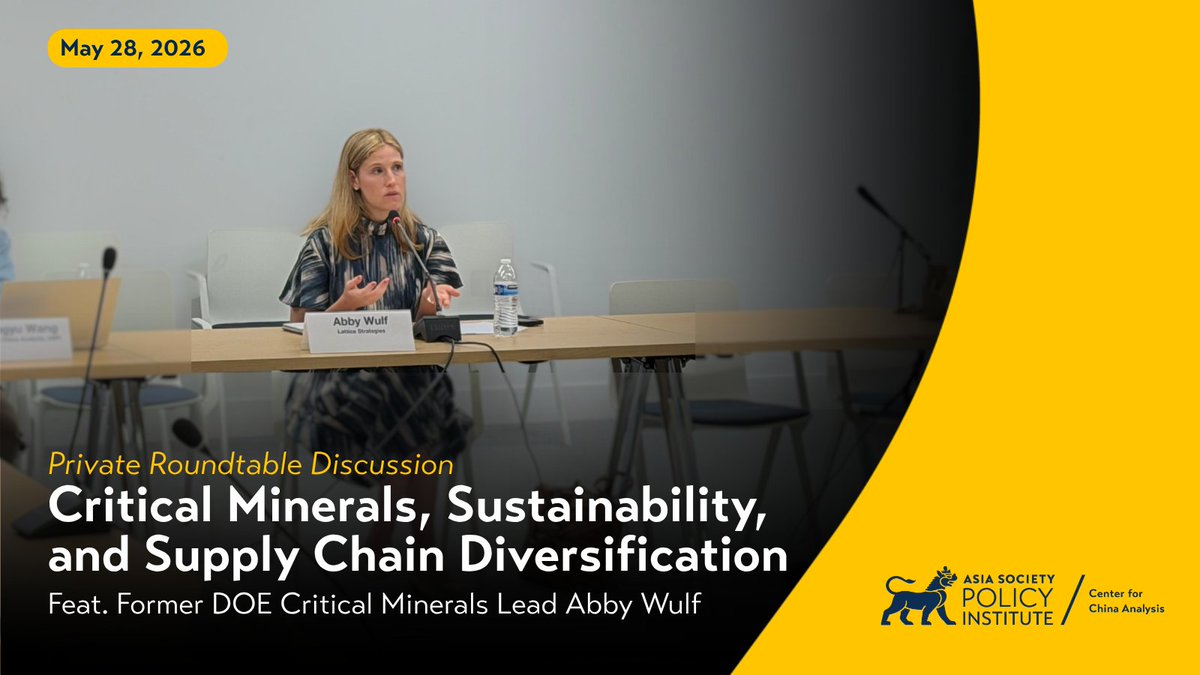
At a private roundtable with the Center for China Analysis on May 28, former DOE Critical Minerals Lead Abby Wulf unpacked why diversifying the critical mineral supply chain is harder than it sounds and what it means for the clean energy transition.
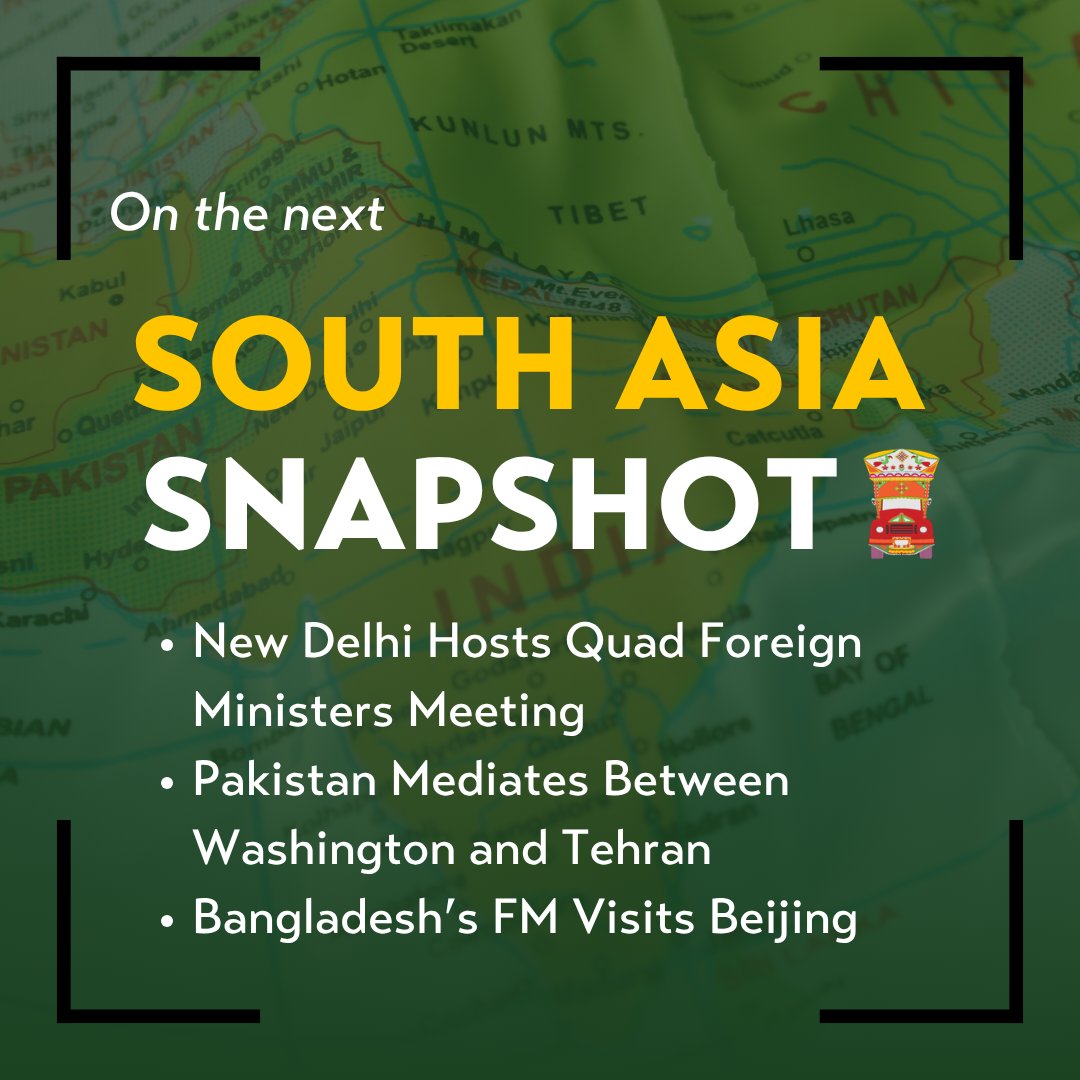
Don't miss Monday's issue of #SouthAsiaSnapshot! Subscribe to @faamer's monthly brief for her take on the Quad FM meeting in New Delhi 🇮🇳, Pakistan's diplomatic gamble 🇵🇰, and Bangladesh's latest strategic signaling 🇧🇩: https://t.co/bEYhhQpuka
As the Iran crisis disrupts energy markets, shipping, and critical supply chains, Asian governments are moving quickly to strengthen resilience. Join us on June 18 for a discussion on how Asia is responding through new forms of crisis cooperation. https://t.co/PWaGaewmR5
How is China reshaping the world, from Russian e-commerce to Korean AI? We asked the next generation of scholars. Selected from 144 submissions across 66 countries, read the four winning essays:
https://t.co/tckcKtMF8Y
The Middle East conflict has exposed vulnerabilities in Asia’s energy security. As demand rises across South & Southeast Asia, what lessons can policymakers draw from recent shocks? Join us on June 4 for a virtual discussion with Atul Arya, @Kate_K_Logan, Sam Reynolds & @faamer
PLA Watch #22 is out!
In this issue, we highlight new assessment metrics centered around joint training within the Southern Theater Command. We also examine a new campaign from the Discipline Inspection Commission targeting officers’ “social circles”. Finally, we analyze the deployment of the aircraft carrier Liaoning near Japan and its implications for Sino-Japan relations.
In particular, I analyze a PLA Daily article highlighting the PLA's ongoing efforts (and struggles) with training under truly "joint" environments. My takeaway is this is a useful reminder that the PLA has a long way to go to achieve a true joint force. The examples cited in the article about progressing step by step from joint training with the “same type of aircraft,” to “mixed training with different types of aircraft,” and then to “integrated ship-aircraft training” are illuminating. For the U.S. joint force, many of these scenarios would seem rudimentary (granted, the U.S. military has by no means “perfected” joint operations; it is always a work in progress). It is also illuminating to read what a massive mindset shift is required for the PLA to train under true joint requirements and environments. This is a historically army-based military which, as the article concedes, has relied on individual exercise scores that likely inflate their sense of accomplishment. For all the handwringing these days in Washington that the PLA is 10-feet tall and outpacing the United States in several net assessment metrics, it still struggles with adopting a joint force mindset and accurately assessing training in joint settings.
Finally, I examine another PLA Daily article covering a new campaign undertaken by Party Committees and Discipline Inspection departments within the PLA to crack down on “personal social circles” among PLA officers, especially while off duty. There appears to be a new, almost comical push within the PLA to warn officers not to do "favors" for family friends and business associates while off-duty. This is fascinating to me, becuase one of the most common avenues for corruption to take place in the PLA is through these "guanxi" networks. My take: good luck enforcing it.
Have a read and tell me what you think!
https://t.co/xB8MMhNrc5
In the 22nd edition of PLA Watch, we highlight new assessment metrics centered around joint training within the Southern Theater Command. We also examine a new campaign from the Discipline Inspection Commission targeting officers’ “social circles”. Finally, we analyze the deployment of the aircraft carrier Liaoning near Japan and its implications for Sino-Japanese relations.
See the full issue: https://t.co/6X4IspqT6y