Property Media Professional | Content Creator | Award-Winning Journalist | Speaker | Tweets are my own opinion not advice.📩For collaborations: [email protected]
Hi, I'm Ash.
With over a decade of experience writing about real estate in South Africa, I’ve built a career around turning concrete into compelling stories. My background as a property broker gave me the inside edge, and today, I use that knowledge to create media that connects, informs, and sells.
I’m the founder of Ask Ash, a media house dedicated to marketing real estate across South Africa — from bustling retail hubs to industrial parks, luxury homes, and commercial developments. Whether I’m crafting sharp copy, creating video or social content, or speaking at industry events, my goal is simple: to make property relatable and marketable in a modern, digital-first world.
I work with developers, agencies, landlords, property-related companies, and brands that want more than listings - they want narratives that move people and media campaigns that matter. That’s where I come in, blending strategy, storytelling, and market insight to help property brands stand out and stay relevant.
Ready to turn your property into a story worth sharing? Let’s create media that actually moves the market.
For collaborations: [email protected]
New Life Rights development under construction at the V&A Waterfront, Cape Town, with 147 apartments for adults aged 60 and older🏘️🌊
Details about the development:
• Development name: The Bower
• Completion date: November 2027
• Key handover to residents: 1 February 2028
• Location: right in front of the InterContinental Table Bay Hotel on the Breakwater Boulevard in Granger Bay
• Amenities include: gym, wellness centre, yoga studio, indoor heated lap pool and vitality pool, restaurant, bar, library lounge, cinema lounge, meeting spaces, communal gardens level 1 and 5, 24/7 Medical on-site support, 24-hour nursing, 14-unit memory care centre
• Architect: KPF
The development has 147 apartments in total, made up of:
• 47 × 1-bedroom apartments - average total area of 86m²
• 10 × 1.5-bedroom apartments - average total area of 131m²
• 73 × 2-bedroom apartments - average total area of 131m²
• 13 × 2.5-bedroom apartments - average total area of 246m²
• 3 × 3-bedroom apartments - average total area of 305m²
• 1 × 3.5-bedroom apartment - average total area of 266m²
The Bower uses a Life Rights model - basically you’re paying for the right to live in a specific apartment for the rest of your life, while also getting access to the community’s facilities, services and healthcare.
You don’t own the apartment in the traditional sense, so you can’t sell it on the open market whenever you want. When a resident leaves or passes away, the apartment is handled in accordance with the Life Rights agreement, which outlines how the apartment is reallocated and what happens to any refundable funds, including any applicable deductions.
This development forms part of the larger expansion plans for Granger Bay - a R24 billion development along Cape Town’s coastline, with the project expected to roll out over roughly 10 to 15 years.
There are still a number of approvals required before it can move ahead, including approval from national government for any proposed land reclamation. The development could eventually provide homes for around 6,000 people and, according to the plans, support up to 125,000 jobs by 2046.
There is also a proposal for a 1km coastal park and promenade, which would open up more of the shoreline to the public and create better connections between the area and the sea.
Who holds the pavement?
If anywhere in Johannesburg has development action right now, it's Rosebank. Drive down Oxford Road or Jan Smuts Avenue, and you'll count cranes sprinkled across the suburb.
Rainmaker Marketing's March 2026 property market report calls Rosebank a "high-growth, high-activation node", which is a fancy way of saying it's busy. Property transactions in the suburb rose 53% between 2023 and 2025, and sales value more than doubled in a single year, from R282.7 million in 2024 to R653.1 million in 2025.
Vacancy rates have dropped from 15.4% at the end of 2021 to 8% at the end of 2025, and average household income has grown 171% since 2011. With multi-billion rand projects like Oxford Parks, Rosebank has evolved from up-and-coming to established.
Property transactions in Sandton, Rosebank and surrounding suburbs, 2023–2025. Rosebank's 434 transactions in 2025 made it one of the two top-performing suburbs in the report. Source: Rainmaker Marketing, Property Market Report, March 2026.
I recently did a deep dive on a pocket precinct within the Rosebank suburb. Keyes Art Mile 2.0 is a marvel, but the one page of their marketing brochure I liked most is about who owns the pavement.
In most developments, the owner looks after everything inside the boundary walls. Everything outside – the pavement, the street lights, the kerb – belongs to the city, and the city's maintenance budget (or lack thereof) decides what it looks like.
Read the full article on below:
New retail wing in Fourways Mall, valued at R100 million, is officially open👏
• The name of this wing is The View
• Construction began: March 2026
• Location: corner of Cedar and Witkoppen Roads, Fourways Mall
• New retailers include: Pantry (they’ve signed a 10-year lease), Tasha’s, George’s Grill, Fournos Bakery, Nonna’s Riviera, Nossa Casa, Mangwanani Spa, Popsicle Nails, The Piercery, The Glow Theory, Petworld, Liquor Lane, Clay Café, WorkShop17 co-working space and others.
The new lease agreements cover 4 342 m² at an average rental of R201.80/m².
Fourways Mall has come a long way and continues to do so. Not long ago, the centre faced a seriously uncertain future. Today, with vacancies reportedly down from 24% to 6.6% and tenant turnover up by 61%, the turnaround is becoming tangible.
The View is an experience that shows how the centre is evolving its offering and giving people new reasons to visit and stay longer. I’m looking forward to seeing how this premium addition changes the dynamic at Fourways Mall and enhances the overall mall experience.
🚧UNDER CONSTRUCTION: Latest drone shots of the R3.2 billion private Afrikaans university being developed on a 220-hectare site in Pretoria East.
A week after the team cast the dome’s ring beam inside what will become an amphitheatre at Akademia’s campus, they began exposing the concrete and tensioning the cables.
The central needle will reach 25 metres high, while the ring beam stands 13 metres tall and measures 33 metres in diameter. The project has already involved pouring 280 tonnes of concrete to create a dome spanning 850m2.
Quick facts about the development:
• Completion: 2028
• Location: near Boschkop Road, 8 km from Solomon Mahlangu Drive
• First phase is valued at: R1.8 billion
• The campus includes: learning centres, sporting facilities, a library, offices, an amphitheatre, coffee shops, an agricultural facility with its own farm, a cafeteria, a student centre, lecture rooms and laboratories. It will also include 8 student residences with 1,500 beds.
Akademia is targeting an initial enrolment of 3,500 students studying on campus in its first year.
Latest construction images are below, along with a render of the amphitheatre dome (📸: Kanton)
Over the past year, I have come across one zoning dispute after another. A luxury apartment block in Sea Point and a place of worship and instruction in Sandton, to name two. An owner wants to do something new with a piece of land, the neighbours object, and the debate grinds through the system for years. By the time a decision arrives, both sides are exhausted, and often neither is satisfied.
Some of these cases are nearing a decision, which is why I wanted to write about them. One in Johannesburg has been running for nearly 20 years and returns to the Municipal Planning Tribunal later this month. In Cape Town, residents who won their appeal took the fight to the High Court in August because construction never stopped. Whether the plot holds a block of flats or a place of worship, the fight usually comes down to who gets the final say, and why it takes so long to get there.
Every piece of land in South Africa comes with a set of rules about what you are and aren’t allowed to do on that erf. Zoning specifically tells you what the land can be used for. On top of that sit development controls, like how tall you may build and how many parking bays you need.
Some properties also carry conditions in the title deed itself, often written when the suburb was first laid out. If an owner wants to change any of these, they apply to the municipality; neighbours can object, and in Johannesburg, a panel called the Municipal Planning Tribunal (MPT) weighs it all up and decides.
Read the full article below.
I wrote about Diary of a CEO host Steven Bartlett’s Bishopscourt mansion, examining the asking price and what that figure means in the context of Cape Town’s luxury property market.
The story caught the attention of international media, and correspondents from The Times and Al Jazeera subsequently contacted me for further insight into the property and the Cape Town market.
The Times has now published its piece, which includes some of my commentary.
You can read the article here: https://t.co/iQVgejfKsW
display the country’s inequality more starkly than the road from Cape Town airport, where shacks line the route to the villas, hotels and top-end restaurants of the city’s wealthier suburbs.
Geordin Hill-Lewis, the city’s mayor, has defended Cape Town’s strategy of attracting foreign capital, arguing that the city has spent years drawing investment and tourism to grow the economy. His administration says the answer to rising housing costs is more homes, not turning away the people the city has worked to attract.
Cape Town’s appeal goes beyond its mountains, beaches and wine farms. It is widely regarded as one of South Africa’s better-run cities. The pro-business Democratic Alliance has governed Cape Town for more than two decades.
Skyline of Johannesburg city center with railway lines.
Johannesburg is the largest city in South Africa
getty images
In enclaves near the beaches and wine farms, where you are more likely to hear a European language than a local accent, foreign buyers can account for more than half of purchases. At the top end, they accounted for about two-fifths of South African property sales above 20 million rand over the past decade.
The tensions echo Barcelona, where residents have protested rising property prices, short-term rentals and homes being diverted from the local market. Barcelona plans to eliminate more than 10,000 licensed tourist apartments by 2028.
Bartlett, meanwhile, has offered no public explanation for putting his Cape Town house back on the market after such a short period of ownership. On his podcast, he has warned listeners that buying a home is often not an investment and urged them to consider the “opportunity cost” of tying up their money in property.
A sale anywhere close to 189 million rand would establish a new benchmark for Bishopscourt — one that neighbours may not necessarily welcome. “This area doesn’t appreciate this sort of attention or extravagant pricing. I can’t see any benefit to residents if he gets that price. The winner will be the city who will want to put up the rates bills!” a neighbour told The Times.
Cape Town property is booming — and Steven Bartlett is cashing in
new
The Diary of a CEO podcaster, who has listed his mansion for double what he paid for it two years ago, is at the centre of a row over soaring prices
Jane Flanagan, Cape Town
Friday September 25 2026, 9.20am BST, The Times
A university dropout who built a business empire selling a blend of entrepreneurship, wellness and “self-optimisation”, Steven Bartlett’s bite-sized wisdom attracts about 100 million views and listens to his podcast each month. “For the biggest purchase of your life,” he tells fans of Diary of a CEO, “you’ve got to run the numbers.”
The 34-year-old Briton is now testing a fairly spectacular number of his own. Two years after buying a mansion in Cape Town for 93.3 million rand (£4.3 million), he is asking more than double what he paid for the property where he has spent barely a month. The apparent flip has landed him in the middle of a heated debate over soaring property prices and the growing influence of foreign buyers.
Sitting on nearly two acres, the house has seven bedrooms, 9.5 bathrooms and parking for a dozen cars. Among its luxuries are a heated rim-flow pool, plunge pool, high-tech gym, steam room, jacuzzi, wine cellar, poker room and cinema. The wine cellar is perhaps wasted on Bartlett, who has said two or three glasses are enough to ruin the next few days.
With its glass and polished concrete, the property appears rather more Shoreditch than Bishopscourt. The suburb, in the shadow of Table Mountain, is better known for gabled Cape Dutch homes, oak-lined avenues and old colonial money. The estate agent blurb pitches Bartlett’s house as offering “exceptional proportions with flawless symmetry”, its large sliding doors opening on to terraces, gardens and pools.
Bartlett’s addition was a padel court, an increasingly obligatory accessory for the wealthy. During the renovations, he rented the property to Warner Bros to film parts of Germany’s version of The Bachelor.
Cape Town property prices have soared in recent years, fuelled by the so-called semigration of South Africans leaving dysfunctional cities such as Johannesburg and Durban for the Western Cape, as well as buyers from Europe and America. Foreign money has tended to cluster along the Atlantic coast, drawn by the beaches and sunsets.
The transformation of Cape Town into what the property analyst Ash Müller calls “the new Cannes” has left locals feeling priced out as neighbourhoods fill with second homes, Airbnb rentals and empty properties. Prices affordable to buyers earning in euros, pounds or dollars can be beyond the reach of South Africans paid in rand.
Bishopscourt, its history stretching back to Jan van Riebeeck, the founder of Cape Town’s Dutch settlement, has traditionally been a market for established South African wealth. Average selling prices there, in a suburb of just over 300 homes, reached 30 million rand in the first quarter of this year, almost three times the roughly 11 million rand average five years ago, according to sales data.
Müller described Bartlett’s 189 million rand asking price as “a crazy, abnormal jump and opportunistic”.
Cape Town has spent years marketing itself aggressively to foreign investors and tourists, even as resentment has grown over locals being squeezed out by property investors with pounds, euros and dollars.
Sedick Dawood, who lives near Bartlett’s house and is a fan of The Diary of a CEO, can see little benefit in the arrival of such wealth. “I love Steven, but here again Cape Town is being bought by foreigners, under the guise of ‘foreign investment’, but in reality pushing up property prices for citizens.”
Steven Bartlett, a British entrepreneur and podcaster, stands before a wooden partition, his hands clasped together.
TIMES PHOTOGRAPHER RICHARD POHLE
Critics have evoked the city’s apartheid past, when racial segregation forcibly displaced people from desirable areas close to jobs and the city centre. Few places
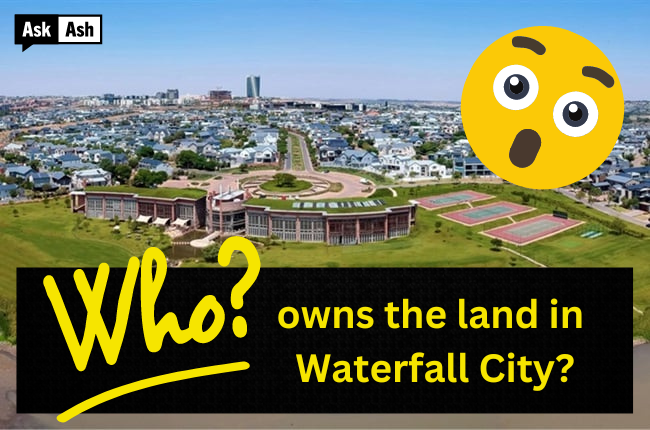
Who does the Waterfall City land in Midrand, #Gauteng belong to? If you think it’s a JSE-listed property fund, think again...🤔
The land belongs to Allah - The Islamic God.
THE FULL STORY EXPLAINED BELOW:
The Waterfall City land is owned by the Waterfall Islamic Institute (WIC), founded by the Mia family. The land is not allowed to be sold/transferred for religious reasons, however it can be leased. The profits made off of the leases must be used for public good such as charities and community initiatives.
The entire Waterfall City precinct is leasehold ownership. When it comes to Balwin’s 5020 apartment development (Munyaka) and others - all residential developers in Waterfall City, Midrand will develop with an unusual ownership structure in place - that being 99-year leasehold agreements. You as the purchaser of the apartment will then enter into a long-term 99 lease with the Islamic Trust land owner.
The lease agreements are registered in the Pretoria Deeds Office (this is not the norm when it comes to lease agreements) and they are renewable after the 99-year period with an infinite number of extensions. You can sell your property at any time during the 99-year lease and the new owner will receive a brand new 99-year lease. The lease cannot be cancelled.
Here’s what is really interesting when it comes to the Balwin Munyaka Development. When you sell your apartment one day, you would pay an agent commission (which they have capped at 5%). You will also be liable to pay 3% plus VAT of the total sales price to the Islamic Trust.
If your 99-year lease period expires, you can then renew your lease agreement with the Islamic Trust and pay them 3% plus VAT and 0.5% to the residents association based on the current market value of your apartment.
In the event of death or divorce, The Islamic Trust does not require you to pay the 3.5% plus VAT. And if you inherit the apartment after someone’s death, you can continue ownership for the remainder of the 99-year lease without paying the 3.5% plus VAT.
This also means that during any of the above, there will be no transfer duties applicable at any stage (unless the law changes). Transfer fees can be exorbitant so I would say that this is appealing for an investor.
More importantly, getting banks to fund these projects with leases in place and having title deeds issued could change the game when it comes to unlocking the potential of homelands and areas under traditional ownership in South Africa. Banks treat these lease agreements as bondable assets and that is great.
What are your thoughts about the 99-year leasehold ownership of Waterfall City land?
Just before COVID hit, the state-owned company that runs nine of South Africa's airports had a plan for a stretch of vacant land at O.R. Tambo International Airport that would have changed the airport's western skyline.
ACSA wanted to develop a 180 000m² mixed-use precinct, on roughly 8.5 hectares, across seven phases: offices, a hotel, retail and conference facilities, all built on airport-owned land.
Phase one, the smallest slice of that seven-phase plan, was costed at R4.5 billion. It would comprise three six-storey office buildings totalling 30 000m² of space, plus around 2 000 parking bays.
Then the pandemic halted air travel. Passenger numbers collapsed, ACSA's revenue went with them, and a plan built on the assumption that more and more people would keep flying suddenly became a luxury nobody could afford. The hotel, the conference centre and most of the retail space were shelved.
The project was basically scrapped, except phase one, which survived largely intact.
What actually got built was Aviation Park: 33 000m² of office space across three buildings with parking underneath, home to ACSA's own head office and the South African Civil Aviation Authority. Compared with the original 180 000m² vision, that's only around a fifth of the full precinct.
To read the full article, DM me for the link to my WhatsApp channel.
You can drive up a ramp and park at your own front door on the fifth floor🤔
I sat down with the VP of Zimbali Lakes, Neil Cocker, to hear more about the major development plans for Zimbali Lakes in Ballito, including Vilasita in the Tatali precinct, its newest residential launch.
The Tatali precinct alone is a R5 billion precinct. Neil drove me around in his car and showed me the busy site currently under construction, where about R20 million a month is going into earthworks and foundations.
Crazy to think the owner of Zimbali Lakes, IFA Hotels & Resorts, committed $100 million to Zimbali in 2003, back when the area barely promised potential.
Today that big bet has paid off. The group says it has invested more than R30 billion in Zimbali, and its 2030 vision includes a R50 billion investment pipeline.
Vilasita Development details:
• Storeys: 6
• 80 villa-style homes launching in phase one
• Prices from R2.95m for one-bedroom, two-bedroom, three-bedroom, and four-bedroom apartments
• 23 penthouses - priced from R8 250 000. The largest penthouse is 720m2, with its own rooftop pool, four-bay garage, and a price tag of R55 million.
• Every unit faces out over the lake, the ocean or Zimbali Coastal Estate.
• Ground-floor homes open onto gardens, a conservancy and the lakeside promenade.
• Amenities include a 10ha non-motorised water sports lake, Zimbali Square - a 20,000m² centre anchored by Checkers and Woolworths, an 18-hole Ernie Els Signature Course and clubhouse, padel, tennis, a driving range under construction and 15km of trails and a tunnel under the M4 to the beach.
Neil says that Zimbali Lakes closed 2025 with just over R400 million in real estate sales and passed R300 million in the first nine months of this year. These numbers are nothing short of phenomenal.
My take is that Vilasita is for the downscaler who wants to leave a big house but not the estate lifestyle, and this coast has had very few options like this (and perhaps other coasts have been too pricey to invest). The ease of pulling up to your own door with the shopping in the boot is what will sell Vilasita.
Sales open 7 November 2026 at 9 am.