Investigating Google Accounts with Ghunt
Gather custom profile pictures, activated Google services, and where a person has been moving according to Google Maps.
https://t.co/9PaqUpQOAY
Ada nggak sih website atau aplikasi apaan gitu yang bisa mbikinin powerpoint yang cakep dengan kita hanya memasukkan teks dan data2?
Please.
Aku mau bikin powerpoint kok mager banget :(
35 practical thoughts on system design
Core Principles
1. Every system is a trade-off -> you never get speed, cost, and simplicity all at once.
2. Latency compounds -> every millisecond added across layers adds up to user pain.
3. Scalability ≠ performance -> one handles growth, the other handles speed.
4. Read vs. write paths -> scaling each requires completely different strategies.
5. Design for change, not perfection -> requirements will shift.
Databases & Storage
6. Indexes are levers -> high-selectivity columns are worth indexing, low ones often aren’t.
7. Replication helps reads, partitioning helps writes -> don’t confuse the two.
8. Dual writes are a lie -> without coordination, you will see drift.
9. Event stores > queues (sometimes) -> better traceability, worse simplicity.
10. Cache invalidation is still the hardest problem -> freshness vs. performance is the eternal fight.
Reliability & Consistency
11. Idempotency saves you -> retries without it will hurt.
12. Fail fast, fail loud -> silent failures sink systems.
13. Eventual consistency is a feature -> not a bug, but only if the business allows it.
14. Conflict resolution in active-active is business logic, not infra.
15. Durability isn’t free -> syncing across regions has cost and latency.
Architecture Patterns
16. Microservices are an org structure, not a tech goal.
17. Monolith first, modular second, microservices last -> don’t jump too early.
18. Choreography scales, orchestration simplifies -> pick based on team maturity.
19. Serverless buys you focus, costs you control.
20. Queues don’t remove work, they smooth it.
Observability & Operations
21. Tracing > logging -> logs tell you “what”, traces tell you “why”.
22. Metrics rot without ownership -> measure what someone actually uses.
23. Retries without backoff = DDoS on yourself.
24. Dead-letter queues aren’t optional -> every system has poison messages.
25. Levers > knobs -> design quick kill switches and controls to contain blast radius.
Performance & Cost
26. Optimize the hot path, not the cold path.
27. Most bottlenecks live in the database, not the code.
28. Horizontal scaling beats vertical scaling ->until coordination kills it.
29. Warm caches mask bad queries -> measure against cold starts too.
30. The cheapest resource is disk, the most expensive is time.
People & Process
31. The best architecture dies without documentation.
32. System design reviews aren’t about diagrams, they’re about trade-offs.
33. Small PRs are for speed, big PRs are for context -> balance both.
34. A senior engineer’s role in design is asking the uncomfortable “what if”.
35. No design survives first contact with production -> but good ones bend instead of break.
What else?
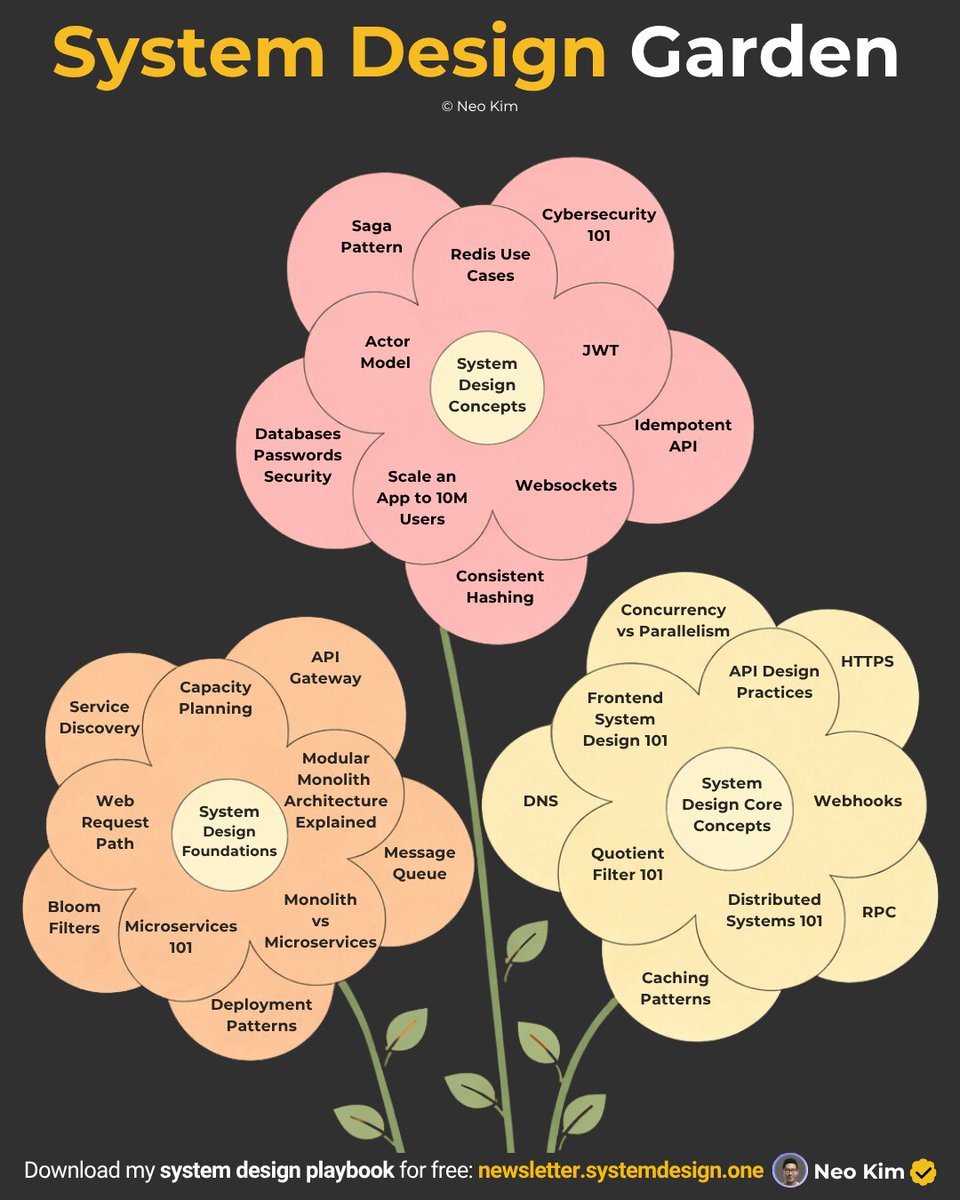
33 posts that'll teach you 33 system design concepts:
1 Idempotent API
↳ https://t.co/afe7ACuSYE
2 Saga Design Pattern
↳ https://t.co/2CffTodOHL
3 Redis Use Cases
↳ https://t.co/hZ571ruVeA
4 Actor Model
↳ https://t.co/Xj4dpBKuBv
5 Quotient Filter 101
↳ https://t.co/ISVmY29PWc
6 How Databases Keep Passwords Securely
↳ https://t.co/KSfIhpAT2j
7 How to Scale an App to 10 Million Users on AWS
↳ https://t.co/RozCGli0r8
8 How JWT Works
↳ https://t.co/SZXXrlBsWH
9 Cybersecurity 101
↳ https://t.co/t7X3mJb5Bm
10 Consistent Hashing 101
↳ https://t.co/7d6EipPcKF
11 Service Discovery 101
↳ https://t.co/BcL3tgxx1u
12 Monolith vs Microservices
↳ https://t.co/KwVAEGVkA9
13 Microservices Lessons From Netflix
↳ https://t.co/XgS7VQoBFv
13 Web Request Path Explained
↳ https://t.co/P3SiURMFlW
14 Caching Patterns
↳ https://t.co/JhviWosR1L
15 Modular Monolith Architecture
↳ https://t.co/VVV6v3KGHJ
16 How Websockets Work
↳ https://t.co/JfT6mj4mrv
17 Bloom Filters 101
↳ https://t.co/ntZXq7LxVn
18 Capacity Planning 101
↳ https://t.co/umTNhM2dVY
19 How API Gateway Works
↳ https://t.co/sJZZN0qgNG
20 Deployment Patterns
↳ https://t.co/YC7sphP77c
21 Concurrency Is Not Parallelism
↳ https://t.co/BwRHeuJ5AF
22 How Do Webhooks Work
↳ https://t.co/sTCTaFD5Nv
23 Frontend System Design 101
↳ https://t.co/ViPOQrLZzA
24 How Does HTTPS Work
↳ https://t.co/r5rUtVpw0O
25 API Design Best Practices
↳ https://t.co/I2ejJ0kbYq
26 How DNS Works
↳ https://t.co/H7hcZnws8N
27 System Design Concepts
↳ https://t.co/DgL8xz0KTQ
28 API Versioning - A Deep Dive
↳ https://t.co/OHAtKSUgVN
29 System Design Fundamentals
↳ https://t.co/Jqfyh7YfZn
30 How RPC Actually Works
↳ https://t.co/yeIgcmAxQx
31 How Message Queues Work
↳ https://t.co/bZjdqs8Py2
32 Distributed Systems 101
↳ https://t.co/yi0K5K5RIE
33 System Design Core Concepts
↳ https://t.co/8ZlHtl7vxU
What else should make this list?
===
👋 PS - Want my System Design Playbook for FREE?
Join my newsletter with 200K+ software engineers now:
→ https://t.co/ByOFTtOihX
===
💾 Save this for later & RT to help others learn system design.
👤 Follow @systemdesignone + turn on notifications.
Every OSINT investigator needs the right operating system!
Is Tsurugi Linux the best OS for open source intelligence investigations?
In this article, we break it down from the hacker perspective:
https://t.co/ZQWTFJNdSE