Nearly 4 million citizens across the Kurdistan Region — and over 115,000 businesses — now enjoy 24-hour electricity through the KRG’s Runaki program.
I’m pleased to announce that Halabja is the first province to switch entirely to 24-hour electricity.
Congratulations Kurdistan.
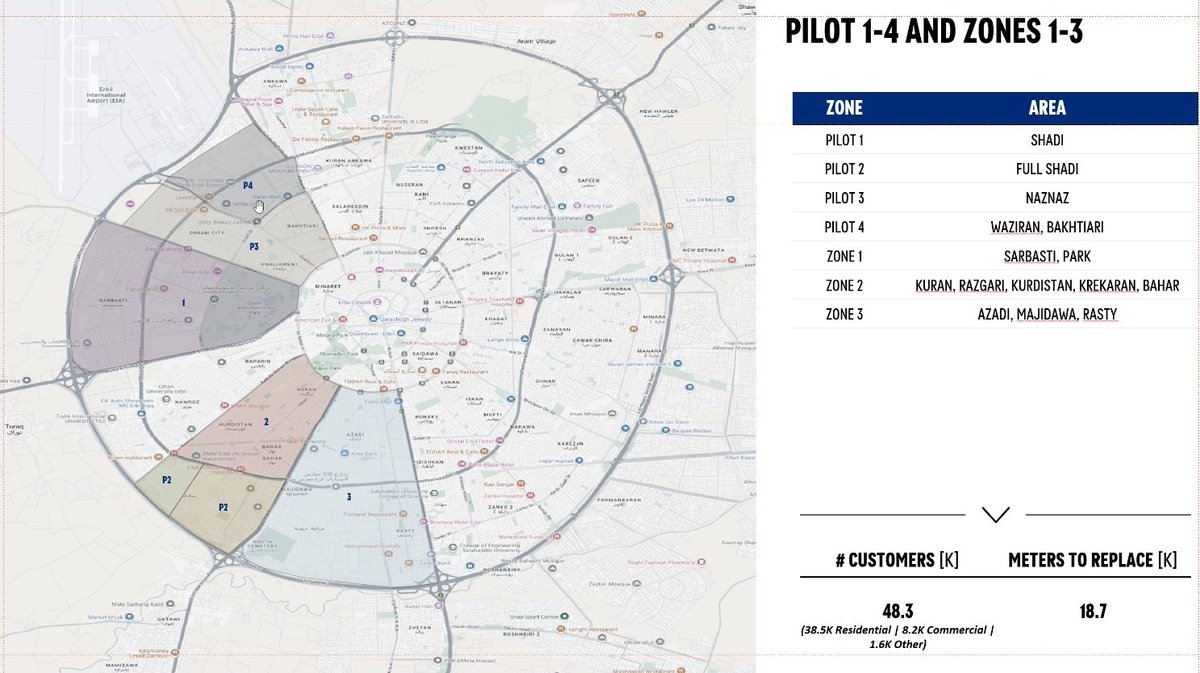
Erbil city: Areas currently covered by the KRG’s 24-hour Runaki electricity programme.
The current coverage area — within Erbil’s 150m ring-road — includes around 60% of all homes and businesses across the province.
Do you live or work in this area? We welcome your feedback and experience.
Visit https://t.co/QreyCqt6QZ
The KRG will credit over $1 million to more than 60,000 families on in its 24-hour electricity #Runaki initiative.
This follows the KRG’s May 14th decision to credit new discounts and the difference between the new (cheaper) tariffs and the previous pilot ones.
Over 10,000 households won’t pay anything for their May bills.
Today, more than 1 million citizens enjoy 24-hour electricity in the Kurdistan Region. We plan to double that in 3 weeks.
For more details, read the official press release:
https://t.co/on67LCOm0p
@Runaki_gov_krd
ضمن مبادرة "روناکی" التابعة لحكومة إقليم كردستان، تمكن أكثر من مليون مواطن في الإقليم من الحصول على خدمة الكهرباء على مدار 24 ساعة.
تهدف الخطة إلى إيصال خدمة الكهرباء المستمرة على مدار 24 ساعة إلى جميع المنازل بحلول نهاية عام 2026.
هذا هو التقدم المحرز.
#روناکی#ڕووناکی
It’s been a transformational week for the Kurdistan Region.
The Cabinet unanimously passed the KRG’s 24/7 electricity programme — Project #Runaki — and adopted new tariff reforms.
The new tariffs are progressive, protect low-income households, and allow the KRG to gradually reduce the (unsustainable) 87% subsidy of state power. Today: theft in the electricity grid is over 50%.
The new tariffs are simple:
• 1–400 kWh: 72 IQD per kWh
• 401–800 kWh: 108 IQD
• 801–1200 kWh: 175 IQD
• 1201–1600 kWh: 265 IQD
• 1601+ kWh: 350 IQD
Under the new model, and whenever new neighbourhoods join Runaki, households will receive a 50% discount on their first bill, 25% on the second, and 15% on their third.
Why? Because data shows consumer behaviour changes after the first two months of 24/7 power under the new prices — usage drops by nearly 20%. Peak pressure on the grid eases. Families embrace new lifestyles. Businesses change behaviour too.
Let’s look at the numbers.
Most households in Kurdistan consume around 670 kWh/month on 24/7 power, meaning a bill of 58,000 IQD, or about $44/month. In fact, 64% of Kurdistani households are in the first two slabs and consume less than 800 kWh/month. When you apply the KRG’s three-month discount scheme to those prices, this becomes very affordable — giving families ample time to change behaviour.
Under the old model — a blend of diesel generators and national power — the same household would have paid at least 65,000 IQD, or $49/month, for unreliable low-voltage power.
With the new tariff, low-income households (who typically consume around 490 kWh) will see bills drop to 39,000 IQD/month, or $30 — compared to 53,000 IQD, or $40, under the diesel generators + national grid model.
When all into account — and looking at data from over 100,000 households and businesses — we can confirm that 80% of households will pay less than they did before.
The key design principles were:
1.Ensure citizens pay less than they do today to diesel generators + national power.
2.Protect low-income households.
3.Promote sustainability in the electricity grid.
It makes zero sense that 7,000 diesel generators make over $1 billion/year — money that should go to the KRG to provide clean, reliable power. That’s what Runaki is designed to change.
The Cabinet also approved additional support targeting low-income households — including solar initiatives and access to energy-efficient appliances. Up to $200 million/year will be appropriated to these programmes. We’ll announce the initiatives soon.
We’re also introducing seasonal discounts in summer and winter — peak seasons — for low-income households and small/medium businesses. The less you use, the bigger the KRG’s discount scheme for you.
It’s been an extraordinary journey. In October last year, Prime Minister @masrourbarzani promised to bring 24/7 electricity to the entire Kurdistan Region by the end of 2026. This week’s brave Cabinet decision makes that goal more attainable than ever.
Next month, over 1 million citizens will have access to 24/7 electricity. We’re accelerating the rollout to complete all city centres — Erbil, Suli and Duhok — before the end of this year.
Independent polling and research show 90% satisfaction levels. With diesel generators shutting down, our neighbourhoods are becoming cleaner; schools are switching to smart screens, and businesses are increasing productivity.
Don’t listen to the naysayers — Runaki is central to seeing Kurdistan move forward, and the tariff and programme design protects vulnerable households against bill shocks. After all, the half a million people currently on 24/7 can’t all be opposed, surely.
Now that tariffs have been approved, and a massive awareness campaign is underway, a cultural challenge has emerged: helping the public move away amp measurements — historically tied to low-voltage diesel generators — to understanding kilowatt-hours (kWh)…
729 private generators have been phased out so far.
Phasing out the private generators is reducing air pollution and noise, and phasing out this number of generators is equivalent to the removal of 125,000 cars in terms of CO2 emissions
Tonight, 14 new neighborhoods in Erbil and Slemani will switch to 24/7 electricity under the KRG’s #Runaki programme.
This means reliable, affordable and clean national power to another 42,000 homes and businesses - reaching over 100,000 more people. To date, more than 150,000 homes and businesses across the Kurdistan Region have made the switch to 24/7 power.
Over 700 diesel-powered neighbourhood generators have already been turned off in Erbil, Slemani and Duhok — the equivalent to removing 125,000 vehicles from the roads.
We're on track to complete Erbil’s city center (within the 120m Ring Road) by next month. Suli, Duhok and Halabja are also on track to finish by the end of the year.
We're exploring ways to accelerate the programme in all four city centers to ease the summer burden on our people.
Prime Minister @masrourbarzani announced plans last year to move the whole of the Kurdistan Region to 24/7 power by the end of 2026. This will happen.
We commend the team in the Ministry of Electricity for their commitment and support to the programme.
For rollout updates, follow @Runaki_gov_krd or visit https://t.co/Oj4o8qCQ0C for more information.
#ڕووناکی
The KRG Ministry of Electricity announced tonight that eight new neighbourhoods in Erbil, comprising nearly 30,000 homes and businesses, switched to 24/7 power at midnight.
The first neighbourhoods in Suli and Duhok will move to 24/7 power in the next few weeks too.
#Runaki
#رووناکی
https://t.co/LTfhbkhair
Introducing Nightwatch: application monitoring & logging obsessively optimized for Laravel.
Don’t sleep on improving your monitoring and join the waitlist (launch is Q1 2025)
https://t.co/tRDzlBWIll
Grateful for the hard work and collaboration that led to the successful First Go-Live milestone for OUC & OUM today, 30-Sept-2024. A significant achievement made possible by the collective efforts across OUC, OUM, and Infrastructure!