If you are in SEO, you probably already know that Google Search Console is missing a lot of data + you get sampled data + there's a disconnect between the click chart and the query/pages tables.
The totals in the GSC chart don't match the totals in the Queries table. Ever.
If you add up every click across every row of your Queries tab, you'll almost always come up short against what the chart figures show.
That gap is your anonymised queries, rare or personal searches that Google hides from the Queries table but still counts in the chart totals, the Pages tab, Countries, Devices and Days.
On some sites it's a 30%+ gap. We've even seen it go as far as 50% on larger publications.
It's one of a few things in the Performance report that catches SEOs out.
We've just written a search console performance walk-through.
This covers:
Why 16 months is the hard limit and how to get past it
What the four metrics really measure (and where CTR misleads you)
Using regex to do filter combinations the UI won't let you do
The 1,000-row export limits and 4 ways around it
Why your "average position" isn't your actual position
Why the chart and the table are 2 seperate datasets
If you want to understand Google Search Console's performance reporting tool, filtering, quirks + more check out our latest article:
https://t.co/f2nNJbaAHs
Google is indexing LESS content year by year, their threshold for indexing content has gone up significantly.
Why?
1. It costs money to store and process website data
2. It doesn't need 10,000 URLS with the same copy
3. It makes no sense to index something you are unlikely to serve (quality issues, trust issues etc)
So, we put together a FULL guide on using Google's URL inspection tool.
If you aren't using it but you are in SEO, you should be using it.
🡲 Periodically check power pages on a domain to check index state
🡲 Check indexing states
🡲 Address and deal with anomalies
🡲 Request indexing for pages where issues have been fixed
🡲 Check rendered outputs (screenshot / HTML)
🡲 Check canonical profile
and so much more.
we've done a video which walks you through Google's URL inspection!
Enjoy
https://t.co/ZeYwQFqcWx
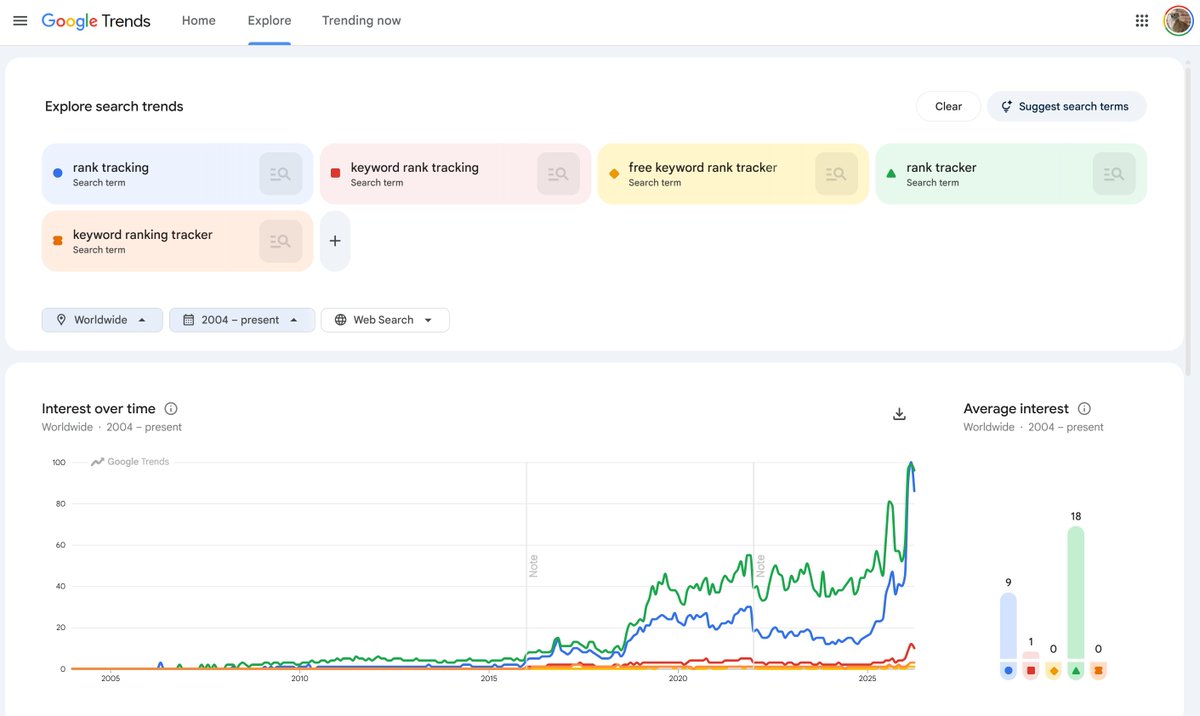
Holy cow, if SEO is dead, rank tracking certainly isn't.
SEO isn't dead, rank tracking certainly isn't.
We're not talking LLM tracking here, we're talking traditional rank tracking.
Why has demand boomed?
🡲 People still care about ranking in Google
🡲 Rank tracking is significantly more beneficial than prompt tracking
🡲 Google killed &num=100, it broke a lot of rank tracking tools
🡲 Lot's of people still want to track rankings whilst embarking on SEO
🡲 Because traditional rank tracking is cool
Yes, OK so, Google is hammering SEOs, we're seeing a rise in zero click searches, we're seeing Google push functionality into AI MODE that takes more clicks away.
But, ultimately ORGANIC still retains a majority of the search market, and, let's face it, knowing where you rank and reporting back on it helps with SEO campaigns.
Traditional rank tracking lives on, the demand is growing, seems a lot of people are still interested to know where they appear in search.
Here are some AMAZING rank tracking tools:
1. SE Ranking - really good rank tracker
2. Advanced Web Ranking - one of our favourites + long time users
3. AccuRanker - another good rank tracker
4. Ahrefs - good for rank tracking
5. SEO Stack - absolutely biased here as its our own tool but you can track rankings with us
There's still benefits to rank tracking in 2026.
Especially those that report on AI OVERVIEWS despite them being unstable.
The reason rank tracking still has value is because it's where MORE demand exists and where a majority of transactions and purchases/enquiries originate from, not only that but it's also a LOT more stable than LLM prompt tracking.
#SEO
60% of searches now end without a click
37% of people ask ChatGPT or Perplexity instead of Googling
AI, AI Overviews and LLMs have been the first true things to being a paradigm shift within SEO. SEO is thriving but getting value from it by the way of clicks is changing.
Google's exchange of value (you give it content, it gives you clicks) is changing as we see growing zero click searches + more people turning to LLMS for conversational queries.
LLMs don't read your page the way Google does. They don't rank it. They don't even look at the whole thing. They scan for fragments, self-contained chunks they can pull, reframe, and cite in an answer.
Which means the game is shifting when it comes to earning visibility and maintaining a flow of clicks.
Bury your answer in a 200-word intro and you may not get cited.
Write sections that only make sense after reading the one before and you may not get cited.
Use "as mentioned earlier" anywhere in your content and you've just told the LLM your content can't be cleanly extracted.
We've written a full breakdown of how to structure content so LLMs actually choose you as a source. It covers:
Why question-based subheadings beat clever ones every time
The standalone section test (paste one section into a blank doc does it still make sense on its own?)
Where schema markup actually helps, and where it doesn't
Why topical depth matters more than ever, not less
The specific mistakes keeping otherwise solid sites out of AI answers
https://t.co/u1Ziv8HxAT
SEO has had three "everything's changing" moments in 25 years.
We've been through all of them.
🕰️ 1998-2002:
Keyword stuffing → meta tag manipulation → directory submissions → AltaVista vs Yahoo vs Lycos vs Ask Jeeves vs the rest.
Our founders were working with hundreds of search engines long before Google.
Back when SEO was far simpler, HTML was much more basic, back when putting keywords in pages and tags carried weight, back when submitting to search engines was a commodity.
🕰️ 2003-2011:
Google's monopoly consolidates.
Florida update.
Big Daddy.
Caffeine.
Panda.
Penguin.
Each one wiped out an entire class of agency overnight. These were fun times but equally painful for a LOT of businesses who'd seen great success of the back of spam, that is until Panda and Penguin wiped out millions of websites from search results overnight.
🕰️2012-2022:
Mobile-first, semantic search, RankBrain, BERT, helpful content, E-E-A-T.
The frameworks got more sophisticated; the bad practices got more sophisticated alongside them. As always, Google takes 1 step forwards, spammers & blackhats take 3. However, the bar to rank continued to get higher.
SEO became more sophisticated, it became far less about tags and telling Google what things were for Google to start understanding words, context, meaning & being able to far better understand everything from user behaviour to end user search intent.
⌚ 2023-now:
AI Overviews,
AI Mode,
LLM citations,
agentic search.
The third "everything's changing" wave.
Here's the pattern across all of them:
The agencies that survive each transition are the ones that were already doing the right things during the previous era. The ones that disappear or suffer are the ones who'd been spamming / hitting up blackhat or low ball SEO techniques.
We've watched this cycle three times. The fundamentals don't change much. The tactics change every 3-5 years.
We've been in SEO since 2007, it's still as rewarding today as it was many many years ago to get amazing client results.
Take this Casino client, ultra-competitive space with high value keywords averaging £30-£50 per click, average FTD costs ranged from £250-£500.
Using a high quality SEO strategy we managed to significantly increase clicks with a hybrid SEO strategy.
Anyone who knows Casino, iGaming and Sports Betting will know how brutally competitive the casino niche is.
The BIGGEST CHALLENGES faced are:
☑️ YMYL and regulatory compliance for content
☑️ Brand / client internal content compliance checks, speed of approval
☑️ Hyper-competitive constantly shifting / erratic SERPS
☑️ Constant displacement in SERPS from hijacked sub-domains, spam pages and aggressive scaled content abuse
☑️ Extortionate link costs (and equally as expensive when earning links)
☑️ Heavy weighting on YMYL compliance, alignment whilst facilitating solid E-E-A-T
☑️ Balancing SEO to avoid over-optimisation and to find the perfect balance between content types, lengths, formats, tone of voice, perspectives
☑️ Dealing with 3rd party spam attacks, anchor jacking, aggressive tiered link abuse
☑️ Constant DMCA battles with false DMCA take-down requests / claims
Alongside that there's also the battle to:
☑️ Stand out with game coverage and game diversification (which is key)
☑️ Hitting UX hard to maximise engagement and interaction / positive user engagement
☑️ Game to content support strategy to avoid dilution - this means having a doorway page strategy for games (informational pages) that subsequently drive users into signing up to play the games for free spins or real money
and so much more.
We get Casino, iGaming and Sports Betting.
We've dealt with Casino across so many markets both regulated and unregulated jurisdictions i.e. Sweden.
We've dealt with all aspects of Casino SEO, so if you are looking for an agency that can put its money where its mouth is, look no further.
https://t.co/ulnZ9WMmZ4
Did you know Google's URL Inspection tool gives you the rendered HTML output of any of your pages, but only if you select "Live Test" first?
The default view shows you what Google has crawled and indexed historically. You used to be able to put cache: in front of any URL to see what Googlebot had last indexed (and when) until Google retired the cache view.
Now, it's a case of using Google's live URL inspection.
Live Test shows you what Google would render right now if it crawled the page in the moment. When we say shows you, what we mean is you get a sample render (not an accurate view of how Googlebot sees your site) and the HTML output (this is key)
The difference between those two outputs is where about 60% of the technical SEO problems we audit actually live.
If you've never compared them side by side on a page that's underperforming, now's the time!
(15-minute job. Inspect URL → Live Test → View Tested Page → HTML. Compare to your browser's rendered DOM. Find what's missing.)
Copy the HTML from Google's URL inspection output, then, visit the same URL you inspected in another tab in Chrome, hit F12 to open devtools, go to the ELEMENTS tab, at the top where you get the opening HTML tag, right click and select EDIT AS HTML, ctrl + A to remove the current code then ctrl + V to paste your inspection output, then click anywhere in the window.
You will then see the output render from the source Google returns to you.
It's here you can see / identify any issues, missing DOM elements etc.
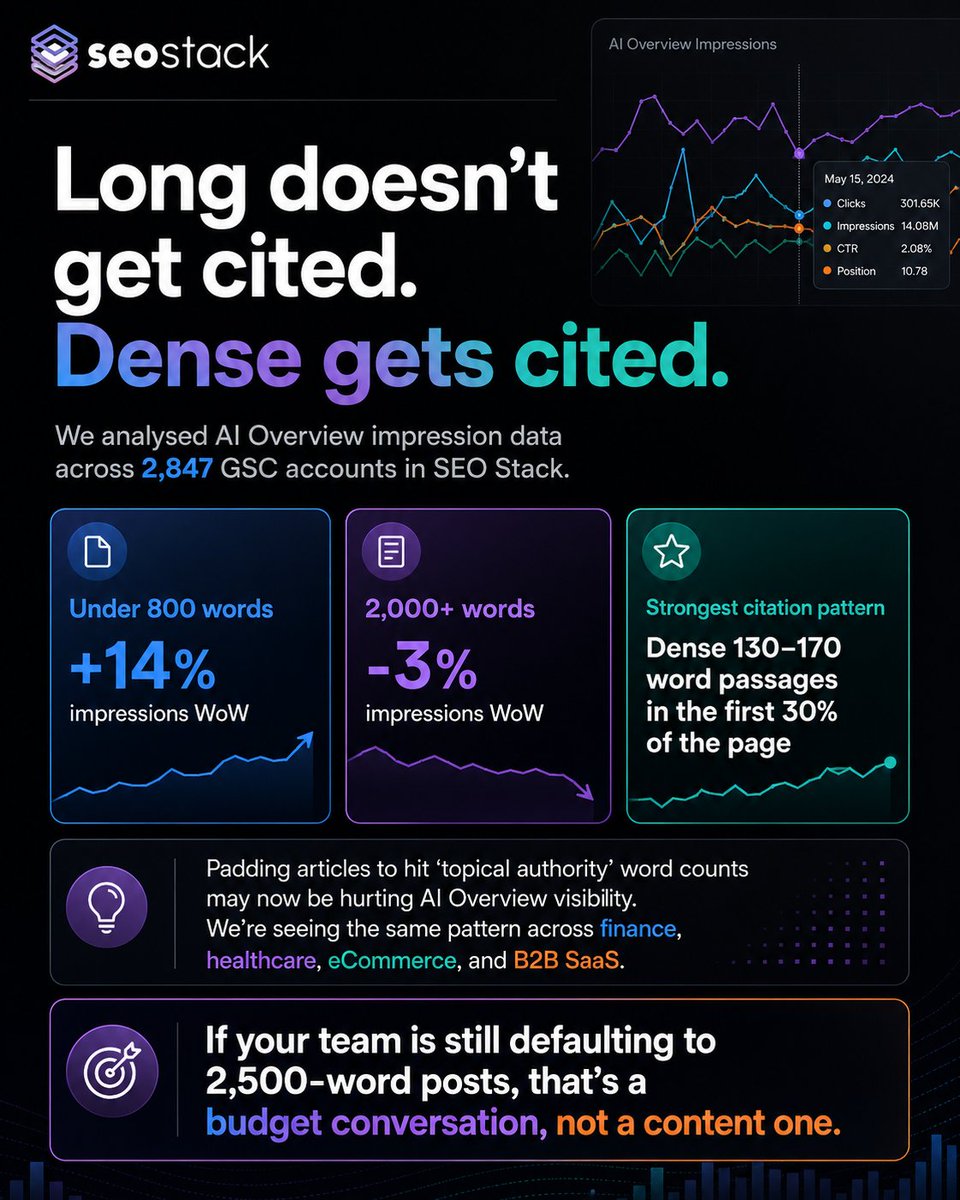
We pulled AI Overview impression data across 847 of our own GSC accounts in SEO Stack last week.
The results aren't great if you've been writing 2,000-word "comprehensive guides".
What we saw:
➡ Pages cited in AIOs with under 800 words: +14% impressions week-on-week
➡ Pages cited in AIOs with 2,000+ words: -3% impressions week-on-week
➡ Strongest correlation factor for citation: dense self-contained passages of 130-170 words sitting in the first 30% of the page
Long doesn't get cited. Dense gets cited most of the time across the 847 properties we extracted data from.
Padding articles to hit "topical authority" word counts MAY now actively harm you in AI Overviews.
We're seeing this pattern consistently across niches - finance, healthcare, eCommerce, B2B SaaS.
If your content team is still producing 2,500-word posts as a default, maybe reconsider it.
AI Overviews are responsible for significant click degredation, especially for sites where their content base is predominantly informational.
Google AI Overview citations do not always increase for more detailed content - this is likely to do with processing limits from Google Gemini as well as query fan out and context establishment.
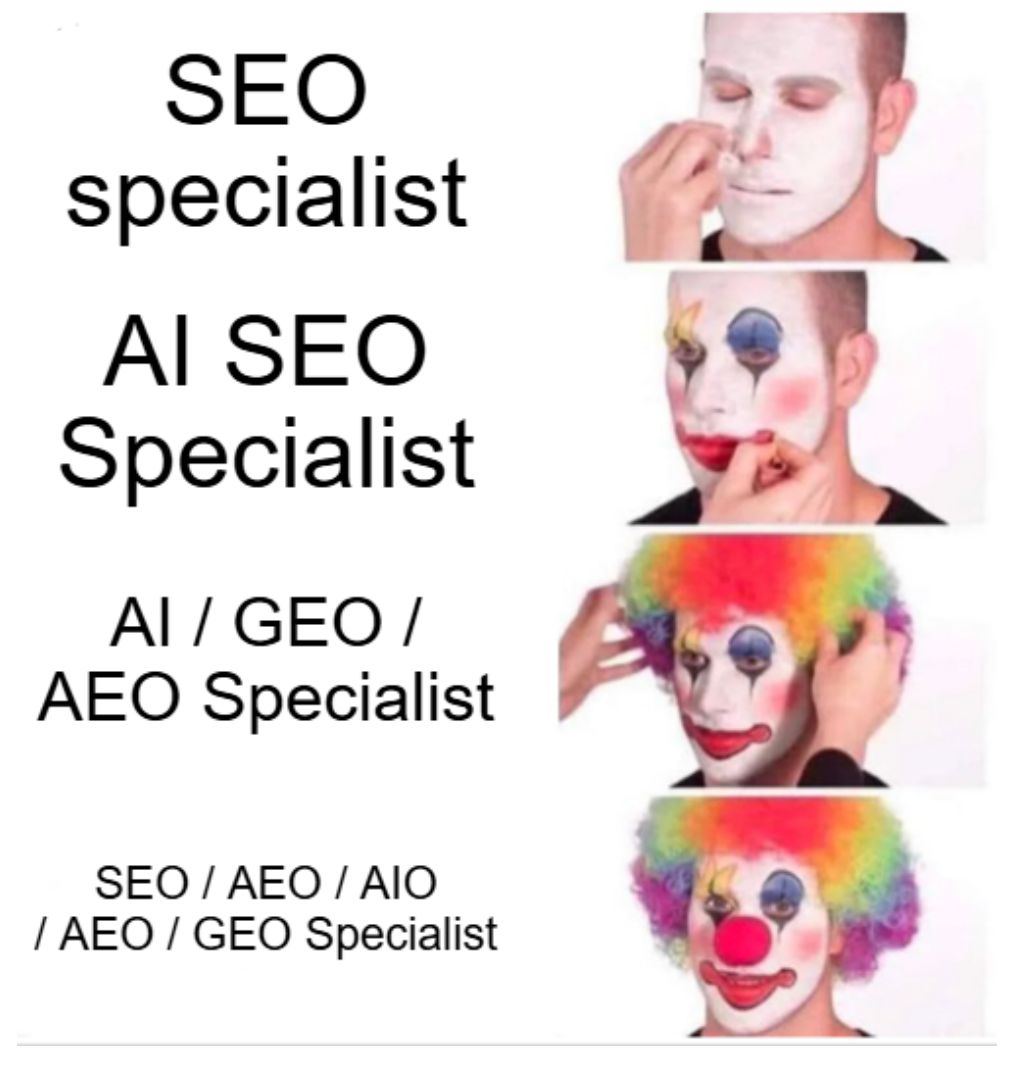
Three things "GEO experts" with 2 years of experience are selling that aren't real:
❌ Prompt search volume data
There isn't any. AI platforms don't publish impression data. Anyone showing you "ChatGPT search volume" for keywords is making it up or extrapolating from third-party crawls of dubious quality.
❌ Citation guarantees
Citations vary by model, model version, personalisation, RAG pipeline, retrieval source, localisation, and the natural randomisation in LLM output. Anyone guaranteeing you'll be cited in ChatGPT is either lying or hasn't tested at scale.
❌ "Optimise your content for LLMs" as a separate discipline
The content that gets cited is the same content that ranks. Solid expertise, real value, citable structure. There is no secret LLM-only formatting layer.
What you can actually measure: end clicks.
From AI Overviews, from AI Mode, from LLM referral traffic in GA4. Track outcomes, not the journey.
This means focusing on the end result (GA4 referral traffic from LLMS) and not obscure prompt visibility scores.
Google dropped a guide building agent-friendly websites.
Why? because we're heading towards an agentic web where agents will render websites, they'll read and parse HTML, they'll need to understand what elements do, what's interactive and what's not.
You need to pay attention to this NOW - primarily because, the last thing you want is to fall behind when Google launches UCP (universal commerce protocol).
Our Daniel Foley Carter has put together an article on getting your website AGENT READY!
https://t.co/y31pwAxOdW
AI Overviews now appear on HALF of all Google searches.
Organic CTR for queries with an AIO: down 61%.
Paid CTR: down 68%.
BUT sites cited within AI Overviews earn 35% more clicks than those that are not.
The new position one is citation. Is your brand in the running? #SEO #AIOverviews #GEO
A majority of SEO decision making is based off third party data.
Keywords to target
Pages to create
Competitor analysis
Because, the reality is, there isn't anything else to go by, you can't get access to your competitors Google Search Console data, so you go with the next best thing.
AHREFS, SEMRUSH, SISTRIX etc.
But, as we have always said you MUST be careful with the data you look at - it's not gospel, it's not always overly accurate and, if you are making business critical decisions with it, well, good luck.
Here we see ACTUAL data for our SEO consultancy website vs what competitors would see if they were looking at my site in AHREFS.
Take what you see with a pinch of salt.
Holy cow, if SEO is dead, rank tracking certainly isn't.
SEO isn't dead, rank tracking certainly isn't.
We're not talking LLM tracking here, we're talking traditional rank tracking.
Why has demand boomed?
🡲 People still care about ranking in Google
🡲 Rank tracking is significantly more beneficial than prompt tracking
🡲 Google killed &num=100, it broke a lot of rank tracking tools
🡲 Lot's of people still want to track rankings whilst embarking on SEO
🡲 Because traditional rank tracking is cool
Yes, OK so, Google is hammering SEOs, we're seeing a rise in zero click searches, we're seeing Google push functionality into AI MODE that takes more clicks away.
But, ultimately ORGANIC still retains a majority of the search market, and, let's face it, knowing where you rank and reporting back on it helps with SEO campaigns.
Traditional rank tracking lives on, the demand is growing, seems a lot of people are still interested to know where they appear in search.
Here are some AMAZING rank tracking tools:
1. SE Ranking - really good rank tracker
2. Advanced Web Ranking - one of our favourites + long time users
3. AccuRanker - another good rank tracker
4. Ahrefs - good for rank tracking
5. SEO Stack - absolutely biased here as its our own tool but you can track rankings with us
There's still benefits to rank tracking in 2026.
Especially those that report on AI OVERVIEWS despite them being unstable.
The reason rank tracking still has value is because it's where MORE demand exists and where a majority of transactions and purchases/enquiries originate from, not only that but it's also a LOT more stable than LLM prompt tracking.
#SEO
Google is indexing LESS content year by year, their threshold for indexing content has gone up significantly.
Why?
1. It costs money to store and process website data
2. It doesn't need 10,000 URLS with the same copy
3. It makes no sense to index something you are unlikely to serve (quality issues, trust issues etc)
So, we put together a FULL guide on using Google's URL inspection tool.
If you aren't using it but you are in SEO, you should be using it.
🡲 Periodically check power pages on a domain to check index state
🡲 Check indexing states
🡲 Address and deal with anomalies
🡲 Request indexing for pages where issues have been fixed
🡲 Check rendered outputs (screenshot / HTML)
🡲 Check canonical profile
and so much more.
we've done a video which walks you through Google's URL inspection!
Enjoy
https://t.co/ZeYwQFpF6Z
If you are in SEO, you probably already know that Google Search Console is missing a lot of data + you get sampled data + there's a disconnect between the click chart and the query/pages tables.
The totals in the GSC chart don't match the totals in the Queries table. Ever.
If you add up every click across every row of your Queries tab, you'll almost always come up short against what the chart figures show.
That gap is your anonymised queries, rare or personal searches that Google hides from the Queries table but still counts in the chart totals, the Pages tab, Countries, Devices and Days.
On some sites it's a 30%+ gap. We've even seen it go as far as 50% on larger publications.
It's one of a few things in the Performance report that catches SEOs out.
We've just written a search console performance walk-through.
This covers:
Why 16 months is the hard limit and how to get past it
What the four metrics really measure (and where CTR misleads you)
Using regex to do filter combinations the UI won't let you do
The 1,000-row export limits and 4 ways around it
Why your "average position" isn't your actual position
Why the chart and the table are 2 seperate datasets
If you want to understand Google Search Console's performance reporting tool, filtering, quirks + more check out our latest article:
https://t.co/f2nNJbaAHs
60% of searches now end without a click
37% of people ask ChatGPT or Perplexity instead of Googling
AI, AI Overviews and LLMs have been the first true things to being a paradigm shift within SEO. SEO is thriving but getting value from it by the way of clicks is changing.
Google's exchange of value (you give it content, it gives you clicks) is changing as we see growing zero click searches + more people turning to LLMS for conversational queries.
LLMs don't read your page the way Google does. They don't rank it. They don't even look at the whole thing. They scan for fragments, self-contained chunks they can pull, reframe, and cite in an answer.
Which means the game is shifting when it comes to earning visibility and maintaining a flow of clicks.
Bury your answer in a 200-word intro and you may not get cited.
Write sections that only make sense after reading the one before and you may not get cited.
Use "as mentioned earlier" anywhere in your content and you've just told the LLM your content can't be cleanly extracted.
We've written a full breakdown of how to structure content so LLMs actually choose you as a source. It covers:
Why question-based subheadings beat clever ones every time
The standalone section test (paste one section into a blank doc does it still make sense on its own?)
Where schema markup actually helps, and where it doesn't
Why topical depth matters more than ever, not less
The specific mistakes keeping otherwise solid sites out of AI answers
https://t.co/u1Ziv8GZLl
New to SEO or just starting out your SEO learning journey? if you are new or are a begginer SEO our own Daniel Foley Carter put together a video series of how to use Google Search Console performance tools.
In this video you are shown:
🡲 Google search console performance tools
🡲 How to understand the filters
🡲 Exporting and export limitations
🡲 Understanding clicks, impressions, CTR and average position
🡲 Understanding pages, page served queries
🡲 Understanding which devices generated impressions and clicks
🡲 Search appearances - what they are, how they work
🡲 Countries
🡲 Filtering
and more.
This is aimed at new/junior SEOs who are just getting started.
Enjoy!
https://t.co/3875dL7sKE
What makes a good SEO Audit?
➜ Full tear down of Google Search Console Data
➜ Segment of brand, non brand, sub folders by type
➜ Search console page & query decay analysis
➜ SERP reviews for decaying queries i.e. money queries
➜ CTR review (AI overview impact, device, query and page impact)
➜ Google core update impact review
➜ Query counting with SEO Stack
➜ SERP Feature & Device click performance review
➜ Last 3 Month year over year click gap
Then:
➜ Full site crawl for a technical SEO Audit
➜ Prioritise rendering analysis & DOM output analysis
➜ Prioritise internal links, anchors, canonicals, parameters, structure
➜ Prioritise word count, readability, index state
➜ Performance & rendering review (core web vitals, CLS, INP etc.)
➜ Fixes based on weight and ease of implementation, tech debt etc.
Then:
➜ Full non indexed page audit - review of ALL non indexed page reasons
➜ Elimination of invalid URLS, segment of URLS to be controlled
➜ Management of blocking via robots txt / meta robots
➜ Reduction of non value pages and non link equity distributing routes
➜ Full review & clean ups for crawled/discovered currently not indexed
➜ Clean ups for duplicate, canonical childs, malformed URLS
➜ Clean up of dead weight auxiliary / thin content pages
➜ HTTP Header checks and accessibility checks i.e. http 200 robots.txt
➜ Review of crawl stats and general indexing performance
Then:
➜ Full content audit - seperating content by sub folder, type, classification
➜ Content quality audit (value, uniqueness, maintenance, engagement)
➜ Content NLP audits (topical coverage, entity, KGs)
➜ YMYL compliance and/or E-E-A-T coverage/utilisation
➜ Content UX & user behaviour indicators
➜ Content evaluation by state (decay, core update losses)
➜ Internal linking and anchor contexts
Then:
➜ Full domain backlink and authority/trust audit
➜ Segment of links by traffic performance
➜ Segment of link topical trust flow, link context and relevance
➜ Link accruement performance over time
➜ Linking content quality checks (spot checks)
➜ Link distribution (top pages & anchor alignment)
➜ Link accruement types (redirects, consolidations, spam)
➜ General domain citation flow analysis
➜ KG & link entity review
➜ Anchor alignment (internal vs external vs relevance)
➜ Anchor types (URL, naked, exact or partial match)
➜ Domain history check (wayback, DNS changes)
➜ Brand equity review (reviews, sub-searches, sentiment of queries)
➜ Brand consistency (company reg, address, reviews etc)
Interested in getting an SEO audit?
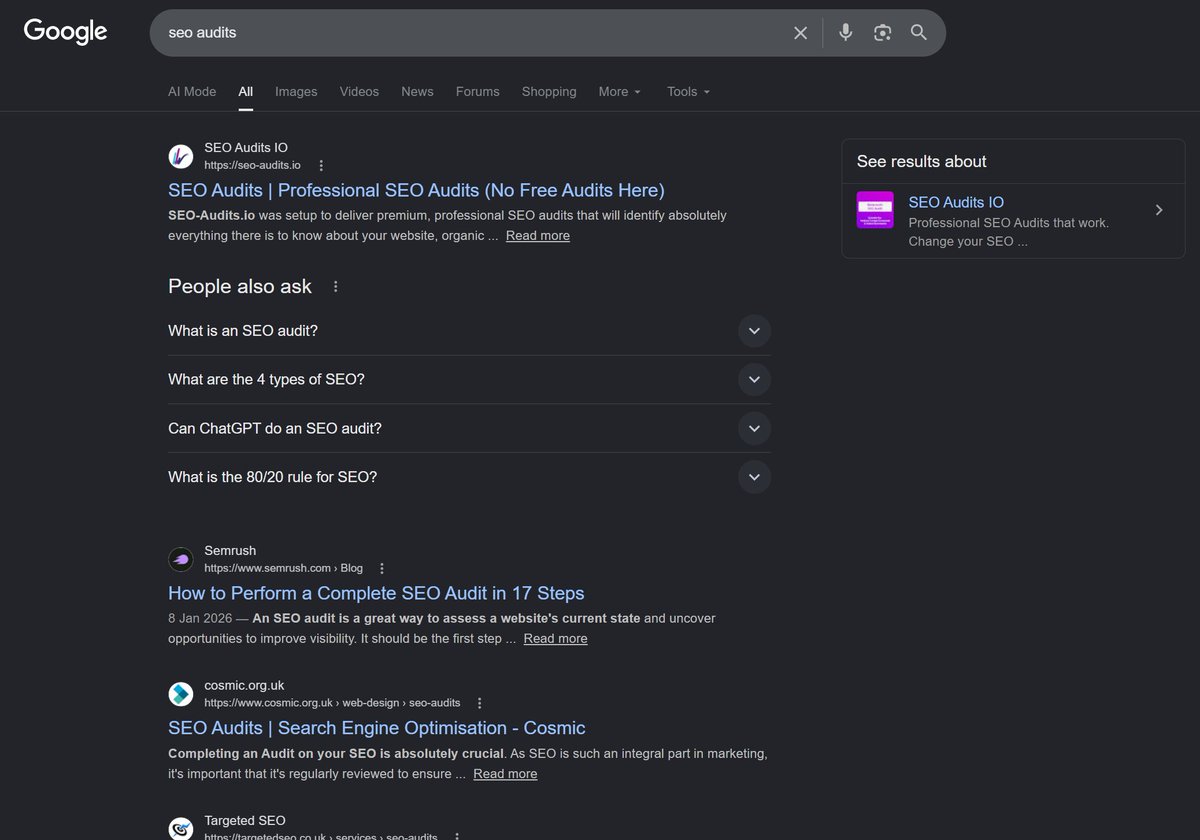
Google SEO audits and you should find our sub-brand https://t.co/kY93kMf0Jf ranking #1
Visit https://t.co/Hb8ND8Xrvj
Internal links are crucial for SEO in 2026 and they will remain crucial.
They allow Google to discover new content. They help users sub-navigate your site. They transfer link equity around your domain.
Here are the most important things to keep in mind with internal links:
❌ 1 internal link is not enough
❌ Using generic anchors is a terrible idea if not balanced out with keyword anchors
✅ Add internal links that make sense to end users. Whatever the content is, the sub-links should be relevant and supportive of end user intent.
Here are the most common issues we see with internal linking:
1. A lot of sites are configured to only add 1 internal link to a page. A common offender is WordPress with blogs. Generally people write a blog, it gets one internal link from a category page, and that's it.
2. Pages that become "legacy" often link to content that no longer exists or redirects
3. Anchor consistency is generally poor or mismatched, or there are only generic anchors used i.e. "click here," "more information" etc.
4. Most sites have batches of content with less than 5 internal links
5. Some sites have pages with significant performance opportunities where the internal link counts are low
So, to help you get your internal linking right, we've put together a quick video showing you how to build internal linking + anchor maps for your website, quickly and easily.
Enjoy
https://t.co/KtBmXqhcLz
Make a copy of this sheet and fill it with your own data like in the video:
https://t.co/S2s2ToIXYe
#seo
At Assertive, we've been doing SEO since 2007.
A lot has changed. The fundamentals have not.
Ranking for terms that drive revenue still requires technical excellence, content that genuinely serves the user and links from sources that carry real authority.
Those three things have been true for twenty years and they are still true now.
What has changed is the layer on top.
AI Overviews.
LLM citations.
Query fan-out.
Zero-click behaviour.
The measurement frameworks.
The tools.
At Assertive we have built our AI visibility capability into every client engagement, not as an add-on but as part of the core strategy.
We track brand presence across Google AI Overviews, ChatGPT, Perplexity and Gemini. We run content through E-E-A-T frameworks specifically designed around LLM retrieval.
And we use SEO Stack, our own data warehousing platform, to get the full picture of GSC performance rather than the sampled subset.
We do not tie clients into fixed-term contracts because we believe the results should be reason enough to stay. Most of our clients have been with us for years.
If you want a conversation about where your site stands in 2026, get in touch. No sales deck. Just a straight assessment of where the opportunities are.
https://t.co/9k1AtSKPPf