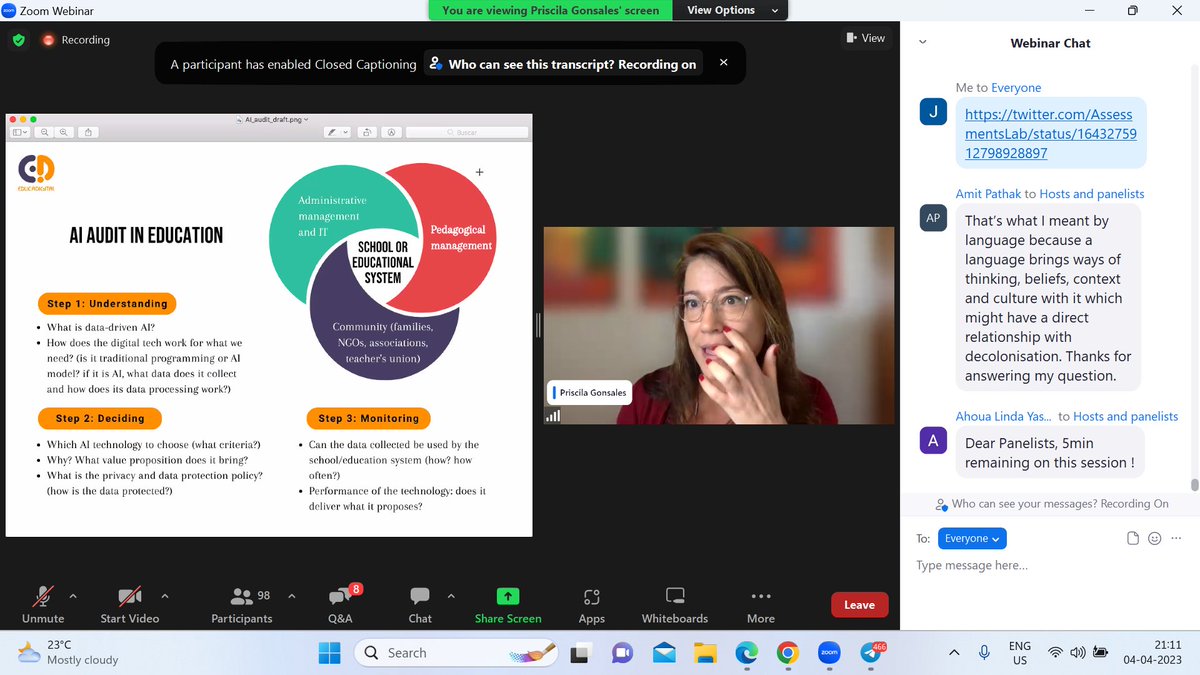
Audience question - Will the problem of english dominance and exclusion be solved by ed-tech? Answers from panelists: Yes language will with AI, but not culture and values embedded will be hard to challenge. #Data#DecolonizingData#EdTech#Education
Could you give examples from international development which pushed the adoption/purchase of ed-tech by global south governments? #Data#DecolonizingData#EdTech#Education
She discusses how earlier colonised, global south countries, people have an attitude to tech (equivalent to modernity) that is shaped by their colonial histories.
Siddhi Gupta speaks about how ed-tech positions itself as the the single route to reach what they claim is the single goal of education. #Data#DecolonizingData#EdTech#Education
She speaks about the coherence and complementarity of different logics - the 'learning outcomes' dominance in education governance and the rise of ed-tech.
@marina__avelar speaking of new actors and intermediaries in ed-tech- philanthropies, software companies, etc. And they bring to the table their particular worldviews (eg. tech-solutionism, profit orientation).
She nuances the idea of exclusion with the concept of 'adverse incorporation' where the marginalised are forced to participate in ed-tech as it is their only access to education.
The session on decolonising ed-tech has begun with a talk by @kathrynmoeller who positions herself as holding multiple stakeholder identities in this debate- parent, educator, researcher. #Data#DecolonizingData#EdTech#Education