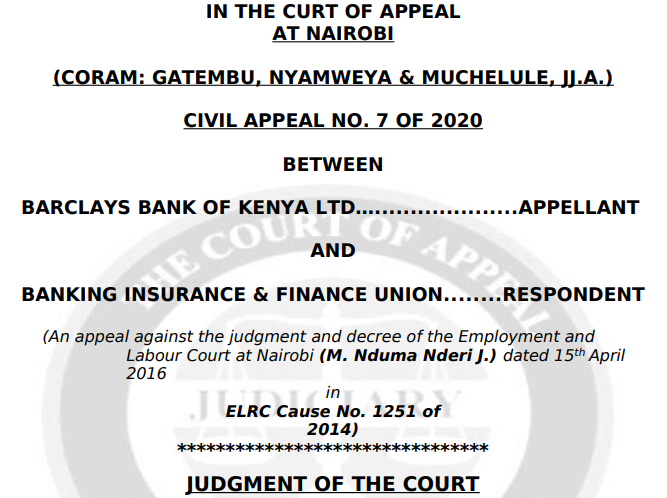
🚨🚨RT WIDELY: THE COURT OF APPEAL SPEAKS: IGNORE YOUR OWN CONTRACT RULES, AND THE DISMISSAL FALLS
The Court of Appeal has drawn a hard, practical line for every employer in Kenya: follow the disciplinary rules in your contract, or lose the case. In Barclays Bank of Kenya Ltd v Banking Insurance & Finance Union (on behalf of Yasmin Namsi Athman), 2020 , a long-serving employee of 23 years was dismissed after approving transactions later found to be fraudulent, costing millions. The bank insisted it had complied with the Employment Act - there was a hearing, investigations, and reasons for termination. But the employee’s side pointed to the Collective Bargaining Agreement (CBA): for negligence, the employer had to issue two written warnings before dismissal. That never happened. The real issue became stark: can an employer follow the statute but ignore its own agreed disciplinary process?
The Court was not moved by the bank’s defence. It held that a CBA is binding law, automatically forming part of the employment contract, and cannot be brushed aside. The reasoning was precise: where a contract provides a stricter or clearer disciplinary pathway than the statute, that pathway must be followed. The bank’s failure to issue the mandatory warnings made the termination procedurally unfair, regardless of the seriousness of the allegations. But the Court did not excuse the employee entirely; her failure to observe internal fraud controls contributed to the loss. As a result, while the dismissal was declared unfair, compensation was reduced from 12 months to 4. The Court enforced both discipline and fairness, no shortcuts, no free passes.
To the ordinary mwananchi, this decision lands where it matters - your job. It means employers cannot freestyle discipline or skip steps when things go wrong; if your contract or union agreement sets out a process, that process must be respected. Jurisprudentially, this is a sharp warning and a quiet empowerment: a warning to employers that procedural shortcuts will collapse even “strong” cases, and an empowerment to employees that the law will enforce the exact terms agreed, not just minimum standards. The implication is direct: read your contract, understand your workplace rules, and act the moment due process is ignored. In this legal climate, procedure is not a formality, it is your first line of defense.
Kindly repost 🙏.
BREAKING from Court of Appeal: If You Were the Last Person Seen With a Murder Victim, Failure to Explain What Happened May Prove Your Guilt
The Court of Appeal has upheld the murder conviction of a man who killed his own two-week-old son before secretly burying the infant in a shallow grave near his home in Meru. The chilling case began when the child's mother left the newborn asleep in the appellant's house, only to return moments later and discover the baby had vanished. As panic spread through the family compound, the father gave conflicting explanations before police compelled him to reveal the child's location. He led officers to a nearby banana plantation where the infant's body was recovered. Medical evidence later revealed devastating head injuries, including multiple scalp haematomas and bleeding within the brain, ruling out any possibility of an accidental fall.
In a powerful endorsement of circumstantial evidence, the Court found that although nobody witnessed the killing, the chain of facts pointed irresistibly to the father as the perpetrator. The judges relied heavily on the "last seen with" doctrine, noting that the appellant was the last adult left alone with the child and failed to offer any credible explanation for the baby's disappearance and death. The Court rejected arguments that the prosecution's case was weakened by the absence of a murder weapon or the failure to call certain witnesses, holding that the medical findings and surrounding circumstances were more than sufficient to prove guilt beyond reasonable doubt.
The decision reinforces a growing body of Kenyan jurisprudence affirming that murder convictions can rest entirely on circumstantial evidence where the facts form an unbroken chain pointing to the accused. It also strengthens the application of the "last seen with" doctrine, placing a heavy evidential burden on individuals who were the final known companions of deceased victims. While the Court upheld the murder conviction and found clear evidence of malice aforethought, it reduced the sentence from death to 25 years' imprisonment, reflecting the post-Muruatetu shift towards determinate sentencing even in the most serious criminal cases.
Kindly retweet. 🙏
BREAKING from Court of Appeal: If You Were the Last Person Seen With a Murder Victim, Failure to Explain What Happened May Prove Your Guilt
The Court of Appeal has upheld the murder conviction of a man who killed his own two-week-old son before secretly burying the infant in a shallow grave near his home in Meru. The chilling case began when the child's mother left the newborn asleep in the appellant's house, only to return moments later and discover the baby had vanished. As panic spread through the family compound, the father gave conflicting explanations before police compelled him to reveal the child's location. He led officers to a nearby banana plantation where the infant's body was recovered. Medical evidence later revealed devastating head injuries, including multiple scalp haematomas and bleeding within the brain, ruling out any possibility of an accidental fall.
In a powerful endorsement of circumstantial evidence, the Court found that although nobody witnessed the killing, the chain of facts pointed irresistibly to the father as the perpetrator. The judges relied heavily on the "last seen with" doctrine, noting that the appellant was the last adult left alone with the child and failed to offer any credible explanation for the baby's disappearance and death. The Court rejected arguments that the prosecution's case was weakened by the absence of a murder weapon or the failure to call certain witnesses, holding that the medical findings and surrounding circumstances were more than sufficient to prove guilt beyond reasonable doubt.
The decision reinforces a growing body of Kenyan jurisprudence affirming that murder convictions can rest entirely on circumstantial evidence where the facts form an unbroken chain pointing to the accused. It also strengthens the application of the "last seen with" doctrine, placing a heavy evidential burden on individuals who were the final known companions of deceased victims. While the Court upheld the murder conviction and found clear evidence of malice aforethought, it reduced the sentence from death to 25 years' imprisonment, reflecting the post-Muruatetu shift towards determinate sentencing even in the most serious criminal cases.
Kindly retweet. 🙏
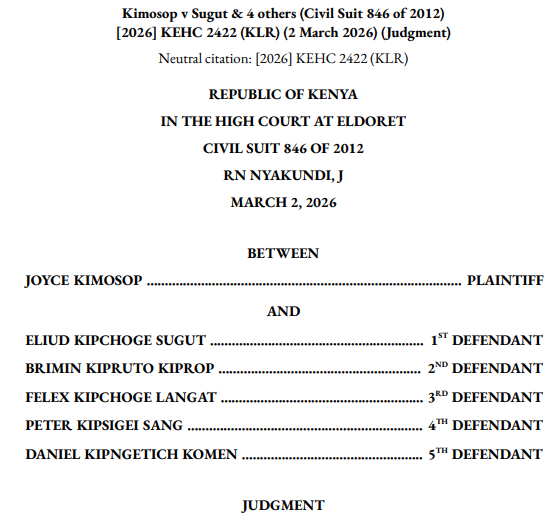
🚨🚨RT WIDELY: BREAKING: Wife Loses Bid to Cancel Land Sale as Court Finds Fraud Claims Were Not Proven
A long-running battle over matrimonial property ended in disappointment for a wife who sought to overturn the sale of land she claimed was jointly acquired during marriage. In Kimosop v Sugut & 4 Others, Joyce Kimosop moved to the High Court arguing that LR No. 86***/26 in Eldoret was matrimonial property held by her husband in trust for both of them and that its sale to third parties was fraudulent, lacked spousal consent, and violated land laws. The purchasers, however, maintained that she knew about the transaction from the beginning and had even been present during the preparation of the sale agreement. They further claimed that part of the sale proceeds had been paid out and that she benefited from the transaction, allegations she firmly denied.
After examining the evidence, the High Court found that the allegations of fraud did not meet the strict legal standard required to invalidate a registered land transfer. Justice R. Nyakundi noted that fraud is not presumed and must be specifically pleaded and strictly proved. While the plaintiff challenged documents connected to the transaction and disputed payments allegedly made to her, the court was not persuaded that the transfers were fraudulent or illegal. The judge also found insufficient evidence to support her claim that the land was held in trust for her or that the completed sale should be reversed.
The decision sends a significant message to spouses, land buyers, and property owners across Kenya. The court reaffirmed that serious allegations alone cannot defeat registered property rights without clear and convincing evidence. For spouses, the case highlights the importance of documenting beneficial interests in property during marriage. For purchasers, it offers reassurance that courts will protect completed transactions where fraud has not been proved. In short, the judgment underscores a central principle of land law: ownership records will not be disturbed unless strong evidence justifies the court's intervention.
Kindly retweet widely🙏🙏
🚨🚨RT WIDELY: BREAKING: Wife Loses Bid to Cancel Land Sale as Court Finds Fraud Claims Were Not Proven
A long-running battle over matrimonial property ended in disappointment for a wife who sought to overturn the sale of land she claimed was jointly acquired during marriage. In Kimosop v Sugut & 4 Others, Joyce Kimosop moved to the High Court arguing that LR No. 86***/26 in Eldoret was matrimonial property held by her husband in trust for both of them and that its sale to third parties was fraudulent, lacked spousal consent, and violated land laws. The purchasers, however, maintained that she knew about the transaction from the beginning and had even been present during the preparation of the sale agreement. They further claimed that part of the sale proceeds had been paid out and that she benefited from the transaction, allegations she firmly denied.
After examining the evidence, the High Court found that the allegations of fraud did not meet the strict legal standard required to invalidate a registered land transfer. Justice R. Nyakundi noted that fraud is not presumed and must be specifically pleaded and strictly proved. While the plaintiff challenged documents connected to the transaction and disputed payments allegedly made to her, the court was not persuaded that the transfers were fraudulent or illegal. The judge also found insufficient evidence to support her claim that the land was held in trust for her or that the completed sale should be reversed.
The decision sends a significant message to spouses, land buyers, and property owners across Kenya. The court reaffirmed that serious allegations alone cannot defeat registered property rights without clear and convincing evidence. For spouses, the case highlights the importance of documenting beneficial interests in property during marriage. For purchasers, it offers reassurance that courts will protect completed transactions where fraud has not been proved. In short, the judgment underscores a central principle of land law: ownership records will not be disturbed unless strong evidence justifies the court's intervention.
Kindly retweet widely🙏🙏
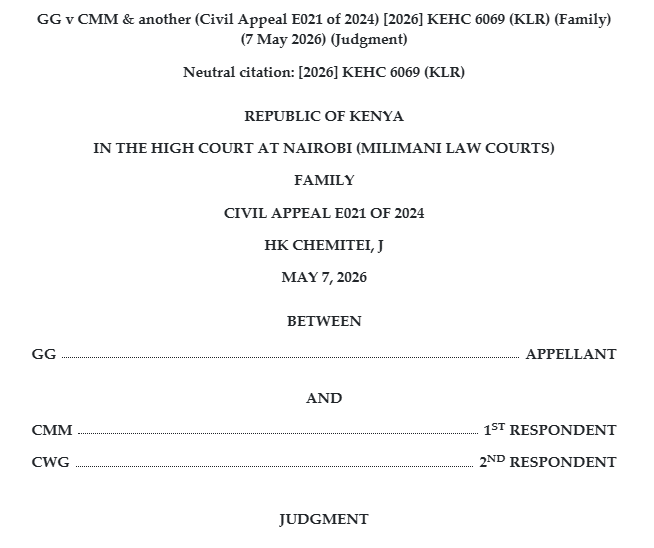
BREAKING: High Court Says “Equal Parenting” Does Not Always Mean Equal Financial Contribution
The High Court in Nairobi has delivered a significant family law ruling in GG v CMM & another, exposing a major tension in Kenyan child maintenance law: equal parental responsibility does not always translate into equal financial contribution. The dispute involved an adopted daughter over 18 years old who sought continued parental support while pursuing university education. Her adoptive father appealed after a magistrate ordered him alone to pay all tuition fees, upkeep, and related expenses, despite evidence that he suffered from diabetes, hypertension, brain surgery complications, and declining earning capacity. He argued that the mother, who had relocated to the United Kingdom and allegedly earned substantial income from employment and Nairobi rental properties, should shoulder at least 50% of the burden. Even the daughter supported the father’s appeal, insisting that both parents had equal constitutional obligations under Article 53 of the Constitution and the Children’s Act.
The High Court agreed with the father on a critical legal point: the magistrate had indeed failed to properly investigate the parties’ respective incomes, obligations, health conditions, and earning capacities before imposing the entire financial burden on one parent. Justice HK Chemitei held that maintenance orders should not be punitive or oppressive and acknowledged that parental responsibility under Kenyan law is generally joint and proportionate. The court also noted procedural discomfort with the magistrate relying on another children’s case whose file had not formally been produced before the court. However, despite identifying those errors, the appeal was still dismissed. The turning point was another related appeal involving the same couple’s biological son living in the UK with the mother, where the mother had already been left to solely maintain that child. The High Court therefore adopted a broader “family balancing” approach, effectively reasoning that if the mother carries one child abroad, the father can carry the adopted daughter in Kenya.
The jurisprudential implication is massive. This case quietly shifts Kenyan family law away from a rigid mathematical interpretation of “equal parental responsibility” toward a contextual and equitable model. The court appears to say that equality under Article 53 is not necessarily a 50:50 financial split in every case, but rather a fair allocation assessed against the wider family matrix, existing obligations, custody realities, and economic circumstances. That introduces uncertainty too. On one hand, the judgment protects flexibility and practicality in family disputes. On the other, it risks weakening predictability because courts may now justify unequal burdens using external family dynamics rather than strict proportional contribution analysis. The decision also reinforces another growing legal threshold: parental responsibility may extend beyond 18 years where a child remains dependent and is actively pursuing education, though courts will scrutinize dependency, finances, and fairness before granting such relief.
Kindly retweet.🙏
BREAKING: High Court Says “Equal Parenting” Does Not Always Mean Equal Financial Contribution
The High Court in Nairobi has delivered a significant family law ruling in GG v CMM & another, exposing a major tension in Kenyan child maintenance law: equal parental responsibility does not always translate into equal financial contribution. The dispute involved an adopted daughter over 18 years old who sought continued parental support while pursuing university education. Her adoptive father appealed after a magistrate ordered him alone to pay all tuition fees, upkeep, and related expenses, despite evidence that he suffered from diabetes, hypertension, brain surgery complications, and declining earning capacity. He argued that the mother, who had relocated to the United Kingdom and allegedly earned substantial income from employment and Nairobi rental properties, should shoulder at least 50% of the burden. Even the daughter supported the father’s appeal, insisting that both parents had equal constitutional obligations under Article 53 of the Constitution and the Children’s Act.
The High Court agreed with the father on a critical legal point: the magistrate had indeed failed to properly investigate the parties’ respective incomes, obligations, health conditions, and earning capacities before imposing the entire financial burden on one parent. Justice HK Chemitei held that maintenance orders should not be punitive or oppressive and acknowledged that parental responsibility under Kenyan law is generally joint and proportionate. The court also noted procedural discomfort with the magistrate relying on another children’s case whose file had not formally been produced before the court. However, despite identifying those errors, the appeal was still dismissed. The turning point was another related appeal involving the same couple’s biological son living in the UK with the mother, where the mother had already been left to solely maintain that child. The High Court therefore adopted a broader “family balancing” approach, effectively reasoning that if the mother carries one child abroad, the father can carry the adopted daughter in Kenya.
The jurisprudential implication is massive. This case quietly shifts Kenyan family law away from a rigid mathematical interpretation of “equal parental responsibility” toward a contextual and equitable model. The court appears to say that equality under Article 53 is not necessarily a 50:50 financial split in every case, but rather a fair allocation assessed against the wider family matrix, existing obligations, custody realities, and economic circumstances. That introduces uncertainty too. On one hand, the judgment protects flexibility and practicality in family disputes. On the other, it risks weakening predictability because courts may now justify unequal burdens using external family dynamics rather than strict proportional contribution analysis. The decision also reinforces another growing legal threshold: parental responsibility may extend beyond 18 years where a child remains dependent and is actively pursuing education, though courts will scrutinize dependency, finances, and fairness before granting such relief.
Kindly retweet.🙏
🔥🚨BREAKING NEWS: High Court Opens Door for Transgender Rights Claims, Rules Constitution Protects Their Right to Be Heard
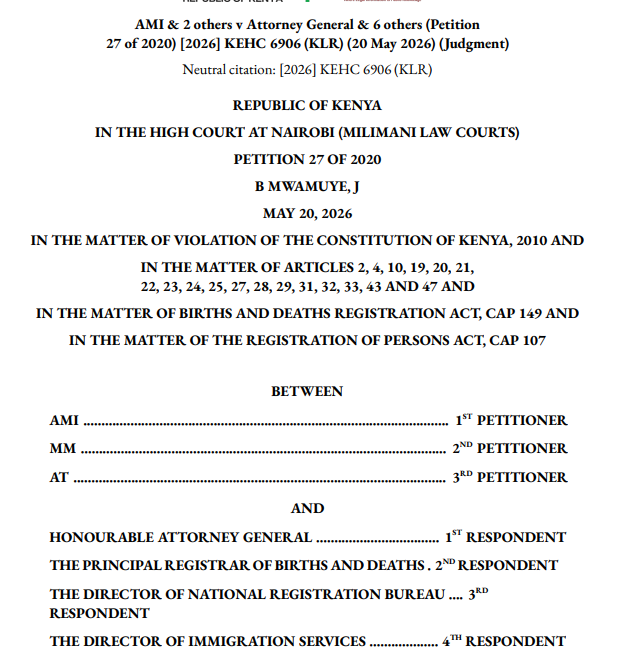
In a landmark constitutional ruling, the High Court in AMI & 2 Others v Attorney General & 6 Others delivered what many are calling the first major courtroom breakthrough for transgender persons seeking legal recognition in Kenya. The petitioners, who identified as transgender and intersex persons, moved to court after the NGO Coordination Board declined to reserve and register the name of their proposed organization on grounds that the words “transgender” and “intersex” were allegedly contrary to Kenyan values and public morality. The petitioners argued that the refusal was discriminatory, unconstitutional, and violated their rights to dignity, equality, association, expression, and freedom from discrimination under the Constitution. Importantly, the court was not being asked to legalize transgender identity or same-sex relations. The dispute was strictly about whether transgender persons could lawfully access constitutional protections and register an organization advocating for their welfare and rights.
The court drew a sharp constitutional line between moral disagreement and legal rights. It held that the Constitution protects every person, including minorities and unpopular groups, and that state agencies cannot deny citizens access to constitutional freedoms merely because part of society disagrees with them. The judges emphasized that registration of an association does not amount to endorsement of its beliefs or activities. Instead, it is recognition of the constitutional right to associate, organize, and be heard. The court therefore found that the refusal to reserve the organization’s name violated the petitioners’ rights under the Bill of Rights and ordered the authorities to reconsider the application within the confines of the Constitution and the law. The judges were careful not to declare transgender identity “legalized” in the wider social or criminal law context; rather, they affirmed that constitutional rights are not reserved only for socially accepted groups.
For ordinary Kenyans, the decision sends a powerful message about the role of the Constitution in protecting minorities, even where public opinion is sharply divided. For transgender and intersex persons, the ruling marks a major legal milestone because the court affirmed that they cannot simply be erased from constitutional protection. For the government and regulatory bodies, the judgment is a warning that administrative power cannot be exercised on the basis of morality alone without clear legal grounding. At the same time, the court deliberately avoided entering the political and cultural battlefield over broader recognition of transgender rights in Kenya. The judgment therefore stands as a careful but significant constitutional statement: the Bill of Rights protects every person’s access to justice, association, and dignity, even in deeply controversial spaces.
Kindly retweet🙏.
🔥🚨BREAKING NEWS: High Court Opens Door for Transgender Rights Claims, Rules Constitution Protects Their Right to Be Heard
In a landmark constitutional ruling, the High Court in AMI & 2 Others v Attorney General & 6 Others delivered what many are calling the first major courtroom breakthrough for transgender persons seeking legal recognition in Kenya. The petitioners, who identified as transgender and intersex persons, moved to court after the NGO Coordination Board declined to reserve and register the name of their proposed organization on grounds that the words “transgender” and “intersex” were allegedly contrary to Kenyan values and public morality. The petitioners argued that the refusal was discriminatory, unconstitutional, and violated their rights to dignity, equality, association, expression, and freedom from discrimination under the Constitution. Importantly, the court was not being asked to legalize transgender identity or same-sex relations. The dispute was strictly about whether transgender persons could lawfully access constitutional protections and register an organization advocating for their welfare and rights.
The court drew a sharp constitutional line between moral disagreement and legal rights. It held that the Constitution protects every person, including minorities and unpopular groups, and that state agencies cannot deny citizens access to constitutional freedoms merely because part of society disagrees with them. The judges emphasized that registration of an association does not amount to endorsement of its beliefs or activities. Instead, it is recognition of the constitutional right to associate, organize, and be heard. The court therefore found that the refusal to reserve the organization’s name violated the petitioners’ rights under the Bill of Rights and ordered the authorities to reconsider the application within the confines of the Constitution and the law. The judges were careful not to declare transgender identity “legalized” in the wider social or criminal law context; rather, they affirmed that constitutional rights are not reserved only for socially accepted groups.
For ordinary Kenyans, the decision sends a powerful message about the role of the Constitution in protecting minorities, even where public opinion is sharply divided. For transgender and intersex persons, the ruling marks a major legal milestone because the court affirmed that they cannot simply be erased from constitutional protection. For the government and regulatory bodies, the judgment is a warning that administrative power cannot be exercised on the basis of morality alone without clear legal grounding. At the same time, the court deliberately avoided entering the political and cultural battlefield over broader recognition of transgender rights in Kenya. The judgment therefore stands as a careful but significant constitutional statement: the Bill of Rights protects every person’s access to justice, association, and dignity, even in deeply controversial spaces.
Kindly retweet🙏.
🔴🚨ELRC Sends Blunt Message to Employers as Ex-Employee Wins Kshs.1.25 Million After Unfair Dismissal
In Kagai v Kenga Equatorial Hotels Limited t/a Mombasa Continental Resort, the Employment and Labour Relations Court ruled in favour of Benson Muriithi Kagai, a Procurement Manager who had been dismissed barely five months into employment without being told why. The employer later attempted to justify the dismissal using allegations surrounding a delayed Kshs.2.7 million linen procurement deal. However, evidence before the court showed that the purchase orders, payment approvals, and cheques had all been authorized by senior management and company signatories. The court found that the termination letter itself contained no accusation, no misconduct claim, and no explanation beyond a vague reference to a contractual clause allowing termination by notice.
Justice Agnes Kitiku Nzei held that an employer cannot dismiss an employee first and then begin constructing reasons during trial. The court emphasized that Sections 41, 43, and 45 of the Employment Act require employers to provide valid reasons for termination and accord employees a fair hearing before dismissal. Since the Respondent neither informed the Claimant of any accusations nor subjected him to disciplinary proceedings, the dismissal was declared both procedurally and substantively unfair. The court further clarified that paying salary in lieu of notice does not excuse an employer from complying with statutory safeguards under employment law. Kagai was consequently awarded Kshs.1.25 million as compensation for unfair termination.
The decision carries major implications for ordinary employees and employers across Kenya. To the common mwananchi, the judgment reinforces that employers cannot use intimidation, office politics, or sudden dismissal letters to sidestep due process. Even short-term employees remain protected by the law and are entitled to dignity and fairness at the workplace. For employers, the ruling is a warning that internal frustrations, management conflicts, or boardroom pressure cannot replace lawful disciplinary procedures. Once termination occurs without proper reasons and hearing, the court is unlikely to rescue the employer later through afterthought explanations raised during litigation.
Kindly retweet🙏
🔴🚨ELRC Sends Blunt Message to Employers as Ex-Employee Wins Kshs.1.25 Million After Unfair Dismissal
In Kagai v Kenga Equatorial Hotels Limited t/a Mombasa Continental Resort, the Employment and Labour Relations Court ruled in favour of Benson Muriithi Kagai, a Procurement Manager who had been dismissed barely five months into employment without being told why. The employer later attempted to justify the dismissal using allegations surrounding a delayed Kshs.2.7 million linen procurement deal. However, evidence before the court showed that the purchase orders, payment approvals, and cheques had all been authorized by senior management and company signatories. The court found that the termination letter itself contained no accusation, no misconduct claim, and no explanation beyond a vague reference to a contractual clause allowing termination by notice.
Justice Agnes Kitiku Nzei held that an employer cannot dismiss an employee first and then begin constructing reasons during trial. The court emphasized that Sections 41, 43, and 45 of the Employment Act require employers to provide valid reasons for termination and accord employees a fair hearing before dismissal. Since the Respondent neither informed the Claimant of any accusations nor subjected him to disciplinary proceedings, the dismissal was declared both procedurally and substantively unfair. The court further clarified that paying salary in lieu of notice does not excuse an employer from complying with statutory safeguards under employment law. Kagai was consequently awarded Kshs.1.25 million as compensation for unfair termination.
The decision carries major implications for ordinary employees and employers across Kenya. To the common mwananchi, the judgment reinforces that employers cannot use intimidation, office politics, or sudden dismissal letters to sidestep due process. Even short-term employees remain protected by the law and are entitled to dignity and fairness at the workplace. For employers, the ruling is a warning that internal frustrations, management conflicts, or boardroom pressure cannot replace lawful disciplinary procedures. Once termination occurs without proper reasons and hearing, the court is unlikely to rescue the employer later through afterthought explanations raised during litigation.
Kindly retweet🙏
🚨🚨COURT OF APPEAL RAISES THE BAR FOR CUSTOMARY TRUST CLAIMS IN LAND DISPUTES
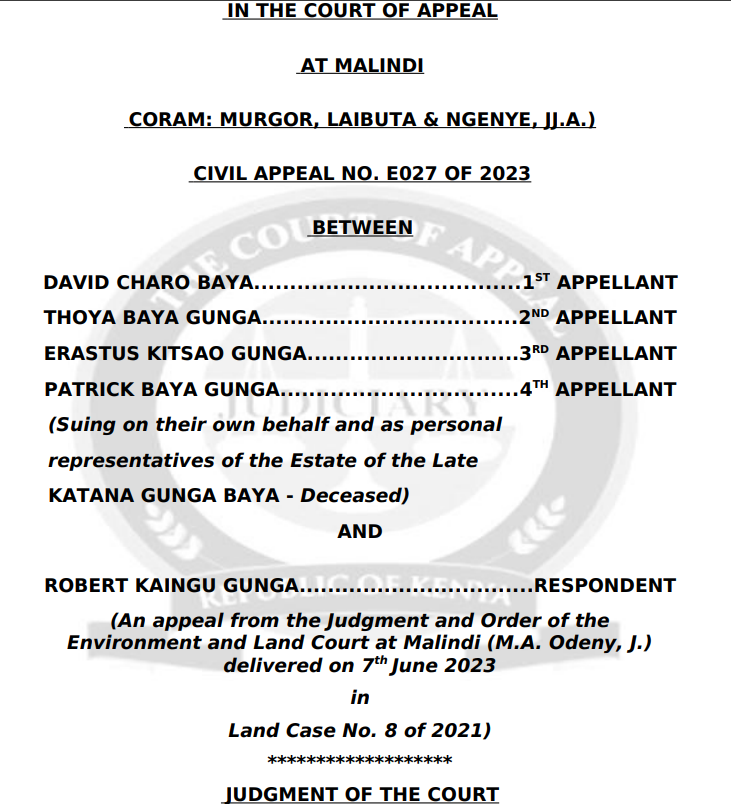
In a landmark decision that could redefine ancestral land litigation in Kenya, the Court of Appeal of Kenya has ruled that family occupation and blood ties alone are not enough to prove a customary trust over registered land. In David Charo Baya & Others v Robert Kaingu Gunga, the appellants argued that the Kilifi land belonged to their grandfather and had always been occupied communally by different family houses under traditional arrangements. They claimed the land was registered during adjudication in the names of two family members merely as representatives of the wider family. But the Court rejected the claim, holding that the appellants failed to prove a critical element: intention. There was no adjudication record, family agreement, committee minutes, or documentary evidence showing the registered owners intended to hold the land in trust for the larger family.
The Court placed major emphasis on the fact that the title described the proprietors as tenants in common, each holding a defined half share. According to the judges, that registration structure pointed to individual ownership, not fiduciary holding for others. Relying heavily on the Isack M’Inanga Kiebia v Isaaya Theuri M’lintari principles, the Court reaffirmed that customary trust remains an overriding interest under Kenyan land law, but only where supported by credible and specific evidence. The judgment firmly rejected the growing trend where extended family members invoke ancestral occupation alone to defeat registered title decades after adjudication.
The jurisprudential impact is massive. The ruling strengthens certainty of title while sharply increasing the evidentiary threshold for customary trust claims. Courts will now require litigants to demonstrate not only family lineage and occupation, but also a clear intention at the time of registration that the land was to be held for others. For landowners, especially those registered as tenants in common, the decision provides powerful protection against speculative family claims. For future litigants, the message from the Court is unmistakable: customary trust is not presumed from history or sentiment - it must be proved through evidence capable of displacing the sanctity of registered ownership.
Kindly retweet widely🙏
For more info, check our profile.
🚨🚨COURT OF APPEAL RAISES THE BAR FOR CUSTOMARY TRUST CLAIMS IN LAND DISPUTES
In a landmark decision that could redefine ancestral land litigation in Kenya, the Court of Appeal of Kenya has ruled that family occupation and blood ties alone are not enough to prove a customary trust over registered land. In David Charo Baya & Others v Robert Kaingu Gunga, the appellants argued that the Kilifi land belonged to their grandfather and had always been occupied communally by different family houses under traditional arrangements. They claimed the land was registered during adjudication in the names of two family members merely as representatives of the wider family. But the Court rejected the claim, holding that the appellants failed to prove a critical element: intention. There was no adjudication record, family agreement, committee minutes, or documentary evidence showing the registered owners intended to hold the land in trust for the larger family.
The Court placed major emphasis on the fact that the title described the proprietors as tenants in common, each holding a defined half share. According to the judges, that registration structure pointed to individual ownership, not fiduciary holding for others. Relying heavily on the Isack M’Inanga Kiebia v Isaaya Theuri M’lintari principles, the Court reaffirmed that customary trust remains an overriding interest under Kenyan land law, but only where supported by credible and specific evidence. The judgment firmly rejected the growing trend where extended family members invoke ancestral occupation alone to defeat registered title decades after adjudication.
The jurisprudential impact is massive. The ruling strengthens certainty of title while sharply increasing the evidentiary threshold for customary trust claims. Courts will now require litigants to demonstrate not only family lineage and occupation, but also a clear intention at the time of registration that the land was to be held for others. For landowners, especially those registered as tenants in common, the decision provides powerful protection against speculative family claims. For future litigants, the message from the Court is unmistakable: customary trust is not presumed from history or sentiment - it must be proved through evidence capable of displacing the sanctity of registered ownership.
Kindly retweet widely🙏
For more info, check our profile.
🚨🚨BREAKING: COURT DECLARES HOUSEWIVES ARE NOT “JUST STAYING AT HOME” - EX-WIFE AWARDED PROPERTY, COMPANY SHARES AND BANK MONEY DESPITE HER NAME APPEARING NOWHERE
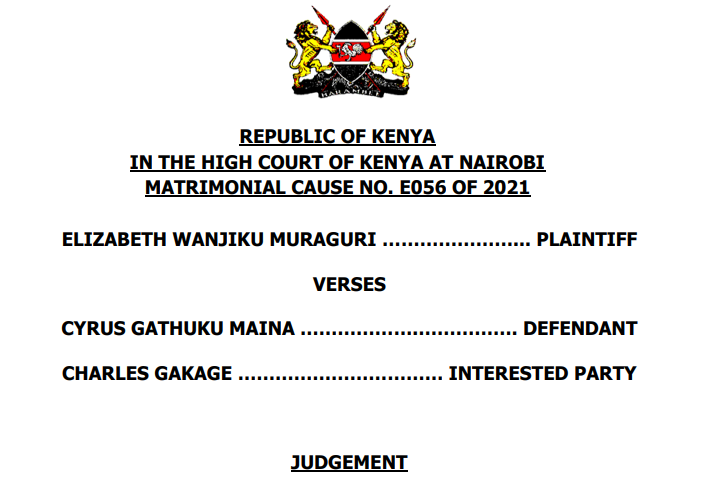
In a landmark judgment in Elizabeth Wanjiku Muraguri v Cyrus Gathuku Maina, the High Court in Nairobi in has ruled that a spouse can walk away with a share of wealth acquired during marriage even where their name does not appear on title deeds, logbooks, company records or bank accounts. The husband argued that most of the assets belonged to a company where he only held 5% shares and relied on the famous corporate law principle in that a company is separate from its owners. But the court rejected the argument, holding that a spouse cannot hide behind company structures to defeat matrimonial rights. Justice Chemitei found that while the husband travelled and built businesses, the wife managed the home, raised children, provided companionship and created the stability that enabled wealth creation.
The judgment now delivers a powerful warning to spouses who think property ownership is only about whose name appears on documents. The court reaffirmed that under Kenya’s Matrimonial Property Act, non-monetary contribution is equal to monetary contribution. Cooking, childcare, emotional support, managing the family and supporting a spouse’s career can legally translate into ownership rights worth millions. The court specifically held that the wife indirectly contributed to the success of Blue Bubble Homecare Products Limited and therefore deserved half of the husband’s 5% shareholding in the company together with a stake in assets linked to those shares. The judge further noted that marriage is an economic partnership and courts will increasingly look beyond paperwork to the real contribution made inside the family structure.
For husbands, wives and business owners alike, the ruling is a brutal reminder that matrimonial disputes can pierce through company walls, personal accounts and privately registered assets. The court awarded the ex-wife half of the Thome property, half of the husband’s shares, half of money held in his accounts and rights over other assets acquired during the marriage. The properties are now to be divided or sold within 90 days. The message from the High Court is loud and unmistakable: if wealth was built during marriage with the support of a spouse, whether financial or domestic, Kenyan courts will treat that wealth as jointly earned, regardless of whose name appears on the paperwork.
Kindly retweet/share 🙏
🚨🚨BREAKING: COURT DECLARES HOUSEWIVES ARE NOT “JUST STAYING AT HOME” - EX-WIFE AWARDED PROPERTY, COMPANY SHARES AND BANK MONEY DESPITE HER NAME APPEARING NOWHERE
In a landmark judgment in Elizabeth Wanjiku Muraguri v Cyrus Gathuku Maina, the High Court in Nairobi in has ruled that a spouse can walk away with a share of wealth acquired during marriage even where their name does not appear on title deeds, logbooks, company records or bank accounts. The husband argued that most of the assets belonged to a company where he only held 5% shares and relied on the famous corporate law principle in that a company is separate from its owners. But the court rejected the argument, holding that a spouse cannot hide behind company structures to defeat matrimonial rights. Justice Chemitei found that while the husband travelled and built businesses, the wife managed the home, raised children, provided companionship and created the stability that enabled wealth creation.
The judgment now delivers a powerful warning to spouses who think property ownership is only about whose name appears on documents. The court reaffirmed that under Kenya’s Matrimonial Property Act, non-monetary contribution is equal to monetary contribution. Cooking, childcare, emotional support, managing the family and supporting a spouse’s career can legally translate into ownership rights worth millions. The court specifically held that the wife indirectly contributed to the success of Blue Bubble Homecare Products Limited and therefore deserved half of the husband’s 5% shareholding in the company together with a stake in assets linked to those shares. The judge further noted that marriage is an economic partnership and courts will increasingly look beyond paperwork to the real contribution made inside the family structure.
For husbands, wives and business owners alike, the ruling is a brutal reminder that matrimonial disputes can pierce through company walls, personal accounts and privately registered assets. The court awarded the ex-wife half of the Thome property, half of the husband’s shares, half of money held in his accounts and rights over other assets acquired during the marriage. The properties are now to be divided or sold within 90 days. The message from the High Court is loud and unmistakable: if wealth was built during marriage with the support of a spouse, whether financial or domestic, Kenyan courts will treat that wealth as jointly earned, regardless of whose name appears on the paperwork.
Kindly retweet/share 🙏
🚨🚨BREAKING: COURT BACKS EMPLOYER, SAYS YOU DON’T NEED A CRIMINAL CONVICTION TO FIRE AN EMPLOYEE FOR MISCONDUCT
In a major decision likely to shake workplaces across Kenya, the Employment and Labour Relations Court in Mombasa in Ogola v Bamburi Cement PLC (Cause E056 of 2025) [2026] KEELRC 1294 (KLR) has upheld the dismissal of a long-serving employee of who was accused of attempting to leave the company premises with electrical spares hidden in his bag. The employee fought back hard, arguing that police investigations found no criminal case against him and that he was never charged in court. He claimed the dismissal traumatized him, caused anxiety and mental distress, and insisted the CCTV footage never showed him actually stealing anything. But the court still sided with the employer. Justice ruled that an employer is legally allowed to dismiss an employee once internal investigations create a genuine and reasonable belief that gross misconduct occurred, even if no criminal charges are ever filed.
The judgment now sends a chilling warning to employees across the country: your job can still disappear even when the police do not charge you. The court emphasized that workplace disciplinary processes are completely separate from criminal proceedings. According to the court, an employer only needs to show that it genuinely believed misconduct happened after following proper disciplinary procedure. In this case, the company proved that the employee was issued with a show-cause letter, invited to disciplinary hearings, allowed representation, and given a right of appeal. The court also noted that the recovered items matched company stock and that the employee already had previous warning letters on record. Once trust and confidence break down in employment, the court said, the employer is entitled to terminate the relationship.
For employers, the ruling comes as a powerful message of confidence and authority. The court has effectively reaffirmed that companies are not helpless when handling internal misconduct, theft allegations, or breaches of trust. As long as due process under the Employment Act is followed, employers do not have to wait for the police, the DPP, or criminal courts before taking action against an employee. The former employee walked into court seeking millions in compensation and damages. Instead, his entire case was dismissed with costs. The message from Mombasa is loud, sharp and unforgiving: if an employer can demonstrate a fair process and reasonable grounds for suspicion, Kenyan courts will stand behind workplace discipline - even where no criminal conviction exists.
Kindly retweet 🙏
🚨🚨BREAKING: COURT BACKS EMPLOYER, SAYS YOU DON’T NEED A CRIMINAL CONVICTION TO FIRE AN EMPLOYEE FOR MISCONDUCT
In a major decision likely to shake workplaces across Kenya, the Employment and Labour Relations Court in Mombasa in Ogola v Bamburi Cement PLC (Cause E056 of 2025) [2026] KEELRC 1294 (KLR) has upheld the dismissal of a long-serving employee of who was accused of attempting to leave the company premises with electrical spares hidden in his bag. The employee fought back hard, arguing that police investigations found no criminal case against him and that he was never charged in court. He claimed the dismissal traumatized him, caused anxiety and mental distress, and insisted the CCTV footage never showed him actually stealing anything. But the court still sided with the employer. Justice ruled that an employer is legally allowed to dismiss an employee once internal investigations create a genuine and reasonable belief that gross misconduct occurred, even if no criminal charges are ever filed.
The judgment now sends a chilling warning to employees across the country: your job can still disappear even when the police do not charge you. The court emphasized that workplace disciplinary processes are completely separate from criminal proceedings. According to the court, an employer only needs to show that it genuinely believed misconduct happened after following proper disciplinary procedure. In this case, the company proved that the employee was issued with a show-cause letter, invited to disciplinary hearings, allowed representation, and given a right of appeal. The court also noted that the recovered items matched company stock and that the employee already had previous warning letters on record. Once trust and confidence break down in employment, the court said, the employer is entitled to terminate the relationship.
For employers, the ruling comes as a powerful message of confidence and authority. The court has effectively reaffirmed that companies are not helpless when handling internal misconduct, theft allegations, or breaches of trust. As long as due process under the Employment Act is followed, employers do not have to wait for the police, the DPP, or criminal courts before taking action against an employee. The former employee walked into court seeking millions in compensation and damages. Instead, his entire case was dismissed with costs. The message from Mombasa is loud, sharp and unforgiving: if an employer can demonstrate a fair process and reasonable grounds for suspicion, Kenyan courts will stand behind workplace discipline - even where no criminal conviction exists.
Kindly retweet 🙏
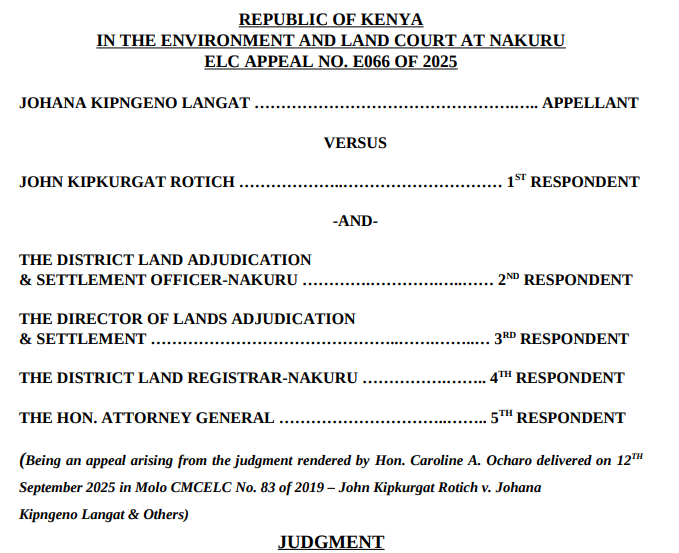
🚨🚨ANOTHER BRUTAL LAND TITLE BLOW : MAN LOSES LAND, TITLE CANCELLED, AND COURT ORDERS HIM TO PAY COSTS AFTER YEARS OF FIGHTING
In a hard-hitting judgment delivered by the Environment and Land Court at Nakuru in Johana Kipngeno Langat v John Kipkurgat Rotich & 4 Others, the court stripped a man of his land title after finding that the land had already been allocated to another person years earlier. The appellant walked into court armed with what many Kenyans believe is the ultimate shield: a title deed. He argued that the law protects registered owners under Sections 24, 25 and 26 of the Land Registration Act, insisting he had lawfully obtained the land through a government allocation process. But the court was not convinced. Justice M. A. Odeny found that the title had been acquired “unprocedurally,” noting that the appellant obtained registration despite knowing there was an active ownership dispute and despite earlier findings from land officials that the land belonged to the respondent.
What makes the decision explosive is the court’s clear reminder that a title deed alone is not enough if the process behind it is tainted. Evidence showed the respondent had occupied and claimed the land since the 1980s, later receiving a formal allotment in 2002 when the area became a settlement scheme. Government verification teams later concluded that the land had mistakenly been allocated to the appellant during a later exercise. Shockingly, the appellant admitted he knew there was a dispute, knew investigations were ongoing, and still proceeded to obtain a title deed in 2016. The court stated that “waving a title” does not make ownership indefeasible where the title falls under illegality, fraud, mistake, or procedural irregularity under Section 26 of the Land Registration Act. The judge further held that the court has power under Section 80 of the Act to cancel titles obtained through fraud or mistake, even where a title deed has already been issued.
The decision delivers a brutal lesson to thousands of Kenyans who still assume a title deed automatically ends all disputes. The court reaffirmed the now-growing judicial position that ownership is not merely about whose name appears on the green card, but whether the process leading to registration was lawful from the beginning. In dismissing the appeal with costs, the court concluded that the appellant actively participated in securing the title despite knowing the land was disputed and despite recommendations that the property belonged to the respondent. The message from Nakuru is cold and unmistakable: if your title was born from a flawed process, the courts can erase it completely, years later, and hand the land to someone else as you helplessly watch.
Kindly retweet🙏
🚨🚨ANOTHER BRUTAL LAND TITLE BLOW : MAN LOSES LAND, TITLE CANCELLED, AND COURT ORDERS HIM TO PAY COSTS AFTER YEARS OF FIGHTING
In a hard-hitting judgment delivered by the Environment and Land Court at Nakuru in Johana Kipngeno Langat v John Kipkurgat Rotich & 4 Others, the court stripped a man of his land title after finding that the land had already been allocated to another person years earlier. The appellant walked into court armed with what many Kenyans believe is the ultimate shield: a title deed. He argued that the law protects registered owners under Sections 24, 25 and 26 of the Land Registration Act, insisting he had lawfully obtained the land through a government allocation process. But the court was not convinced. Justice M. A. Odeny found that the title had been acquired “unprocedurally,” noting that the appellant obtained registration despite knowing there was an active ownership dispute and despite earlier findings from land officials that the land belonged to the respondent.
What makes the decision explosive is the court’s clear reminder that a title deed alone is not enough if the process behind it is tainted. Evidence showed the respondent had occupied and claimed the land since the 1980s, later receiving a formal allotment in 2002 when the area became a settlement scheme. Government verification teams later concluded that the land had mistakenly been allocated to the appellant during a later exercise. Shockingly, the appellant admitted he knew there was a dispute, knew investigations were ongoing, and still proceeded to obtain a title deed in 2016. The court stated that “waving a title” does not make ownership indefeasible where the title falls under illegality, fraud, mistake, or procedural irregularity under Section 26 of the Land Registration Act. The judge further held that the court has power under Section 80 of the Act to cancel titles obtained through fraud or mistake, even where a title deed has already been issued.
The decision delivers a brutal lesson to thousands of Kenyans who still assume a title deed automatically ends all disputes. The court reaffirmed the now-growing judicial position that ownership is not merely about whose name appears on the green card, but whether the process leading to registration was lawful from the beginning. In dismissing the appeal with costs, the court concluded that the appellant actively participated in securing the title despite knowing the land was disputed and despite recommendations that the property belonged to the respondent. The message from Nakuru is cold and unmistakable: if your title was born from a flawed process, the courts can erase it completely, years later, and hand the land to someone else as you helplessly watch.
Kindly retweet🙏








![AssociatesRoba's tweet photo. 🚨🚨BREAKING: COURT BACKS EMPLOYER, SAYS YOU DON’T NEED A CRIMINAL CONVICTION TO FIRE AN EMPLOYEE FOR MISCONDUCT
In a major decision likely to shake workplaces across Kenya, the Employment and Labour Relations Court in Mombasa in Ogola v Bamburi Cement PLC (Cause E056 of 2025) [2026] KEELRC 1294 (KLR) has upheld the dismissal of a long-serving employee of who was accused of attempting to leave the company premises with electrical spares hidden in his bag. The employee fought back hard, arguing that police investigations found no criminal case against him and that he was never charged in court. He claimed the dismissal traumatized him, caused anxiety and mental distress, and insisted the CCTV footage never showed him actually stealing anything. But the court still sided with the employer. Justice ruled that an employer is legally allowed to dismiss an employee once internal investigations create a genuine and reasonable belief that gross misconduct occurred, even if no criminal charges are ever filed.
The judgment now sends a chilling warning to employees across the country: your job can still disappear even when the police do not charge you. The court emphasized that workplace disciplinary processes are completely separate from criminal proceedings. According to the court, an employer only needs to show that it genuinely believed misconduct happened after following proper disciplinary procedure. In this case, the company proved that the employee was issued with a show-cause letter, invited to disciplinary hearings, allowed representation, and given a right of appeal. The court also noted that the recovered items matched company stock and that the employee already had previous warning letters on record. Once trust and confidence break down in employment, the court said, the employer is entitled to terminate the relationship.
For employers, the ruling comes as a powerful message of confidence and authority. The court has effectively reaffirmed that companies are not helpless when handling internal misconduct, theft allegations, or breaches of trust. As long as due process under the Employment Act is followed, employers do not have to wait for the police, the DPP, or criminal courts before taking action against an employee. The former employee walked into court seeking millions in compensation and damages. Instead, his entire case was dismissed with costs. The message from Mombasa is loud, sharp and unforgiving: if an employer can demonstrate a fair process and reasonable grounds for suspicion, Kenyan courts will stand behind workplace discipline - even where no criminal conviction exists.
Kindly retweet 🙏](https://pbs.twimg.com/media/HIv_fMyWcAAjUm_.png)