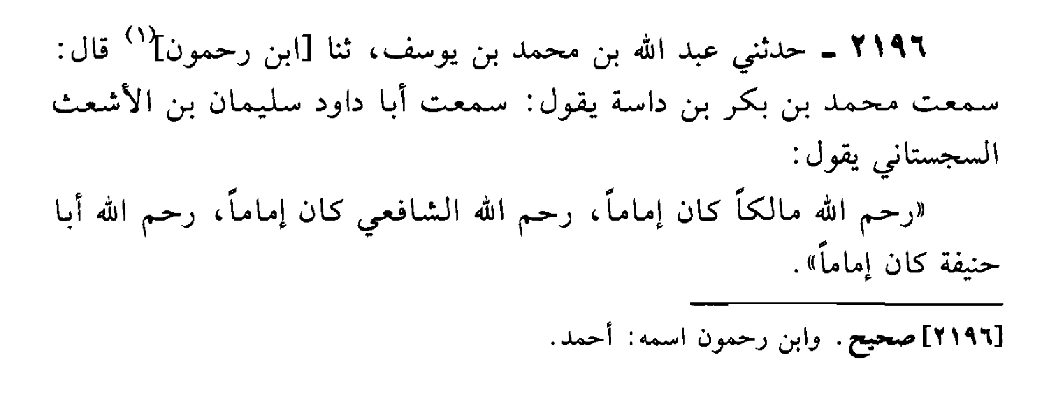
Abū Dāwūd al-Sijistānī (d. 275) said:
❝May Allāh have mercy on Mālik, for he was an Imām. May Allāh have mercy on ash-Shāfiʿī, for he was an Imām. May Allāh have mercy on Abū Ḥanīfah, for he was an Imām.❞
✽ Jāmiʿ Bayān al-ʿIlm wa Faḍlih, vol. 2, p. 272, no. 2196
Abū Dāwūd al-Sijistānī (d. 275) said:
❝May Allāh have mercy on Mālik, for he was an Imām. May Allāh have mercy on ash-Shāfiʿī, for he was an Imām. May Allāh have mercy on Abū Ḥanīfah, for he was an Imām.❞
✽ Jāmiʿ Bayān al-ʿIlm wa Faḍlih, vol. 2, p. 272, no. 2196
ʿAnbasah bin Saʿīd bin Ghunaym al-Kalāʿī said:
"No man innovates an innovation except that his heart harbours resentment towards the Muslims and he loses his trustworthiness."
✽ Al-Harawī, Dhamm al-Kalām wa Ahlih, vol. 4. p. 165, no. 919.
Yazīd bin Hārūn (d. 206) said:
“I encountered the people [of my time] and I did not see anyone more intelligent, nor more virtuous, nor more pious than Abū Ḥanīfah.”
✽ Tārīkh Baghdād, vol. 15, p. 498.
Regarding the verse: "That He may enrage the disbelievers with them (48:29)." ʿĀʾishah said:
"(These are) the companions of Allāh's Messenger, they were commanded to seek forgiveness for them but they revile them."
Imām Aḥmad bin Ḥanbal (d. 241) was asked about someone who reviles a companion of Allāh's Messenger ﷺ and he said:
❝I don't view him to be upon Islam.❞
✽ Al-Khallāl, As-Sunnah, vol. 3, p. 493, no. 782.
Allah's Messenger ﷺ said:
"Falsehood leads to wickedness, and wickedness leads to the Hellfire, and a man may keep on telling lies till he is written before Allah, a liar."
- Sahih al-Bukhari 6094
Regarding the verse: "And the mosques are for Allāh, so invoke not anyone along with Allāh (72:18)."
Qatādah (d. 117) said: "When the Jews and Christians entered their churches and synagogues, they would commit shirk with Allāh. Therefore, Allāh commanded His Prophet to make the invocation purely for Him alone when he entered the mosque."
✽ Tafsīr al-Ṭabarī
Bakr bin Muḍar (d. 174) said:
❝When Allāh intends evil for a people, He preoccupies them with argumentation and prevents them from doing good.❞
✽ Jāmiʿ Bayān al-ʿIlm wa Faḍlih
The Prophet's (ﷺ) uncle, al-ʿAbbās bin ʿAbd al-Muṭṭalib (d. 32), was once asked:
"Are you older (akbar) than Allāh's Messenger (ﷺ)?"
Al-ʿAbbās responded by saying: "He (ﷺ) is greater (akbar) than me, though I was born before him."
May Allāh be pleased with al-ʿAbbās.
Bakr bin Muḍar (d. 174) said:
❝When Allāh intends evil for a people, He preoccupies them with argumentation and prevents them from doing good.❞
✽ Jāmiʿ Bayān al-ʿIlm wa Faḍlih
Yazīd bin Hārūn (d. 206) said:
“I encountered the people [of my time] and I did not see anyone more intelligent, nor more virtuous, nor more pious than Abū Ḥanīfah.”
✽ Tārīkh Baghdād, vol. 15, p. 498.