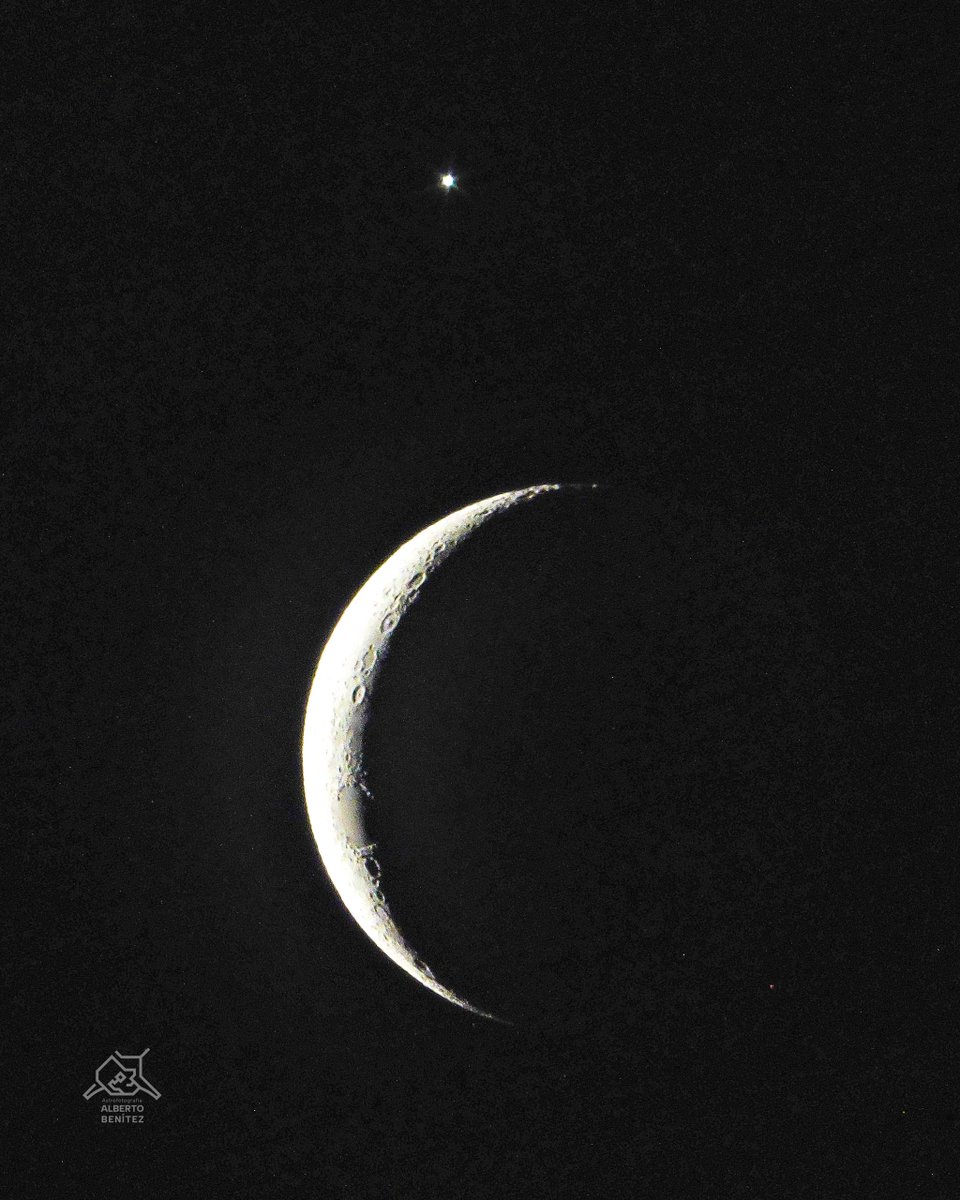
🌒 19.2% illuminated Moon captured on 18 June 2026 at 22:40 CEST from Slovakia.
The waxing crescent reveals spectacular crater detail along the terminator, where long shadows emphasize the rugged lunar landscape.
#Moon#Astrophotography#Atronomy@MoonHourSocial
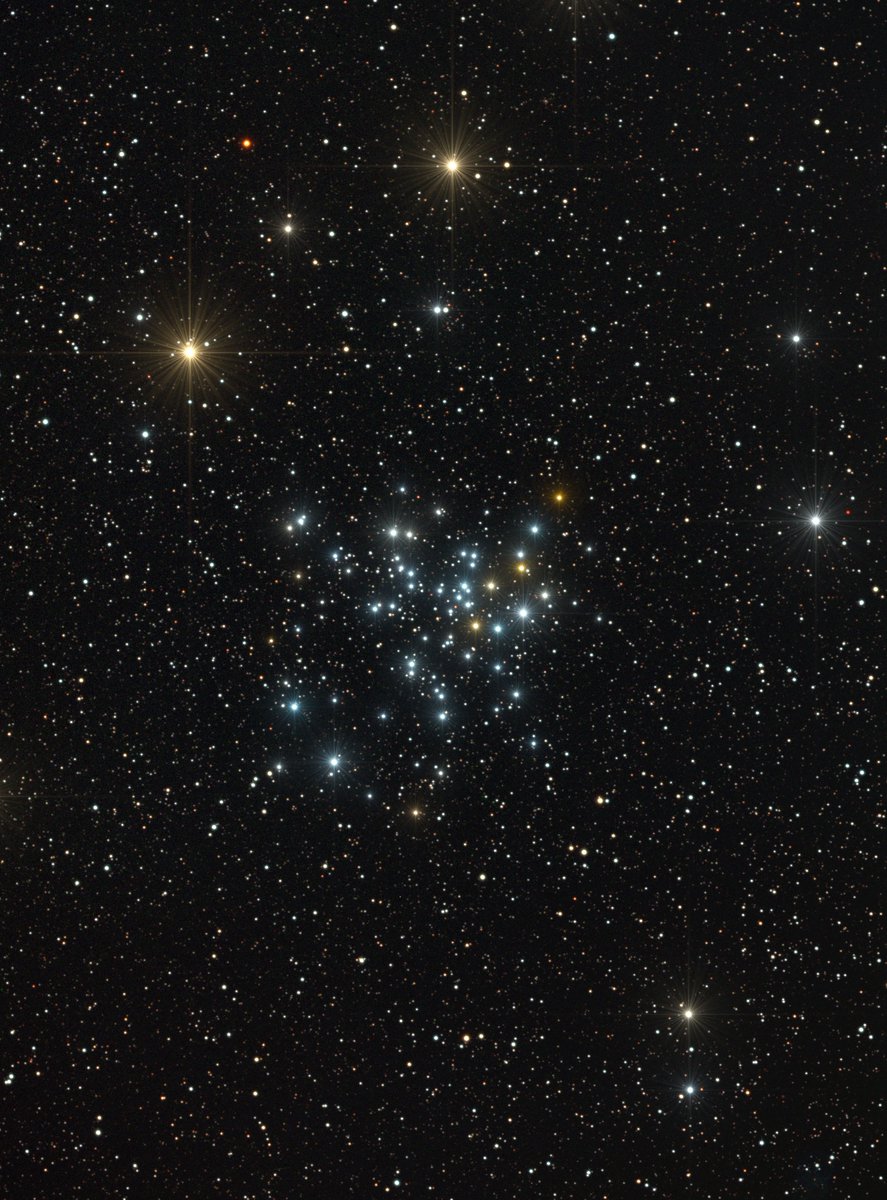
Messier 53 (M53) and NGC 5053 are two globular clusters in the constellation Coma Berenices that can actually be seen together in the same field of view through a telescope, making for a fascinating astronomical sight. #stars
⭐️ Messier 53 is a denser globular cluster, one of the most distant in the Milky Way, at a distance of about 58,000 light-years from Earth. It's a rich system containing several hundred thousand stars and is notable for its dense core and spherical shape. With an apparent magnitude of about +7.7, M53 can be seen with a small telescope or even a good pair of binoculars under dark, non-polluted skies.
✨ NGC 5053, only about 1 degree southeast of M53, is in stark contrast to its neighbor. It is a much looser globular cluster with an apparent magnitude of +9.9, making it a more difficult target to observe. NGC 5053 is at a similar distance to M53, about 53,000 light-years away, but its scattered appearance and lower stellar density distinguish it from the more compact M53.
🔭 Observing M53 and NGC 5053 is like looking back in time, witnessing the conditions of the early universe long before our Solar System was even a ...cloud ☁️ of cosmic dust. #stargazing To view them in the same field of view (FOV) you'll need a medium-sized amateur telescope with a wide field eyepiece. I use my 4" doublet one, with 900mm focal length and my 40mm wide field eyepiece during the spring months, when Coma Berenices is well placed in the night sky for observers in the northern hemisphere.
📷 For the rest of us, the #astrophotography enthusiasts, capturing both clusters can be a rewarding challenge, see my image below taken with my telescope. However, as impatient as I always am, this is another very short exposure, only a few minutes, in our astrophotography jargon you could call it a ... snapshot.🖖🤣
🦖🦕
Messier 53 is estimated to be about 12.67 billion years old.This makes it one of the older globular clusters in our Milky Way, formed when the Universe was relatively young, about 1-2 billion years after the Big Bang.
NGC 5053 is also old, although determining its exact age can be difficult without specific spectroscopic data. In general, globular clusters like NGC 5053 are thought to be around 10-13 billion years old, suggesting that they formed in the early stages of the galaxy.
🚀✨
Messier 53´s distance puts it in the outer halo of the Milky Way. Same goes for NGC 5053 which is about 5,000 light-years closer to our planet, as I stated previously, but still roughly in the same distant halo region of our galaxy.
But there is one more WOW...👇
💥💥
When the stars in Messier 53 first ignited about 12.67 billion years ago, the Earth didn't exist 😳 and the Universe was in its early stages of development. The Milky Way itself was still forming, and the Solar System was billions of years away from forming.
Something similar applies also to NGC 5053. At that time, our universe was a place of intense activity, with galaxies forming and stars being born at a rapid rate.If NGC 5053 is closer to 13 billion years old, its formation coincides with the early epochs of the universe's history, not long after the cosmos began to cool and stars began to light up the darkness, forming the first galaxies.
Fiat Lux!
NGC 5005 and NGC 5033 are a galactic pair located in the constellation Canes Venatici, offering a rewarding target for stargazers and astrophotographers alike.
🌌 NGC 5005, about 60 million light-years away, is a bright spiral galaxy with an apparent magnitude of 10.6 and a size of roughly 90,000 light-years. It features a luminous core powered by a low-luminosity active galactic nucleus (AGN) and displays tightly wound spiral arms with noticeable dust lanes. The light from NGC 5005 is dating back to the Paleocene epoch, a time just after the extinction of the dinosaurs. 🦕🪦 Earth was recovering, and mammals were beginning to evolve rapidly, taking over ecological niches left vacant by the vanished reptiles.
🌌 Just a few degrees away lies NGC 5033, a slightly fainter spiral galaxy at magnitude 10.8, located approximately 40 million light-years from Earth. That means, the light from NGC 5033 began its journey to Earth during the Eocene epoch. This was a warm and humid period in Earth’s history, when lush forests covered much of the planet and early primates were thriving in the canopies. The ancestors of whales, 🐳 horses, and many modern mammals were taking shape.
Similar in size to the Milky Way at around 100,000 light-years across, NGC 5033 also hosts an AGN and presents a beautifully tilted disk, adding visual depth and asymmetry.
🔭👀 Under dark skies, both galaxies can be seen #stargazing through medium to large telescopes as elongated smudges of light. With wide-field eyepieces and steady conditions, it’s possible to fit them into a single field of view, especially rewarding when sweeping through Canes Venatici during galaxy season.
📷 To #astrophotography photograph them, use a long focal length telescope and deep exposures to reveal their spiral arms, core structures, and faint halos. Color imaging will enhance the contrast between the bluish spiral arms and the yellow-white cores.
💃🕺 Both galaxies are rich in detail and structure, making them excellent subjects for long-exposure imaging with smart telescopes like my Vaonis #Vespera2, see image below.
For now enjoy, the light of a cosmic duo showcasing the elegance and diversity of spiral galaxies in the northern sky. Clear Skies! ✨
Surprising supernova remnants...
"Astronomers have uncovered a population of supernova remnants in a nearby galaxy that are unexpectedly changing in X-ray brightness.
Using Chandra data spanning 14 years, researchers found 22 supernova remnants that brighten and dim dramatically in X-rays."
#Science #Space #Astronomy
⏯️NASA’s Chandra Finds Unexpected Fireworks in Aftermath of Stellar Explosions
1-https://t.co/v8SY8u2RrO
2-https://t.co/IiPtS8FK7u
/