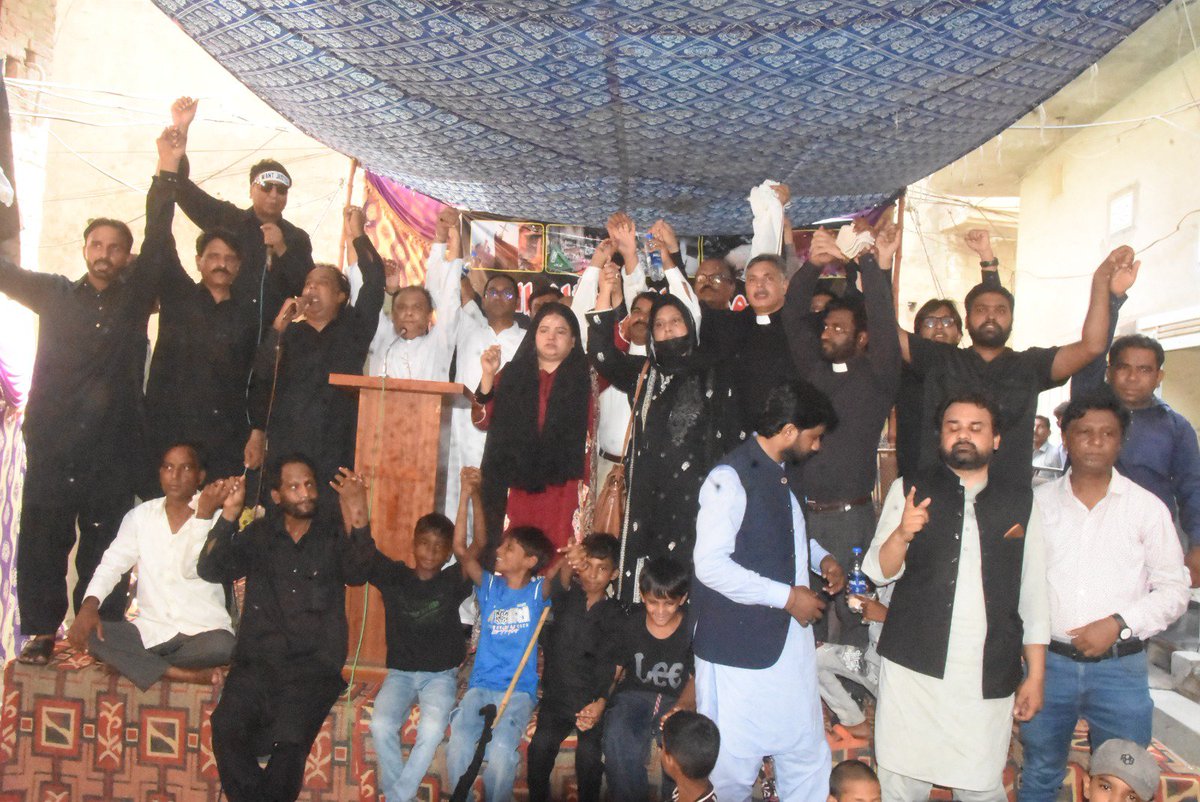
Izhar-e-Khayal | Expression of Thoughts 16 August 2026 — Third Anniversary of the Jaranwala Tragedy
On the third anniversary of the Jaranwala tragedy, I had the opportunity to express my thoughts on the suffering of the Christian community, the painful absence of justice, and the urgent need for accountability.
My words were not merely a remembrance of what happened in Jaranwala. They were a call to reflect on the history of attacks against religious minorities in Pakistan, the consequences of extremism, and the responsibility of those entrusted with protecting every citizen's life, dignity, and fundamental rights.
I am sharing my complete speech because these questions deserve to be heard, discussed, and answered.
First of all, I want to sincerely thank everyone who has joined us today. Your presence matters because we are not gathered here simply to remember a tragedy. We are gathered to demand justice, accountability, and equality.
I especially want to thank Minorities Rights Movement Pakistan and its entire team, and particularly Lala Robin Daniel, whose voice has never been shaken and who has never forgotten Jaranwala. Your continued solidarity means a great deal to the victims and survivors.
Today, I want us to look beyond one incident. Jaranwala did not happen in isolation.
Before Jaranwala, we saw Shanti Nagar, Joseph Colony, and other attacks against Christian communities. Where are those responsible? Where is accountability?
This is not merely a legal problem. It is a problem of equality before the law. Now let us come to Jaranwala. On 14 August, Pakistan celebrates its Independence Day.
Only two days later, on 16 August 2023, our community witnessed one of the darkest chapters in its history.
Churches were attacked. Bibles were destroyed. Homes were burned. Families were terrified. People were forced to run for their lives.
And today, three years later, we are still asking the same question:
Where is justice?
We were told that the Jaranwala case would be pursued seriously. We were told that the perpetrators would be punished.
But look at the reality.
After three years, if only one person is in jail while many accused have obtained bail or been acquitted, then we have to ask whether justice is really being delivered or whether the passage of time itself is becoming a tool for forgetting.
And while we speak about justice, we must also speak honestly about the environment that allows such tragedies to happen.
When restrictions on extremist organizations are removed or weakened, and when institutions or political actors subsequently appear to normalize or promote such forces, we cannot pretend that there are no consequences.
There is a direct relationship between what the state tolerates and what society eventually suffers.
We saw the consequences in Jaranwala.
And we must have the courage to say this: extremism does not become less dangerous because it is politically convenient.
As I concluded my speech, I reaffirmed my faith and determination: “Nothing can separate us from the love of Christ.”
Our voices will not be silenced, our struggle will not be forgotten, and we will not stop until justice prevails.
Pakistan: A Nation Where the Vulnerable Continue to Suffer
Behind the silence of the powerless lie countless stories of pain, injustice, and shattered dreams. Pakistan is a country of immense diversity and resilient people, yet many of its most vulnerable citizens continue to struggle against discrimination, poverty, violence, and exclusion. For them, equality remains an unfulfilled promise, and dignity a daily battle.
Among the most vulnerable are religious minorities, particularly Christians, who face discrimination, persecution, and fear because of their faith. Reports of forced conversions and forced marriages involving minority girls raise serious concerns about consent and justice. Blasphemy accusations can expose individuals and entire communities to threats and mob violence, as the devastating tragedy of Jaranwala in August 2023 demonstrated, when churches and Christian homes were attacked and destroyed.
Beyond physical persecution, Christians continue to face social and economic discrimination. Many are associated with sanitation work and subjected to degrading caste-based labels such as “Chuhra.” When children are denied equal opportunities and judged by their religion or background, discrimination becomes a cycle passed from one generation to the next.
Yet, Pakistan’s suffering extends beyond religious minorities. Women and girls face gender-based violence, child marriage, and barriers to education. Bonded labourers endure exploitation and debt, while transgender people experience stigma, violence, and social exclusion. Persons with disabilities encounter inaccessible institutions and limited opportunities. Baloch and Pashtun communities have raised serious concerns about insecurity, enforced disappearances, and restrictions on peaceful expression. Meanwhile, impoverished families struggle with child labour, inadequate healthcare, and limited access to education.
These challenges reveal a deeper crisis of equality, accountability, and human dignity. When vulnerable citizens cannot access justice, prejudice determines opportunity, and the powerless struggle to be heard, the foundations of a just society begin to weaken.
The solution requires more than sympathy. It demands impartial investigations, effective law enforcement, equal educational opportunities, protection against exploitation, and accountability for those responsible for abuses. Governments, institutions, and citizens must challenge the prejudices that allow discrimination to persist.
Pakistan’s vulnerable communities are not outsiders; they are part of its history, culture, and future. No person’s religion, ethnicity, gender, disability, or economic circumstances should determine their worth or their rights.
A nation’s greatness is measured not merely by its strength, but by how it protects those with the least power.
We do not ask for privilege; we demand justice, equality, and dignity. Pakistan cannot fulfil its promise while its most vulnerable citizens remain unheard, unprotected, and excluded.
We do not want a nation where the vulnerable merely survive. We want a Pakistan where every human being can live freely, safely, and with dignity.
Mr. Jason, I truly appreciate your work and your efforts. I would also encourage you to look into the situation of the Jaranwala Christian community and, if possible, help bring this matter to the attention of the United Nations. Thank you for standing with vulnerable communities and for your continued efforts.
Calling me a hypocrite doesn't change what I believe.
As a Christian, I don't choose whom to love based on ethnicity or religion. Jesus Christ taught me to love my neighbor, pray for my enemies, and stand against injustice.
I can stand with the Jewish people and acknowledge their suffering with hating Muslims because i personally experienced persecution. So I also speak about persecuted people and vulnerable communities without abandoning my support for Israel.
My loyalty is first to Christ. “Blessed are the peacemakers, for they shall be called children of God.” Matthew 5:9
I will stand for life, truth, justice, and peace, because that is what I believe Christ calls me to do.
Exactly. As a Christian, I believe we should also be honest about the difference between the teachings of Christ and acts committed in the name of religion.
Jesus Christ taught His followers to love their enemies, pray for those who persecute them, forgive, and not repay violence with violence. He never commanded His followers to murder innocent people in His name.
“Love your enemies and pray for those who persecute you.” — Matthew 5:44
Religious extremism should be confronted honestly, and people should be held accountable for the violence they commit. At the same time, we should distinguish between extremists and ordinary people who share their religion.
My faith is in Christ, whose command was to love, not to kill innocent people while invoking His name.
Mr. Thames, I truly appreciate your work and your efforts for persecuted and vulnerable communities. I would also encourage you to look into the situation of vulnerable communities in Pakistan, particularly the challenges and persecution faced by Christians.
I am a survivor, victim, and witness of the tragedy of Jaranwala, where 27 churches and thousands of Christian homes were burned and many families were deeply affected. This is not just a distant issue for me, I witnessed its devastating impact firsthand.
It would mean a great deal to the people of Jaranwala if you would take an interest in our situation, learn more about what happened, and use your platform and work to help bring greater attention to the struggles of the affected community.
Thank you for standing with persecuted people and for the work you continue to do for justice and human dignity.
Mr. Jason, I truly appreciate your work and your efforts. I would also encourage you to look into the situation of the Jaranwala Christian community and, if possible, help bring this matter to the attention of the United Nations. Thank you for standing with vulnerable communities and for your continued efforts.