Modular, Multi-layer, Blockchain Network Modernizing the Sport Industry by Transforming market structures and Enabling the next generation of applications
⚡️ What’s Next for Atleta Network
A short progress note from the team: we’re focused on shipping real utility and expanding the ecosystem step by step.
Over the next few months our team is preparing something really special.
Some major future updates:
• $ATLA: new venues by end of 2026 (incl. US-facing, approvals pending)
• Staking for ATLA holders
• Campaigns for Community & Early investors
• Introducing the @bcs_arena app
A Squad List Is a Permission System
Before the Champions League begins, every club has already made one crucial decision: who is actually allowed to play.
A squad list looks like a roster. In reality, it defines access. List A closed at the league-phase registration deadline, while eligible List B players can still be added before each match. That is the real point: the player has not changed – their permission to enter the competition has.
Sports products should understand that difference. Identity tells you who someone is. Eligibility tells you whether they can act now, under these rules, in this competition.
For https://t.co/TgKU6SqNgs the interesting part is not putting squad lists “on-chain.” It is making eligibility a shared, verifiable state that connected products can read and act on.
Security Starts With Separation of Duties
Sport already understands a simple rule: the person making the play should not be the only one validating the result.
https://t.co/TgKU6SqNgs brings that discipline into its validator architecture. Authors collect transactions and package them into blocks. Publishers then monitor that work, re-validate the blocks and append them to the chain. These roles are assigned by the network and regularly reshuffled.
The point is bigger than terminology: critical responsibilities should not depend on a single role doing everything.
For us, security is not only stronger cryptography. It is architecture designed to check itself.
Because trust should come from the system, not from a single role within it
Purpose-Built Shouldn’t Mean Product-Prescriptive
A sports-first chain should understand the industry without deciding what the industry is allowed to build.
Sport does not need one “default” Web3 product. One team may build scouting infrastructure, another club operations, another media, data or fan products. Specialization should give all of them better foundations not force them into the same template.
That is the idea behind https://t.co/TgKU6SqNgs: a generalized, modular and permissionless L1 designed around sports, while leaving product logic to builders.
Purpose-built should narrow the infrastructure problem, not the product imagination
A Draw Is Where Football Becomes a Dependency Graph
For fans, a European draw is a few tense minutes of names and future opponents. For the industry, it redraws an entire operating map.
Across 27-28 August, @UEFA league-phase draws trigger changes far beyond the bracket: scouting priorities, travel, broadcasting, ticket demand, sponsor geography, media calendars and fan products all start moving at once.
That is why sports infrastructure cannot treat data as isolated records. It has to understand relationships and let one verified change reach everything that depends on it.
https://t.co/TgKU6SqNgs is built as a shared foundation for that connected state, so sports products can react to the same reality instead of maintaining separate versions of it
The Fan Shouldn’t Be the End of the Funnel
Sports marketing still tends to end at the fan: brand → agency → club → media → audience. Attention is delivered, the campaign is measured and the funnel stops there.
But fans already do much more than watch. They share, react, create, recommend and move attention through their own communities. The opportunity is to make that participation part of the system itself.
@bcs_arena builds around that idea through tasks, Arena Points and club contribution mechanics turning fan activity into an ongoing loop between brands, clubs and supporters rather than a one-way campaign.
And once actions, attribution and value start moving across several sides of the same ecosystem, they need a common layer underneath.
That is where Atleta fits: execution, verifiable records and shared logic for sports products where participation does not end with attention it keeps moving.
Transparent Sport Does Not Mean Public Sport
In Web3 transparency is often reduced to a simple idea: put more on-chain and make more visible. But real sports infrastructure needs a more precise standard the right information should be trustworthy and verifiable without automatically becoming available to everyone.
Sport runs on data that should be verifiable without becoming public by default: injuries, health records, biometrics, contract context, identity and internal performance data.
https://t.co/TgKU6SqNgs documentation treats privacy as a core frontier. The direction is clear: athletes should retain control over sensitive biological and healthcare data, while technologies such as ZK proofs and fully homomorphic encryption are explored to make verification possible without revealing everything underneath.
For us, that is what mature sports infrastructure should aim for: verifiable when needed, private when required.
🔥🔥🔥 THE ARENA MERCH LINEUP
You saw the sneak peek in our last Reel. Now take a look at these photos! 👕
This gear captures the culture and the mindset behind Arena as we take this movement worldwide. Built for the fans, creators, and clubs making it happen with us.
Want one? Comment with the design you like the most 💬🔥
A Fixture Is a Live Data Object
The Premier League season begins today, as European football moves into another new campaign. And even before the first whistle, one thing is already true: official fixtures remain subject to change.
That matters because a fixture is not just “Team A vs Team B.” It anchors venue, kickoff, broadcast, ticketing, accreditation, player availability, sponsor assets, media and fan products. Change one parameter, and a chain of systems has to update with it.
Sports data should do more than announce an event. It should coordinate the state around it.
At https://t.co/TgKU6SqNgs we believe sports infrastructure should be built for exactly this reality. Shared, verifiable state and execution logic can give connected applications the same source of truth and a way to respond when that truth changes.
Because sports data should not just describe what happens. It should help the ecosystem move with it
Rivalry Is More Than a Matchday Emotion
A new @premierleague season is about to begin, and with it comes an old question: which club has the stronger community?
Usually, rivalry is compressed into 90 minutes and a scoreline. But digital sports products can turn that emotion into an ongoing system of participation.
On @bcs_arena choosing a club is not cosmetic. Fans complete tasks, create and share content, collect Arena Points and climb leaderboards while every completed task also adds points to the club they support. Rivalry becomes measurable: who shows up more, creates more and pushes their club further.
For Atleta, this is exactly the kind of sports logic infrastructure should make durable: verifiable activity records and ecosystem rules beneath the product.
Matchday creates rivalry. Infrastructure lets it keep score between matches
Sports Builders Should Inherit Tooling, Not Reinvent It
Sports builders should not need a new development universe just to build on a sports-first chain.
The faster route on-chain is familiar: Solidity, Ethereum-style RPCs, Ethers.js, Hardhat, Foundry tools teams already know how to test, deploy and debug with.
https://t.co/TgKU6SqNgs keeps that door open through EVM compatibility, while giving those builders infrastructure designed around sports.
Specialization should happen in the workflows, not in forcing developers to relearn the stack.
A vertical L1 earns its place when it shortens the distance between proven Web3 skills and real industry products
Sport Runs on Edge Cases. Infrastructure Has to Handle Them
Sport rarely follows the happy path.
A player gets injured before kickoff. A registration changes. A result is corrected. Access to medical data shifts. An appeal rewrites what happens next.
These are not exceptions to the system. They are the system.
Sports infrastructure has to preserve what changed, who changed it and what the new state allows – without forcing every product to rebuild around the update.
That is why https://t.co/TgKU6SqNgs modular design matters: execution rules can evolve, records can keep their history and individual components can be refined without abandoning the wider stack.
Real sport changes fast. Its infrastructure has to change without losing the truth
The Competition Changes. The Context Should Travel
Tonight in Salzburg, Champions League winners PSG meet Europa League winners Aston Villa in the UEFA Super Cup
Two competitions become one match but the data around them should not reset. Player records, eligibility, media rights, sponsor context, match history and fan signals all carry value across the boundary.
That handoff is what interoperability should mean in sport: context that follows the game instead of being rebuilt around every new tournament, platform, or partner.
https://t.co/TgKU6SqNgs provides the shared infrastructure for that continuity – connecting execution, data and products while preserving where each record came from and what it means.
Sport already moves across competitions. Why should its context stop at the boundary?
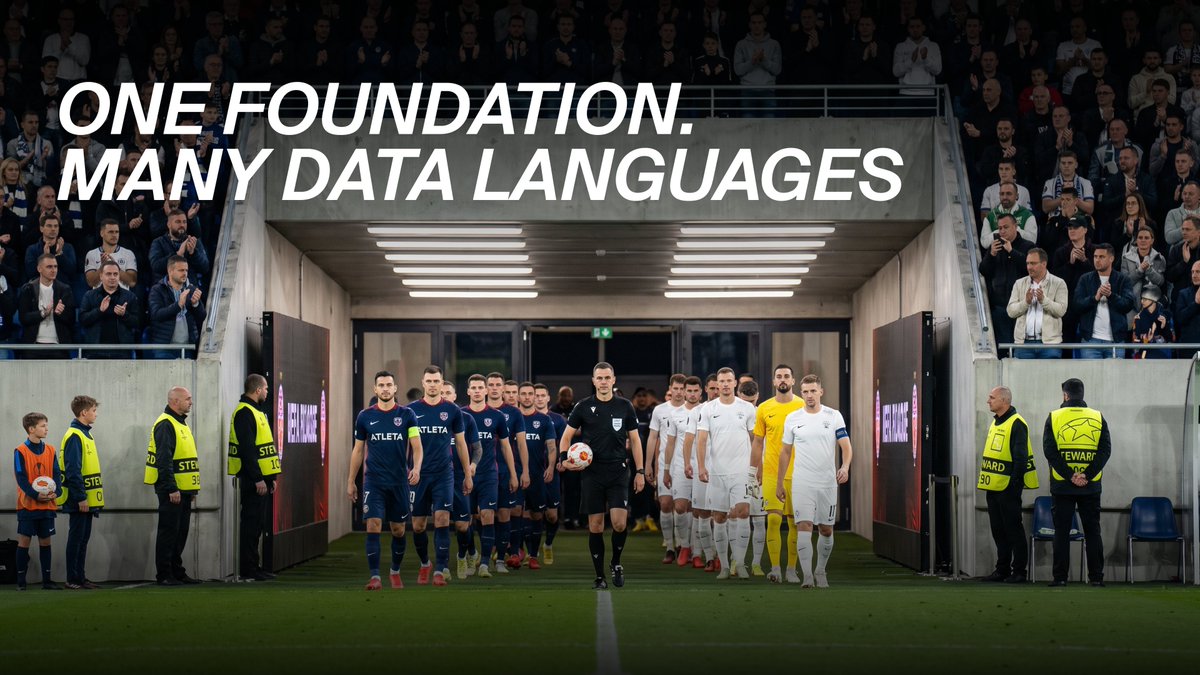
One Championship, many data languages
Sport does not speak in one data format
A race, fight, match, routine, or lap can produce completely different rules, metrics, media and qualification logic. Shared infrastructure should not flatten those differences. It should make them interoperable.
https://t.co/TgKU6SqNgs multi-layer design maps naturally to that challenge: Execution for sport-specific logic, Storage for context and Interoperability for moving data across products and systems.
Different sports should keep their own language while sharing the same reliable foundation.
One base layer. Many sports. No loss of meaning