I'll be at @NeurIPSConf 2025 in San Diego presenting our new work from @proximafusion:
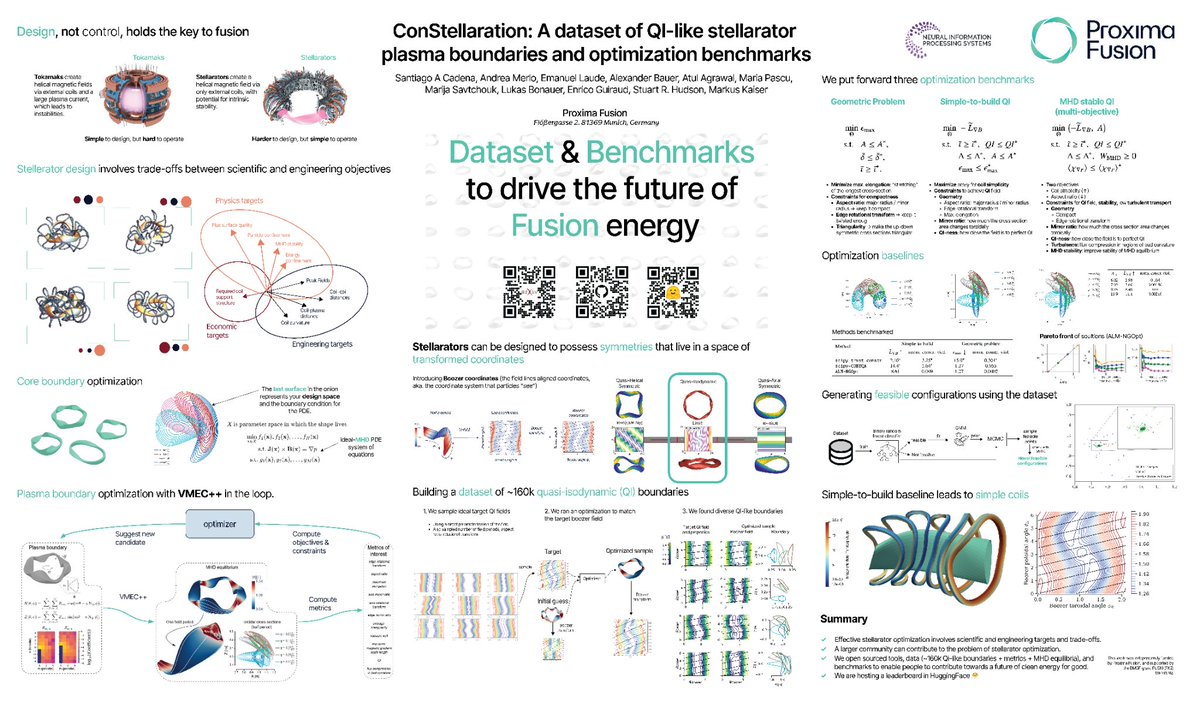
ConStellaration - a dataset of QI-like stellarator boundaries + optimization benchmarks.
Poster #2211, Exhibit Hall C/D/E Dec 4, 11am-2pm
Paper: https://t.co/s4mRE8a1B5... #fusion#Al#AI4Sci
ARTICLE: From concrete mixture to structural design—a holistic optimization procedure in the presence of uncertainties
✍️@Atul_Ag07, @SKoutsourelakis (@TU_Muenchen), Erik Tamsen and J.F. Unger (@BAMResearch)
👉https://t.co/5XrYaCFXmR
Have an optimization problem involving a real-world physics-based simulator? The simulator is stochastic, 💵💵, black-box, multi-modal, and high dimensional? We might have a solution. Check out: https://t.co/4XJ9FhI4YM
(w Kislaya Ravi, @SKoutsourelakis , J.H. Bungartz)
Our submissions in @NeurIPSConf@ML4PhyS got accepted.
(1/3) When a stochastic, high-dimensional, black-box physics-based simulator is involved in constrained optimization, there are not many viable options out there. We attempt to propose one.
(collab. with @SKoutsourelakis)
(3/3)
We proposed a physics-based inductive bias term in a popular ML model for the unclosed term in the Reynolds-Averaged Navier-Stokes #RANS equations, leading to improved predictions.
https://t.co/M3JOXAEAgg
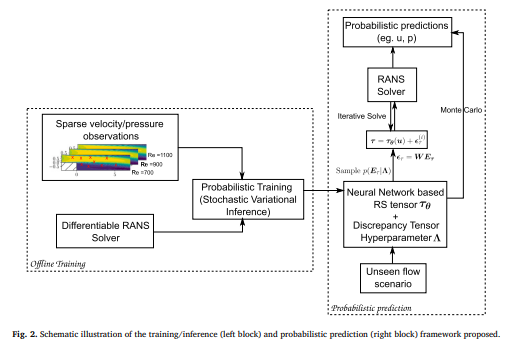
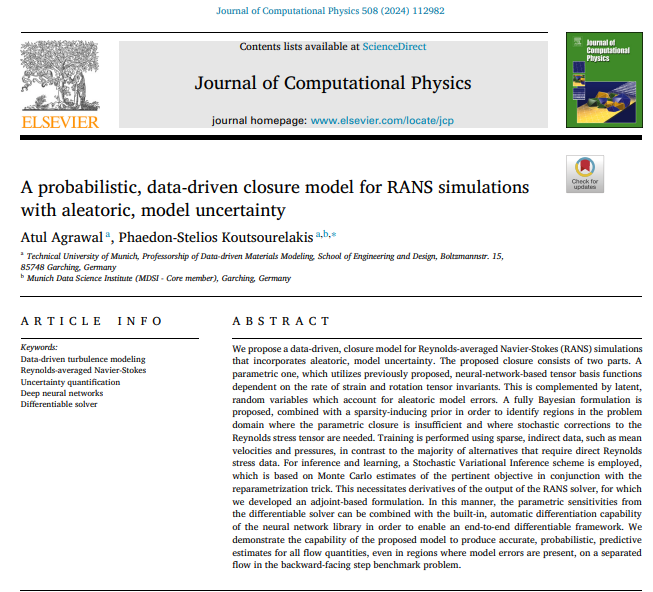
Model uncertainty remains one the most difficult topics in #Uncertainty_Quantification. Here is our attempt to quantify it in the context of the Reynolds-Averaged Navier-Stokes model #RANS, in a physically meaningful manner that still allows probabilistic predictive estimates.
Check out our new #JCP paper about:
Simple computational strategies for more effective physics-informed neural networks modeling of turbulent natural convection
The paper is freely available for next 50 days, click below.
https://t.co/0uoWCEleTs
#turbulence#AI#PINN#fluid
@RailMinIndia@AshwiniVaishnaw@IRCTCofficial Train 03170 takes 16.5 hours to traverse 560 Kms. Mean speed ~34 kph. Being a customer, I believe I deserve the right to know why so slow even in 21st century.
Interested about efficient surrogate for turbulent thermal convection? Or ML for fluid mechanics in general 👇
Work from my time in @LisnLab ( @UnivParisSaclay)
#ML#turbulence#PINNs
Physics-aware deep neural networks for surrogate modeling of turbulent natural convection. Didier Lucor, Atul Agrawal, and Anne Sergent https://t.co/iZrWALpix5
Interested in using unlabeled data (i.e. just inputs) and physical constraints in constructing efficient surrogates for PDEs with high-dimensional parametric inputs in the Small-Data regime? More information in the newly-published J. of Comp. Phys. paper https://t.co/1QHDPLDULO
Our paper on "Physics-aware, probabilistic model order reduction with guaranteed stability" has been accepted to #ICLR2021. Congratulations to Sebastian Kaltenbach for putting in all the hard work!
More details: https://t.co/PRycrtF0u8
#RAISE2020 is all set to take place from Oct 5 to 9, 2020 in a virtual avatar. The summit will host some of the world's most renowned AI leaders and decision makers - to understand how AI can be mobilised for greater social good.
Register NOW: https://t.co/I7V7elb8r7
#AIforAll