Learn, Connect, Create
• Learn coding with our resources and community
• Connect with top talent or career opportunities
• Create your own audio plug-in
Our new book "The Complete Beginner's Guide to Audio Plug-in Development" is here!
"How do I create my own audio plug-in?"
Anyone who has ever asked that question knows that the answers are complex. Audio programming is an amazing intersection of code, math, and creativity, and one of the most challenging parts is just getting started...
...until now!
This is a new collaboration with @mhollemans that's designed specifically for people who are getting started - no coding experience necessary!
Our favorite part about this book is that it TRULY takes you from the beginning and shows you not only how to get started, but also provides a foundational understanding of how plug-ins work.
This is an ideal book for...
• Sound designers
• Music producers
• Developers from other areas in software
• Audio developers seeking a better understanding of how things work
Here are just a few of the subjects we cover:
• Downloading your first IDE (both Windows & Mac)
• Getting started with the JUCE Framework
• Starting C++ from the very beginning
• Introduction to digital signal processing
• Creating your first audio plug-in
• Creating a custom look and feel
• Debugging techniques
• How to release your plug-in
...and much more!
Find out more here: https://t.co/Kcdo7DCnxy
Get the book here:
Today, I'll be speaking online with the Audio Engineering Society about the past, present, and future of audio programming!
From Bell Labs to LLMs, we've come a long way since first getting sound out of a computer. And we'll be taking a look at patterns throughout history to help us learn where we can apply our focus for the next era of music computing.
(This was a talk that was rescheduled from July)
Catch us today at 2pm Est / 7pm UK. See you there!
Ctrl+F, but for sound 🔍🔊
SpotSound just landed on Hugging Face, give it a long recording and describe what you're looking for, and it will hand back the timestamps
▶️ on Spaces https://t.co/s6STHcV539
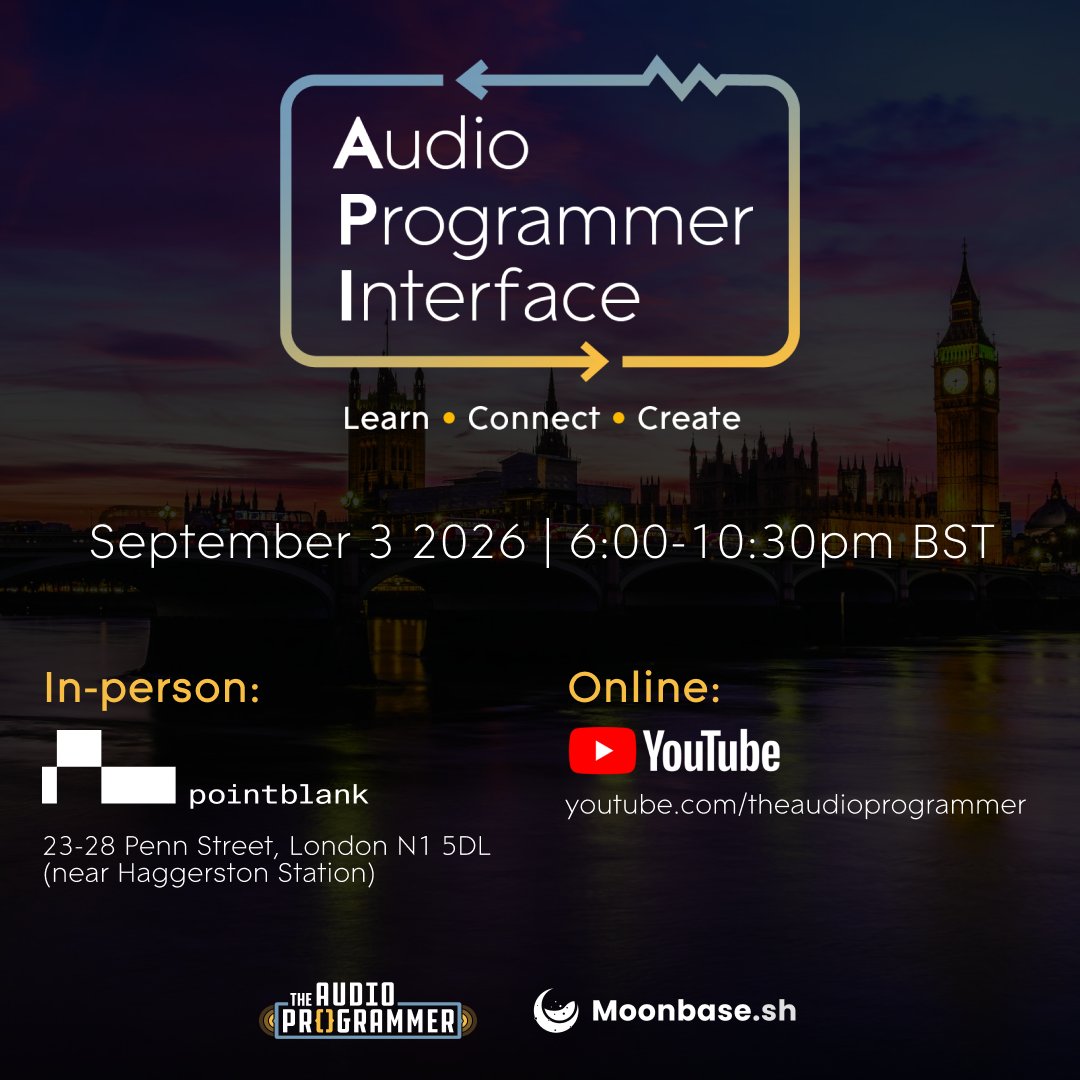
Audio devs, creators and music-tech builders in London! We’re getting together again for our next event, and you're invited.
Twice a year, we come together as a community to talk about where music and audio software is heading - from plugins and apps to the creative tools we use to build them.
And along with the talks and networking, we’re introducing something new called "Share Your Work."
Building a web app, plugin, hardware project, or something else entirely? We’d love for you to show the community what you’ve made. It’s an opportunity to put your work in front of the room and, through our livestream, the wider world.
Find out how to take part via the link below.
What the night holds:
✅ Talks from the people building tomorrow's audio tools
✅ A room full of creators who are energized about music and audio
✅ Pizza! 🍕
We'll be hosting the event in partnership with @Point_Blank Music School.
Can't make it to London? We'll be livestreaming on YouTube for the global community.
Registration is open now: https://t.co/fuYqVuwwne
Most developers can build the plugin. The hard part is getting anyone to care.
Tomorrow we're going live on why most audio plugins never sell, and what actually works.
We're sitting down with Dani Karanyi, founder of Karanyi Sounds. They're a boutique plugin brand with over 100,000+users, including Grammy-winning producers and composers scoring Netflix trailers. Dani approaches plugins as a producer first and a developer second, and he's going to show what that looks like when you're building a real business.
Here's what we'll get into:
✅ Why marketing is the harder half of the plugin business
✅ How positioning and sub-brands beat a feature list
✅ The real economics of your own store vs. resellers vs. regional distribution
✅ Launch mechanics: pricing, DLC, bundles and sale cadence
✅ The mistakes that cost him, and why most indie teams need marketing capability in-house rather than an agency
We're streaming live, so bring your questions. We'll be taking them in real time!
Join us here: https://t.co/2WT7fVJHIa
Connect with the global audio developer community.
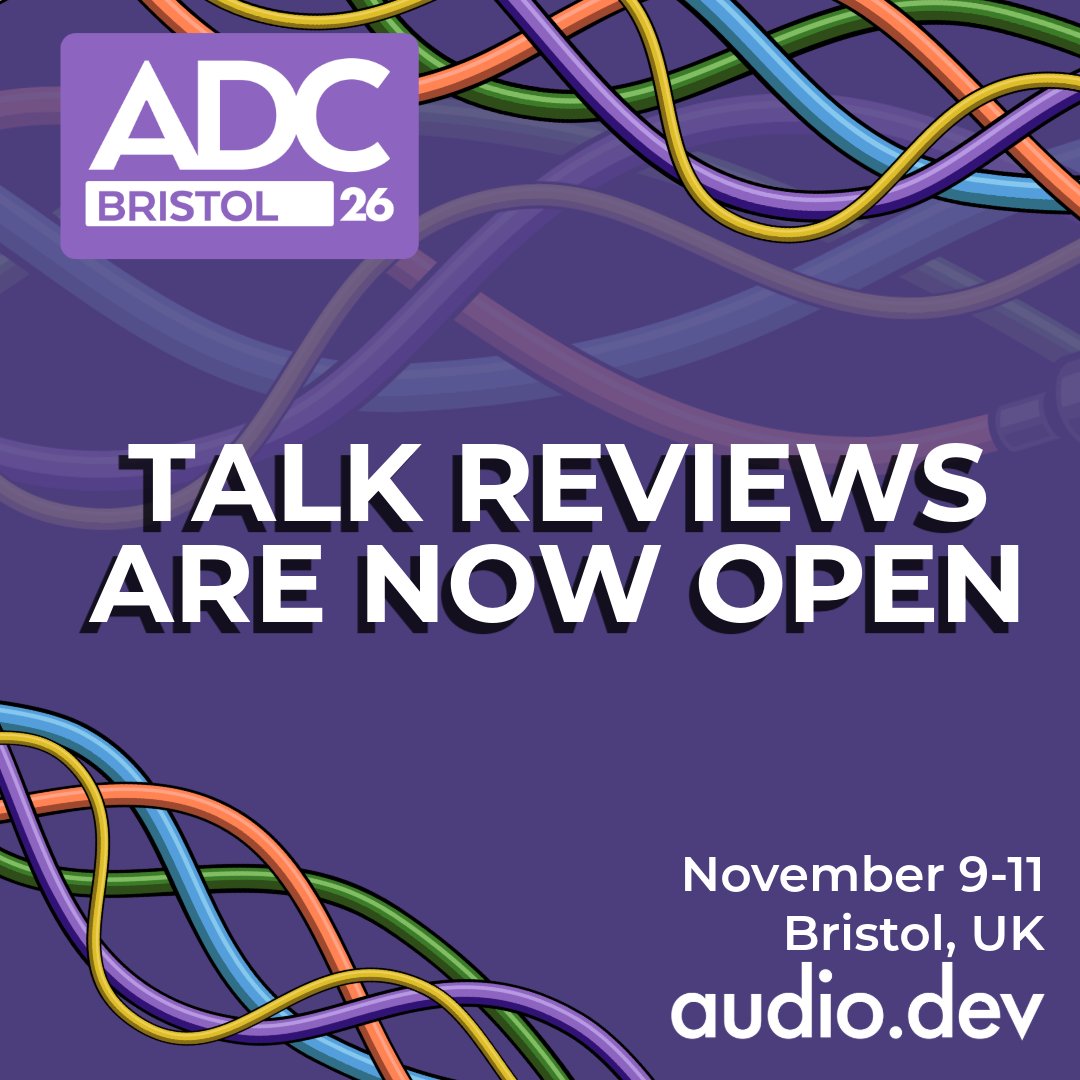
Sponsor ADC Bristol 2026 and showcase your technology while supporting education, collaboration, and innovation.
Join Us! Nov 9-11 Bristol UK & Online
https://t.co/n2QJyMFVf2
#audio#developer#programmer#programming#coding
Building audio products that people love to use is tough...
Getting investment to build those products is even tougher.
I found someone who has done both!
Meet Max Shafer, Co-Founder of Just 4 Noise. They're an ethical AI audio company based out of Berlin.
I had a great conversation with him about the challenges of building an audio plugin company in this saturated industry, using AI in a way that doesn't repulse customers, and the journey of finding investment along the way!
https://t.co/K909IhdgKa
Isn't it just wonderful how we can talk to these ancient machines from half a century ago? Available now on GitHub, I've completely overhauled my old Atari 2600 MIDI interface as the "A26F-neo". Simpler hardware, better control, more samples. https://t.co/RBiTjiJpBc
This week I learned how to teach audio synthesizers how to program themselves using LAION-AI/CLAP audio embedding in my application https://t.co/hEiYeJyQQu
Help shape the Audio Developer Conference program!
Last call to review talk proposals. vote for your favorites, and help decide what takes the stage this November.
Comparative Reviews close July 17. Get started:
https://t.co/wSW98OFOd2
#audio#developer#programmer
The best way to predict the future is to understand the past.
Tomorrow I'm speaking for AES UK. My talk is called "Audio Programming: Where We've Been, Where We Are, & Where We're Heading."
Many rules that worked even one year ago is rapidly changing. AI is transforming the playbook at an unprecedented pace, and the skills that got people hired over the past year are transforming rapidly over time.
Over the past 9 years at The Audio Programmer, I've watched this industry shift in ways nobody expected. I've seen what separates the people who thrive from the ones who get left behind.
In this talk, I'll share three key approaches I've seen creators use to find success in this new era of audio development.
Whether you're in academia looking to transition into industry, or a professional dealing with industry changes, this talk offers valuable insights.
📅 Tuesday 14th July, 7pm BST
💻 Free registration via Zoom
Help shape the Audio Developer Conference program!
The ADC Bristol UK 2026 Community Review is now open. Review talk proposals, vote for your favorites, and help decide what takes the stage this November.
Comparative Reviews close July 17.
Get started: https://t.co/wSW98OFOd2
How do you level up your plugin UIs from beginner to a more polished result?
One way is to use a PNG strip (sometimes called a filmstrip or sprite).
This is single image with dozens of pre-rendered frames, each one rotated slightly further than the last. The plugin just picks the right frame based on where the knob is pointing.
It's the same concept as a flipbook animation. Simple idea, professional result.
In this latest tutorial, I walk through exactly how to set this up in JUCE:
✅ Build a LookAndFeel class that pulls from the filmstrip
✅ Create a reusable knob component for this project and future ones
✅ Wire it to your parameters and get it on screen
Once the foundation is there, adding new knobs takes just two lines of code.
This is Part 5 of our sampler series.
Watch here: https://t.co/uG1UhRCOiZ
AI can write your DSP algorithms now. But can it tell you when they're broken?
More developers are using AI to generate signal processing code. It's fast, it's exciting, and honestly, it works better than I expected.
But I keep seeing this: the code compiles, the plugin loads, and the output sounds... off. You get a filter that drifts, or a saturation curve that clips wrong. It's subtle stuff that passes a listening test until it doesn't.
DSP breaks in ways that are hard to catch by ear. And when you're generating code with AI, you're trusting something that doesn't know what "correct" sounds like.
That's why I'm excited about what Daniel Leonov is presenting at our meetup today. He built HART, a test framework specifically for audio DSP. It's the kind of tool that lets you verify your algorithms are actually doing what you think they're doing.
If you're writing DSP (especially with AI in the loop), you won't want to miss this one.
📅 Today, Thursday June 11
🕡 18:30 UK / 13:30 EST
🔗 https://t.co/orjMzCUkOO
See you there! 👋
@audioprogrammer The hard part is still knowing what failure sounds like. A plugin can compile, load, and still be wrong in the places that only show up under real session pressure.