Interested in automated scoring of speech recall across languages? Check out this new preprint. https://t.co/XSKPoFmbbM
Possibly helping the hearing sciences to use more naturalistic speech materials to assess comprehension.
New work from the lab on PsyArXiv. We show that older adults recognize less well modern AI-based speech. This seems to be unrelated to hearing loss, but rather to the processing of prosodic information in speech: https://t.co/8uTOKUY3IA
Interested in graduate studies at @uoft and the @rotmanresearch in the hearing and aging space? please get in touch with @bjoherrmann. We are looking for two graduate students, one in the brain health space and one in the social health space. We would love hearing from you!
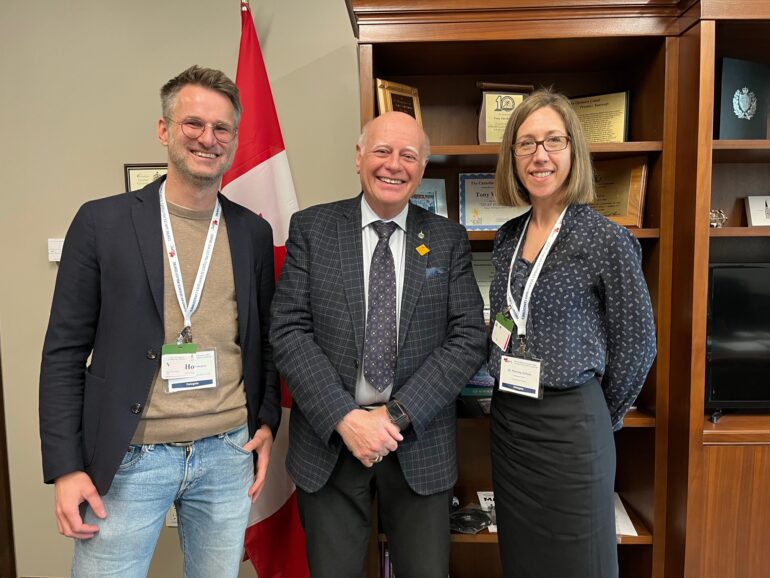
The Canadian Science Policy Center's Science Meets Parliament program is bridging the gap between scientists and parliamentarians. This program is a game-changer, empowering scientists to actively contribute to evidence-based decision-making: https://t.co/70M2xUILMw @TonyVanBynen
New lab work: In this study we show that natural language processing models (from Google and OpenAI) can be used to automate speech-intelligibility scoring. Intelligibility from human and NLP scoring correlate 0.95. Python code is provided.
https://t.co/8lDc1smImh
I think it's pretty cool when hearing aids get mentioned in a #SOTU address: "Millions of Americans can now save thousands of dollars because they can finally get hearing aids over-the-counter without a prescription." Hear, hear!!
New lab work ready https://t.co/UgKDqIxdQi with @mecui22 & @bjoherrmann
We show that eye movements decrease during effortful listening. We demonstrate this for sentences and spoken stories as well as under different visual conditions (fixation, free viewing, object tracking).
Newest lab work: Exploring whether modern AI-based synthesized speech may be useful for hearing research; common speech-in-noise perception phenomena are similar for AI vs human speech; and older adults notice substantially less the presence of AI speech.
https://t.co/2h8eE0Dpgd
We are happy to see this one explore the world. We find age-related changes in alpha oscillatory activity during dynamic attention in time under listening challenges (with @MollyJHenry, @burkhardmaess, @jonasobleser, @ingridjohnsrude).
https://t.co/H1aXDhE3sR
Job alert! Join @rotmanresearch in Toronto, Canada, as the new executive director:
https://t.co/mbrJiABT0U
We are a great team of scientists + amazing opportunities at the RRI to push forward research on the aging brain. Feel free to get in touch for more infos.
Awesome news from the Auditory Aging team. Our @CopelliFran was awarded a 2022 CGS-M Canadian Graduate Scholarship award from @CIHR_IRSC to work on neural markers of naturalistic speech. Thanks also to @rotmanresearch@UofT. We are look forward to seeing results of this research.
Dip-listening (masking release) is often reduced in older adults. We find this is the case only for disconnected sentences. Older adults benefit as much from dip-listening when listening to engaging stories. To appear in Sci Rep (V.Irsik @ingridjohnsrude): https://t.co/i87l6GkUJ3
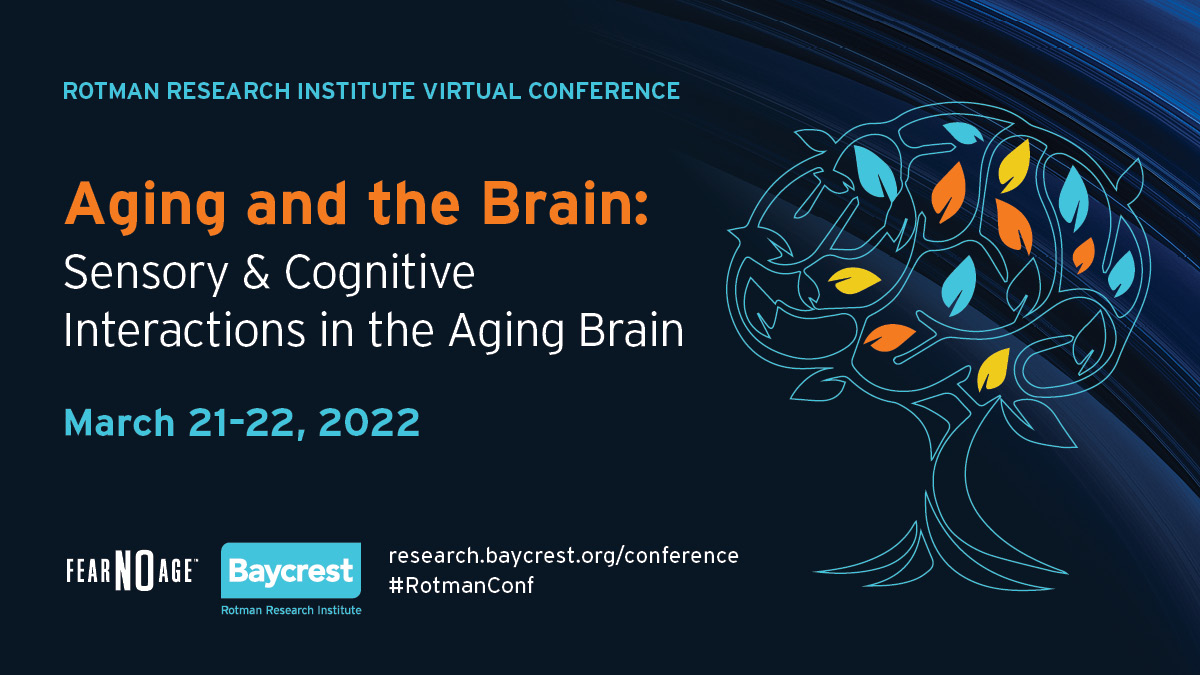
Just one week to go until the #RotmanConf! Don't miss this chance to learn about the latest breakthroughs in Sensory & Cognitive Interactions in the Aging Brain.
Registration & details: https://t.co/1mdophElZg
Registration is OPEN for the 2022 Rotman Research Institute Virtual Conference on March 21 & 22!
Don’t miss out! Due date for poster abstracts is February 14 & early bird registration deadline is March 1.
Details: https://t.co/7vz0W17fB7
We are looking for a postdoc with qualitative research skills. One week left until deadline (25th). If you know someone who could be interested, please forward.
Postdoc call now official: focus on listening experiences in people with late-life vision impairment (@rotmanresearch also with @Amanda__Grenier:
https://t.co/eS5G0lKEFW
Qualitative research; community engagement. May also hire a #graduate student in this area. Get in touch.