Welcome to the Official Account of the Holy Roman Empire Association - Associazioni dei Nobili del Sacro Romano Impero - HREA is an Organization that was established in 1963 with the aim of uniting descendants in the male and female line of individuals who were granted Noble Titles by the Holy Roman Empire through Imperial Letters Patent.
Foundation of the HREA: Founded on Christmas Day in Rome in 1963, the HREA seeks to connect living descendants of noble families from the Holy Roman Empire. The association was initiated by Prince Giovanni Alliata di Montereale and Count Giancarlo Bonifazi di Statte.
Purpose and Activities: The HREA serves as the supreme governing authority over the titles of nobility of the Holy Roman Empire, managing an official list of those who have the right to bear and enjoy these titles and armorial bearings. It also engages in cultural and historical preservation activities, including organizing events related to art and history. The association has reinstated historical institutions like the Aulic Council (Consilium Aulicum - Reichshofrat) and the Imperial Chamber Court (Reichskammergericht - Iudicium imperii) to maintain the tradition and legal aspects of the Holy Roman Empire.
Membership and Recognition: Membership is typically for those with a direct lineage to nobility titles, although honorary members also exist. The Association is recognized for its role in preserving the heritage of the Holy Roman Empire and its Nobility, with members including all the Princes, Dukes, Marquises, Counts, Barons and Nobles of the Holy Roman Empire from different Nobles families across Europe.
Geographical Presence: While it has a strong presence in Italy due to its founding in Rome, the Headquarters of the HREA is in the UK with additional Offices in Italy and Monaco.
Cultural Impact: The HREA contributes to cultural history by maintaining records, hosting events, and actively participating in discussions about the Holy Roman Empire's legacy, where it shares historical artifacts and regalia connected to the Empire. The HREA, therefore, plays a crucial role in the preservation of the historical, cultural, and legal aspects of the nobility associated with the Holy Roman Empire, connecting past traditions with contemporary society.
Email:
[email protected][email protected]
Websites:
https://t.co/PxN0c0VUAZ
Copyright Held - 1963-2025 - All Rights Reserved Protected by U.S. and International Copyright Laws.
The Hals-Doppeladler of the Order of Dignity of the Hereditary First Knight of the Holy Roman Empire. First Established in September of 1790 by the Holy Roman Emperor Leopold II (1747-1792) and presently conferred by the Chancellor of the Holy Roman Empire Association - Associazioni dei Nobili del Sacro Romano Impero, as Grand Master of the Order, upon members of the HREA, members of the Nobility of the Holy Roman Empire of the German Nation.
https://t.co/pAB77lfVg5
https://t.co/G2bBVBgsIo
God Save the Holy Roman Emperor - Gott schütze den Kaiser des Heiligen Römischen Reiches - Dio salvi il Sacro Romano Imperatore.
https://t.co/lbkvVcYmRU
https://t.co/7ehbqavWe5
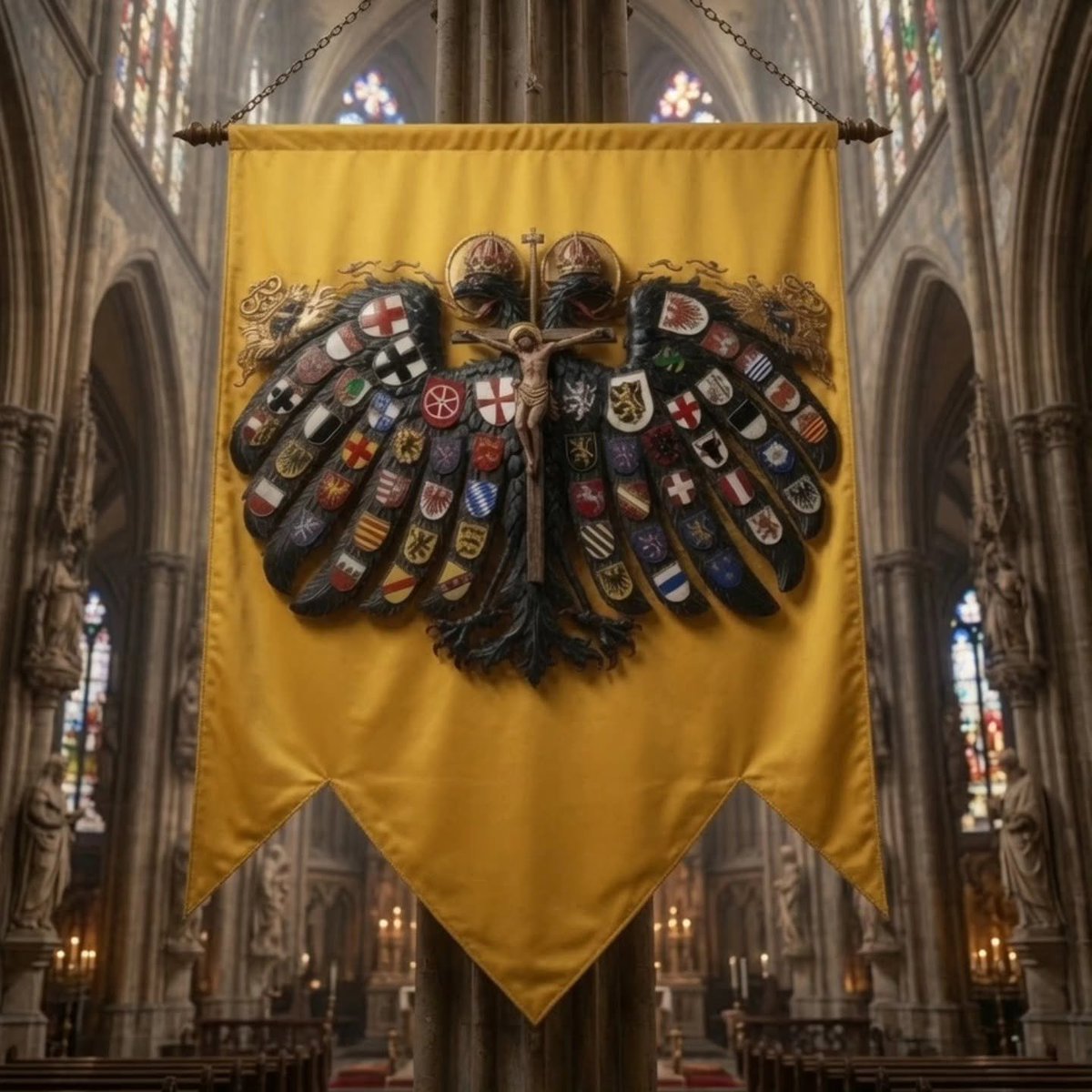
The Quaternion Eagle Banner of the Holy Roman Empire Association - Associazioni dei Nobili del Sacro Romano Impero - HREA, Established in 1963 In Rome.
The Quaternion Eagle (German: Quaternionenadler; Italian: aquila quaternione), also known as the Imperial Quaternion Eagle (German: Quaternionen-Reichsadler) or simply Imperial Eagle (German: Reichsadler), was an informal coat of arms of the Holy Roman Empire. It mixed two pre-existing concepts: the Imperial Quaternions and the Imperial Eagle (double-headed eagle).
https://t.co/pAB77lfVg5
https://t.co/G2bBVBgsIo
The Imperial Doppelalder Banner of the Holy Roman Empire of the German Nation - Das kaiserliche Doppelalder-Banner des Heiligen Römischen Reiches Deutscher Nation - Imperial Doppelalder Vexillum Sacri Romani Imperii Germanicae Nationis - Lo stendardo imperiale Doppelalder del Sacro Romano Impero della Nazione Tedesca.
https://t.co/pAB77lfVg5
The Bust of Charlemagne (German: Karlsbüste) is a reliquary from around 1350 which contains the top part of Charlemagne's skull. The reliquary is part of the treasure kept in the Aachen Cathedral Treasury. Made in the Mosan region (the valley of the River Meuse), long a centre of high-quality metalwork, the bust is a masterpiece both of late Gothic metalwork and of figural sculpture. The Bust of Charlemagne, as a masterpiece of Mosan goldwork, initiated a height of silver-gilt naturalistic reliquary busts.
https://t.co/pAB77lfVg5
https://t.co/eSV2DpoJhL
Portrait of Frederick III, Holy Roman Emperor (1415-1493), with his wife Eleanor of Portugal, Holy Roman Empress (1434-1467).
https://t.co/lbkvVcYmRU
https://t.co/7ehbqavWe5
Emperor Frederick III (German: Friedrich III, 21 September 1415 – 19 August 1493) was Holy Roman Emperor from 1452 until his death in 1493. He was the penultimate Emperor to be Crowned by the Pope, and the last to be crowned in Rome. He was the first Emperor from the House of Habsburg.
https://t.co/pAB77lfVg5
https://t.co/G2bBVBgsIo
The Turnierbuch Ritterspiele gehalten von Kaiser Friedrich III und Kaiser Maximilian I in den Jahren 1489 - 1511 (Cod.icon. 398) is a Tournament Book of the Holy Roman Empire of the German Nation created in ca. 1511. The original currently rests in the holdings of the Bayerische Staatsbibliothek in Munich, Germany.
Das Turnierbuch Ritterspiele gehalten von Kaiser Friedrich III. und Kaiser Maximilian I. in den Jahren 1489 - 1511 (Cod.icon. 398) ist ein Turnierbuch des Heiligen Römischen Reiches Deutscher Nation, das ca. 1511. Das Original befindet sich derzeit im Bestand der Bayerischen Staatsbibliothek in München.
https://t.co/pAB77lfVg5
Father of Europe - Emperor Charlemagne - Charles the Great - Karl der Große - Carlo Magno (2 April 748 – 28 January 814) was King of the Franks from 768, King of the Lombards from 774, and Emperor of what is now known as the Carolingian Empire from 800. He united most of Western and Central Europe, and was the first recognised Emperor to rule from the west after the fall of the Western Roman Empire approximately three centuries earlier. Charlemagne's reign was marked by political and social changes that had lasting influence on Europe throughout the Middle Ages.
https://t.co/pAB77lfVg5
https://t.co/G2bBVBgsIo
+ One Empire under God, One Rule Under Christ, One Reich for all Time +
The Map, Shields and the Imperial Doppeladler of the Holy Roman Empire of the German Nation - Mappa, scudi e il sosia imperiale del Sacro Romano Impero della nazione germanica - Tabula Geographica, Scuta et Doppeladler Imperialis Sacri Romani Imperii Nationis Germanicae - Karte, Schilde und der Reichsdoppeladler des Heiligen Römischen Reiches Deutscher Nation.
https://t.co/pAB77lfVg5
https://t.co/G2bBVBgsIo
The Quaternion Eagle Banner of the Holy Roman Empire Association - Associazioni dei Nobili del Sacro Romano Impero - HREA, Established in 1963 In Rome.
The Quaternion Eagle (German: Quaternionenadler; Italian: aquila quaternione), also known as the Imperial Quaternion Eagle (German: Quaternionen-Reichsadler) or simply Imperial Eagle (German: Reichsadler), was an informal coat of arms of the Holy Roman Empire. It mixed two pre-existing concepts: the Imperial Quaternions and the Imperial Eagle (double-headed eagle).
https://t.co/pAB77lfVg5
https://t.co/G2bBVBgsIo
The Quaternion Eagle (German: Quaternionenadler; Italian: aquila quaternione), also known as the Imperial Quaternion Eagle (German: Quaternionen-Reichsadler) or simply Imperial Eagle (German: Reichsadler), was an informal coat of arms of the Holy Roman Empire. It mixed two pre-existing concepts: the Imperial Quaternions and the Imperial Eagle (double-headed eagle). https://t.co/pAB77lfVg5
The Territorial Map of Holy Roman Empire in 1648 - Die Gebietskarte des Heiligen Römischen Reiches im Jahr 1648 - Mappa territoriale del Sacro Romano Impero nel 1648 - Tabula Territorialis Sacri Romani Imperii anno 1648.
https://t.co/lbkvVcYmRU
https://t.co/7ehbqavWe5
The Imperial Regalia, also called Imperial Insignia (in German Reichskleinodien, Reichsinsignien or Reichsschatz), are regalia of the Holy Roman Emperor. The most important parts are the Crown, the Imperial orb, the Imperial sceptre, the Holy Lance and the Imperial Sword. Today they are kept at the Imperial Treasury in the Hofburg palace in Vienna, Austria.
The Imperial Regalia are the only completely preserved regalia from the Middle Ages. During the late Middle Ages, the word Imperial Regalia (Reichskleinodien) had many variations in the Latin language. The regalia were named in Latin: insignia imperialia, regalia insignia, insignia imperalis capellae quae regalia dicuntur and other similar words.
https://t.co/pAB77lfVg5
The Imperial Regalia, also called Imperial Insignia (in German Reichskleinodien, Reichsinsignien or Reichsschatz), are regalia of the Holy Roman Emperor. The most important parts are the Crown, the Imperial orb, the Imperial sceptre, the Holy Lance and the Imperial Sword. Today they are kept at the Imperial Treasury in the Hofburg palace in Vienna, Austria.
The Imperial Regalia are the only completely preserved regalia from the Middle Ages. During the late Middle Ages, the word Imperial Regalia (Reichskleinodien) had many variations in the Latin language. The regalia were named in Latin: insignia imperialia, regalia insignia, insignia imperalis capellae quae regalia dicuntur and other similar words.
https://t.co/pAB77lfVg5