“Cochlear implants are sound implants: they are not language implants, nor are they learning implants. While many deaf children learn to use this sound to develop spoken language & learning, these are not guaranteed outcomes for all children” (my latest dissertation draft 🧐🎯)
@LingdeptGU As a former HKNC teacher (late 80’s), I agree! Then we had Bob Smithdas and his wife Michelle, a DeafBlind couple who I learned more from than ANYONE. Bob was friends with Helen Keller and was an HKNC administrator. Michelle taught in the Communication Learning Center 🥹
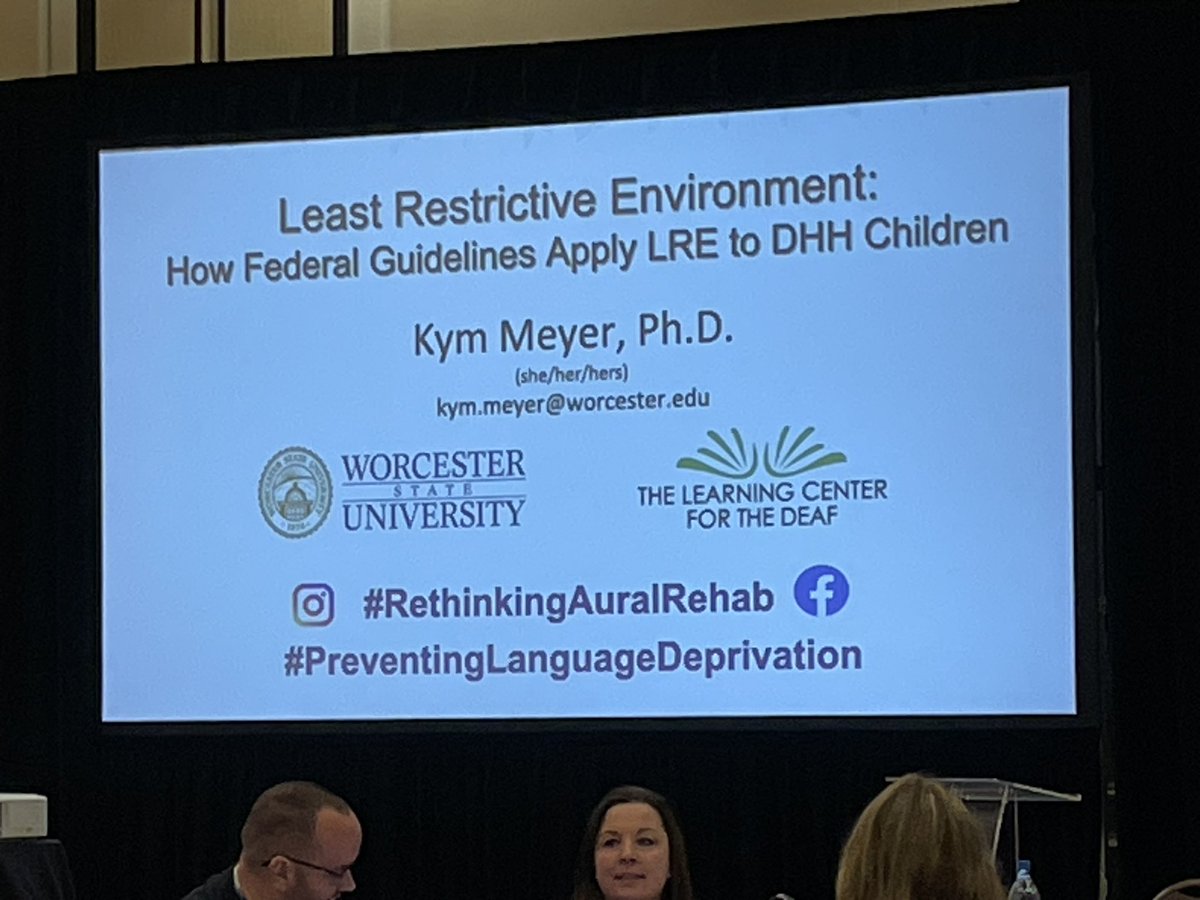
Thank you @ceasd1868 (hosted by @scsdb175th) for inviting me to present “Least Restrictive Environment: How Federal Guidelines Apply to DHH Children” at the CEASD Conference! It was well-received and many folks said they can’t wait for us to publish the updated version.
My #RethinkingAuralRehab graduate SLP students are watching
#SigningBlackInAmerica. In this post, Dr. Joseph Hill, one of the documentary’s researchers and presenters, shares challenges to find Black male interpreters to voice for him.
Watch 🎬 & read🧵: https://t.co/xmArOwQMuI
Early signed language exposure does not negatively impact spoken language processing in deaf CI users but may instead potentially offset negative effects of language deprivation without any signed language exposure experience prior to implantation. https://t.co/sDFwDUxHOC
#tdih 1990 "Capitol Crawl" as part of months long protest by disability rights activists at the White House and U.S. Capitol.
Read more below & watch the excellent documentary, @CripCampFilm about history of disability rights activism, the ADA, & more.
https://t.co/JF1ipVUUY6
#RethinkingAuralRehab: A New Framework for Teaching, Supervising, and Engaging in Clinical Work
This course will help make changes to your aural rehabilitation class to improve deaf/hard of hearing (DHH) language outcomes
Share with SLPs & AuDs 🗣️🦻🏻🤟🏼
https://t.co/lr0G2w7Z5X
@KatBrockway@MarieCoppola68 This Deaf Yes training video needs to be watched by every healthcare provider and shown in medical schools. https://t.co/08sLE3m41q
@msrebeccabirch@TheAaveMaria A better teacher would ask, why isn’t the school providing appropriate support for children with emotional/behavioral concerns, instead of dumping them in an inclusion class, and poorly expecting the teacher to take care of it. Blame systems/principals/supervisors, not children.
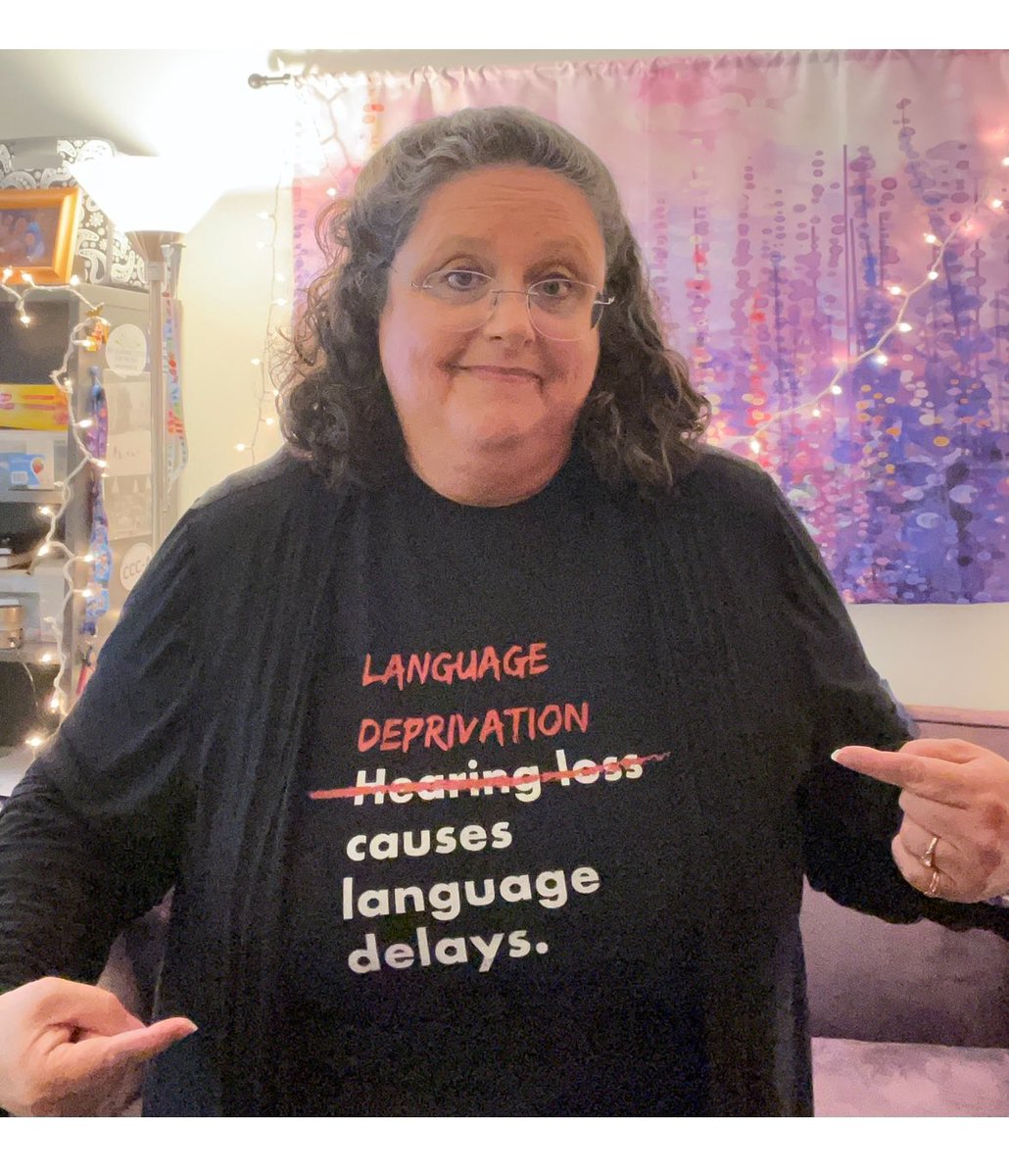
❤️ wearing ⬇️ t-shirt to teach #PreventingLanguageDeprivation to #RethinkingAuralRehab SLP grad students. Discussed why “Language Deprivation & Deaf Mental Health” (Glickman & Hall) has that title & showed the PBS “Language Deprivation” documentary: https://t.co/uXSzxoTkF1
@LocoLindoLA @TerynceTeaches NO! Please delete this link. They have stolen this and are profiting off the Deaf small business owner who created it. I will post the actual link
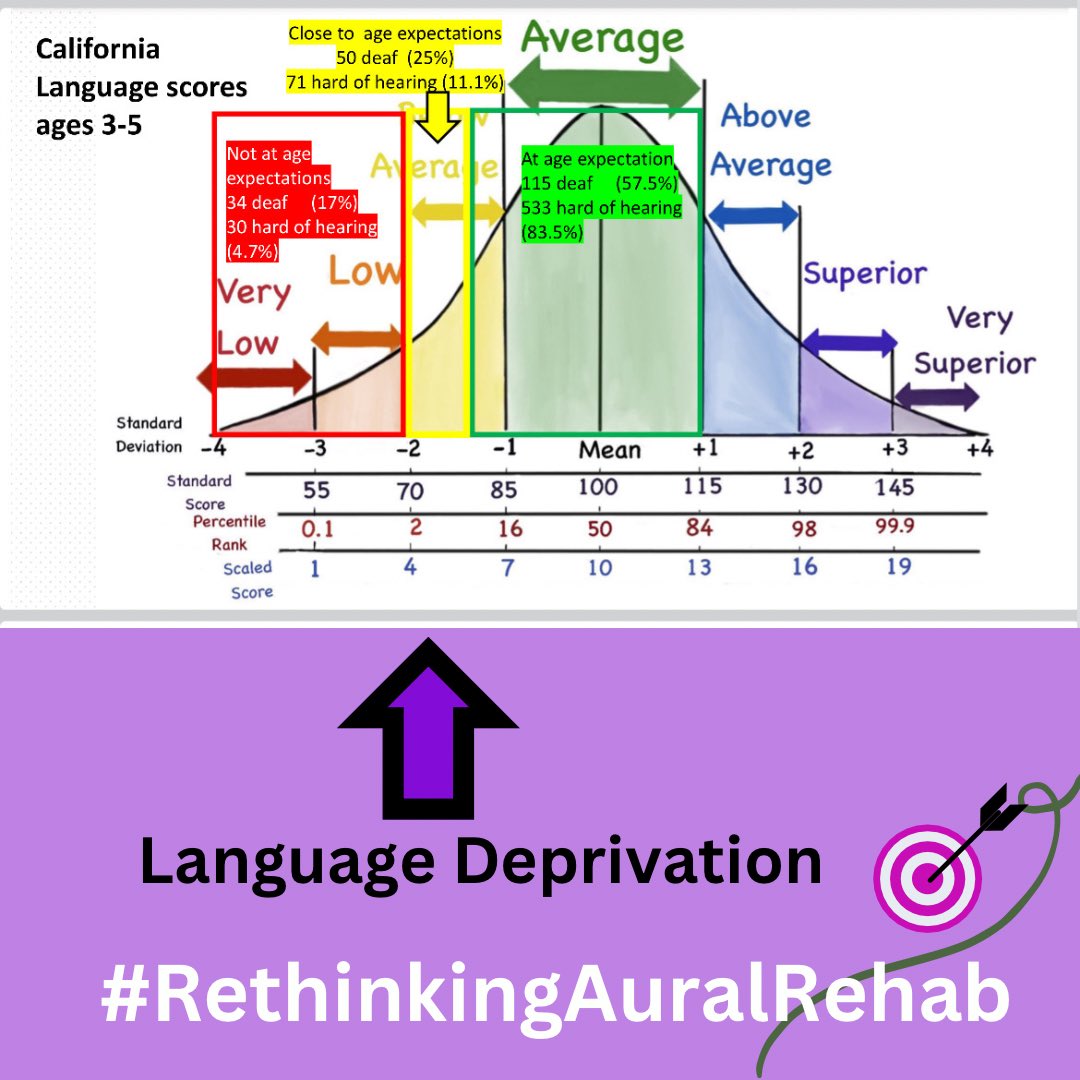
#RethinkingAuralRehab requires understanding research & data to prevent language deprivation. Slides are from this week‘s grad class. Certain states collect language outcome data of all deaf/hard of hearing children (following passage of state legislation).
@MarieCoppola68 I’m all for a graphic to make language deprivation visible and understandable to the not-us crowd. My grad students understood more 🤯💡when the data they read was superimposed like this (on the normal distribution chart they’ve seen all semester). Ideas for something better?
@MarieCoppola68 As I tell my SLP grad students: “the children in green and above are getting what they need and their language is meeting our expectations. I’m not worried about them.
YOU need to focus your concern and raise language expectations for children who fall to the left of the green”
@MarieCoppola68 California only identified “at expectations” which could also be above. Other states’ data separates out “at” and “above.”
State data that shows “below” (and they all have students that fall into this category) is the #LanguageDeprivation focus of concern.