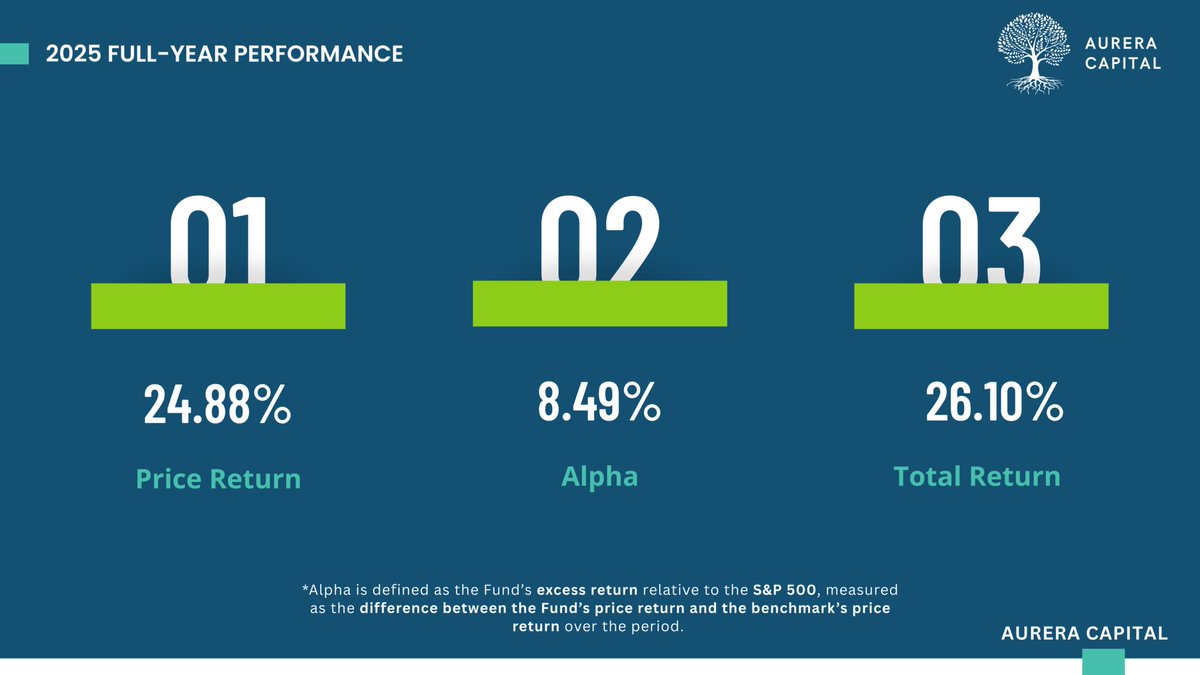
1/4 - Aurera Global Equities Fund — 2025 full-year: +24.88% price return vs the S&P 500 (benchmark) + 16.39%. That's 8.49% of outperformance, delivered with a concentrated 15-position book. The Fund's +26.10% total return represents price appreciation plus dividends.
This is a long awaited move, and one we are excited about. In the past, we spoke about how $META needs to diversify beyond its advertising engine as the core ad business matures. Subscriptions across Instagram, Facebook, and WhatsApp give Meta a new way to monetise its significant user base without relying solely on ads.
Investors seem to be receiving this positively as reflected by the stock price, because it points to significant revenue diversification. Current estimates suggest this new business segment could add around 2% to 4% to revenue and lift operating profit by 3% to 5%. For a platform with billions of engaged users, even modest adoption can become a meaningful, high margin revenue stream.
We estimate that if launched in H2 2026, the service could generate around $1.7 billion in revenue this year, lifting Meta's revenue by 0.86% and operating profit by $1.3 billion or 1.59%. In FY27, its first full year, we estimate revenue could reach $10.30 billion, lifting revenue by 5.12% compared to FY25, while operating profit could rise by $7.87 billion, or 9.45%.
Overall, this is a move in the right direct and could be a major catalyst for the stock. The next big question is how $META monetises AI beyond ads and image or video generation. We think their biggest opportunity could be an enterprise AI platform built around Meta's consumer behaviour and engagement data, almost like a real time consultant for brands and creators. It could tell a sneaker brand what designs are trending among 18 to 21 year olds in London, or show a creator which video styles are gaining traction in a specific market. That would move Meta from selling ads to selling intelligence.
It really is.
This is a long awaited move, and one we are excited about. We have spoken before about how $META needs to diversify beyond its advertising engine as the core ad business matures. Subscriptions across Instagram, Facebook, and WhatsApp give Meta a clean new way to monetise its significant user base without relying solely on ads.
Investors seem to be receiving this positively as reflected by the stock price, because it points to significant revenue diversification. Current estimates suggest these tiers could add around 2% to 4% to revenue and lift operating profit by 3% to 5%. For a platform with billions of engaged users, even modest adoption can become a meaningful, high margin revenue stream.
By our estimates, if launched in H2 2026, the service could generate around $1.7 billion in revenue this year, lifting Meta's revenue by 0.86% and operating profit by $1.3 billion or 1.59%. In FY27, its first full year, we estimate revenue could reach $10.30 billion, lifting revenue by 5.12% compared to FY25, while operating profit could rise by $7.87 billion, or 9.45%.
Overall, this is a move in the right direct and could be a major catalyst for the stock. The next big question is how $META monetises AI beyond ads and image or video generation. We think the bigger opportunity could be an enterprise AI platform built around Meta's consumer behaviour and engagement data, almost like a real time consultant for brands and creators. It could tell a sneaker brands what designs are trending among 18 to 21 year olds in London, or show a business which video styles are gaining traction in a specific market. That would move Meta from selling ads to selling intelligence.
This is a long awaited move from $META, and one we are excited about. We had spoken before about how Meta needs to diversify beyond its advertising engine, especially as growth in the core ad business becomes more mature. A paid subscription layer across Instagram, Facebook, and WhatsApp gives Meta another way to monetise its huge user base without relying only on ads.
Investors seem to be taking the news positively because it shows Meta is thinking more seriously about revenue diversification. Current estimates suggest these paid tiers could add around 2% to 4% to revenue and potentially increase operating profit by 3% to 5%.
By our estimates, if the service launches in the second half of 2026, it could generate around $1.7 billion in revenue this year. That would lift Meta's revenue by roughly 0.86%, while operating profit could rise by about $1.3 billion, or 1.59%. For FY27, which would be the first full year of contribution, we estimate the service could generate $10.30 billion in revenue, lifting their revenue by 5.12% (compared to FY25), while operating profit could increase by $7.87 billion, or 9.45%.
All in all, this is a move in the right direction and will likely be a major catalyst for the stock. What investors will want to see next is how $META monetises AI beyond improving its advertising business. One opportunity we have spoken on beyond their current AI platform which is set to focus on image and video generation, could be an enterprise focused model, built around Meta's unique advantage in consumer behaviour, and engagement data. This could act almost like a real time consultant for businesses, brands, and creators, advising them on what trends are gaining traction among specific age groups, cities, or countries. For instance, it could tell a sneaker brand what product designs are resonating most with 18-21 year olds in London. That would move Meta from only selling ads to selling intelligence, helping businesses understand culture, demand, and consumer behaviour in real time.
Uber's move to increase its stake in Delivery Hero is interesting because it would give the company deeper access to some of the most attractive delivery markets outside its core Western geographies.
The biggest opportunity is Asia, which remains the largest delivery market and a major source of GMV, with South Korea standing out as the clearest entry point through Delivery Hero's ownership of Baemin. For Uber, this would be about gaining access to consumer behaviour, restaurant and store relationships, and delivery infrastructure that would be difficult and expensive to build organically.
The Middle East opportunity is also important. Through Delivery Hero, Uber would strengthen its exposure to platforms such as talabat and HungerStation, giving it a broader position in high-growth markets where delivery is moving beyond restaurants into groceries, and convenience.
A full takeover would be a much larger step, but the strategic logic is clear. Delivery Hero would give Uber greater exposure to Asia, and a stronger position in the Middle East.
One of the names we have the most confidence in within our Aurera Capital Global Equities Fund for 2026, is Amazon (NASDAQ:AMZN) - $AMZN
Our long term constructive view is built on one central idea. Amazon is now a global infrastructure platform across cloud, logistics, commerce, and connectivity.
There are three reasons why we remain highly constructive on the stock.
1. AWS having the largest absolute growth potential
AWS remains Amazon's most important profit engine.
In FY25, AWS generated ~$129B in revenue. If AWS compounds at roughly 17% annually, as forecasted by their CEO, revenue could reach close to $283B by 2030. At a slightly higher teens growth rate, revenue could move toward $305B
The operating income impact would be substantial. If AWS sustained margins close to current levels, it could generate around $100B to $110B in operating income by 2030, compared to roughly $46B in FY25.
This means AWS alone could add more than $60B in incremental operating income over the next five years.
2. Amazon's logistics expansion is under appreciated
Amazon's move into broader supply chain services could become one of its next major growth engines.
The company is now opening its logistics network to third-party businesses. Amazon's greatest advantage is that it is not entering logistics from scratch. It already has the warehouses, fulfilment centres, cargo planes, delivery systems, and data infrastructure.
That is why the market reaction was so significant. UPS and FedEx both fell sharply on the news, showing that investors understand the competitive threat.
Global logistics is a trillion dollar market, and Amazon has a rare advantage, in that it can monetise the infrastructure it has already built.
3. Amazon Leo could strengthen the enterprise ecosystem
Amazon Leo, is another long term opportunity we think the market may be underestimating.
We do not see Leo mainly as a consumer internet product. The more attractive opportunity is enterprise connectivity. Amazon already has substantial relationships through AWS. If satellite internet becomes a valuable connectivity layer, Amazon could bundle Leo with AWS, giving enterprise customers cloud services and satellite connectivity as one package.
This gives Amazon a lower customer acquisition cost than most standalone satellite internet connectivity businesses.
We see Leo becoming a key facet in Amazon's infrastructure ecosystem.
---
Amazon's biggest opportunity may not be in what it sells, but in the infrastructure it is building for the digital economy. AWS gives it cloud infrastructure, its logistics business gives it physical infrastructure, Leo could become its connectivity infrastructure, and advertising and marketplace services gives it commerce infrastructure. This is why Amazon remains our single highest-conviction stock over the long term. While the market still sees Amazon as a large platform, we see it is as a company building and monetising the infrastructure layer of the digital economy.
At Aurera Capital, we do not conform to the idea that investors can consistently time the market.
However, we do believe investors should pay close attention to liquidity events that can alter market behaviour.
Ray Dalio has argued that bubbles do not usually burst because valuations are high. They burst when investors are forced, or incentivised, to sell assets in order to raise cash. His example was a wealth tax or similar tax event that forces holders of financial assets to liquidate equity holdings.
We think a different version of this dynamic may be forming:
1. The IPO Liquidity Event
The potential IPOs of OpenAI, SpaceX and Anthropic, could become one of the most important liquidity events in the market.
Our concern is not the IPO themselves but the funding rotation they could trigger.
In the first phase, investors may begin reducing exposure to current AI leaders and other "priced for perfection" names in order to create room for these new listings. That would not necessarily cause a sharp immediate correction. It would more likely create a gradual selloff across over-owned and highly valued parts of the market, which could lead to negative sentiment around the AI trend emerging.
In the second phase, once these companies list, investors may rush into them aggressively. Given the excitement around AI, space infrastructure and frontier technology, there is a credible scenario where these business come to market at stretched valuations and then become even more expensive in the public market.
This would create fragility.
When a company is priced for perfection, even a small disappointment can become a major event. If AI adoption slows, monetisation disappoints, margins compress, or capital expenditures comes in higher than expected, investor may reevaluate the entire trade quickly.
At that point, the selloff would no longer be gradual. It would begin with the newly listed names, but the pressure could spread into the broader AI complex and then into the wider equity market.
Point Two: Interest Rates:
What would make this setup more complicated is if the Federal Reserve moves back toward hiking interest rates.
Higher rates would make fixed income securities more attractive on a relative basis, especially if investors can earn higher yields without taking on the same level of equity risk. In than environment, the incentive to rotate out of equities would increase, particularly out of long-duration growth stocks and technology names whose valuations depend heavily on future earnings.
This would also create a more complicated setup for private credit mainly from the lens of sentiment, although the actual mechanics would actually change. Even if private credit fundamentals remain relatively constrained, a higher rate environment could make investors more cautious toward risk assets more broadly. That caution would affect how investors think about credit risk, refinancing risk and liquidity risk across private credit.
---
The result would be a more dangerous market structure. On one side, investors may be selling existing AI and technology winners to fund new IPOs. On the other side, higher rates could be pulling capital toward fixed income and away from equities altogether.
This combination would create a perfect storm.
The most vulnerable names would be the technology companies that have seen valuations extend far beyond fundamentals. In a market where positioning is crowded, valuations are stretched and alternative yields are becoming more attractive, even a small disappointment could trigger a substantial selloff.
Therefore, our base view is this:
The first selloff may come before these listings, driven by portfolio rotations. The second selloff may come after the listings, driven by overvaluation and disappointment/sentiment risk. The third selloff could emerge if interest rates rise again, creating a broader rotation away from equities and into fixed income.
Overall, we are not advising anyone to leave the market. It's a reminder that liquidity, positioning, valuation, and rates, matter most when everyone is crowded into the same story.
We see today's selloff as creating compelling opportunities in the names we are already investing in.
Amazon stands out the most to us. At $264, against our one year price target of $319.22, we see 20.9% upside. Given the scale of its operations, the growth of AWS, and its future earnings power, we think this is a uniquely compelling entry point for $AMZN
We also hold sizeable allocations in $NVDA and $MSFT, so the selloff in both names are opportunities we have taken.
On the tactical side, Micron is the most interesting move today. $MU's 9.97% selloff looks like an overreaction to us, creating a short term mean reversion setup where even a partial recovery in the coming week could offer attractive upside.
This is a key group of executives travelling with President Trump to China.
What stands out most to us is the presence of major bank and finance CEOs, particularly Citi, Goldman Sachs, BlackRock, and Blackstone.
Our main focus is whether this visit signals a reopening of investment flows between the U.S. and China.
For Citi and Goldman Sachs, stronger financial ties could mean more equity trading, bond trading, capital markets activity, and cross border advisory work linked to China. That would be a meaningful earnings opportunity if activity between both countries increases.
BlackRock and Blackstone are also important inclusions.
Their presence suggests the U.S. may be looking at capital allocation more holistically. On one end, the U.S. could be encouraging more Chinese capital to flow into U.S. assets through major alternative asset managers such as Blackstone and Blackrock. At the same time, it could create a path for more alternative capital to be invested into Chinese assets, which trade at a material discount to U.S. assets, and may offer a compelling avenue for return maximisation.
From a finance lens, investors will be looking at whether this trip markets the beginning of stronger capital flows between the world's two largest economies.
$C $GS $BLK
One of the most important market developments we are watching right now is the direction of U.S. - China relations, with President Trump's visit to China serving as the key focal point.
If tensions ease, trade improves, and both sides begin moving toward more concrete commercial agreements, we think there is a real possibility that global capital starts looking at Chinese equities differently again.
The reason we see this being the case is valuation. Chinese equities remain substantially discounted relative to U.S. equities. Take two ETFs as a simple comparison:
1. iShares Core S&P 500 ETF
$IVV trades at a P/E of 29.78x
2. iShares MSCI China ETF
$MCHI trades at a P/E of 14.15x
On a simple earning basis, China is trading at a roughly 52.48% discount to the U.S. market.
If sentiment toward China improves and $MCHI rerates toward even a 20x earnings multiple, that would imply about 41% upside, assuming earnings remain unchanged.
For us, there are two key catalysts that could spur that rerating.
1. Better U.S. - China relations
Any movement toward stronger trade, reduced tensions, and clearer business agreements would be a meaningful gain for Chinese equities. Investors have spent years pricing China with a substantial discount. If that discount begins to narrow, the move could be significant.
2. The AI trade broadening beyond the U.S.
From 2023, AI helped drive a major rerating in U.S. equities. The market rewarded companies exposed to AI infrastructure, productivity, cloud, semiconductors, digital advertising, and enterprise software.
The question now is whether investors will begin pricing China's AI opportunity more seriously.
If they do, Chinese equities could move from being viewed purely as a macro/geopolitical risk trade to being viewed as an under owned technology and innovation opportunity.
That is where we think the opportunity becomes interesting.
Our preferred way to express this view would be through the WisdomTree China ex-State-Owned Enterprise Fund - $CXSE
The reason is that we would prefer owning China's private sector and innovation exposure than a broader index with substantial state-owned enterprise exposure.
State-owned institutions may still benefit from a better macro backdrop, but they are less likely to be the fastest beneficiaries of AI-driven productivity gains or private sector rerating potential.
$CXSE offers a more targeted way to express this thesis. With Consumer Discretionary at 26.30%, Information Technology at 24.84%, and Communication Services at 12.23%, it offers investors a clear way to express a China rerating thesis tied to technology, and AI.
If U.S. - China relations improve from here, and if investors begin to reevaluate China's AI and private sector opportunity, Chinese equities may offer one of the more compelling asymmetric opportunities in global markets.
#Trump #China #ElonMusk #JensenHuang #Tesla #Nvidia #Beijing #Stocks #MarcoRubio #PeteHegseth #Markets #Investing #Finance
One of the more important market events we are watching.
We are interested to see how talks develop between the U.S. and China. If tensions ease, trade improves, and both sides move toward more concrete commercial agreements, we could see a real opportunity for U.S. capital to begin flowing back into Chinese equities.
That would be compelling given how undervalued Chinese stocks remain relative to U.S. stocks. Take two ETFs as an example.
1. The iShares Core S&P 5OO ETF - $IVV currently trades at a P/E of 29.78x
2. The iShares MSCI China ETF - $MCHI trades at a P/E of 14.15x
On a simple earnings basis, China is trading at a 52.48% discount to the U.S. market. If sentiment toward China improves and $MCHI rerates toward even a 20x multiple, that would imply roughly 41% upside, assuming earnings remain unchanged.
For us, there are two key catalysts that would spur this rerating:
1. First, better U.S. - China relations. Any movement toward stronger trade, reduced tensions, and more concrete business agreements would be a major gain for Chinese equities.
2. Second, the AI trade potentially broadening beyond the U.S. The same way AI helped drive a major rerating in U.S. equities from 2023 onward, China could become the next major market if investors begin pricing in its AI opportunity more.
The way we would play this is through the WisdomTree China ex-State-Owned Enterprise Fund - $CXSE.
The reason is that we would prefer to own China's private sector and innovation exposure than a broad index with more state owned enterprise exposure. State owned institutions are likely to be slower beneficiaries of AI driven productivity gains and may not capture the same rerating potential.
With Consumer Discretionary at 26.30%, Information Technology at 24.84%, and Communication Services at 12.23%, $CXSE gives investors a better way to express a China rerating thesis tied to technology, and AI.
Should the visit see U.S. - China relations improve from here, Chinese equities may offer one of the more compelling asymmetric opportunities in global markets.
Completely agree with majority of the list. These are some of the names which the market is feeling too negative around relative to the actual quality of the businesses.
The two that stand out most to us are $JD and $META. Both look significantly undervalued at current levels, especially when you look at the earnings power, balance sheet strength, and the room for sentiment to improve.
$META remains one of our favourite large cap names. The business is still printing cash, AI is making its ad business stronger, and the market is still discounting its future earnings power. We have a one year price target of $775 which represents a 28.5% upside from current levels.
$JD is also compelling here. The valuation looks too low for a business that still has solid growth potential, strong logistics infrastructure, and meaningful upside if sentiment toward China improves. We have a one year price target of $65 which represents a 106% upside from current levels.
We are also constructive on $NVO. We have been spending more time researching the stock, and the direction of the business is one we strongly like. The long-term opportunity in obesity and diabetes care looks uniquely compelling.
The only one where we disagree is $ADBE. It is a high quality company, but we see AI disrupting Adobe in a more direct way than many other software names. So while the valuation looks cheap, the risk feels more complicated.
Overall, this is a very strong list. The names we are most constructive on are $JD, and $META, with $NVO looking compelling.
We see $AMZN as having the greater upside potential. The reasons we see this as being the case are:
1. The growth of AWS - If AWS can continue scaling at a 17% CAGR toward the long term cloud opportunity, the earnings power becomes substantial. With AWS producing a 35.43% operating margin in FY25, our internal modelling sees AWS generating around $109B in operating income by FY30.
2. Amazon Leo's satellite opportunity - As satellite internet adoption increases, Amazon is well placed because of its existing enterprise customer base through AWS. The ability to bundle cloud services with connectivity could become a meaningful revenue opportunity, with the Delta partnership beginning in 2028 already showing signs of that potential.
3. Amazon's shift into logistics - If Amazon opens up its delivery network to external customers, it becomes a more direct competitor to UPS, FedEx, and others. That would be capital intensive, but Amazon already has the scale, infrastructure, and operational expertise to take market share over time.
We still like $MSFT, but we see more near term pressure there, especially around AI disruption fears in software, the ties between private credit and software, and reliance on OpenAI for cloud demand.
Overall, we see Amazon as one of the best opportunities in the market. We have a one year price target of $320, implying 21.1% upside, and a five year price target of $520, implying 96.8% upside from current levels.
We understand why $AMZN would be your largest name.
We currently have a one year price target of $320, which implies 21.2% upside from current levels. That gives us a very attractive setup for the stock, especially considering the scale of Amazon's operations and its long term earnings power.
Alongside $META, Amazon is one of highest conviction bets of the year, with Amazon being our long term hold.
Very keen to see what stock you would replace it with.
We see today's selloff as creating compelling opportunities in the names we are already investing in.
Amazon stands out the most to us. At $264, against our one year price target of $319.22, we see 20.9% upside. Given the scale of its operations, the growth of AWS, and its future earnings power, we think this is a uniquely compelling entry point for $AMZN
We also hold sizeable allocations in $NVDA and $MSFT, so the selloff in both names are opportunities we have taken.
On the tactical side, Micron is the most interesting move today. $MU's 9.97% selloff looks like an overreaction to us, creating a short term mean reversion setup where even a partial recovery in the coming week could offer attractive upside.
Absolutely. We agree with this take.
Uber's true advantage is its scale, brand, and distribution.
When you compare Uber's global fleet and customer network to Waymo's 3,000 robotaxis, the difference is clear. Waymo may have strong autonomous technology, but Uber already owns the consumer relationship at scale.
Uber One reinforces this advantage. The company recently reached 50 million members, and those members now account for around half of Gross Bookings across Mobility and Delivery. That shows the real strength of the platform, which is a large, loyal customer base using Uber across multiple services.
If autonomous rides becomes mainstream, most consumers will care about price, safety, reliability, and wait times. They will likely open the app they already know and trust.
The next key thing we want to see is more stickiness across customers, drivers, and eventually autonomous vehicle partners. This to us, is where Uber's long term advantage becomes even more powerful.
Six Weeks of Weekly Trade Ideas: 43.26% Compounded Net Return
Every week in our newsletter, we publish trade ideas before the markets open on Monday morning.
Our objective is to identify actionable opportunities where a clear catalyst, valuation setup, earnings event, or macro development creates an attractive risk-reward opportunity for the week ahead.
Since the week beginning Monday, 23 March 2026, our weekly trade ideas have produced a 43.26% compounded net return by the end of Week 6.
The weekly breakdown:
Week 1 - Monday, 23 March 2026
Trade idea: CF Industries Holdings, Inc (NYSE:CF)
Net return: 17.00%
Week 2 - Monday, 30 March 2026
Trade idea: Meta Platforms Inc (NASDAQ:META)
Net return: 9.27%
Week 3 - Monday, 6 April 2026
Trade ideas: Microsoft Corp (NASDAQ:MSFT), Meta Platforms Inc (NASDAQ:META), and Nike Inc (NYSE:NKE)
Net Return: 1.80%
Week 4 - Monday, 13 April 2026
Trade ideas: JPMorgan Chase & Co. (NYSE:JPM), and Citigroup Inc (NYSE:C)
Net Return: 3.20%
Week 5 - Monday, 20 April 2026
Trade idea: UnitedHealth Group Inc (NYSE:UNH)
Net Return: 9.33%
Week 6 - Monday, 27 April 2026
Trade ideas: Meta Platforms Inc (NASDAQ:META), Amazon Inc (NASDAQ:AMZN), and Apple Inc (NASDAQ:AAPL)
Net Return: -2.44%
Across the first six weeks, we had a five week winning streak, followed by one losing week. Had someone followed the weekly trade ideas from the beginning, the compounded net return by the end of Week 6 would have been 43.26%.
For us, what matters is not just the return, but the rationale behind each trade.
Each idea is built around an identifiable catalyst. Sometimes, that comes from geopolitics, as was the case with CF Industries Holdings - $CF. Sometimes it comes from rerating after major selloffs, as seen with Meta Platforms - $META. On other occasions, the setup comes from earnings announcements, such as UnitedHealth Group Inc - $UNH.
To get access to all our weekly trade ideas before markets open every Monday morning, subscribe to our newsletter below:
https://t.co/zRobBsavZP
We definitely agree with this.
At this price, $META is one of the most compelling opportunities in the market.
Our thesis on the stock is rather simple:
1. Earnings Growth Should Continue: AI is improving ad targeting, improving ad performance for advertisers, and giving businesses a better reason to spend more on Meta's platforms. The latest quarter showed how powerful this strategy is.
2. A Rerating Catalyst is Building: Meta's AI assistant has the potential to become a daily-use product for billions of users. An official release, combined with clear commentary on monetisation, could be the catalyst the market needs to reprice the stock higher.
3. The Valuation Remains Attractive: Meta trades at a meaningful discount to its own history. Its current P/E of 22.4x is below its five year average of 26.3x. The same applies on cash flow, with Meta trading at 13.7x P/CFO versus a five year average of 15.1x
Our internal research and financial modelling gives us a target price of $775, implying 25.7% upside from current levels.
By the end of 2027, we believe Meta can become a $1,000 stock, implying 62.1% upside from here.
We therefore think that in the next 1-2 years, not owning Meta at these levels would be a big missed opportunity, for a company trading a compelling discount to its future earnings power.