Asst Professor of Work and Organization Studies at MIT Sloan. PhD in Sociology from Stanford University. Culture, identity, and computational social science.
LLM social science papers are often either boring or riddled with basic analytical problems. Per Engzell and I tried to come up with a workflow that would take a human-prompted idea, and actually run with it:
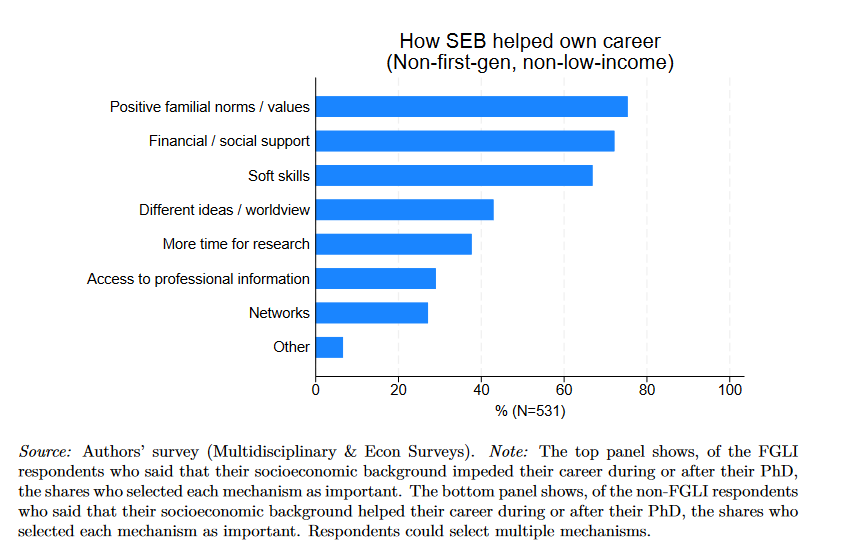
We asked those who said that their socioeconomic background helped them why that was.
Family norms & values and financial/social support came up most prominently (note that this differs from what FGLI respondents thought mattered).
2/3rds also emphasize soft skills
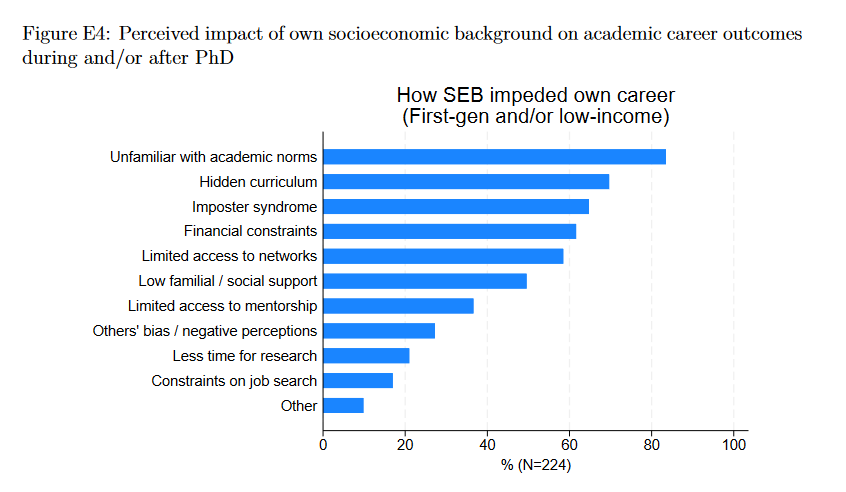
To first-gen or low-income background respondents who answered that their socioeconomic background disadvantaged them, we asked about mechanisms.
Again overwhelmingly, factors like: academic norms, the hidden curriculum, and limited access to networks or mentorship show up
I’m delighted to share that the August 2025 special issue of Sociological Methods & Research on Generative AI is out. With my co-editor, Daniel Karell, we put together this issue to build on the conference we organized last year.
Here's a thread on each of the 10 papers:
We have teaching needs in organizational processes (I call it “sociology for managers”), power and politics, as well as other courses on work, employment, and organizational issues.
Happy to (try to) answer any questions!
🚨JOB OPENING🚨
Come be my colleague! Work and Organization Studies at MIT Sloan seeks applications for an open rank, tenure-track faculty member. Research should focus on employment, work, or organizational issues (broadly defined).
Deadline Sept 5!
https://t.co/5FwxEFzfsr
Excited to continue learning about the latest #CSS at @IC2S2! I’ll be at the Social Prediction Session, presenting the mixed subjects design on combining human and LLM data in experiments. Paper with Michael Howes and @AustinVanLoon. Come join us! https://t.co/lg1DbJYX5F
Blog post on mixed subjects (human & LLM) studies. Using prediction powered inference makes more sense than blindly substituting LLMs for humans, but still subect to garbage-in-garbage-out & won't resolve deeper questions about what we're trying to study
https://t.co/ZwMzb3iIws
👀
“…the mixed [subjects] design… is the most reasonable approach I’ve seen in the LLMs for social science literature for integrating LLM simulations into confirmatory-style experiments…”
Also provides thoughtful reflections on the limitations of the approach!
Thanks to @JessicaHullman for a thoughtful dive into our Mixed Subjects Design paper with Michael Howes and @AustinVanLoon on the Stat Modeling blog!
Read the discussion ➡️ https://t.co/fer0MuQBHi
𝐃𝐨 𝐋𝐋𝐌𝐬 𝐡𝐚𝐯𝐞 𝐬𝐲𝐧𝐞𝐬𝐭𝐡𝐞𝐬𝐢𝐚? In a forthcoming paper in 𝐶𝑜𝑔𝑛𝑖𝑡𝑖𝑣𝑒 𝑆𝑐𝑖𝑒𝑛𝑐𝑒, we show yes! But this synesthesia deviates significantly from the color associations of ppl, incl. colorseeing, colorblind, and painters https://t.co/CNB43R65fi
#LLMs offer cost-effective but potentially inaccurate predictions. Study says #LLM predictions be viewed as informative but imperfect, with humans serving as the gold standard in a mixed subjects design.
Read: https://t.co/oZIcsSKtt0
Subscribe: https://t.co/ZSwZtZQ0LL
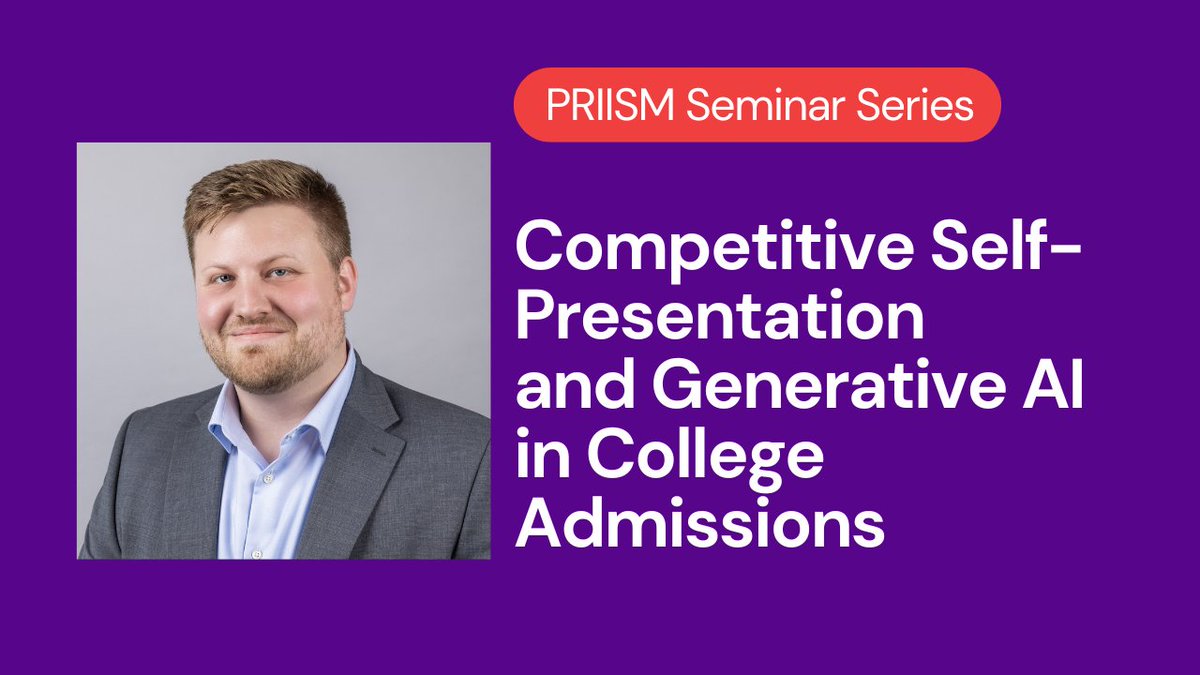
Who Gets In? AI-generated essays in college admissions
Join us & @AustinVanLoon to learn about how GAI in college admission essays may reshape demographic makeup of admitted students & transform how merit is evaluated.
Wed 5/7, 10 am ET (Hybrid)
RSVP: https://t.co/WKusTd6FRU
🚨🚨 I’m looking for a postdoctoral fellow to join my lab at Harvard's Psychology Department starting Fall 2025!🚨📣
Please retweet/share widely, and spread the word to interested candidates!
Application review begins April 30
Apply here: https://t.co/q2bUUfMUPM (1/2)
Mixed feelings about silicon subjects (LLM predictions of human behavior) as replacements for human subjects? Consider the mixed subjects design.
🚨Now published at Sociological Methods and Research🚨
https://t.co/lg1DbJZuVd
⚡️Really thrilled that #textgrad is published in @nature today!⚡️
We present a general method for genAI to self-improve via our new *calculus of text*.
We show how this optimizes agents🤖, molecules🧬, code🖥️, treatments💊, non-differentiable systems🤯 + more!
New paper from the computational culture lab, forthcoming in AJS!
Building on (largely untested) sociological intuitions, we show how positions in the organizational network relate to identification with the organization, using a language model:
https://t.co/2m4KAz9mR8
Want to learn about computational social science *for free* and launch interdisciplinary research projects? We are so excited to announce there will be *26* Summer Institutes in Computational Social Science this year! Apply to one of them here: https://t.co/trE4O9OhCc
Our paper is out today in @PNASNews! 🎉 In a large-scale experiment on a YouTube-like platform, we find that giving people politically “slanted” video recs doesn’t shift beliefs or viewing behaviors.
In other words, online filter bubbles may not be as polarizing as we think…