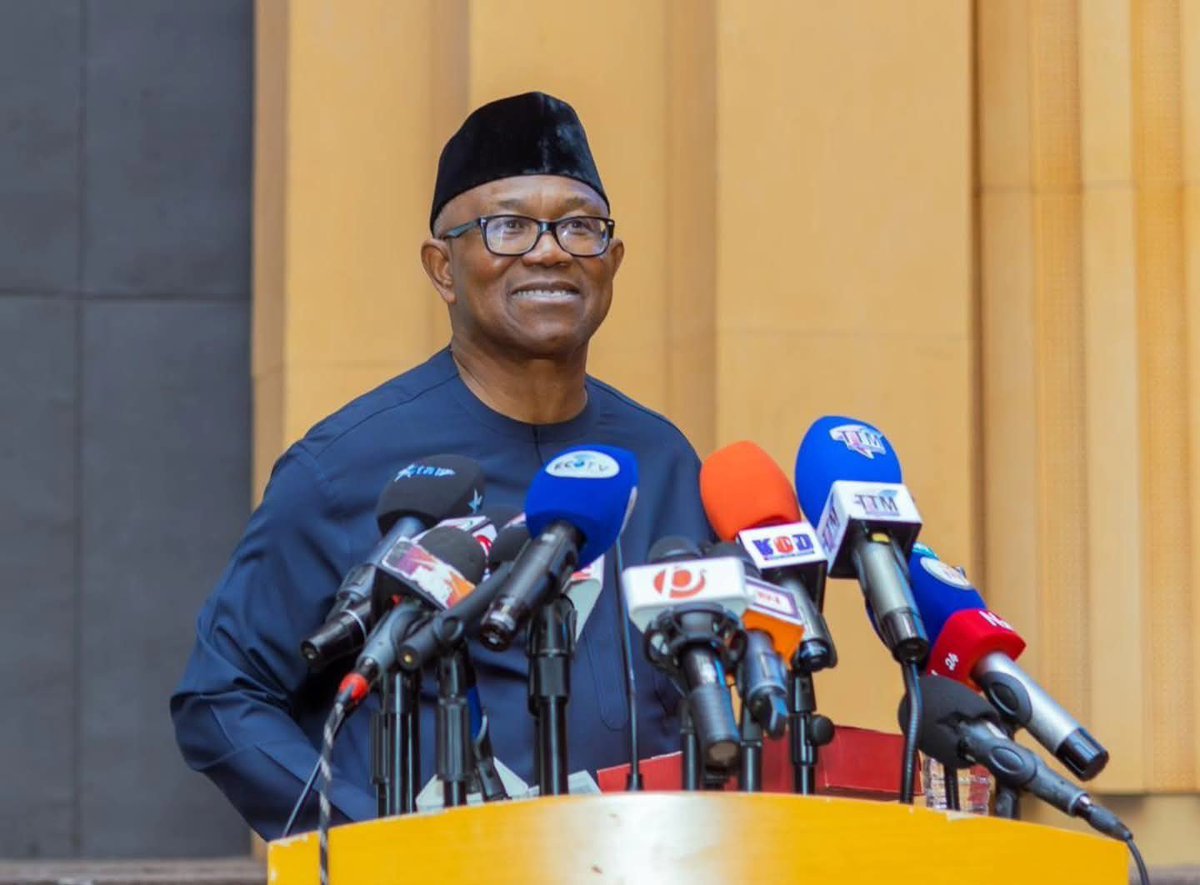
@AnambraNewMedia I just wasted my time reading this, I was actually looking forward to see the bank statements of the said account which you said you have a certified true copy. You just gat nothing but envy on the Man Peter Obi. He is a Man you can never become
I made a website about @PeterObi. It details his entire life, his roots, offices held, source of wealth, documented donations, achievements as a governor, and more.
When they ask you what Peter Obi did as governor, send them https://t.co/MJy4SuUuXH
Retweet this to get it far!
I have been thinking about something lately, and the more I think about it, the more disturbing it becomes.
A lot of Nigerians became poor without doing anything wrong.
They didn’t stop working. They didn’t become lazy. They didn’t suddenly become irresponsible.
They simply woke up one day and realised that the money they had worked for could no longer buy the things it used to buy.
Think about someone earning ₦100,000 a month.
The person still wakes up early every morning, goes to work, puts in the same hours, probably works even harder, gets promoted occasionally and does everything society says a responsible person should do.
Yet every year, that person seems to be able to afford less.
At some point, ₦50,000 could buy a reasonable amount of food for the house. Today, you can enter the market with the same ₦50,000 and genuinely wonder where the money went.
Nothing happened to you.
The economy happened to you.
And I think this is something we don’t talk about enough.
Imagine working hard for years, only for circumstances completely outside your control to quietly reduce the value of everything you have worked for.
You didn’t lose your job.
You didn’t lose your salary.
But somehow, you lost your standard of living.
That is poverty too.
And this is why I struggle with the way we sometimes discuss palliatives.
Of course, when people are hungry, you must find ways to help them immediately. There is nothing wrong with providing temporary relief.
But surely, the bigger question should be:
Why did millions of working Nigerians suddenly need palliatives in the first place?
If a man could comfortably buy a bag of rice from his salary a few years ago and today he needs government assistance to buy that same bag of rice, giving him rice may solve today’s hunger.
But it has not solved the actual problem.
The real problem is that his labour has lost value.
And perhaps that is what we should be obsessed with fixing.
How do we make the Nigerian worker’s income valuable again?
How do we make ₦100,000 buy more next year, rather than less?
How do we make food cheaper by producing more?
How do we reduce the cost of energy and transportation?
How do we build an economy where salaries can actually keep up with the cost of living?
Because when I think deeply about it, perhaps one of the greatest things a government can do for its people is not to keep giving them money.
It is to build an economy where the money they earn has value.
There is dignity in being able to take care of yourself from the product of your own labour.
There is dignity in a teacher being able to feed a family from teaching.
There is dignity in a nurse being able to pay rent from nursing.
There is dignity in a young person working an honest job and gradually seeing life improve.
People should be able to look back after five years of hard work and say, “My life has become better.”
Not, “I earn more money today, but somehow I can afford less.”
That is the part that keeps bothering me.
Millions of Nigerians are not asking to become millionaires overnight.
They just want hard work to make sense again.
And maybe that should be one of the simplest ways we measure whether our economy is actually working:
Is the ordinary Nigerian who works hard becoming progressively better off, or progressively poorer?
Everything else is secondary.
@tajudine2013gm2@Dee_9889 I'm happy you said "Invested" and not "steal". Which means the government got a return on investment from his "family" business. Can you deny the allegations of "ghost" ministries, agencies etc?
This Saturday, we will be having another edition of the Sterling Bank Nationwide Online Maths Quiz.
The platform for the quiz is https://t.co/dnjSLGbm07 . Just register and wait for the countdown.
It’s open and free for every Nigerian student, and the winners get ₦500k, ₦300k, and ₦200k respectively.
All you need to participate is a phone, tablet, desktop, or laptop.
We are making education rewarding, fun and entertaining again, because that’s the only way we can save the nation.
BREAKING!!! ONE OF THE BEST DOCUMENTARIES ON PETER OBI IS OUT... As an Obidient, you should be proud of your choice in Peter Obi. Retweet massively pls.
The average Nigerian politician sees Peter Obi as a direct threat to their source of livelihood. It unsettles them that a man who has conquered greed could step into the arena. Their greatest shock is discovering they cannot dig up dirt on him. That failure is a major blow to their playbook. Hence, the relentless campaign of calumny against him.