Today, with no tariff in place, the international copper benchmark is trading around $13,600/t.
If the US imposes a 15% import tariff from 2027, copper delivered into the US could cost about $2,036/t more as refiners rush to front‑load purchases ahead of the duty.
If the tariff then scales to 30% in 2028, that premium would roughly double.
via Crux Investor
BREAKING: Iran now declares the Strait of Hormuz "closed effective immediately for the passage of all types of vessels, including oil tankers and commercial ships," in response to US strikes. Any ship attempting to transit will be attacked, per Tasnim.
Iran also denied Trump's claim today of US-led ship passage through the Strait.
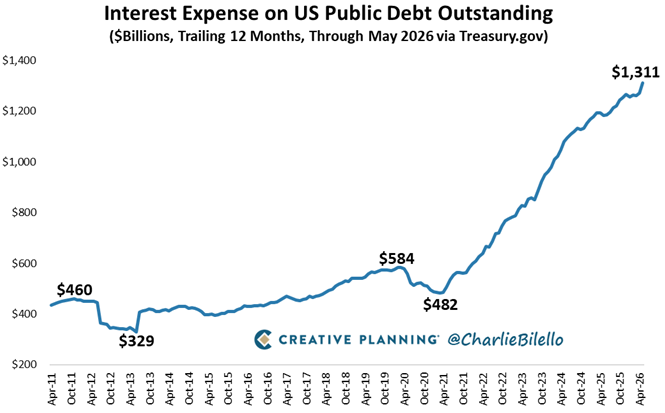
The Interest Expense on US Public Debt hit $1.3 trillion over the last 12 months, another record high. If it continues to increase at the current pace it will soon be the largest line item in the Federal budget, surpassing Social Security.
Chevron just signed an agreement with YPF and Pluspetrol to supply a TGS-led natural gas liquids (NGL) megaproject.
This move comes just weeks after Chevron applied for Argentina's RIGI incentive program with a $13.8B plan to scale up operations at the El Trapial block.
The venture will convert natural gas into exportable liquids like butane and propane.
It is one of several processing and pipeline projects poised to transform Argentina’s shale industry into a global energy powerhouse.
🇦🇷
$CVX $YPF $TGS
4/
This is why initiatives like the Vault project have recently emerged. A $12B public-private stockpile seeded by ExIm Bank and companies like Boeing, GM, and Google.
In the meantime, the U.S. has already deployed over $1B into Latin America's mineral sector since early 2025.
Chile, Argentina, Brazil, and Peru sit at the center of the rebalancing as key suppliers of critical raw material, such as copper, lithium, rare earths and nickel.
Today, with no tariff in place, the international copper benchmark is trading around $13,600/t.
If the US imposes a 15% import tariff from 2027, copper delivered into the US could cost about $2,036/t more as refiners rush to front‑load purchases ahead of the duty.
If the tariff then scales to 30% in 2028, that premium would roughly double.
via Crux Investor
The US is about to decide whether to apply a 15% tariff on refined copper imports from January 2027, with the possibility of raising it to 30% in 2028.
It already has a 50% tariff on aluminum, steel and most semi‑finished copper products, and the COMEX–LME spread is trading around 6% as the market over‑stocks in fear of these tariffs.
It means copper sold to the US is trading ~6% above rest of the world reference prices as buyers are importing and stockpiling extra copper in anticipation of possible tariffs.
US seaborne copper imports remain above the 15–20 kt per week the country actually needs, while implied inventories already cover more than a year of normal imports.
All this is happening while copper stocks outside the US are starting to look increasingly tight (especially in China and on the LME).
If the US ultimately decides to apply tariffs, this could trigger another wave of buying and keep upward pressure on prices, as refiners and traders rush to front‑load purchases and build inventories.
If it steps back from the tariffs, that could bring some relief to prices, since the incentive to keep stockpiling copper in the US would disappear.
In other words, the US is using trade policy to secure copper and support its industrial base, and this tariff decision will determine whether copper demand remains a driver of prices — keeping premiums high and ex‑US markets tight.
The US is about to decide whether to apply a 15% tariff on refined copper imports from January 2027, with the possibility of raising it to 30% in 2028.
It already has a 50% tariff on aluminum, steel and most semi‑finished copper products, and the COMEX–LME spread is trading around 6% as the market over‑stocks in fear of these tariffs.
It means copper sold to the US is trading ~6% above rest of the world reference prices as buyers are importing and stockpiling extra copper in anticipation of possible tariffs.
US seaborne copper imports remain above the 15–20 kt per week the country actually needs, while implied inventories already cover more than a year of normal imports.
All this is happening while copper stocks outside the US are starting to look increasingly tight (especially in China and on the LME).
If the US ultimately decides to apply tariffs, this could trigger another wave of buying and keep upward pressure on prices, as refiners and traders rush to front‑load purchases and build inventories.
If it steps back from the tariffs, that could bring some relief to prices, since the incentive to keep stockpiling copper in the US would disappear.
In other words, the US is using trade policy to secure copper and support its industrial base, and this tariff decision will determine whether copper demand remains a driver of prices — keeping premiums high and ex‑US markets tight.
Inflation in the US is re‑accelerating, echoing the 1970s inflation wave, with renewed pressure coming from energy.
However, back then federal debt was only about 30–35% of GDP, versus roughly 120% today. A key difference.
With federal debt approaching $40 trillion and interest costs already at record highs, the Fed’s room to tighten further is much more constrained.
If the energy shock begins to weigh on growth and employment, the path of least resistance for short term rates will eventually be lower, even if inflation has not fully normalized.
With higher and stickier inflation, real rates pushed back down, and growing doubts about fiscal sustainability, monetary metals are likely to be major beneficiaries.
The US is about to decide whether to apply a 15% tariff on refined copper imports from January 2027, with the possibility of raising it to 30% in 2028.
It already has a 50% tariff on aluminum, steel and most semi‑finished copper products, and the COMEX–LME spread is trading around 6% as the market over‑stocks in fear of these tariffs.
It means copper sold to the US is trading ~6% above rest of the world reference prices as buyers are importing and stockpiling extra copper in anticipation of possible tariffs.
US seaborne copper imports remain above the 15–20 kt per week the country actually needs, while implied inventories already cover more than a year of normal imports.
All this is happening while copper stocks outside the US are starting to look increasingly tight (especially in China and on the LME).
If the US ultimately decides to apply tariffs, this could trigger another wave of buying and keep upward pressure on prices, as refiners and traders rush to front‑load purchases and build inventories.
If it steps back from the tariffs, that could bring some relief to prices, since the incentive to keep stockpiling copper in the US would disappear.
In other words, the US is using trade policy to secure copper and support its industrial base, and this tariff decision will determine whether copper demand remains a driver of prices — keeping premiums high and ex‑US markets tight.
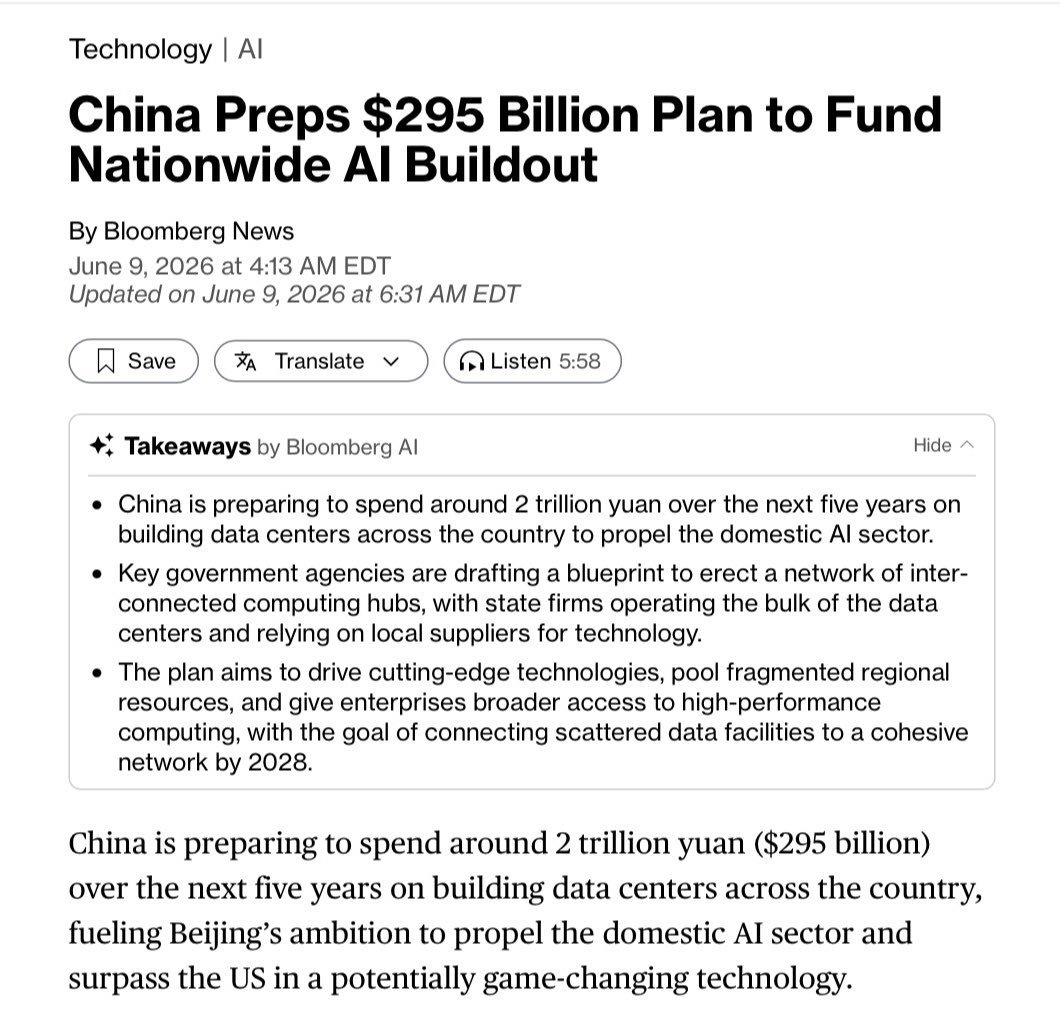
China is preparing a massive infrastructure investment for data centers.
The Chinese government plans to invest nearly USD 300 billion over the next 5 years to boost its AI sector and cut dependence on US companies, such as $NVDA or $AMD.
This plan represents Beijing's most ambitious effort to date to lay the foundation for China's future AI development.
The budget does not include private investment from tech giants like Alibaba Group or Tencent, which could potentially raise the total projected investment to at least 5 trillion yuan, or USD 740 billion.
Chinese data centers generally cost less than those in the United States due to lower labor, component, and construction costs, as well as incentives from local governments.
The developments could also integrate heavy investment in communications infrastructure and the power grid to supply the data centers that will span the country.
AI data centers and the energy transition in general are rapidly decoupling copper from traditional industrial cycles.
With ore grades deteriorating, no new discoveries in years and demand charts turning vertical, there has never been a more compelling macro case for base metals.
Act accordingly.
Historically speaking, this is arguably one of the best moments ever for copper producers.
The price-to-cost spread is now one of the widest on record, which explains the exceptional cash flows we're seeing across some companies in the sector.
The direct cost of copper production (C1) — which measures essentially how much it costs a mine to extract each pound of copper, excluding depreciation, sustaining capex, and significant royalties — is the most widely used metric to compare operational efficiency across projects.
The cost curve has an upward slope, showing that the cheapest mines operate first (on the left), while the most expensive ones only come online when the price justifies it.
With spot at ~600 USc/lb (roughly ~$13,000/t) and the 90th percentile at ~240 USc/lb (the cost of the most expensive marginal producer still operating), virtually every producer in the world is generating enormous operating margins — even the least efficient ones.
#Copper
China is increasingly using rare earths as a strategic weapon rather than just an export business.
By restricting shipments of heavy rare earths and magnets to Japan after political tensions over Taiwan, Beijing signaled it is willing to weaponize its near‑monopoly over critical minerals that feed autos, chips and defense supply chains.
Now foreign firms using Chinese rare earths or tech face Chinese licensing to export their own products.
Recent dual‑use export bans and tighter controls on elements like dysprosium, yttrium and gallium show how China can exert pressure without firing a shot, forcing importers to accelerate diversification and rethink their industrial security strategies.
As a reminder, Beijing still controls ~90% of global rare earth refining capacity.
🇦🇷⚒️ Patagonia Gold Corp just announced its first doré dispatch from the Calcatreu gold‑silver project in Río Negro.
The company sent 518 gold‑equivalent oz (about 514 oz Au and 232 oz Ag) to Asahi Refining, a key milestone.
Leaching started in mid‑April, so this marks the formal start of metal recovery activity and cash‑flow ramp‑up from the heap leach operation.
Calcatreu holds roughly 669 koz of gold and 6.3 Moz of silver in indicated resources, plus additional inferred ounces, and an updated NI 43‑101 resource is due by the end of Q2 2026.
This is the first precious metals mine developed in Río Negro with up to USD 1.8 billion in projected exports over its full mine life.
$PGDC.NE
China is increasingly using rare earths as a strategic weapon rather than just an export business.
By restricting shipments of heavy rare earths and magnets to Japan after political tensions over Taiwan, Beijing signaled it is willing to weaponize its near‑monopoly over critical minerals that feed autos, chips and defense supply chains.
Now foreign firms using Chinese rare earths or tech face Chinese licensing to export their own products.
Recent dual‑use export bans and tighter controls on elements like dysprosium, yttrium and gallium show how China can exert pressure without firing a shot, forcing importers to accelerate diversification and rethink their industrial security strategies.
As a reminder, Beijing still controls ~90% of global rare earth refining capacity.
4/
Now zoom out.
In the last few years, China has used its own chokepoints too: rare earths.
Beijing controls most global rare earth refining capacity.
In 2025, it expanded export controls on rare earths and related magnets used in defense, EVs, and chips.
Foreign firms using Chinese rare earths or tech now face Chinese licensing to export their own products.
That’s leverage.