@Antosolus It matters for blockchain because it enables privacy-preserving smart contracts and decentralized computations where sensitive data—like user identities, transaction amounts, or voting preferences—can be processed without any single node or participant ever seeing the raw info
How do you calculate something using someone's private data without learning what that data is?
Let's say two companies want to compare their financial positions.
Company A has $8 million and Company B has $5 million.
Both want to know which company has more money, but neither wants to reveal its actual balance to the other.
If Company A simply tells Company B its balance, the information is no longer private.
But what if they could determine the answer without exchanging their actual balances?
This is the kind of problem that Multi-Party Computation (MPC) is designed to solve.
And @sodabubblelabs uses a technique called Garbled-Circuit Multi-Party Computation (GC-MPC) in Soda Bubble.
Let's understand how it works.
First, what is MPC?
MPC allows multiple parties to compute a result using their private inputs without having to reveal those inputs to one another.
Think of it as agreeing on a calculation without agreeing to share everything that goes into it.
In our example, the companies want to calculate:
Which balance is greater?
The answer is all they need. Neither company needs to learn the other's actual balance.
But how can a calculation happen without simply exposing the numbers?
That's where GARBLED CIRCUITS come in.
Second, what exactly is a garbled circuit?
A computer normally solves problems by breaking them into smaller operations, much like a flowchart made up of simple yes-or-no decisions.
For example, comparing two balances involves a series of logical operations that eventually produce one answer: A is greater, B is greater, or both are equal.
A garbled circuit takes those operations and transforms them into a cryptographically protected version of the computation.
Here's the interesting part.
Instead of representing every intermediate value with an ordinary readable 0 or 1, the circuit uses random-looking cryptographic labels to represent those values.
The circuit's gates contain encrypted instructions for how to move from one label to the next.
A participant evaluating the circuit receives the appropriate labels for the inputs they're allowed to use. Those labels let them carry out the computation, but they don't automatically reveal the underlying values or provide access to every possible alternative.
It's similar to having a puzzle where you possess the specific keys needed to follow the correct path, but not the keys needed to open every other path.
The evaluator can process the protected circuit and obtain the relevant output without simply receiving the other participant's original private input.
That's the central idea behind garbled circuits.
Third, how do MPC and garbled circuits work together?
MPC describes the broader goal: multiple parties jointly compute a function while protecting their private inputs.
Garbled circuits are one cryptographic technique that can help achieve that goal.
In a typical garbled-circuit protocol, one party prepares the protected circuit, and another evaluates it using the appropriate input labels. Additional cryptographic steps help each party contribute its private input without freely disclosing it.
The exact protocol determines who learns the final result and what else, if anything, they can infer.
So the goal isn't to make computation impossible without revealing anything whatsoever. It's to limit what participants learn beyond the information the agreed computation reveals.
Now, why does this matter for blockchain?👇
Last week’s contest is officially over🏁
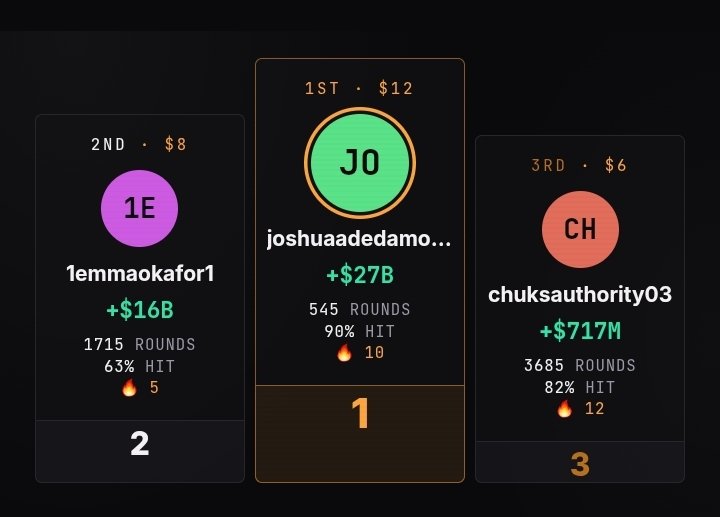
Our 60-second BTC, ETH and SOL prediction markets wrapped up with a massive 27B record during our $50 weekly contest
Full details on the winners coming shortly.
Want to be part of the next one? Check in here 👇
https://t.co/XvmfZ89eSF
Today, we want to see your numbers.
Big wins, crazy streaks, or a P&L you’re proud of. Whatever your Blink Markets session looks like, let’s see it.
Share your Pnls on Blinkmarkets, quote this post with a screenshot, and let the timeline see how you’re doing.
Let’s see who’s cooking and who’s getting cooked. 😂
Your bragging rights are officially unlocked. 👇
→ https://t.co/cPR6NHiaka
Have you ever tried tracing a crypto transaction and ended up with more questions than answers? 😭
Imagine someone sends funds from one wallet to another. You check the transaction, follow the receiving address, and discover that the funds have already moved somewhere else.
You follow that transaction, only to find another address waiting at the end.
Before you know it, you're jumping between wallets, checking transaction histories, and trying to figure out how everything connects.
The funny thing is that all this information is publicly available on the blockchain.
The difficult part is making sense of it.
That's one reason I find @iris_intel_app interesting. Two features that caught my attention are its Explorer and AI integration.
Let me explain why.
1. The Explorer: Connecting the dots between wallets.
When you open a traditional block explorer, you can inspect transactions, check wallet activity, and see where funds move.
That's useful, but investigating complicated transaction trails can get tedious when you're jumping between addresses and manually piecing together what happened.
@iris_intel_app Explorer approaches this differently.
It presents wallets as cards connected by transaction arrows, allowing you to explore relationships between addresses, follow funds across multiple transactions, and organize your findings with notes and tags.
Think about researching a new token.
You find the developer's wallet and want to understand where its funding came from. You might also want to investigate whether it connects to addresses associated with previous token launches.
Instead of examining each wallet in isolation, you can explore their relationships and follow the available transaction trails.
The same idea applies when investigating suspicious fund movements. Following transactions can help you understand where assets went after leaving the original wallet.
Of course, discovering a connection doesn't automatically prove that two wallets belong to the same person or that wrongdoing occurred.
What I find interesting is how the Explorer helps you visualize these relationships instead of forcing you to piece everything together manually.
But what happens when you want to investigate further without manually navigating every wallet and transaction?
That's where Iris's AI integration comes in.
2. The AI integration: Investigating wallets by asking questions.
Imagine being able to ask an AI assistant to help investigate a wallet and retrieve relevant on-chain information rather than searching through every transaction yourself.
That's where Iris's Model Context Protocol (MCP) integration comes in.
MCP allows compatible AI assistants to connect to external tools, and Iris makes its on-chain investigation capabilities accessible through supported AI workflows.
For example, imagine researching an unfamiliar wallet and wanting to understand its funding sources or identify transaction patterns worth investigating.
You could use an AI assistant connected to Iris's available tools to help retrieve and examine relevant information.
While the Explorer gives you a visual way to follow wallet connections, AI integration offers another way to explore the underlying data and investigate activity.
For beginners, this could make on-chain research more approachable without requiring them to understand every technical detail before getting started.
For experienced users, it provides another way to investigate wallets without relying entirely on manual navigation.
But what interests me most is how this could be useful for developers.
Iris also offers an API that developers can explore to integrate supported wallet-analysis capabilities into their applications.
Combined with MCP, these tools provide different ways to incorporate on-chain intelligence into applications and AI-assisted research workflows⤵️
On the Hall of Fame twice 🫡 @bunnyofmx came for one contest and keeps landing on the podium. Pure reads, fresh $1,000 every day. Come chase it. https://t.co/wIrXKyiwi3
Think you can read the market better than everyone else?
New round starts every 60 seconds. Pick SOL, ETH or BTC, call UP or DOWN, and watch the whole room make their calls.
$50 is up for grabs across the Top 10 every week.
Free to play, nothing to deposit.
Pove it↪️: https://t.co/KtbqyitlSJ
This week leaderboard is getting serious.
Last week, traders were putting up some crazy numbers, and this week the board is already getting higher.
Every round you play adds to your weekly performance, so there’s still time to make your move and fight your way into the Top 10.
The $50 weekly prize pool is waiting. 🏆
Who’s taking the top spot this week?
→ https://t.co/cPR6NHhCuC
@itsblinkmarkets Blink market is a 60 second predictation market which is fun and interesting I love being on the project I can be so intimidated trading but I also know my limit. Nice project tho looking forward to more progress
We heard your feedback, and we’ve been making moves.
Blinkmarkets interface has had a few updates to make navigating the platform feel cleaner, smoother, and easier to understand most especially for mobile users.
We’re constantly looking for ways to improve your experience, and your feedback plays a big part in that.
There’s more to explore, so go check out what’s changed.
→ https://t.co/cPR6NHiaka
Hey @anondotinc , I really like what you're building around on-chain privacy. I've always been interested in private payments and transaction privacy, so I'd genuinely love to work with you.
I previously worked with @killroy192 , the founder of @zeroledgerxyz , on content around private payments and transaction privacy. That experience gave me a deeper appreciation for the problem privacy-focused projects are trying to solve.
What I'd love to do with Anon is create UGC that makes on-chain privacy easier to understand and relatable. Breaking down the problems you're solving through real-life use cases, simple analogies, and content that helps people understand why financial privacy matters, not just what the product does.
You can check out my page and the work I did around ZeroLedger on their page, too.
I'd love to discuss how I could contribute as a UGC Writer and help tell Anon's story.