I’m cloning my website visitors into thousands of AI agents so I can build the perfect sales funnel.
Current state, around 95/100 visitors do not book.
Many users will just bounce, but a big chunk read for minutes, open details, and still leave. Something isn’t there for them, so I’m building a way to find out what.
So here is what I am doing:
1) Every page is split into blocks (860 so far)
2) Each block gets a 768-dimension embedding of it's meaning plus a ~40-dimension “look” vector: size, text density, images, faces, buttons, animation speed
I then added a small tracking script which records real users on how they interact with these blocks.
My first pass will tell me, things like a tall section on mobile leads to higher bounce rates, or people who see your testimonials section have a higher book rate.
After this it is the fun part.
I am training agents on the live user data coming in to mimic their behavior
Which blocks they spend time on, where they click, etc.
When someone books we also have their intake data
So what can this allow me to do?
The agents are trained on meaning, each one has a user persona, so they will also be trained on content they have never seen before --> their tests will then be added to a live A/B and they will continually be refined
Until?
We have thousands of agents who accurately represent our user base.
We can run thousands of landing page combinations by these agents until what we are left with are pattern backed versions....
Do you think this idea has potential?
Stop paying for Wix & Squarespace
Even if you already have a website, you can copy it and pay $0/month
1) Create a Github account
2) Screen record scrolling through your website on both desktop and mobile view
3) Copy page source from each page
4) Feed 2 & 3 into an LLM (I use Claude) and tell Claude to split the videos into frames with ffmpeg.
5) Tell it to download your images and loop until the generated code matches your recordings
6) Tell it to spin up an independent agent to evaluate that the output matches
7) Use the free Github MCP and create a new repo {Your Site Name}
8) Create a free Cloudflare account and deploy your worker from github (Netlify works too)
9) Point your Wix / GoDaddy / Squarespace DNS to Cloudflare
Your only cost left is your domain (~$12/yr). Just did this for a local business moving off GoDaddy.
And now you can deploy new pages directly through an LLM without needing anyone else.
How to stop AI from building the same slop landing page as everyone else
You have to give it examples or it defaults to whatever it was trained on
I tried pasting Palantir’s page source first. 475KB, 99% JavaScript, 28 characters of actual page text. Useless
What actually works:
Screenshot the sections you like (or record a video)
Right click > Inspect > Copy > Copy outerHTML on just one section
Screenshot/recording gives it the look and the outerHTML helps with structure
What do you use to steer AI on design?
@CesareDadamo You have to give it some examples or it will default to whatever it is trained on
Finding some example landing pages you like, and screenshotting them as reference is always good.
and copying outer html of certain sections you like
@ayesha_fatiima The Claude app runs on the same agent as Claude Code. Hook up the GitHub and Cloudflare MCPs and it’s basically the same thing, just in the cloud instead of local.
Local mostly gives you an advantage with testing
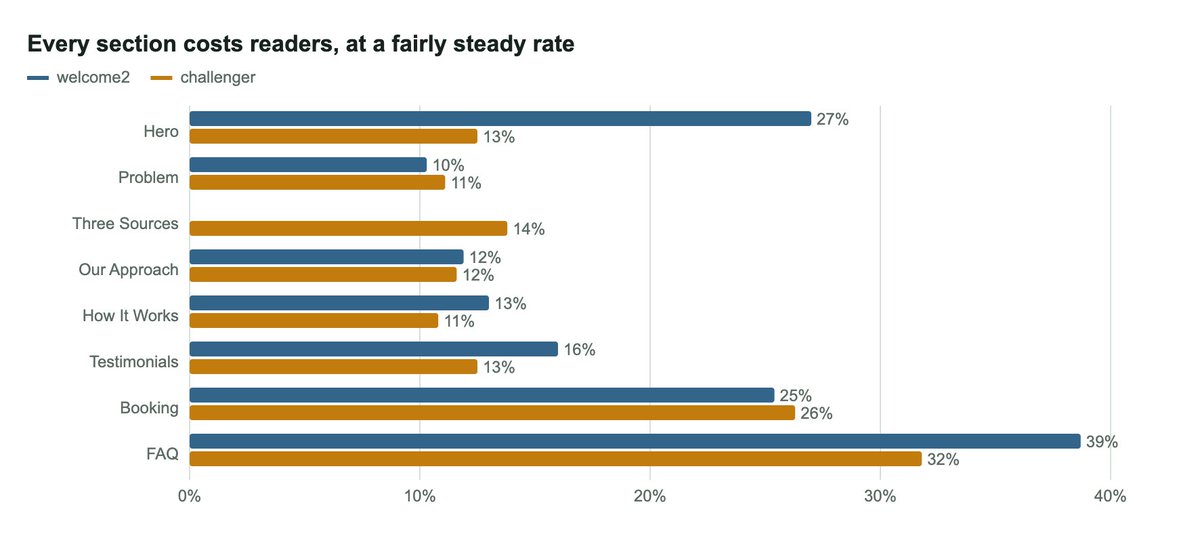
Here are the results from our A/B landing page test
What do you guys think we do next?
N=1,433 visitors
The setup:
Each page got a 50/50 split of instagram traffic
Original = Welcome2
Challenger = Challenger
What we measured:
1) Bounce rates
2) Scroll Depth
3) Dwell time (Extrapolated to being skimmers, medium engaged, high engaged)
4) Bookings
5) Shows
Result:
1) More people book on the challenger, even though fewer people make it to the booking section
2) People no show to their calls at a higher rate on the challenger
3) Less "engaged" leads made it to the booking section on the challenger
4) "Engaged" leads made it to the booking section on the challenger less often
Interpretation:
1) Screen height is larger on the challenger (see diagram) which led to more skimmers booking while engaged leads didn't make it
2) Dwell time was highest when users had to click something
3) "How it Works" had one of the lowest bounce rates
Solution:
1) Cut the "Our Approach section" mostly to shorten the screen height
2) Add a click through diagram on the "how it works section"
3) Add these changes to "Welcome4" and run the test against the original "welcome2"
Do you agree with the approach?
@signulll Might be worth getting a used mac mini or something like that running from your home network. Site's can't tell the difference from a human since I am logged into chrome there.
@Im_IrushiK You can try using the Figma MCP. Sketch a rough outline first so it has something to go off of.
Also for diagrams, try having it write them as code (SVG). Way more precise and you can tweak one box without it redrawing everything
The LLM improvement curve seems to be accelerating
Now we are giving them a body
Tesla will start delivering their humanoid robot in 2027
OpenAI says it's developing its own humanoid, with Altman targeting a first public demo in 2027.
They are building robot brains to just be LLMs.
A "terminator" like scenario doesn't seem that crazy anymore
Tesla's factory workers refused to wear the motion-capture suits that train Optimus, the humanoid meant to replace them.
Why the suits matter:
⬩Optimus learns by imitation, copying expert human movements recorded in mocap
⬩Workers reportedly knew the robots were designed to eventually replace them
⬩Some had injuries and severe motion sickness from earlier teleoperation sessions
Then the hand became the bottleneck:
⬩The V3 hand is ~60% of the robot's total engineering difficulty, per Musk
⬩Sub-millimeter tolerances, but automotive assembly gear is built for centimeter-scale
⬩22 degrees of freedom, 25 actuators per arm, 100+ screws per hand
Tesla moved training into dedicated teams and purpose-built hubs. Production reportedly went from a few dozen robots weekly to several hundred by August, with a target of 1,000+ per week by end of 2026.
Musk says public sales could start by late 2027.
The definition of human intelligence has changed in the AI era
Memorizing facts and formulas is pointless now, but schools won't change curriculums anytime soon
Deciding what problem is worth solving, judging whether an answer is right, and explaining your reasoning is what matters more
@iguptapankaj Thanks for the input. Their category is Home health care service and seems competitors have the same category
The landing pages per town is good... I will need to ask for some specifics so they aren't duplicated
I am being tasked with increasing the reach of this local business in Connecticut
Anyone have any SEO tips?
They operate an elder care business and need help getting the word out.
My plan right now:
Foundational:
1) Fix their broken links
2) Add a sitemap / get up on google search console
3) Add llms.txt
4) Add details like hours to their google profile
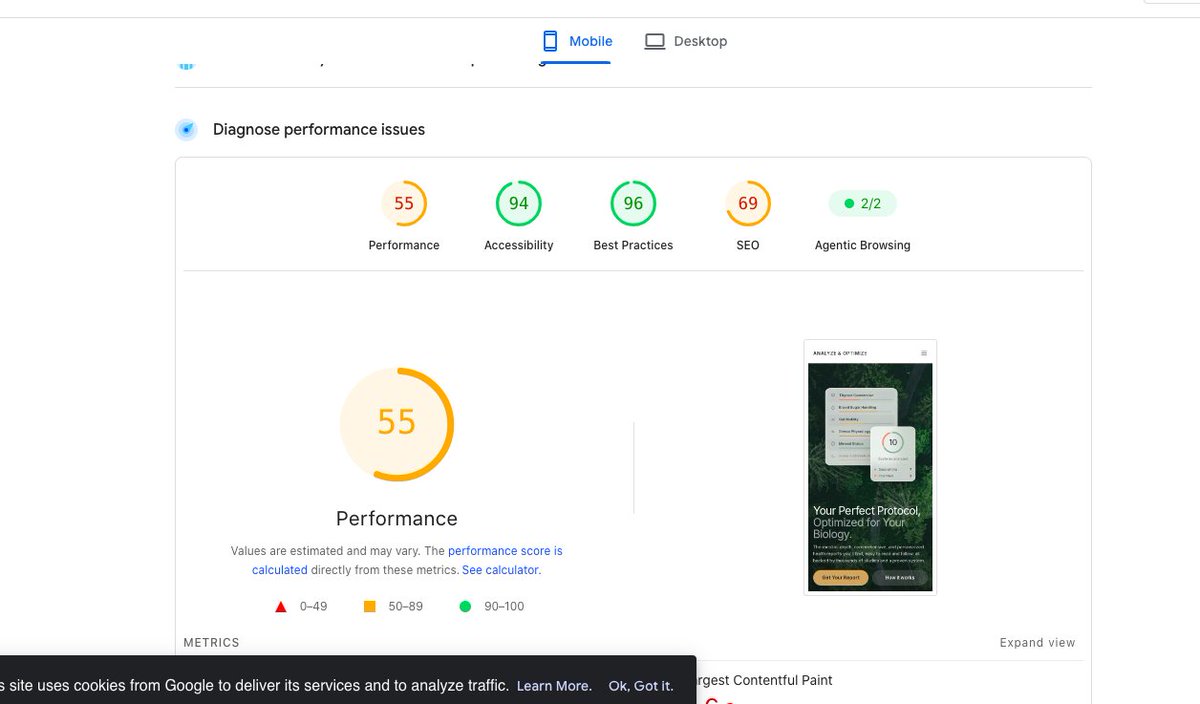
5) Fix mobile performance (It is a 55 right now)
6) Generally adding the proper meta data (image/link descriptions etc)
7) Add in better tracking via Cloudflare worker/ideally get them off of GoDaddy.
8) Claim the business in ChatGPT
Scalable:
1) Research competitors to see how their websites are structured, which keywords they use
2) Research similar businesses outside of CT who have good SEO to see what they are doing
3) Use the above to create articles, zoom in on specific keywords and hammer those
4) Review the tracking from Foundational to edit sections we lose people/move sections up which are engaging
Appreciate any other thoughts you guys have!
Biggest thing was loading the animation libraries only after interaction so they didn't interfere with first paint.
The browser also built the whole page upfront, so we changed it to only build the page as the user scrolls which again helped blocking time.
That's a good point on the SVGs, luckily ours were already inline. Thanks for the input!
My one business launched a new health report today
The new landing page for it wasn't designed super well though
On page speed insights it was clocking a 46-55 on page performance the 3 times I ran it.
Here was my prompt to Claude to get it to 90+
"Install lighthouse locally and loop until page performance score >90"
I also gave it some context saying to lazy load any scripts, defer font awesome and then sent it the current lighthouse performance metrics.
It ran for about 23 minutes without needing further input and by the end my score was a 91, ready to use.
I’m cloning my website visitors into thousands of AI agents so I can build the perfect sales funnel.
Current state, around 95/100 visitors do not book.
Many users will just bounce, but a big chunk read for minutes, open details, and still leave. Something isn’t there for them, so I’m building a way to find out what.
So here is what I am doing:
1) Every page is split into blocks (860 so far)
2) Each block gets a 768-dimension embedding of it's meaning plus a ~40-dimension “look” vector: size, text density, images, faces, buttons, animation speed
I then added a small tracking script which records real users on how they interact with these blocks.
My first pass will tell me, things like a tall section on mobile leads to higher bounce rates, or people who see your testimonials section have a higher book rate.
After this it is the fun part.
I am training agents on the live user data coming in to mimic their behavior
Which blocks they spend time on, where they click, etc.
When someone books we also have their intake data
So what can this allow me to do?
The agents are trained on meaning, each one has a user persona, so they will also be trained on content they have never seen before --> their tests will then be added to a live A/B and they will continually be refined
Until?
We have thousands of agents who accurately represent our user base.
We can run thousands of landing page combinations by these agents until what we are left with are pattern backed versions....
Do you think this idea has potential?
Here is one slice coming from X (for a different business obviously not this page). Data since Nov 10 when I added tracking.
I am thinking:
1) Move the causes and protocol sections up since they are the most engaging so more users see it.
2) Add another CTA right after one of these two engaging sections.
3) Convey client results better / maybe rephrase the book CTA.
And then a separate A/B test I am running for instagram showed that an FAQ section was the most engaging and led to the most bookings, so maybe add that here too.
I also have some ad data for this page but I want to slice based on UTM since behavior is different.