@MaxandBaz@ChrisWillx It's interesting, though, given what you've just said about tradies generally being happier and how satisfying the work is, that construction workers and tradespeople have some of the highest suicide rates of any occupational group in both the UK and the US.
Altered biological functioning is still biological dysfunction.
We don't always need to see structural damage to recognise that something isn't functioning as it should.
Interesting research on #microglia and their ability to dynamically shift between functional states.
What happens when these states become #maladaptive, leading to chronic #neuroinflammation and metabolic #dysfunction?
Are these changes reversible?
https://t.co/LX4kycj6Au
People often associate the word 'functional' with psychological rather than biological.
But look at microglia. When their functional states become maladaptive, the consequences can include persistent neuroinflammation, metabolic dysfunction and neuronal damage.
A new analysis by evolutionary anthropologists Colin Shaw (University of Zurich) and Daniel Longman (Loughborough University) argues that the modern world has developed faster than human biology can adapt..
https://t.co/ZZXpliNXia
Research identifying genetic risk factors for #fibromyalgia.
A large-scale study involving more than 2.5 million people provides insight into the genetic factors and biological mechanisms that may contribute to fibromyalgia.
https://t.co/xW9WYX7GTp
November issue of Brain Journal now out with an Editorial by @belin_david and myself on The return of neuropsychiatry: why clinical neuroscience needs neurology and psychiatry reunited
https://t.co/T8OczRtLnn
Every clean bottom turn was paid for with a thousand wipeouts. The sea teaches slowly, and only those who keep paddling out.
What are you practicing out there?
#surf#stoicism
Article on the convergence of neurology & psychiatry.
As #neuroscience advances, maybe we're moving towards a more integrated understanding of the #brain, reconnecting two disciplines that share common roots but developed along separate paths.
https://t.co/ojSMN8AovX
“Today, more people are surviving #neurological disorders, but they are also living longer with their consequences,”
Researchers observed increases in several conditions, including Parkinson’s disease, multiple sclerosis, motor neuron diseases, & autism.
https://t.co/VhR7uLKyW8
Not all #meditation is the same. Different practices have different purposes and effects, and some can even worsen symptoms.
We need to be more precise. What are we trying to achieve? Which symptoms, cognitive processes or neural circuits are we trying to influence?
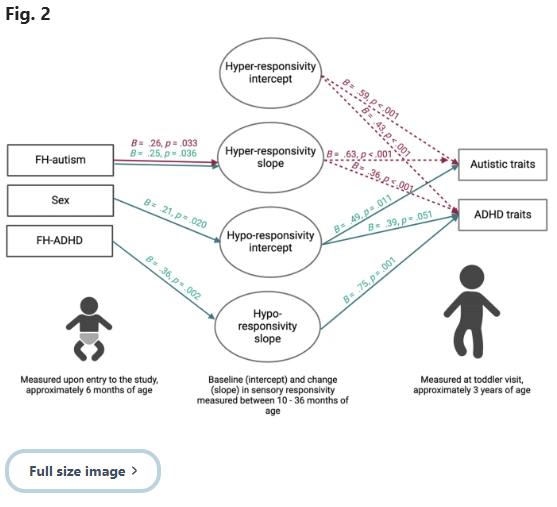
Another interesting finding is the difference between hyper- & hypo-responsivity
People with the same diagnosis, such as ME/CFS, can present very differently. Some feel exhausted & under-stimulated, others wired & overstimulated
Could different regulatory profiles explain this?
Paper exploring excitation/inhibition balance and sensory processing in infants with a family history of #autism and #ADHD, with some really interesting findings.
https://t.co/0LQ5CJ1qdm
I can't help noticing the link between autism & ADHD and people also being diagnosed with conditions like FND, ME/CFS and fibromyalgia.
Could differences in E/I balance leave some people more vulnerable to conditions involving altered sensory processing and neural regulation?
@GidMK I haven't read the full article, but I think you're looking at the long-term health effects of the pandemic through a very narrow lens. I'd argue it exposed much bigger health problems, not smaller ones. Somehow, I think people are missing the bigger picture of what it revealed
"What fascinates me most is how deeply intertwined our emotional and cardiovascular systems are, and how much we still don't understand," Dr. Alkhouli says. "Could we one day 'rewire' this connection for healing, using therapy, neuromodulation...
https://t.co/wPkUvZtMLF
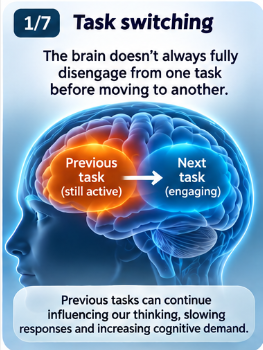
1/7 – Task switching
Interesting point from Stephen Monsell's research on task switching: the brain doesn't always fully disengage from one task before moving to another.
Previous tasks can continue influencing our thinking, slowing responses and increasing cognitive demands.
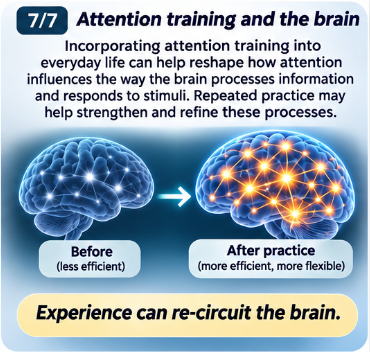
7/7 – Attention training and the brain
Incorporating attention training into everyday life can help shape how attention influences the way the brain processes information and responds to stimuli.
Repeated practice may help strengthen and refine these processes.