The last time the Fed hiked, banks got paid to sit still.
This time they got left with a bill.
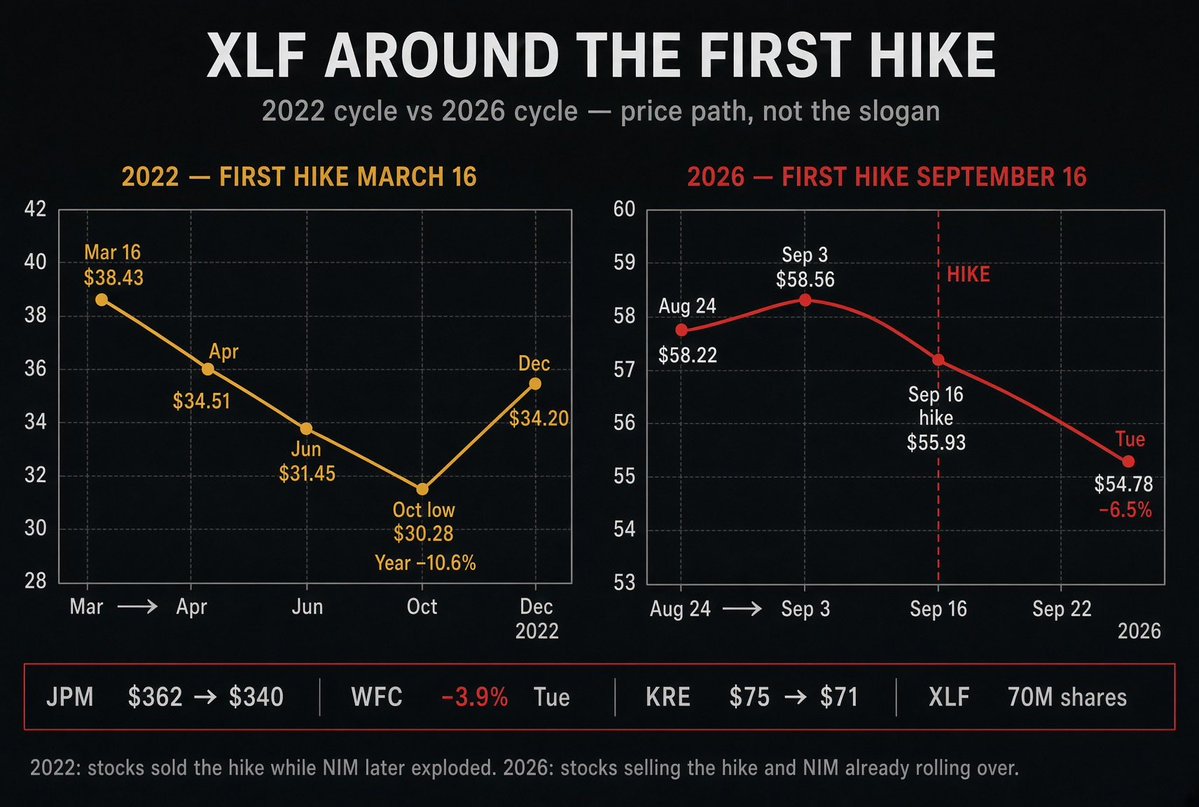
XLF hit 58.60 on September 3. Tuesday it closed $54.78 on 70 million shares.
Look at the two charts:
March 16, 2022 — first hike from zero. XLF bounced that day. Then it sold for six months. June was already down double digits from the hike print. The year finished −11%. Checking paid nothing… Deposit beta lagged a year. Industry NIM jumped the most since 2002. That money showed up in 2023 and 2024. That is when XLF actually ripped.
September 16, 2026 — first hike from 3.50%. No bounce. Hike day $55.93. Tuesday $54.78. Three weeks from the high: −6.5%.
That book is gone. Time deposits 17% → 30%. 87% of CDs roll inside a year. JPM NIM already −10 bps in Q2. Huntington cut NII the same afternoon as the hike.
2022: stock sold first, NIM paid later. 2026: NIM already spent, stock is selling off now. Very different situation.
Use this with it:
Thursday they buried crypto at $76,000. Tonight it’s $86,000
First print above $85k since January. ETH off the $2,400 dump to ~$2,750. Six hundred million in shorts paid the bill in a day. Market cap back near $3T.
The Clarity Act still failed. Nobody brought it back. Atkins and Selig just kept talking. Oil came off. The 10-year slipped under 5%. Risk came back
Scoreboard since Thursday’s post:
$COIN $174 → $201 (+16%). Armstrong said agencies would move. They did. CFTC registration is still the on-ramp.
$CRCL $85 → $94. The bill that wasn’t even about stablecoins still gave you the discount. GENIUS already passed.
$HOOD $110 → $123. Chain + prediction markets + whatever leveraged-retail rule Selig actually ships.
$PURR $12.83 → $13.55 (tagged $14.76 today). Only U.S. ticker on the thing they keep saying they want onshore. HYPE token ~$93.
ethereum:native — the one that already had its classification in March and still got sold like it was on the ballot.
Nothing in the original call required a 60-vote cloture. It required the agencies to stop hiding behind Congress. That’s what printed.
The trade is not “buy crypto because the Senate blinked.” It’s the same five names, now with the de-rate partially closed.
Original thread if you’re just walking in:
$COIN — Armstrong said before the vote that failure would be fine because the agencies would move. He was right within 24 hours. CFTC exchange registration is a direct on-ramp for the biggest U.S. exchange. -8% on the vote was a gift.
ethereum:native — the one that already got its classification and nobody's trading it that way. The March SEC/CFTC interpretation explicitly cleared protocol staking as not a security. That's settled. ETH sold to $2,400 on a Senate vote that had nothing to do with it.
Crypto just had its worst week in months over a vote that didn't matter.
Let me show you why.
Quick recap. Clarity Act Failed votes: 49-50. Needed 60. $BTC to $76k. $COIN -8%. $CRCL -10%. Twitter declared it dead.
Atkins at the SEC: "with or without legislation, we will act decisively... Stay tuned." Selig at the CFTC: "locked in and ready to ship its rules."
Thursday, Bernstein put out a note expecting "aggressive and swift" rulemaking. Bitwise's Hougan quietly walked back his call for six weeks of pain.
Here's the thing nobody wants to admit that could be the next leg up for Crypto:
The Clarity Act was never where the legitimacy came from. It was just Congress writing down what the regulators already decided. SEC and CFTC put out a joint interpretation in March saying most crypto assets aren't securities. The $75M offering exemption went out in August. CFTC already approved bitcoin perps. Strategy said it flat out — CFTC calls BTC a commodity, IRS calls it property, SEC approved the spot products, FASB puts it on the balance sheet. Bitcoin's been legal for years. We just got used to arguing about it.
So what did the failed vote actually do? It forced two federal agencies to say, on the record, that they'll build the framework themselves. It got fifty senators to vote yes on a crypto bill. The regulators are now out ahead of Congress instead of hiding behind it.
Yeah, JPM's right that agency rules aren't permanent. Someone can undo them later. But the direction isn't a debate anymore. The only thing left to argue about is how fast.
And honestly — the reason BTC is at $76k isn't the Senate. The Fed hiked Wednesday. Oil is $103. Everything with risk got sold this week. If you're blaming a cloture vote for a rates-and-oil tape, you're going to miss the entry.
Here's who is actually positioned for this 👇👇👇
$PURR — Trump named Hyperliquid on Aug 20 as something regulators want to bring onshore. Stock ran 30% that day. Now the CFTC is writing rules for exchange registration and leveraged trading — Hyperliquid is leveraged trading. $1.9B HYPE treasury, zero debt, runs its own validator. Only U.S. ticker for the thing Selig keeps saying he wants to onshore
Great to see everyone getting interested in $SDGR — we’ve been following this one for over a year.
Below you can find an article from January. We also alerted to the stock at $14 in February.
Follow so you don’t miss the next one
Schrodinger ( $SDGR ) looks cheap right now if Wall Street starts caring more about AI speeding up drug discovery. Why?
- It's a tool that mixes AI with real physics (like quantum math) to predict how new drugs or materials will work — cuts years and billions off testing by spotting winners early without endless lab trials.
- They sell this software to big pharma (like Lilly) for steady cash, and have their own drug candidates advancing (like oncology programs in early stages).
Why it's a good buy now at $14:
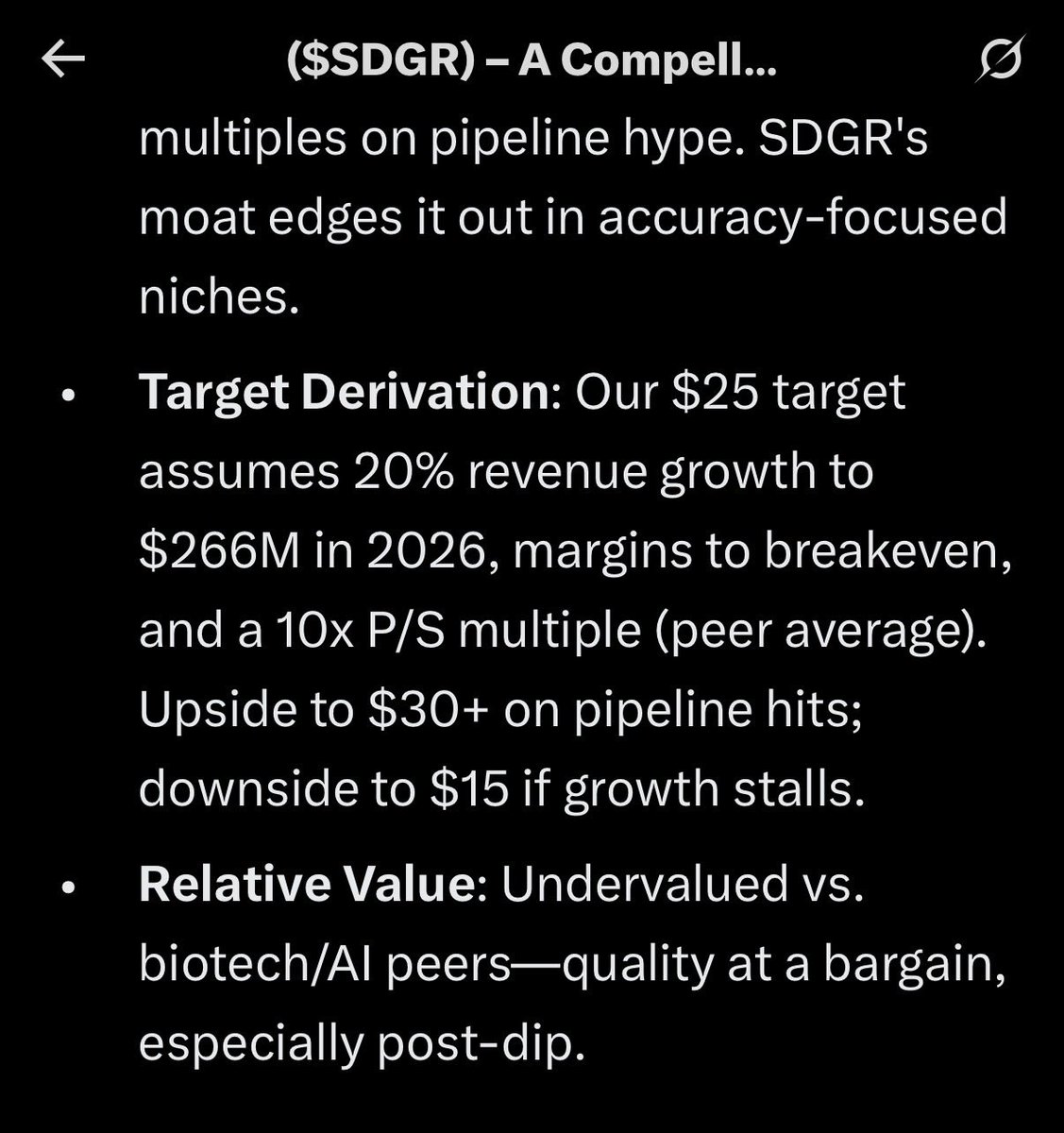
- Trades cheap (5x sales) for its growth potential, with analysts seeing 50%+ upside to $25.
- Losses are shrinking as they focus more on selling software (recurring cash) and less on risky in-house drugs.
Catalysts to watch (could make the stock jump in next 1–2 years):
1. New deals with big pharma (like Lilly or Otsuka expansions) — could bring $100M+ in upfront cash/milestones soon.
2. Software sales ramping up (aiming for $250M+ this year) as more companies use their AI for R&D — turns losses to profits by 2027.
3. Pipeline wins: Early data from their drugs (like SGR-1505 cancer trial in Q1) or out-licensing deals — one hit could double the stock.
4. Materials side (batteries, chemicals) breaking through — taps EV/green tech boom for extra revenue.
What makes it strong: Their physics + AI mix is super accurate (better than pure AI rivals like Recursion or Absci ), with patents and huge data sets nobody can easily copy. In a world where AI is speeding up drug discovery ($100B market growing fast), SDGR is a cheap way to play it.
In plain English:
SDGR’s got a brainy tool that helps find new drugs fast with AI + science — and the market hasn’t priced in how game-changing that is yet. That’s the hidden value most people miss.
It is the company that gives the shovels to the gold miners. The miners (pharma) do the digging, but SDGR gets paid reliably for the shovels — and if the gold rush (AI drug discovery) keeps growing, the shovel seller wins big