ethereum:0xec53bf9167f50cdeb3ae105f56099aaab9061f83 — THE RESTAKING AND VERIFIABLE CLOUD BET
⠀
A $159 MILLION cryptocurrency.
⠀
More than $5 BILLION in protocol TVL.
⠀
Over 1 BILLION tokens circulating.
⠀
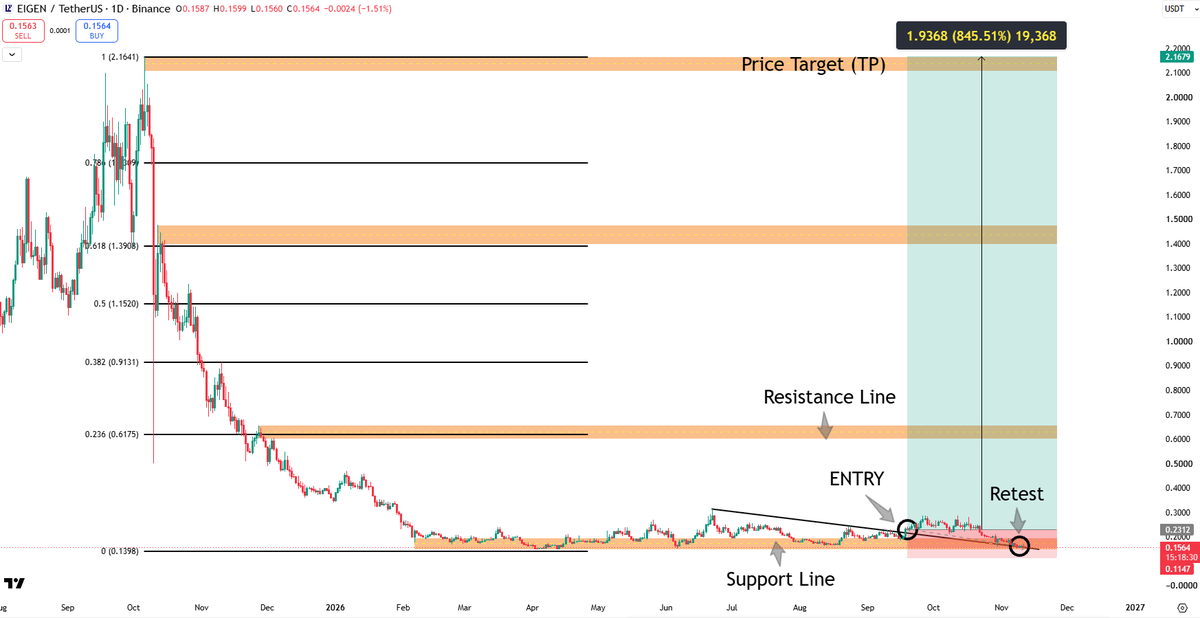
And a token trading approximately 97% below its all-time high.
⠀
But here's the contradiction.
⠀
EigenLayer built infrastructure for shared cryptoeconomic security.
⠀
EigenCloud expanded the vision into verifiable computing.
⠀
Yet deposited capital does not automatically generate income for EIGEN holders.
⠀
Is ethereum:0xec53bf9167f50cdeb3ae105f56099aaab9061f83 an overlooked infrastructure investment?
⠀
Or is the market correctly questioning how much economic value the token can capture?
⠀
Let's examine the numbers.
⠀
01 | WHAT IS EIGENCLOUD?
⠀
EigenCloud is a developer platform built around EigenLayer’s restaking infrastructure.
⠀
Its architecture brings together:
⠀
• EigenLayer restaking
• Autonomous Verifiable Services
• EigenDA for data availability
• EigenVerify for dispute resolution
• EigenCompute for execution
⠀
The goal is to make application behavior verifiable across on-chain and off-chain environments.
⠀
Potential applications include AI agents, financial services, and other software requiring stronger assurances about execution.
⠀
02 | THE NUMBERS THAT MATTER
⠀
November 12, 2026 snapshot:
⠀
EIGEN Price: ~$0.1562
Market Cap: ~$159.5M
FDV: ~$291.1M
Circulating Supply: ~1.021B EIGEN
Total Supply: ~1.864B EIGEN
Maximum Supply: No fixed cap
Circulating / Total Supply: ~54.8%
24H Token Trading Volume: ~$10.04M
All-Time High: ~$5.65
Decline From ATH: ~97.2%
⠀
FDV here uses current total supply. It is not a valuation based on a fixed eventual maximum.
⠀
PROTOCOL FUNDAMENTALS:
⠀
TVL: ~$5.23B
30D Reported Fees: ~$324K
30D Reported Protocol Revenue: $0
30D Reported Holders Revenue: $0
⠀
These are DefiLlama’s tracked metrics, rather than consolidated financial statements for every EigenCloud business activity.
⠀
03 | THE RESTAKING OPPORTUNITY
⠀
New decentralized services need operators and economic security.
⠀
Building both from scratch can be expensive.
⠀
EigenLayer provides a marketplace connecting restakers, operators, and services.
⠀
Supported assets can be committed to additional services, with rewards for participation and potential slashing when specified commitments are broken.
⠀
The investment opportunity is a market for security that developers are willing to pay for.
⠀
But supplying security and selling security are different achievements.
⠀
My central question is whether recurring customer demand can support the capital committed to the system.
⠀
04 | THE EIGEN TOKEN’S DISTINCT ROLE
⠀
EIGEN was designed to address intersubjectively attributable faults.
⠀
These are faults that external observers can broadly agree occurred, even when a simple on-chain rule cannot establish them.
⠀
Its design includes a token-forking mechanism intended to resolve such disputes without forking Ethereum itself.
⠀
This gives EIGEN a different security thesis from ETH.
⠀
But a technically distinctive mechanism still needs customers.
⠀
The economic test is whether services value that protection enough to create sustained demand for the token.
⠀
05 | THE TVL CONTRADICTION
⠀
Using the snapshot above:
⠀
Market Cap / TVL: ~0.03x.
⠀
That looks inexpensive at first glance.
⠀
But TVL is deposited collateral.
⠀
It is not cash owned by EIGEN holders.
⠀
Buying the token does not give an investor a proportional claim on those deposits.
⠀
My interpretation: a low market-cap-to-TVL ratio demonstrates a valuation gap between collateral and token value.
⠀
It does not explain whether that gap should close.
⠀
For that, investors need evidence of monetization and token value capture.
⠀
06 | THE REVENUE QUESTION
⠀
DefiLlama defines its tracked EigenLayer fees as rewards earned by suppliers.
⠀
Its methodology currently assigns no retained protocol revenue because those rewards accrue to suppliers.
⠀
That distinction matters.
⠀
Rewards paid through a network are not necessarily revenue retained by the protocol.
⠀
And neither category automatically becomes income for passive tokenholders.
⠀
The figures should also not be interpreted as proof that every EigenCloud product has zero commercial revenue.
⠀
The investment question requires a clearer bridge between customer spending, operating costs, and benefits delivered to EIGEN.
⠀
07 | THE PROPOSED VALUE-CAPTURE FRAMEWORK
⠀
The Foundation’s published incentives framework proposed:
⠀
A 20% fee on AVS rewards associated with EIGEN-subsidized stake.
⠀
Routing those fees toward a contract that could fund buybacks.
⠀
And directing cloud-service fees, after operator expenses, toward the same mechanism.
⠀
This outlines a potentially stronger economic connection.
⠀
But a published framework does not establish the amount of executed buybacks.
⠀
I would not value EIGEN as though large recurring repurchases have already been demonstrated.
⠀
The evidence that matters is collected fees, executed purchases, and the subsequent treatment of acquired tokens.
⠀
08 | THE INFLATION QUESTION
⠀
EIGEN launched with approximately 1.674 billion tokens, excluding subsequent inflationary issuance.
⠀
Its original incentive program used a 4% annual issuance framework.
⠀
Later PIv2 documentation increased the configured programmatic rate to 7%, while ELIP-12 described a broader 8% incentives envelope.
⠀
These describe different program stages.
⠀
They should not be presented as interchangeable current inflation rates.
⠀
The practical conclusion is that EIGEN’s supply is not permanently capped.
⠀
My valuation framework therefore requires tracking actual minting and current governance settings.
⠀
Staking rewards funded by new tokens redistribute ownership.
⠀
They do not, by themselves, demonstrate customer-funded profitability.
⠀
09 | THE UNLOCK QUESTION
⠀
DefiLlama lists the next investor and early-contributor unlock for November 30, 2026.
⠀
Estimated amount:
⠀
36.82 MILLION EIGEN.
⠀
Breakdown:
⠀
Investors: ~19.75M EIGEN.
⠀
Early Contributors: ~17.07M EIGEN.
⠀
That represents approximately 3.6% of the circulating supply.
⠀
At the research price, the tokens would be worth approximately $5.75 million.
⠀
An unlock permits liquidity.
⠀
It does not prove an immediate sale.
⠀
But it increases the importance of monitoring recipient transfers and new demand.
⠀
Unlocks and inflation are separate sources of potential circulating-supply growth.
⠀
10 | THE VALUATION QUESTION
⠀
Using approximately 1.864 billion current total EIGEN:
⠀
$0.25 implies ~$466M total-supply valuation.
⠀
$0.50 implies ~$932M.
⠀
$1.00 implies ~$1.86B.
⠀
$2.00 implies ~$3.73B.
⠀
$5.00 implies ~$9.32B.
⠀
These are valuation illustrations, not price targets.
⠀
Future issuance can increase the supply used in these calculations.
⠀
A return to the historical token price could therefore require a substantially different valuation from the one implied at that earlier date.
⠀
My view: a 97% drawdown creates a reason to investigate.
⠀
It does not establish a margin of safety.
⠀
11 | THE BULL AND BEAR CASE
⠀
THE BULL CASE:
⠀
Developers increasingly pay for verifiable services.
⠀
Restaked capital supports economically useful applications.
⠀
Customer-funded rewards become more important than subsidies.
⠀
Fee collection creates measurable benefits for EIGEN.
⠀
And token demand absorbs issuance and unlocks.
⠀
Under this scenario, EIGEN could gain a stronger economic foundation beyond the restaking narrative.
⠀
THE BEAR CASE:
⠀
Deposits fail to translate into sufficient paid demand.
⠀
Developers choose alternative security or computing arrangements.
⠀
Rewards remain dependent on incentives.
⠀
Value-capture mechanisms generate limited buying pressure.
⠀
And additional liquid supply exceeds demand.
⠀
Under this scenario, useful infrastructure could coexist with disappointing token returns.
⠀
12 | THE FINAL VERDICT
⠀
EIGEN has a credible infrastructure thesis.
⠀
But my investment test is stricter than the technology thesis.
⠀
How much security is being purchased?
⠀
How much computing demand is recurring?
⠀
What economic benefit reaches the token?
⠀
And how does that benefit compare with supply growth?
⠀
The next major catalyst is evidence that customers will pay enough to make the ecosystem less dependent on token incentives.
⠀
Deposited capital demonstrates participation.
⠀
Paid services demonstrate demand.
⠀
Executed value capture demonstrates the connection to EIGEN.
⠀
The strongest investment case needs all three.
⠀
Bookmark this analysis before the next restaking rotation.
⠀
Which has the strongest long-term shared-security thesis?
⠀
ethereum:0xec53bf9167f50cdeb3ae105f56099aaab9061f83, $SYMB, or $BABY?
⠀
And can EigenCloud turn verifiable infrastructure into sustainable token value?
⠀
Drop your view below.
⠀
📊 Full analysis & trading setups ↓
https://t.co/1pDZVclbWY
@QFEX - one of the more interesting experiments in RWA perps right now.
24/7 perpetual futures on US stocks, indices & commodities. No brokers. No expiry. USDC-margined.
Quick breakdown 👇
Team:
• Annanay Kapila (ex-Tower Research, Flow Traders)
• Joshua Wharton (ex-Citadel)
• Rest of team from Jump, HRT, Jane Street, Optiver
Y Combinator
+ $9.5M seed led by General Catalyst (March 2026)
Current stats (Oct 31): • 24h volume: $440–530M • Open Interest: ~$180–370M • ~236 markets
Biggest names: BRENT, US100, COPPER, GOLD, US500 + individual stocks
Alpha / Interesting Points
-Loss Refunds program — 20% of eligible losing traders can receive a 100% refund of realized losses (up to $2,000). Requires minimum deposit and volume.
-Strong referral system: up to 20% from direct referrals + levels 2 and 3. Affiliate program goes even higher (up to 50%).
-No token yet. The CEO previously published an essay arguing that exchanges should airdrop tokens to early users. From what i know season 0 is already ongoing.
-Architecture is specifically designed for traditional market cycles (different leverage limits during market hours / overnight / weekends, funding rate = 0 when the underlying is closed).
-Positioned as “FTX without the fraud” + long-term ambition to replace the entire ~$100bn exchange, clearing, and brokerage stack.
https://t.co/HQ4PE41x4j
join now to get 10% fee discount
@HuevaToi@vangrid_io Real enterprise demand is the ultimate stress test for any DePIN network. Without paying customers, even flawless infrastructure remains an expensive sandbox