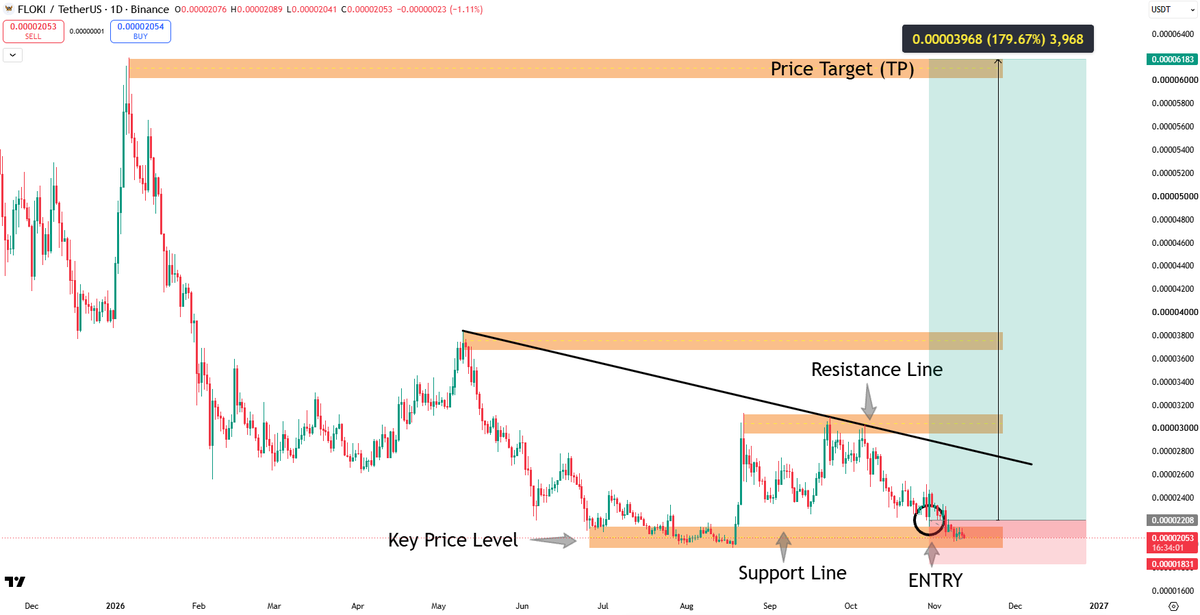
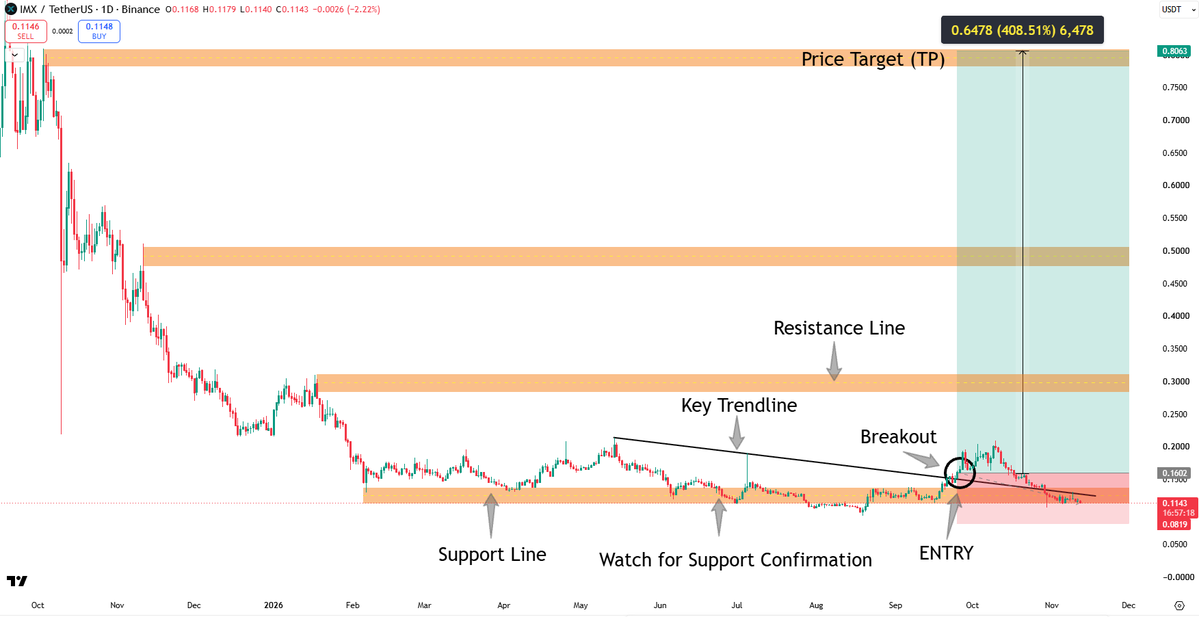
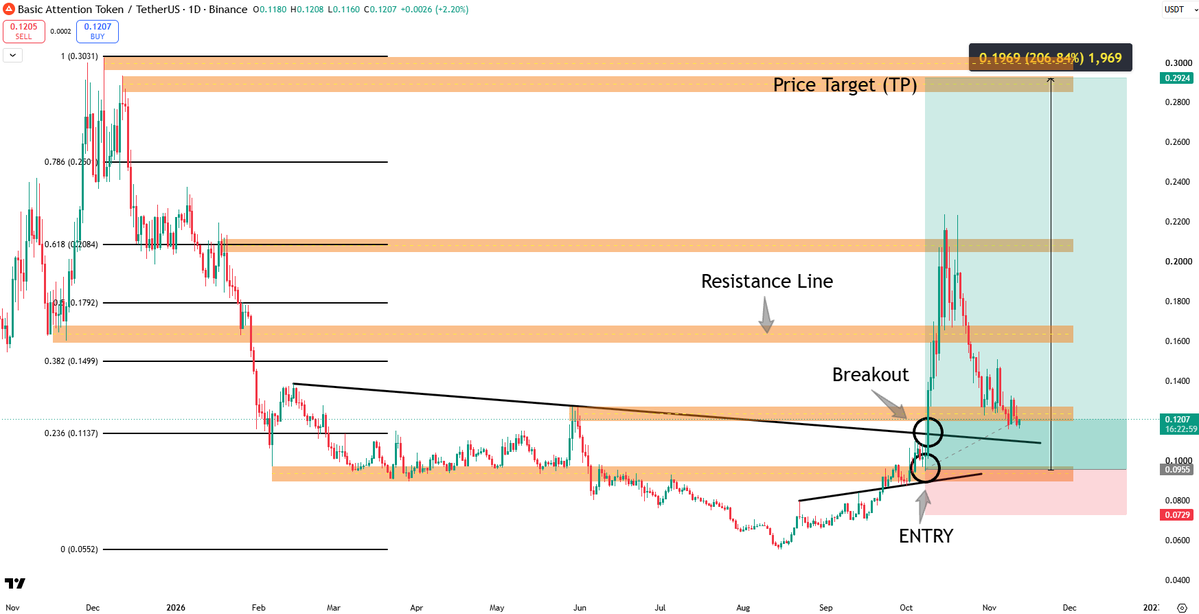
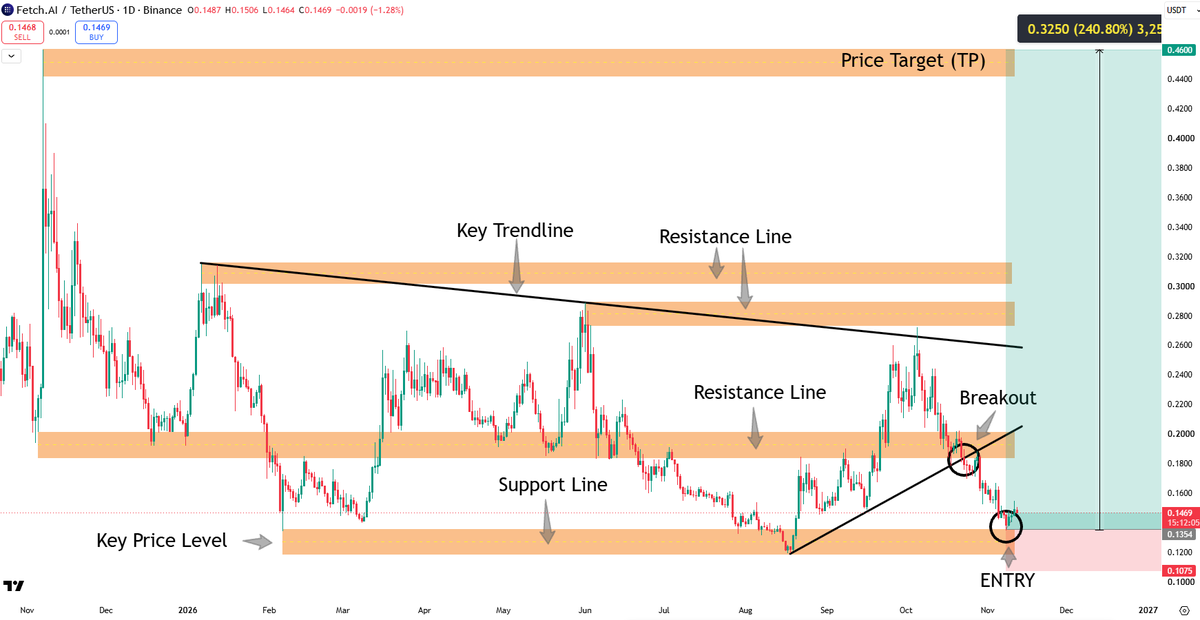
Follow the people who liked & RT’d this tweet — good chance they’ll follow back 🤝
Like, comment & RT so others can find you.
Let’s be mutuals, fam.
ethereum:0xcf0c122c6b73ff809c693db761e7baebe62b6a2e — THE MEME COIN TRYING TO BECOME A REAL BUSINESS
⠀
A globally recognized meme coin.
⠀
A gaming ecosystem built around Valhalla.
⠀
A tokenization platform called TokenFi.
⠀
And a community attempting to turn attention into economic utility.
⠀
But here's the contradiction.
⠀
FLOKI has spent years expanding beyond its original meme coin identity.
⠀
Yet launching products does not automatically create sustainable revenue.
⠀
And ecosystem growth does not necessarily translate into proportional demand for the FLOKI token.
⠀
Is ethereum:0xcf0c122c6b73ff809c693db761e7baebe62b6a2e an overlooked consumer crypto ecosystem?
⠀
Or is the market assigning a technology premium to what remains primarily a speculative meme asset?
⠀
Let's examine the fundamentals.
⠀
01 | WHAT IS FLOKI?
⠀
FLOKI is a cryptocurrency ecosystem that originated from the meme coin sector.
⠀
Its strategy combines community-driven marketing with products intended to create additional utility.
⠀
Major ecosystem initiatives include:
⠀
• Valhalla gaming
• TokenFi tokenization
• FlokiFi DeFi products
• FLOKI staking
• Educational initiatives
• Community marketing
• Ecosystem partnerships
⠀
The project attempts to evolve from a speculative token into a broader consumer crypto brand.
⠀
But the success of that transition must be demonstrated through measurable economic activity.
⠀
02 | THE MEME COIN ADVANTAGE
⠀
Meme coins possess an unusual competitive advantage.
⠀
They can attract attention without relying on conventional technology marketing.
⠀
Strong communities create:
⠀
Brand recognition.
⠀
Social engagement.
⠀
Exchange trading demand.
⠀
Viral distribution.
⠀
And recurring speculative interest.
⠀
FLOKI has built its identity around this model.
⠀
But attention is volatile.
⠀
Community activity can decline rapidly when market sentiment changes.
⠀
The investment question is whether FLOKI can retain users after speculative excitement fades.
⠀
03 | THE VALHALLA GAMING THESIS
⠀
Valhalla is FLOKI's flagship blockchain gaming initiative.
⠀
It aims to combine gameplay with digital assets and an in-game economy.
⠀
Gaming offers a potential route toward recurring user engagement.
⠀
But blockchain gaming faces significant challenges.
⠀
Players need compelling gameplay.
⠀
Retention must extend beyond token rewards.
⠀
And in-game economies must avoid excessive dependence on speculative demand.
⠀
A successful launch is not the same as a successful long-term business.
⠀
The relevant metrics are active players, retention, revenue, and sustainable spending.
⠀
04 | THE TOKENFI ECOSYSTEM
⠀
TokenFi focuses on tokenization infrastructure.
⠀
Its broader objective is to simplify the creation and management of digital tokens and tokenized assets.
⠀
Tokenization is a potentially important crypto sector.
⠀
But investors must distinguish FLOKI from TOKEN.
⠀
TOKEN is a separate asset associated with the TokenFi ecosystem.
⠀
Growth in TokenFi activity does not automatically generate equivalent demand for FLOKI.
⠀
The economic relationship between the two assets must be evaluated through implemented tokenomics.
⠀
05 | THE FLOKIFI PRODUCTS
⠀
FlokiFi represents the ecosystem's DeFi-related product initiatives.
⠀
These have included digital asset locking and other crypto infrastructure services.
⠀
Such products can potentially generate fees and strengthen ecosystem utility.
⠀
But product availability is not evidence of significant adoption.
⠀
Investors should monitor:
⠀
Active users.
⠀
Assets locked.
⠀
Recurring fees.
⠀
Operating costs.
⠀
And the share of economic activity that benefits FLOKI.
⠀
A product can be useful without creating meaningful value for the parent ecosystem token.
⠀
06 | THE STAKING ECONOMICS
⠀
FLOKI has introduced staking mechanisms connected to ecosystem incentives.
⠀
Staking can encourage longer holding periods and reduce immediately liquid supply.
⠀
But the economic value of staking depends on reward sources.
⠀
Rewards funded through newly issued tokens or separate incentive allocations are not equivalent to profits generated from customers.
⠀
Investors should distinguish:
⠀
Nominal staking yield.
⠀
Real yield after dilution.
⠀
Reward token volatility.
⠀
And sustainable external revenue.
⠀
A high advertised yield is not sufficient evidence of a strong investment opportunity.
⠀
07 | THE TOKEN SUPPLY QUESTION
⠀
FLOKI has a very large token supply measured in trillions.
⠀
This creates an important valuation challenge.
⠀
A low unit price can appear psychologically attractive.
⠀
But token price alone does not determine whether an asset is cheap.
⠀
Market capitalization depends on price multiplied by circulating supply.
⠀
Investors should focus on:
⠀
Circulating supply.
⠀
Total supply.
⠀
Verified burns.
⠀
Treasury holdings.
⠀
And future distribution schedules.
⠀
A token trading at a fraction of a cent can still carry a substantial valuation.
⠀
08 | THE BURN NARRATIVE
⠀
FLOKI has used token burns as part of its token-economic strategy.
⠀
Burns can permanently reduce outstanding supply.
⠀
But the impact depends on the percentage of supply removed.
⠀
Burning billions of tokens may sound substantial.
⠀
Against a supply measured in trillions, the percentage reduction can be relatively small.
⠀
The correct questions are:
⠀
How many tokens were permanently burned?
⠀
What percentage of circulating supply was removed?
⠀
Were the burns executed on-chain?
⠀
And are future burns funded by sustainable economic activity?
⠀
Announcements are not equivalent to completed burns.
⠀
09 | THE BRAND DISTRIBUTION ADVANTAGE
⠀
FLOKI has pursued marketing initiatives intended to build global awareness.
⠀
These have included sports-related advertising, social campaigns, and community partnerships.
⠀
Strong distribution can reduce the cost of attracting attention.
⠀
But advertising reach is not the same as customer acquisition.
⠀
And customer acquisition is not the same as customer profitability.
⠀
The relevant metrics are conversion, retention, revenue, and the cost of sustaining growth.
⠀
A recognizable brand can become valuable.
⠀
But only if it converts awareness into recurring economic demand.
⠀
10 | THE REVENUE QUESTION
⠀
FLOKI's long-term valuation should not depend exclusively on social engagement.
⠀
Investors should examine:
⠀
Valhalla gaming revenue.
⠀
FlokiFi product fees.
⠀
TokenFi-related economic flows.
⠀
Staking incentive costs.
⠀
Treasury spending.
⠀
And verified FLOKI buybacks or burns.
⠀
These categories should not be combined without evidence.
⠀
Revenue earned by one ecosystem product does not automatically belong to FLOKI tokenholders.
⠀
The strongest fundamental improvement would be transparent, recurring revenue linked directly to FLOKI demand.
⠀
11 | THE TOKEN VALUE-CAPTURE PROBLEM
⠀
This is the central issue for FLOKI investors.
⠀
The project can launch more products.
⠀
Valhalla can attract players.
⠀
TokenFi can gain users.
⠀
And FlokiFi can expand.
⠀
But those developments do not automatically increase FLOKI's economic value.
⠀
The relevant questions are:
⠀
Which products require FLOKI?
⠀
Which fees are paid in FLOKI?
⠀
Which revenues fund FLOKI purchases?
⠀
How much supply is permanently removed?
⠀
And what economic rights do tokenholders actually possess?
⠀
Without clear answers, the token may continue trading primarily on market sentiment.
⠀
12 | THE COMPETITIVE LANDSCAPE
⠀
FLOKI competes across several different markets.
⠀
In meme coins:
⠀
• DOGE
• SHIB
• PEPE
• BONK
⠀
In blockchain gaming:
⠀
• IMX
• RON
• AXS
⠀
In tokenization infrastructure:
⠀
• Other RWA and tokenization platforms
⠀
This broad strategy creates opportunities.
⠀
But it also creates execution risk.
⠀
Competing across multiple sectors requires significant resources and sustained development.
⠀
A broad product portfolio is not automatically a competitive advantage.
⠀
13 | THE VALUATION FRAMEWORK
⠀
Using a hypothetical circulating supply of 9.6 trillion FLOKI:
⠀
$0.00001 implies ~$96M market cap.
⠀
$0.00005 implies ~$480M.
⠀
$0.00010 implies ~$960M.
⠀
$0.00020 implies ~$1.92B.
⠀
$0.00050 implies ~$4.80B.
⠀
$0.00100 implies ~$9.60B.
⠀
These are illustrative valuations, not price targets.
⠀
The 9.6 trillion supply assumption is used for calculation only and is not a verified current circulating-supply figure.
⠀
Actual supply changes would alter these estimates.
⠀
A $0.001 FLOKI price would require a multibillion-dollar valuation under this assumption.
⠀
A low token price does not make that outcome easy.
⠀
14 | THE BULL CASE
⠀
FLOKI could benefit if:
⠀
Meme coin demand strengthens.
⠀
Valhalla attracts recurring players.
⠀
TokenFi adoption expands.
⠀
FlokiFi generates sustainable fees.
⠀
Verified burns reduce supply.
⠀
Community engagement remains strong.
⠀
And ecosystem growth creates measurable demand for FLOKI.
⠀
Under this scenario, FLOKI could evolve beyond a purely speculative meme asset.
⠀
But the transition must be demonstrated through real usage and economics.
⠀
15 | THE BEAR CASE
⠀
The bearish scenario is equally important.
⠀
Meme coin attention rotates elsewhere.
⠀
Valhalla fails to retain players.
⠀
TokenFi growth primarily benefits TOKEN rather than FLOKI.
⠀
FlokiFi adoption remains limited.
⠀
Marketing costs exceed sustainable economic returns.
⠀
And token burns are too small to materially affect supply.
⠀
Under this scenario, FLOKI could remain heavily dependent on speculative trading demand.
⠀
16 | THE FINAL VERDICT
⠀
FLOKI has several important strengths.
⠀
A recognizable global brand.
⠀
An established community.
⠀
A gaming initiative.
⠀
A tokenization ecosystem.
⠀
DeFi-related products.
⠀
And a history of aggressive marketing.
⠀
But here's the contradiction.
⠀
A meme coin attempting to become a multi-product crypto ecosystem.
⠀
Multiple potential sources of user activity.
⠀
And a large community capable of attracting attention.
⠀
Yet the investment thesis still depends on proving that those products generate meaningful economic value for FLOKI.
⠀
The next major catalyst isn't simply another exchange listing or marketing campaign.
⠀
It's evidence that real users are spending money on FLOKI ecosystem products and that part of this activity creates sustainable token demand.
⠀
Community demonstrates attention.
⠀
Products demonstrate ambition.
⠀
Revenue demonstrates monetization.
⠀
But direct token value capture determines whether the ecosystem's success benefits FLOKI investors.
⠀
Bookmark this analysis before the next meme coin rotation.
⠀
Which has the strongest long-term meme ecosystem thesis?
⠀
ethereum:0xcf0c122c6b73ff809c693db761e7baebe62b6a2e, $SHIB, or $BONK?
⠀
And can FLOKI become a sustainable crypto business beyond the meme narrative?
⠀
Drop your view below.
⠀
📊 Full analysis & trading setups ↓
https://t.co/1pDZVclbWY
THE ULTIMATE ALTCOIN CONVICTION TEST: 30 COINS, ONLY 3 SURVIVE
⠀
30 altcoins.
Only THREE can survive in your portfolio.
⠀
Everything else must go.
⠀
You must hold your three choices through the next major crypto cycle.
⠀
Which projects do you trust the most?
⠀
THE ESTABLISHED GIANTS
$ETH — Smart contract infrastructure
$BNB — Exchange and blockchain ecosystem
$XRP — Global payments
$SOL — High-performance blockchain
$TRX — Stablecoin infrastructure
⠀
THE NEXT-GENERATION CHALLENGERS
$SUI — Move-based Layer 1
$AVAX — Customizable blockchain networks
$NEAR — Chain abstraction
$APT — High-performance Layer 1
$SEI — Trading-focused blockchain
⠀
THE DEFI POWERHOUSES
$HYPE — On-chain derivatives
$AAVE — Decentralized lending
$UNI — Decentralized exchanges
$PENDLE — Yield trading
$MORPHO — On-chain credit markets
⠀
THE FINANCIAL INFRASTRUCTURE BETS
$LINK — Oracle infrastructure
$ONDO — Real-world asset tokenization
stellar:native — Global payments and asset issuance
hedera-hashgraph:native — Enterprise distributed ledger
$ENA — Synthetic dollar ecosystem
⠀
THE AI & COMPUTING CONTENDERS
$TAO — Decentralized AI
solana:rndrizKT3MK1iimdxRdWabcF7Zg7AR5T4nud4EkHBof — Distributed GPU computing
$FET — AI agent infrastructure
$VIRTUAL — AI agent ecosystem
$AKT — Decentralized cloud computing
⠀
THE HIGH-RISK WILDCARDS
$DOGE — Memecoin market leader
$PEPE — Meme-driven speculation
$PENGU — Community-driven ecosystem
$WIF — Solana memecoin culture
$BONK — Solana memecoin ecosystem
⠀
NOW THE REAL CHALLENGE BEGINS.
⠀
You cannot pick 10.
You cannot pick 5.
⠀
You get THREE.
⠀
Would you prioritize established networks with strong liquidity?
⠀
Emerging projects with higher growth potential?
⠀
Or high-risk tokens that could deliver explosive returns?
⠀
Remember:
⠀
A great project isn't always a great investment.
A popular token isn't always a sustainable business.
And the biggest potential upside often comes with the biggest downside.
⠀
This is a hypothetical conviction test, not a recommendation to hold only three assets.
⠀
30 ALTCOINS. 3 PICKS. ONE CRYPTO CYCLE.
⠀
Which THREE are you keeping?
⠀
Drop your picks in the comments and explain why.
THE NEXT CRYPTO GENERATION: 30 ALTCOINS THAT COULD REPLACE TODAY'S MARKET LEADERS
⠀
Here are 30 altcoins competing to shape the future of the industry.
⠀
NEXT-GENERATION LAYER 1
$SUI — Move-based blockchain ecosystem
$APT — High-performance blockchain infrastructure
$SEI — Trading-focused blockchain
$NEAR — Chain abstraction and AI infrastructure
$INJ — Finance-focused blockchain ecosystem
⠀
THE NEW DEFI GENERATION
$HYPE — On-chain derivatives ecosystem
$MORPHO — On-chain lending infrastructure
$PENDLE — Yield trading markets
$ENA — Synthetic dollar ecosystem
$AERO — Base ecosystem liquidity
⠀
RWA & FINANCIAL INFRASTRUCTURE
$ONDO — Tokenized financial products
$CFG — Real-world asset financing
polymesh:native — Regulated asset tokenization
plume:native — RWA-focused blockchain ecosystem
$SYRUP — On-chain institutional lending
⠀
AI & DECENTRALIZED COMPUTING
$TAO — Decentralized AI networks
$FET — AI agent infrastructure
$VIRTUAL — AI agent ecosystem
$GRASS — Decentralized data infrastructure
$AKT — Decentralized cloud computing
⠀
MODULAR & SCALING INFRASTRUCTURE
celestia:native — Modular data availability infrastructure
$EIGEN — Restaking and shared security
$ZRO — Cross-chain interoperability infrastructure
$STRK — Ethereum Layer 2 scaling
$ARB — Ethereum Layer 2 ecosystem
⠀
EMERGING TRADING & CONSUMER ECOSYSTEMS
solana:JUPyiwrYJFskUPiHa7hkeR8VUtAeFoSYbKedZNsDvCN — Solana trading infrastructure
solana:DriFtupJYLTosbwoN8koMbEYSx54aFAVLddWsbksjwg7 — On-chain derivatives trading
$RAY — Solana liquidity infrastructure
$PENGU — Community-driven consumer ecosystem
$TON — Blockchain ecosystem linked to Telegram
⠀
BUT HERE'S THE REALITY:
⠀
New technology doesn't automatically replace established networks.
⠀
Liquidity matters.
Distribution matters.
Network effects matter.
⠀
Some emerging projects could become industry leaders.
Others may struggle to compete with established ecosystems.
⠀
And even if a new protocol succeeds, its token may fail to capture the value it creates.
⠀
The next generation of crypto winners won't be determined by hype alone.
⠀
It will depend on real adoption, sustainable economics, and the ability to compete over multiple market cycles.
⠀
Save this list and revisit it in 2030.
⠀
Which FIVE altcoins could replace today's biggest crypto leaders?
⠀
And which established project do you think is most vulnerable?
25 ALTCOINS THAT COULD OUTPERFORM ETHEREUM IN THE NEXT BULL RUN
⠀
Here are 25 altcoins that could outperform ETH in percentage returns.
⠀
LAYER 1 & HIGH-GROWTH ECOSYSTEMS
$SOL — High-performance blockchain ecosystem
$SUI — Expanding Move-based Layer 1
$AVAX — Customizable blockchain networks
$NEAR — Chain abstraction and AI infrastructure
$SEI — Trading-focused blockchain
⠀
DEFI & ON-CHAIN FINANCE
$HYPE — On-chain derivatives ecosystem
$AAVE — Decentralized lending markets
$MORPHO — On-chain lending infrastructure
$PENDLE — Yield trading markets
$ENA — Synthetic dollar ecosystem
⠀
RWA & FINANCIAL INFRASTRUCTURE
$ONDO — Tokenized financial products
$LINK — Oracle and cross-chain infrastructure
$CFG — Real-world asset financing
stellar:native — Global payments and asset issuance
hedera-hashgraph:native — Enterprise-focused distributed ledger
⠀
AI & DECENTRALIZED COMPUTING
$TAO — Decentralized AI networks
solana:rndrizKT3MK1iimdxRdWabcF7Zg7AR5T4nud4EkHBof — Distributed GPU computing
$FET — AI agent infrastructure
$VIRTUAL — AI agent ecosystem
$AKT — Decentralized cloud computing
⠀
HIGH-BETA & SPECULATIVE CONTENDERS
$DOGE — Memecoin market leader
$PEPE — Meme-driven market speculation
solana:JUPyiwrYJFskUPiHa7hkeR8VUtAeFoSYbKedZNsDvCN — Solana trading infrastructure
$AERO — Base ecosystem liquidity
$PENGU — Community-driven token ecosystem
⠀
BUT HERE'S THE REALITY CHECK:
⠀
Outperforming Ethereum doesn't necessarily mean being a better long-term investment.
⠀
A smaller market cap can create more upside potential, but it also increases exposure to volatility, liquidity risks, and sharp drawdowns.
⠀
Some of these altcoins could deliver significantly higher percentage returns than ETH.
⠀
Others could underperform despite having promising technology and growing ecosystems.
⠀
This is a speculative watchlist, not a prediction that all 25 will outperform Ethereum.
⠀
Save this list and compare their performance against ETH during the next major market cycle.
⠀
Which FIVE altcoins will outperform ETH in the next bull run?
⠀
And which popular altcoin has absolutely no chance?
ethereum:0xf57e7e7c23978c3caec3c3548e3d615c346e79ff — THE WEB3 GAMING INFRASTRUCTURE BET
⠀
A cryptocurrency trading nearly 99% below its all-time high.
⠀
A $233 MILLION fully diluted valuation.
⠀
A blockchain built specifically for gaming.
⠀
And a major infrastructure transition planned for 2027.
⠀
But here's the contradiction.
⠀
Immutable has spent years building technology for blockchain gaming.
⠀
It offers developer infrastructure, digital asset ownership, and tools designed to simplify Web3 onboarding.
⠀
Yet its zkEVM network currently holds only about $11 million in DeFi TVL.
⠀
And its direct chain revenue remains negligible.
⠀
Is ethereum:0xf57e7e7c23978c3caec3c3548e3d615c346e79ff an overlooked investment in the future of gaming?
⠀
Or is the market correctly discounting weak economic adoption?
⠀
Let's examine the fundamentals.
⠀
01 | WHAT IS IMMUTABLE?
⠀
Immutable is an Ethereum-aligned infrastructure ecosystem focused on blockchain gaming and digital asset ownership.
⠀
Its products and infrastructure include:
⠀
• Immutable Chain
• Immutable Passport
• Gaming development tools
• NFT marketplace infrastructure
• Game integrations
• IMX staking and rewards
⠀
The objective is to make blockchain technology easier for game developers and players to use.
⠀
But a strong developer platform does not automatically create a valuable token.
⠀
02 | THE NUMBERS THAT MATTER
⠀
November 12, 2026 snapshot:
⠀
IMX Price: ~$0.116
Maximum Supply: 2B IMX
Total Supply: 2B IMX
FDV: ~$233M
24H Trading Volume: ~$6M–$8M
All-Time High: ~$9.50
Decline From ATH: ~98.8%
⠀
IMPORTANT SUPPLY DISCREPANCY:
⠀
CoinMarketCap reports approximately 2 billion IMX circulating.
⠀
CoinGecko reports approximately 904 million IMX circulating.
⠀
That produces materially different circulating market capitalizations.
⠀
The discrepancy must be resolved before using market-cap-based valuation multiples.
⠀
IMMUTABLE zkEVM:
⠀
DeFi TVL: ~$10.93M
Stablecoin Supply: ~$11.31M
24H DEX Volume: ~$48K
24H Chain Fees: ~$5.62
24H Tracked Chain Revenue: $0
24H App Revenue: ~$4.74K
24H Active Addresses: ~3,366
24H Transactions: ~44,777
⠀
These figures represent tracked zkEVM activity, not the entire Immutable gaming business.
⠀
03 | THE WEB3 GAMING OPPORTUNITY
⠀
Gaming is one of the largest digital entertainment industries.
⠀
Blockchain infrastructure could support:
⠀
Tradable in-game assets.
⠀
Player-owned inventories.
⠀
Digital collectibles.
⠀
Cross-game economies.
⠀
And programmable marketplaces.
⠀
Immutable is positioned around this opportunity.
⠀
But the size of the traditional gaming market does not automatically translate into demand for blockchain games.
⠀
Players prioritize entertainment.
⠀
They do not necessarily care which blockchain supports their assets.
⠀
04 | THE IMMUTABLE PASSPORT ADVANTAGE
⠀
One of Web3 gaming's biggest challenges is onboarding.
⠀
Traditional crypto wallets introduce complexity.
⠀
Players may need to manage private keys, gas fees, and blockchain transactions.
⠀
Immutable Passport is designed to reduce that friction.
⠀
Simpler onboarding can improve adoption.
⠀
But registrations are not equivalent to active players.
⠀
And active players are not automatically paying customers.
⠀
The strongest evidence would be recurring gameplay, retention, and real transaction spending.
⠀
05 | THE IMMUTABLE CHAIN STRATEGY
⠀
Immutable has been developing Ethereum-compatible blockchain infrastructure for gaming.
⠀
The network is designed to support applications requiring low transaction costs and integrated digital assets.
⠀
But its architecture is evolving.
⠀
Recent reporting indicates a planned transition toward OP Stack infrastructure in 2027.
⠀
This could improve ecosystem compatibility and infrastructure flexibility.
⠀
However, the transition also introduces execution risks.
⠀
Developers must understand how contracts, integrations, security assumptions, and token economics will change.
⠀
A roadmap announcement is not proof of successful migration.
⠀
06 | THE ADOPTION CONTRADICTION
⠀
Immutable zkEVM currently reports approximately $10.93 million in DeFi TVL.
⠀
Stablecoin supply is approximately $11.31 million.
⠀
Daily DEX volume is roughly $48,000.
⠀
These are modest figures.
⠀
But gaming blockchains should not be evaluated exclusively through DeFi TVL.
⠀
A successful gaming ecosystem could generate value through NFT trading, marketplace fees, and game-related transactions.
⠀
The important question is whether those activities are measurable, recurring, and economically significant.
⠀
07 | THE TRANSACTION QUESTION
⠀
Immutable zkEVM recently processed approximately 44,777 transactions in 24 hours.
⠀
Tracked active addresses were approximately 3,366.
⠀
But chain fees were only around $5.62.
⠀
That demonstrates the difference between network activity and monetization.
⠀
Low fees are useful for gaming.
⠀
Players should not face expensive blockchain transactions for routine actions.
⠀
But extremely low fees also limit direct chain-level revenue.
⠀
The investment thesis must therefore consider broader marketplace economics and IMX utility.
⠀
08 | THE IMX TOKEN MODEL
⠀
IMX is an ERC-20 utility token.
⠀
Its documented functions include:
⠀
Transaction fees.
⠀
Staking rewards.
⠀
Governance.
⠀
Ecosystem incentives.
⠀
And network gas utility.
⠀
Immutable's published tokenomics describe a mechanism requiring 20% of eligible protocol fees to be paid in IMX.
⠀
Where necessary, the required IMX can be purchased through market conversion.
⠀
This is potentially important.
⠀
It creates a documented connection between qualifying protocol activity and token demand.
⠀
But investors must verify how that mechanism operates across current products and future network architecture.
⠀
09 | THE VALUE-CAPTURE QUESTION
⠀
This is the central investment issue.
⠀
More games do not automatically mean higher IMX prices.
⠀
More registered wallets do not automatically create sustainable buying pressure.
⠀
And greater NFT trading volume does not automatically become tokenholder revenue.
⠀
The relevant questions are:
⠀
How much eligible fee activity occurs?
⠀
How much IMX is actually purchased or required?
⠀
How much is distributed through staking?
⠀
And how much new token supply enters the market?
⠀
The strongest token economics are those supported by recurring demand rather than temporary incentives.
⠀
10 | THE TOKENOMICS STRUCTURE
⠀
IMX has a fixed maximum supply of 2 billion tokens.
⠀
Its original allocation included:
⠀
Ecosystem Development: 51.72%
⠀
Project Development: 25%
⠀
Private Sale: 13.86%
⠀
Public Sale: 5.42%
⠀
Foundation Reserve: 4%
⠀
The largest allocation was designed to support ecosystem development and incentives.
⠀
This can help attract developers.
⠀
But incentive-funded activity must eventually transition toward sustainable organic demand.
⠀
Otherwise, rewards can subsidize usage without creating durable economic value.
⠀
11 | THE UNLOCK QUESTION
⠀
https://t.co/sgImtuiWPP reports that IMX's scheduled vesting program ended on March 5, 2026.
⠀
There are currently no additional dated unlock events listed.
⠀
However, its tracker still identifies approximately 5.6% of supply as locked without scheduled releases.
⠀
Meanwhile, circulating supply estimates differ significantly across market-data providers.
⠀
These figures should not be treated as interchangeable.
⠀
Unlocked supply is not necessarily circulating supply.
⠀
Treasury-held tokens are not necessarily actively traded.
⠀
And the end of scheduled vesting does not guarantee that every token is already liquid.
⠀
12 | THE GAMING BUSINESS CHALLENGE
⠀
Blockchain gaming has historically struggled with retention.
⠀
Many games attracted users through token rewards rather than gameplay quality.
⠀
When incentives declined, activity often weakened.
⠀
Immutable must help developers build games that people want to play independently of financial rewards.
⠀
The key metrics include:
⠀
Monthly active players.
⠀
Retention rates.
⠀
Game revenue.
⠀
Marketplace activity.
⠀
And organic user acquisition.
⠀
A large number of announced games is not equivalent to a successful gaming ecosystem.
⠀
13 | THE COMPETITIVE CHALLENGE
⠀
Immutable competes with:
⠀
• Ronin
• Avalanche gaming infrastructure
• Polygon
• Other Ethereum Layer 2 networks
• Traditional gaming platforms
⠀
Its competitive advantages include specialized gaming infrastructure, developer tooling, and an established ecosystem.
⠀
But gaming distribution is difficult.
⠀
Traditional publishers already possess large audiences and mature monetization systems.
⠀
Blockchain integration must provide tangible benefits without reducing the quality of the player experience.
⠀
14 | THE VALUATION QUESTION
⠀
Using the maximum supply of 2 billion IMX:
⠀
$0.20 IMX implies $400M FDV.
⠀
$0.50 implies $1B.
⠀
$1.00 implies $2B.
⠀
$2.00 implies $4B.
⠀
$3.00 implies $6B.
⠀
These are valuation scenarios, not price targets.
⠀
At $1, IMX would need to justify a $2 billion fully diluted valuation.
⠀
That would require substantially stronger confidence in gaming adoption and sustainable token demand.
⠀
Its previous all-time high does not establish fair value.
⠀
A token trading 98% below its peak can still be expensive relative to current economic activity.
⠀
15 | THE BULL AND BEAR CASE
⠀
THE BULL CASE:
⠀
Blockchain gaming adoption expands.
⠀
Immutable Passport improves player onboarding.
⠀
More games achieve meaningful retention.
⠀
Marketplace activity increases.
⠀
Eligible protocol fees create recurring IMX demand.
⠀
The planned infrastructure migration succeeds.
⠀
And ecosystem activity becomes less dependent on incentives.
⠀
THE BEAR CASE:
⠀
Web3 gaming adoption remains weak.
⠀
Games fail to retain players.
⠀
Marketplace activity stagnates.
⠀
Token incentives subsidize unsustainable demand.
⠀
The infrastructure transition introduces delays or friction.
⠀
And IMX utility fails to generate meaningful net buying pressure.
⠀
16 | THE FINAL VERDICT
⠀
Immutable has several important strengths.
⠀
An established position in blockchain gaming.
⠀
Specialized developer infrastructure.
⠀
Consumer onboarding technology.
⠀
A fixed maximum token supply.
⠀
And a documented fee mechanism connected to IMX.
⠀
But here's the contradiction.
⠀
A $233 million fully diluted valuation.
⠀
Only $10.9 million in tracked zkEVM DeFi TVL.
⠀
Approximately $48,000 in daily DEX volume.
⠀
Almost no direct chain revenue.
⠀
And unresolved discrepancies in reported circulating supply.
⠀
The next major catalyst isn't simply another game announcement.
⠀
It's evidence that games built on Immutable can attract recurring players, generate meaningful transaction fees, and create sustainable IMX demand.
⠀
Game announcements demonstrate developer interest.
⠀
Active players demonstrate adoption.
⠀
Marketplace fees demonstrate monetization.
⠀
But token value capture determines long-term investment returns.
⠀
Bookmark this analysis before the next gaming sector rotation.
⠀
Which has the strongest long-term Web3 gaming infrastructure thesis?
⠀
ethereum:0xf57e7e7c23978c3caec3c3548e3d615c346e79ff, ronin:native, or $BEAM?
⠀
And can Immutable turn its gaming infrastructure into sustainable economic demand for IMX?
⠀
Drop your view below.
⠀
📊 Full analysis & trading setups ↓
https://t.co/1pDZVclbWY
@ZypZapCommunity Exactly. Brave has already proven product-market fit. The real question is whether that massive user base can translate into sustainable demand for BAT.
$BAT — 130 MILLION USERS. A $176 MILLION TOKEN.
⠀
Brave Browser has over 130 MILLION monthly active users.
⠀
Yet its ecosystem token, $BAT, trades at a market capitalization of roughly $176 million.
⠀
A privacy-focused browser.
⠀
A functioning digital advertising business.
⠀
A fixed maximum supply of 1.5 billion tokens.
⠀
And a token trading more than 90% below its historical peak.
⠀
But here's the contradiction.
⠀
Brave has achieved something most crypto projects never will.
⠀
Real consumer adoption.
⠀
Yet the BAT token has struggled to capture the value investors might expect from that distribution.
⠀
Is $BAT one of crypto's most overlooked consumer adoption plays?
⠀
Or is the market correctly separating Brave's business success from BAT's token economics?
⠀
Let's examine the fundamentals.
⠀
01 | WHAT IS BASIC ATTENTION TOKEN?
⠀
Basic Attention Token is a cryptocurrency associated with Brave's privacy-focused digital advertising ecosystem.
⠀
Brave aims to provide an alternative to traditional advertising models built around extensive user tracking.
⠀
Its ecosystem includes:
⠀
• Brave Browser
• Brave Ads
• Brave Rewards
• Creator rewards
• Brave Wallet
• Brave Search
• Privacy-focused consumer products
⠀
BAT is designed to facilitate parts of the advertising and rewards economy.
⠀
But owning BAT is not the same as owning equity in Brave.
⠀
02 | THE NUMBERS THAT MATTER
⠀
BAT Price: ~$0.117
⠀
Market Cap: ~$176M
⠀
Fully Diluted Valuation: ~$176M
⠀
Circulating Supply: ~1.496B BAT
⠀
Maximum Supply: 1.5B BAT
⠀
Circulating Ratio: ~99.7%
⠀
24H Trading Volume: ~$19.8M
⠀
Historical ATH: ~$1.90
⠀
Brave Monthly Active Users: 130.8M
⠀
Brave Daily Active Users: 55.4M
⠀
The market data is a November 12, 2026 snapshot.
⠀
The Brave user figures are from October 31, 2026.
⠀
The most important distinction?
⠀
Browser users are not necessarily BAT users.
⠀
03 | THE 130 MILLION USER ADVANTAGE
⠀
Most crypto projects spend years trying to attract their first million users.
⠀
Brave already has a consumer product with more than 130 million monthly active users.
⠀
That creates an enormous potential distribution channel.
⠀
But distribution is only the first step.
⠀
Investors need to know:
⠀
How many users enable Brave Rewards?
⠀
How many receive BAT?
⠀
How many actively use BAT?
⠀
And how many advertisers generate recurring BAT-related demand?
⠀
A large audience is valuable.
⠀
But only monetized participation can support the token's economic thesis.
⠀
04 | THE BRAVE ADVERTISING MODEL
⠀
Brave offers advertising products designed around privacy.
⠀
The model aims to connect advertisers with users without relying on conventional cross-site tracking.
⠀
This addresses a real market problem.
⠀
Advertisers want measurable performance.
⠀
Users want greater privacy.
⠀
And publishers need sustainable monetization.
⠀
But advertising success must be measured through actual spending, customer retention, and campaign performance.
⠀
A large browser audience does not guarantee advertising revenue growth.
⠀
05 | HOW BAT ENTERS THE ECONOMY
⠀
BAT is associated with Brave's advertising and rewards ecosystem.
⠀
Eligible users can receive BAT through supported rewards arrangements.
⠀
Creators can also participate in BAT-related rewards mechanisms.
⠀
Brave has historically purchased BAT for certain ecosystem activities.
⠀
This creates a potential source of market demand.
⠀
But the strength of that demand depends on actual purchases and distribution.
⠀
Advertiser spending should not automatically be treated as an equivalent amount of BAT buying pressure.
⠀
The payment flow matters.
⠀
06 | THE TOKEN SUPPLY ADVANTAGE
⠀
BAT has a maximum supply of 1.5 billion tokens.
⠀
Approximately 1.496 billion are already circulating.
⠀
That means roughly 99.7% of maximum supply is in circulation.
⠀
Unlike projects with large future unlock schedules, BAT has limited remaining supply dilution relative to its maximum.
⠀
This is a genuine tokenomics advantage.
⠀
But low dilution does not guarantee price appreciation.
⠀
Demand must still exceed available selling pressure.
⠀
07 | THE REAL VALUE-CAPTURE PROBLEM
⠀
This is the most important section.
⠀
Brave can gain millions of new users.
⠀
Brave Search can grow.
⠀
Brave's advertising business can expand.
⠀
And the browser can become more competitive.
⠀
But BAT holders do not automatically receive Brave's corporate profits.
⠀
BAT is not a share of Brave.
⠀
It does not grant ownership of the company.
⠀
And it does not provide an automatic claim on future advertising revenue.
⠀
The token investment thesis depends on actual BAT-related economic demand.
⠀
Not simply the valuation of Brave as a business.
⠀
08 | THE ADVERTISING PURCHASE QUESTION
⠀
One of the clearest indicators of BAT demand is the amount of BAT purchased for ecosystem activities.
⠀
Brave maintains a public transparency page showing certain BAT purchases.
⠀
However, a purchase history is not the same as a complete financial statement.
⠀
Investors should monitor:
⠀
Purchase frequency.
⠀
Purchase size.
⠀
Total monthly BAT demand.
⠀
Reward distributions.
⠀
And whether purchases are increasing over time.
⠀
A strong browser business with weak BAT purchasing activity may provide limited support for token valuation.
⠀
09 | THE BRAVE SEARCH OPPORTUNITY
⠀
Brave Search is another important component of the company's ecosystem.
⠀
Search advertising represents a large global market.
⠀
A privacy-focused search engine could provide an alternative to established platforms.
⠀
But there is a critical distinction.
⠀
Growth in Brave Search does not automatically generate BAT demand.
⠀
Investors must verify whether a particular product's revenue or payment flow is connected to BAT.
⠀
A successful product can strengthen the Brave brand without directly benefiting tokenholders.
⠀
10 | THE PRIVACY NARRATIVE
⠀
Digital privacy remains a major consumer concern.
⠀
Brave competes by emphasizing:
⠀
Tracker blocking.
⠀
Reduced advertising surveillance.
⠀
Browser privacy.
⠀
And greater user control.
⠀
This gives the company a differentiated market position.
⠀
But privacy adoption and crypto adoption are different behaviors.
⠀
Many Brave users may simply want a better browser.
⠀
They may have no interest in earning, holding, or spending BAT.
⠀
That distinction is central to the investment case.
⠀
11 | THE TOKEN VELOCITY PROBLEM
⠀
BAT can move between ecosystem participants.
⠀
Advertisers or ecosystem operators may acquire tokens.
⠀
Users and creators may receive them.
⠀
Some recipients may sell their rewards.
⠀
This creates a potential economic cycle.
⠀
But a token used primarily as a pass-through payment asset may experience high velocity.
⠀
Higher transaction activity does not necessarily create lasting holding demand.
⠀
Investors should evaluate whether BAT is accumulated, retained, or quickly converted into other assets.
⠀
12 | THE COMPETITIVE LANDSCAPE
⠀
Brave competes with some of the world's largest technology companies.
⠀
Its competitors include:
⠀
Google Chrome.
⠀
Microsoft Edge.
⠀
Mozilla Firefox.
⠀
Safari.
⠀
And major digital advertising platforms.
⠀
Brave's advantages include privacy positioning and an established user base.
⠀
But its competitors possess enormous distribution, capital, and advertising infrastructure.
⠀
BAT investors must evaluate both Brave's competitive position and the token's economic relevance.
⠀
13 | THE HISTORICAL PRICE QUESTION
⠀
BAT previously reached approximately $1.90.
⠀
At a current price near $0.117, it trades roughly 94% below that peak.
⠀
That may attract investors searching for deeply discounted crypto assets.
⠀
But a large drawdown is not evidence of undervaluation.
⠀
A token can remain far below its previous high if market demand, narratives, or valuation expectations have changed.
⠀
The relevant question is not how far BAT has fallen.
⠀
It's what future demand could justify a higher valuation.
⠀
14 | THE VALUATION FRAMEWORK
⠀
Using BAT's maximum supply of 1.5 billion:
⠀
$0.10 BAT implies $150M FDV.
⠀
$0.20 implies $300M.
⠀
$0.50 implies $750M.
⠀
$1.00 implies $1.50B.
⠀
$1.50 implies $2.25B.
⠀
$2.00 implies $3.00B.
⠀
These are illustrative valuations, not price targets.
⠀
At $1, BAT would require a valuation of approximately $1.5 billion.
⠀
That is substantially higher than its current market capitalization.
⠀
Such an outcome would require stronger token demand, higher market expectations, or both.
⠀
The number of Brave users alone cannot justify that valuation.
⠀
15 | THE BULL CASE
⠀
BAT could benefit if:
⠀
Brave continues growing its user base.
⠀
Brave Rewards participation increases.
⠀
Advertiser demand expands.
⠀
BAT purchases accelerate.
⠀
Creator adoption improves.
⠀
Token retention increases.
⠀
And the ecosystem introduces additional meaningful BAT utility.
⠀
Under this scenario, BAT could benefit from a stronger connection between consumer adoption and token demand.
⠀
But the thesis requires measurable economic conversion.
⠀
16 | THE BEAR CASE
⠀
The bearish scenario is equally important.
⠀
Brave grows without increasing BAT participation.
⠀
Users continue treating BAT rewards as tokens to sell.
⠀
Advertising activity fails to create meaningful buying pressure.
⠀
Brave Search expands independently of BAT.
⠀
Competing browsers retain market dominance.
⠀
And BAT remains primarily a speculative asset linked to a successful consumer product.
⠀
Under this scenario, Brave could continue succeeding while BAT underperforms.
⠀
17 | THE FINAL VERDICT
⠀
BAT has several important strengths.
⠀
A real consumer product.
⠀
More than 130 million monthly Brave users.
⠀
An established advertising ecosystem.
⠀
A fixed 1.5 billion token maximum supply.
⠀
And almost no remaining dilution relative to that ceiling.
⠀
But here's the contradiction.
⠀
One of crypto's largest real-world consumer distribution channels.
⠀
A recognizable privacy-focused brand.
⠀
And a token trading at a relatively modest market capitalization.
⠀
Yet the direct economic connection between Brave's success and BAT's valuation remains the decisive uncertainty.
⠀
The next major catalyst isn't simply another milestone in Brave browser users.
⠀
It's evidence that more users and advertisers are generating sustained BAT demand.
⠀
Browser growth demonstrates distribution.
⠀
Advertising spending demonstrates monetization.
⠀
BAT purchases demonstrate token demand.
⠀
And sustained net demand determines long-term investment value.
⠀
The market isn't just asking whether Brave can grow.
⠀
It's asking how much of that growth actually matters for BAT.
⠀
Bookmark this analysis before the next consumer crypto rotation.
⠀
Which has the strongest real-world adoption thesis?
⠀
$BAT, ethereum:0xc944e90c64b2c07662a292be6244bdf05cda44a7, or $LINK?
⠀
And can Brave's 130 million users eventually translate into meaningful BAT token demand?
⠀
Drop your view below.
⠀
📊 Full analysis & trading setups ↓
https://t.co/1pDZVclbWY
ethereum:0xaea46a60368a7bd060eec7df8cba43b7ef41ad85 — THE AI AGENT ECONOMY BET
⠀
A $339 MILLION cryptocurrency.
⠀
More than 2.3 BILLION tokens circulating.
⠀
An ecosystem building AI agents, marketplaces, and payment infrastructure.
⠀
And a token trading approximately 96% below its all-time high.
⠀
But here's the contradiction.
⠀
AI agents could become major users of digital payments.
⠀
https://t.co/ALVGy0yZ75 is building tools for that opportunity.
⠀
Yet more AI activity does not automatically mean more demand for FET.
⠀
Is ethereum:0xaea46a60368a7bd060eec7df8cba43b7ef41ad85 an overlooked investment in autonomous commerce?
⠀
Or is the market correctly questioning how much value an AI ecosystem can deliver to its token?
⠀
Let's examine the numbers.
⠀
01 | WHAT IS FET?
⠀
FET is the cryptocurrency associated with https://t.co/ALVGy0yZ75 and the Artificial Superintelligence Alliance.
⠀
Its ecosystem includes:
⠀
• AI agent development
• Agentverse
• ASI
• Agent discovery and communication
• Blockchain payments
• Proof-of-Stake infrastructure
⠀
https://t.co/ALVGy0yZ75’s developer platform provides tools for building, hosting, and connecting agents to applications.
⠀
The investment thesis is that useful agents could create recurring demand for the infrastructure supporting their activity.
⠀
But building an AI product and creating a valuable token are separate challenges.
⠀
02 | THE NUMBERS THAT MATTER
⠀
November 12, 2026 snapshot:
⠀
FET Price: ~$0.1468
Market Cap: ~$339.4M
FDV: ~$398.5M
Circulating Supply: ~2.312B FET
Total Supply: ~2.714B FET
Reported Maximum Supply: ~2.714B FET
Circulating / Reported Maximum Supply: ~85.2%
24H Trading Volume: ~$52.78M
Historical ATH: ~$3.45
Decline From ATH: ~95.7%
⠀
Market and supply figures use CoinGecko’s retrieved snapshot.
⠀
ECONOMIC DATA:
⠀
Verified consolidated 30D ecosystem revenue: Not established in this research.
⠀
Verified direct tokenholder revenue: Not established.
⠀
That is a disclosure limitation, rather than evidence that every product generates zero revenue.
⠀
03 | THE AI AGENT OPPORTUNITY
⠀
AI agents can potentially do more than produce text.
⠀
They can discover services, retrieve information, coordinate tasks, and execute transactions.
⠀
ASI’s documentation describes access to independent agents through Agentverse.
⠀
Its planner mode can break requests into steps, select agents, and incorporate their results into an answer.
⠀
The commercial opportunity is recurring task execution.
⠀
But the investment case needs paying customers.
⠀
An agent created for a demonstration is different from an agent that repeatedly completes valuable work.
⠀
My focus is repeat usage, customer spending, and developer retention.
⠀
04 | THE FET TOKEN UTILITY
⠀
Official network documentation identifies FET as a payment asset for ecosystem services and network transaction fees.
⠀
Native FET also supports staking and Proof-of-Stake security.
⠀
ERC-20 FET and native FET coexist, with transfers between the representations supported through the network’s infrastructure.
⠀
These functions establish utility.
⠀
They do not establish how much token inventory users must hold.
⠀
A service can process many payments while users acquire only small amounts of its payment asset.
⠀
The economic question is how much persistent demand remains after those payments settle.
⠀
05 | THE PAYMENT CONTRADICTION
⠀
https://t.co/ALVGy0yZ75’s December 2025 payment announcement described support for Visa and on-chain payments using USDC and FET.
⠀
Its developer resources also demonstrate a paid image agent that verifies native FET payments before delivering an image.
⠀
That shows a practical payment pathway.
⠀
But it also reveals an important distinction.
⠀
Agent commerce can grow through multiple payment methods.
⠀
Not every transaction must settle in FET.
⠀
My investment test is therefore the share of useful activity that creates FET demand, rather than total agent activity alone.
⠀
06 | THE MERGER AND SUPPLY RESET
⠀
In May 2024, https://t.co/ALVGy0yZ75 announced the minting of approximately 1.478 billion additional FET for the AGIX and OCEAN conversion mechanism.
⠀
That announcement increased the stated supply to approximately 2.631 billion FET at that stage.
⠀
Today’s reported supply is higher.
⠀
This makes historical comparisons more complicated.
⠀
A previous token price reflected a different supply structure.
⠀
Returning to that price would not necessarily mean returning to the same valuation.
⠀
The relevant comparison is market value relative to current economic demand.
⠀
07 | THE ALLIANCE EXECUTION RISK
⠀
The original alliance should not be treated as an unchanged partnership.
⠀
Ocean Protocol subsequently withdrew and published its own account of the breakdown.
⠀
Its allegations represent one party’s position and should not be presented as adjudicated facts.
⠀
For investors, the broader lesson is organizational.
⠀
A shared token does not automatically unify product strategy, treasury management, or commercial incentives.
⠀
My assessment therefore separates working products from assumptions about cooperation across every historical alliance participant.
⠀
Execution matters more than the original merger narrative.
⠀
08 | THE UNLOCK QUESTION
⠀
CoinGecko lists the next scheduled release for November 28, 2026.
⠀
Estimated amount:
⠀
2.4 MILLION FET.
⠀
Listed allocation:
⠀
AGIX Migration.
⠀
Approximate value at the research price:
⠀
$352,000.
⠀
That represents approximately 0.10% of circulating supply.
⠀
A migration allocation is not automatically equivalent to an insider vesting sale.
⠀
Tracker classifications also require care.
⠀
My focus would be actual distributions, recipient behavior, and changes in liquid supply.
⠀
09 | THE BURN QUESTION
⠀
https://t.co/ALVGy0yZ75’s official announcements reported a historical burn of 109,350 FET associated with an ASI wallet-signup campaign.
⠀
The announcement linked the amount to 2,187 qualifying signups.
⠀
That is evidence of a specific burn.
⠀
It is not proof that every agent transaction burns tokens.
⠀
Nor does a promotional burn establish a permanent revenue-funded repurchase mechanism.
⠀
My valuation framework asks:
⠀
Who funds the burn?
⠀
What activity triggers it?
⠀
How large is it relative to supply?
⠀
And does the mechanism persist after the campaign?
⠀
10 | THE VALUATION QUESTION
⠀
Using approximately 2.714 billion FET:
⠀
$0.25 implies ~$679M valuation.
⠀
$0.50 implies ~$1.36B.
⠀
$1.00 implies ~$2.71B.
⠀
$2.00 implies ~$5.43B.
⠀
$3.00 implies ~$8.14B.
⠀
$5.00 implies ~$13.57B.
⠀
These are valuation illustrations, not price targets.
⠀
At $1, FET would require a valuation approximately 6.8 times the current reported FDV.
⠀
That outcome needs substantially stronger expectations for adoption, token demand, or both.
⠀
My view: the size of the AI market cannot substitute for evidence of FET’s share of the economics.
⠀
11 | THE BULL AND BEAR CASE
⠀
THE BULL CASE:
⠀
Agents complete useful work for repeat customers.
⠀
Developers earn enough to keep building.
⠀
FET becomes an economically attractive settlement asset.
⠀
Staking and service participation create persistent demand.
⠀
And commercial growth becomes measurable.
⠀
Under this scenario, FET could develop a stronger foundation beyond speculative AI exposure.
⠀
THE BEAR CASE:
⠀
Agent registrations fail to produce recurring paid activity.
⠀
Customers prefer competing platforms.
⠀
Payments primarily use other assets.
⠀
Developer incentives exceed sustainable customer spending.
⠀
And ecosystem success creates limited demand for holding FET.
⠀
Under this scenario, useful AI products could coexist with disappointing token returns.
⠀
12 | THE FINAL VERDICT
⠀
FET has working developer tools and demonstrable payment use cases.
⠀
But my investment conclusion remains conditional.
⠀
The strongest evidence would be recurring customer spending, retained developers, and a measurable connection between product activity and token demand.
⠀
The next major catalyst is proof that agents create an economy users will pay to participate in.
⠀
Agent creation demonstrates supply.
⠀
Completed tasks demonstrate functionality.
⠀
Repeat payments demonstrate demand.
⠀
Persistent FET usage establishes the token connection.
⠀
The strongest investment thesis needs that progression.
⠀
Bookmark this analysis before the next AI rotation.
⠀
Which has the strongest long-term decentralized AI thesis?
⠀
ethereum:0xaea46a60368a7bd060eec7df8cba43b7ef41ad85, $TAO, or solana:rndrizKT3MK1iimdxRdWabcF7Zg7AR5T4nud4EkHBof?
⠀
And can https://t.co/ALVGy0yZ75 turn autonomous agents into sustainable token value?
⠀
Drop your view below.
⠀
📊 Full analysis & trading setups ↓
https://t.co/1pDZVclbWY
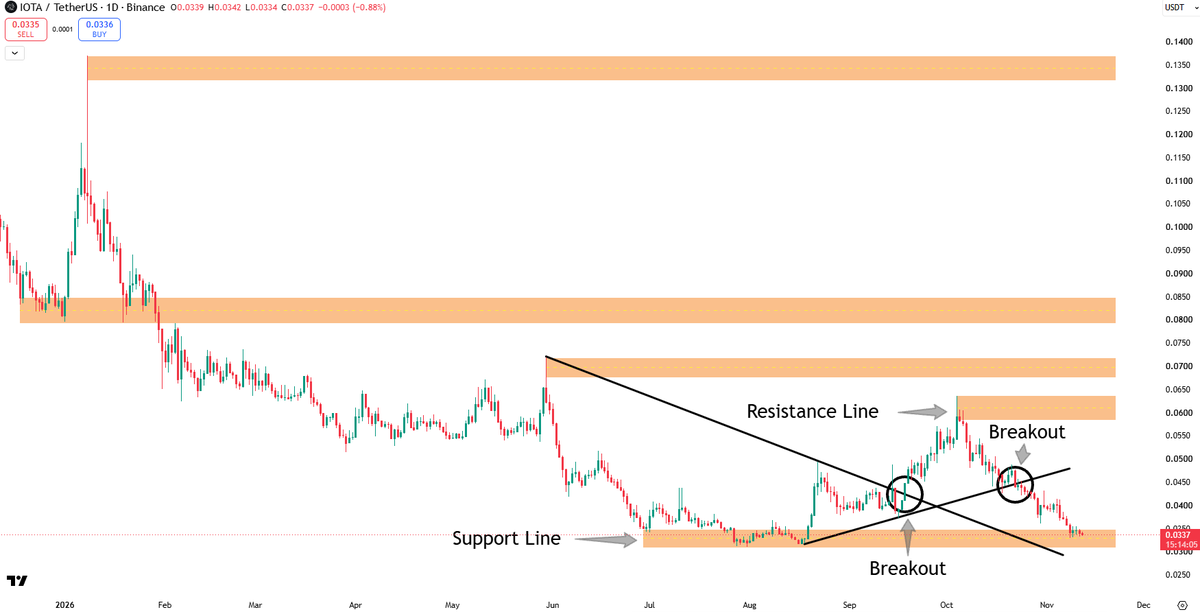
iota:native — THE GLOBAL TRADE INFRASTRUCTURE BET
⠀
A $159 MILLION cryptocurrency.
⠀
Nearly 4.75 BILLION tokens circulating.
⠀
A rebuilt network targeting digital trade and real-world applications.
⠀
And a token trading approximately 99.4% below its all-time high.
⠀
But here's the contradiction.
⠀
IOTA is pursuing practical blockchain adoption.
⠀
Its token has functions in payments, staking, and storage.
⠀
Yet those functions must generate enough demand to support a continuously expanding supply.
⠀
Is iota:native an overlooked infrastructure turnaround?
⠀
Or is the market correctly questioning whether real-world adoption will create meaningful token value?
⠀
Let's examine the numbers.
⠀
01 | WHAT IS IOTA?
⠀
IOTA is a public distributed ledger supporting digital assets and programmable applications.
⠀
Its Rebased upgrade introduced a substantially different architecture, including Move-based smart contracts and delegated Proof of Stake.
⠀
The migration from Stardust began on May 5, 2025.
⠀
The investment thesis now extends beyond IOTA’s original Internet of Things narrative.
⠀
The relevant question is whether the current network can attract recurring economic activity.
⠀
A recognizable name helps distribution.
⠀
It does not establish product-market fit.
⠀
02 | THE NUMBERS THAT MATTER
⠀
November 12, 2026 snapshot:
⠀
IOTA Price: ~$0.03352
Market Cap: ~$158.9M
Reported FDV: ~$168.4M
Circulating Supply: ~4.742B IOTA
Total Supply: ~5.026B IOTA
Maximum Supply: No fixed cap
Circulating / Total Supply: ~94.3%
24H Trading Volume: ~$3.73M
Historical ATH: ~$5.25
Decline From ATH: ~99.4%
⠀
Reported FDV uses current total supply. It does not include every token that could be issued in the future.
⠀
ECOSYSTEM FUNDAMENTALS:
⠀
Tracked IOTA L1 DeFi TVL: ~$1.17M.
⠀
This measures tracked DeFi deposits, rather than the economic value of trade documents or institutional applications using the network.
⠀
03 | THE GLOBAL TRADE OPPORTUNITY
⠀
International trade involves fragmented records, document verification, and coordination across organizations.
⠀
IOTA’s trade initiative includes the Trade Worldwide Information Network, or TWIN.
⠀
Its Q3 2026 update reported improvements to document extraction aligned with UN/CEFACT trade-data standards.
⠀
Trade-finance and payment capabilities leveraging IOTA L1 remained under development in that update.
⠀
The opportunity is credible.
⠀
But a large addressable market is not the same as captured revenue.
⠀
My investment test is whether deployments create recurring mainnet transactions, persistent storage requirements, and measurable token demand.
⠀
04 | THE REBASED TECHNOLOGY RESET
⠀
Rebased brought MoveVM and an object-based architecture to IOTA.
⠀
These changes support programmable assets and more sophisticated applications directly on L1.
⠀
More recently, the Foundation reported that Starfish-Speed reached mainnet in September 2026, improving finality under suitable network conditions.
⠀
These are technical developments.
⠀
Their investment significance depends on the applications they enable.
⠀
Faster infrastructure becomes economically valuable when users repeatedly choose it for useful work.
⠀
Capacity alone does not demonstrate demand.
⠀
05 | THE TOKEN VALUE-CAPTURE MODEL
⠀
IOTA supports several economic functions:
⠀
• Paying transaction costs
• Delegating stake to validators
• Participating in network governance
• Providing deposits for on-chain storage
⠀
A portion of computation fees is burned.
⠀
Storage deposits can be redeemed when the associated objects are deleted.
⠀
Validators and delegators receive rewards that include newly minted tokens.
⠀
These mechanisms create different kinds of demand.
⠀
Gas creates spending demand.
⠀
Staking commits capital to security.
⠀
Storage temporarily ties up tokens.
⠀
They should not be treated as equivalent forms of permanent supply reduction.
⠀
06 | THE BURN VERSUS ISSUANCE QUESTION
⠀
The technical whitepaper permits up to 767,000 newly minted IOTA per epoch, approximately once per day.
⠀
Across 365 epochs, that equals up to:
⠀
279.955 MILLION IOTA.
⠀
The absolute issuance allowance is linear, rather than a permanently fixed percentage of supply.
⠀
Using approximately 5.026 billion current total tokens, my calculation puts that annual allowance near 5.6% before burns.
⠀
The important distinction?
⠀
A burn mechanism does not automatically make a token deflationary.
⠀
Burned tokens must exceed newly minted tokens for total supply to decline.
⠀
The investment case therefore needs actual issuance and burn measurements.
⠀
07 | THE LOW-FEE ECONOMIC TRADEOFF
⠀
Low transaction costs can make applications easier to operate.
⠀
But they also mean each transaction may consume very little IOTA.
⠀
This creates a demanding economic equation.
⠀
A network can attract substantial activity while generating modest token spending.
⠀
My framework therefore considers:
⠀
Transaction frequency.
⠀
Average tokens burned per transaction.
⠀
Persistent storage deposits.
⠀
And demand for staking.
⠀
Transaction count alone cannot establish strong value capture.
⠀
The amount of economic demand created by that activity matters.
⠀
08 | THE UNLOCK QUESTION
⠀
The whitepaper describes biweekly releases of approximately 12.37 million IOTA from October 2025 through September 2027.
⠀
These releases are separate from newly minted staking rewards.
⠀
CoinGecko lists the next scheduled release for November 25, 2026.
⠀
Estimated amount:
⠀
12.37 MILLION IOTA.
⠀
Approximate value at the research price:
⠀
$415,000.
⠀
That represents roughly 0.26% of circulating supply.
⠀
An unlock does not establish an immediate sale.
⠀
But a high circulating ratio does not eliminate supply risk when ongoing issuance also exists.
⠀
09 | THE REAL-WORLD ADOPTION TEST
⠀
IOTA’s Q3 update reported a production deployment involving Argentina’s organ-transplant authority, INCUCAI.
⠀
The Foundation stated that the authority and its 24 provincial agencies received verifiable identities, with official documents notarized on IOTA.
⠀
Patient data was not placed on-chain.
⠀
That is more concrete than a hypothetical use case.
⠀
But institutional adoption and investment returns remain separate questions.
⠀
I would want to measure:
⠀
Recurring usage after deployment.
⠀
Tokens consumed or committed.
⠀
Operating costs.
⠀
And whether similar deployments can scale without persistent subsidies.
⠀
10 | THE VALUATION QUESTION
⠀
Using approximately 5.026 billion current total IOTA:
⠀
$0.05 implies ~$251M total-supply valuation.
⠀
$0.10 implies ~$503M.
⠀
$0.25 implies ~$1.26B.
⠀
$0.50 implies ~$2.51B.
⠀
$1.00 implies ~$5.03B.
⠀
These are valuation illustrations, not price targets.
⠀
Future issuance can increase the supply used in these calculations.
⠀
Historical price comparisons also require care because supply and network economics have changed.
⠀
My view: the distance below a previous high tells us about past losses.
⠀
It does not tell us what the current network is worth.
⠀
11 | THE BULL AND BEAR CASE
⠀
THE BULL CASE:
⠀
Trade and identity deployments generate recurring activity.
⠀
Developers build applications that retain users.
⠀
Storage requirements create persistent token commitments.
⠀
Staking supports robust network security.
⠀
And economic demand strengthens relative to issuance and unlocks.
⠀
Under this scenario, IOTA could develop a stronger investment case around practical infrastructure usage.
⠀
THE BEAR CASE:
⠀
Deployments remain limited in economic scale.
⠀
Applications generate little token spending.
⠀
Storage commitments remain small or temporary.
⠀
Competing networks attract developers.
⠀
And supply growth exceeds new demand.
⠀
Under this scenario, technical progress could continue while the token underperforms.
⠀
12 | THE FINAL VERDICT
⠀
IOTA has a more specific thesis today than a generic promise to connect devices.
⠀
The current investment question centers on programmable infrastructure, digital trade, and the economics of network usage.
⠀
But the burden of proof remains substantial.
⠀
My view: a credible adoption opportunity, with token value capture still requiring measurable evidence.
⠀
The next major catalyst is proof that practical deployments create sustained economic demand for IOTA.
⠀
Partnerships create access.
⠀
Production deployments demonstrate implementation.
⠀
Recurring token consumption and capital commitments reveal economic impact.
⠀
The strongest investment thesis needs that progression.
⠀
Bookmark this analysis before the next real-world infrastructure rotation.
⠀
Which has the strongest long-term adoption thesis?
⠀
iota:native, vechain:native, or hedera-hashgraph:native?
⠀
And can IOTA turn digital trade into sustainable token value?
⠀
Drop your view below.
⠀
📊 Full analysis & trading setups ↓
https://t.co/1pDZVclbWY
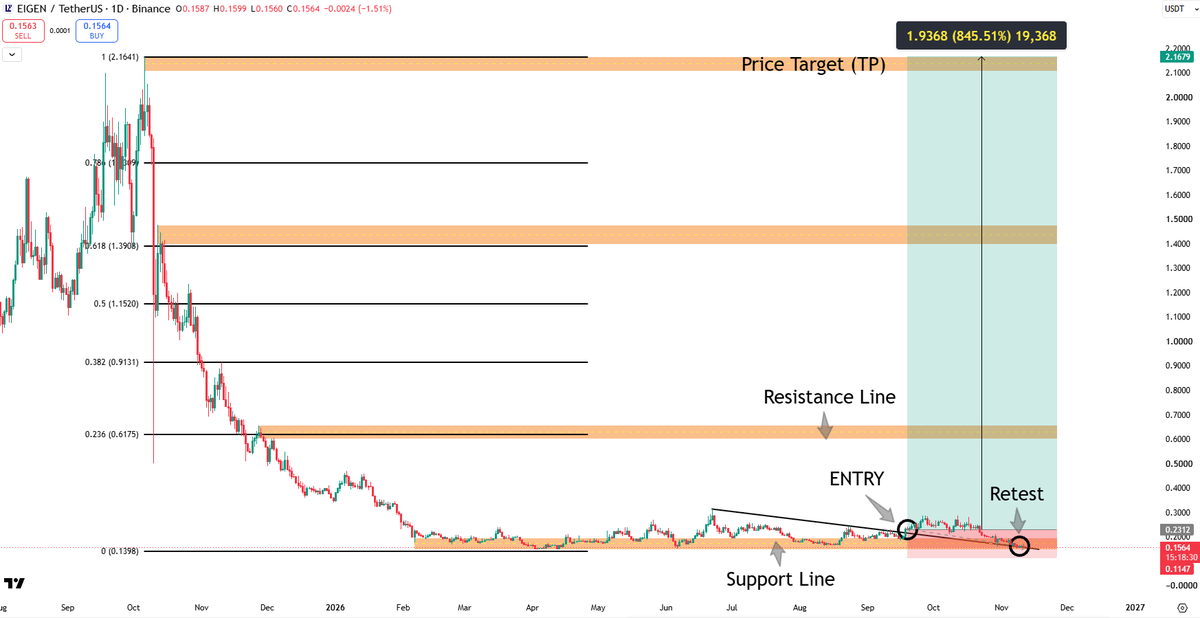
ethereum:0xec53bf9167f50cdeb3ae105f56099aaab9061f83 — THE RESTAKING AND VERIFIABLE CLOUD BET
⠀
A $159 MILLION cryptocurrency.
⠀
More than $5 BILLION in protocol TVL.
⠀
Over 1 BILLION tokens circulating.
⠀
And a token trading approximately 97% below its all-time high.
⠀
But here's the contradiction.
⠀
EigenLayer built infrastructure for shared cryptoeconomic security.
⠀
EigenCloud expanded the vision into verifiable computing.
⠀
Yet deposited capital does not automatically generate income for EIGEN holders.
⠀
Is ethereum:0xec53bf9167f50cdeb3ae105f56099aaab9061f83 an overlooked infrastructure investment?
⠀
Or is the market correctly questioning how much economic value the token can capture?
⠀
Let's examine the numbers.
⠀
01 | WHAT IS EIGENCLOUD?
⠀
EigenCloud is a developer platform built around EigenLayer’s restaking infrastructure.
⠀
Its architecture brings together:
⠀
• EigenLayer restaking
• Autonomous Verifiable Services
• EigenDA for data availability
• EigenVerify for dispute resolution
• EigenCompute for execution
⠀
The goal is to make application behavior verifiable across on-chain and off-chain environments.
⠀
Potential applications include AI agents, financial services, and other software requiring stronger assurances about execution.
⠀
02 | THE NUMBERS THAT MATTER
⠀
November 12, 2026 snapshot:
⠀
EIGEN Price: ~$0.1562
Market Cap: ~$159.5M
FDV: ~$291.1M
Circulating Supply: ~1.021B EIGEN
Total Supply: ~1.864B EIGEN
Maximum Supply: No fixed cap
Circulating / Total Supply: ~54.8%
24H Token Trading Volume: ~$10.04M
All-Time High: ~$5.65
Decline From ATH: ~97.2%
⠀
FDV here uses current total supply. It is not a valuation based on a fixed eventual maximum.
⠀
PROTOCOL FUNDAMENTALS:
⠀
TVL: ~$5.23B
30D Reported Fees: ~$324K
30D Reported Protocol Revenue: $0
30D Reported Holders Revenue: $0
⠀
These are DefiLlama’s tracked metrics, rather than consolidated financial statements for every EigenCloud business activity.
⠀
03 | THE RESTAKING OPPORTUNITY
⠀
New decentralized services need operators and economic security.
⠀
Building both from scratch can be expensive.
⠀
EigenLayer provides a marketplace connecting restakers, operators, and services.
⠀
Supported assets can be committed to additional services, with rewards for participation and potential slashing when specified commitments are broken.
⠀
The investment opportunity is a market for security that developers are willing to pay for.
⠀
But supplying security and selling security are different achievements.
⠀
My central question is whether recurring customer demand can support the capital committed to the system.
⠀
04 | THE EIGEN TOKEN’S DISTINCT ROLE
⠀
EIGEN was designed to address intersubjectively attributable faults.
⠀
These are faults that external observers can broadly agree occurred, even when a simple on-chain rule cannot establish them.
⠀
Its design includes a token-forking mechanism intended to resolve such disputes without forking Ethereum itself.
⠀
This gives EIGEN a different security thesis from ETH.
⠀
But a technically distinctive mechanism still needs customers.
⠀
The economic test is whether services value that protection enough to create sustained demand for the token.
⠀
05 | THE TVL CONTRADICTION
⠀
Using the snapshot above:
⠀
Market Cap / TVL: ~0.03x.
⠀
That looks inexpensive at first glance.
⠀
But TVL is deposited collateral.
⠀
It is not cash owned by EIGEN holders.
⠀
Buying the token does not give an investor a proportional claim on those deposits.
⠀
My interpretation: a low market-cap-to-TVL ratio demonstrates a valuation gap between collateral and token value.
⠀
It does not explain whether that gap should close.
⠀
For that, investors need evidence of monetization and token value capture.
⠀
06 | THE REVENUE QUESTION
⠀
DefiLlama defines its tracked EigenLayer fees as rewards earned by suppliers.
⠀
Its methodology currently assigns no retained protocol revenue because those rewards accrue to suppliers.
⠀
That distinction matters.
⠀
Rewards paid through a network are not necessarily revenue retained by the protocol.
⠀
And neither category automatically becomes income for passive tokenholders.
⠀
The figures should also not be interpreted as proof that every EigenCloud product has zero commercial revenue.
⠀
The investment question requires a clearer bridge between customer spending, operating costs, and benefits delivered to EIGEN.
⠀
07 | THE PROPOSED VALUE-CAPTURE FRAMEWORK
⠀
The Foundation’s published incentives framework proposed:
⠀
A 20% fee on AVS rewards associated with EIGEN-subsidized stake.
⠀
Routing those fees toward a contract that could fund buybacks.
⠀
And directing cloud-service fees, after operator expenses, toward the same mechanism.
⠀
This outlines a potentially stronger economic connection.
⠀
But a published framework does not establish the amount of executed buybacks.
⠀
I would not value EIGEN as though large recurring repurchases have already been demonstrated.
⠀
The evidence that matters is collected fees, executed purchases, and the subsequent treatment of acquired tokens.
⠀
08 | THE INFLATION QUESTION
⠀
EIGEN launched with approximately 1.674 billion tokens, excluding subsequent inflationary issuance.
⠀
Its original incentive program used a 4% annual issuance framework.
⠀
Later PIv2 documentation increased the configured programmatic rate to 7%, while ELIP-12 described a broader 8% incentives envelope.
⠀
These describe different program stages.
⠀
They should not be presented as interchangeable current inflation rates.
⠀
The practical conclusion is that EIGEN’s supply is not permanently capped.
⠀
My valuation framework therefore requires tracking actual minting and current governance settings.
⠀
Staking rewards funded by new tokens redistribute ownership.
⠀
They do not, by themselves, demonstrate customer-funded profitability.
⠀
09 | THE UNLOCK QUESTION
⠀
DefiLlama lists the next investor and early-contributor unlock for November 30, 2026.
⠀
Estimated amount:
⠀
36.82 MILLION EIGEN.
⠀
Breakdown:
⠀
Investors: ~19.75M EIGEN.
⠀
Early Contributors: ~17.07M EIGEN.
⠀
That represents approximately 3.6% of the circulating supply.
⠀
At the research price, the tokens would be worth approximately $5.75 million.
⠀
An unlock permits liquidity.
⠀
It does not prove an immediate sale.
⠀
But it increases the importance of monitoring recipient transfers and new demand.
⠀
Unlocks and inflation are separate sources of potential circulating-supply growth.
⠀
10 | THE VALUATION QUESTION
⠀
Using approximately 1.864 billion current total EIGEN:
⠀
$0.25 implies ~$466M total-supply valuation.
⠀
$0.50 implies ~$932M.
⠀
$1.00 implies ~$1.86B.
⠀
$2.00 implies ~$3.73B.
⠀
$5.00 implies ~$9.32B.
⠀
These are valuation illustrations, not price targets.
⠀
Future issuance can increase the supply used in these calculations.
⠀
A return to the historical token price could therefore require a substantially different valuation from the one implied at that earlier date.
⠀
My view: a 97% drawdown creates a reason to investigate.
⠀
It does not establish a margin of safety.
⠀
11 | THE BULL AND BEAR CASE
⠀
THE BULL CASE:
⠀
Developers increasingly pay for verifiable services.
⠀
Restaked capital supports economically useful applications.
⠀
Customer-funded rewards become more important than subsidies.
⠀
Fee collection creates measurable benefits for EIGEN.
⠀
And token demand absorbs issuance and unlocks.
⠀
Under this scenario, EIGEN could gain a stronger economic foundation beyond the restaking narrative.
⠀
THE BEAR CASE:
⠀
Deposits fail to translate into sufficient paid demand.
⠀
Developers choose alternative security or computing arrangements.
⠀
Rewards remain dependent on incentives.
⠀
Value-capture mechanisms generate limited buying pressure.
⠀
And additional liquid supply exceeds demand.
⠀
Under this scenario, useful infrastructure could coexist with disappointing token returns.
⠀
12 | THE FINAL VERDICT
⠀
EIGEN has a credible infrastructure thesis.
⠀
But my investment test is stricter than the technology thesis.
⠀
How much security is being purchased?
⠀
How much computing demand is recurring?
⠀
What economic benefit reaches the token?
⠀
And how does that benefit compare with supply growth?
⠀
The next major catalyst is evidence that customers will pay enough to make the ecosystem less dependent on token incentives.
⠀
Deposited capital demonstrates participation.
⠀
Paid services demonstrate demand.
⠀
Executed value capture demonstrates the connection to EIGEN.
⠀
The strongest investment case needs all three.
⠀
Bookmark this analysis before the next restaking rotation.
⠀
Which has the strongest long-term shared-security thesis?
⠀
ethereum:0xec53bf9167f50cdeb3ae105f56099aaab9061f83, $SYMB, or $BABY?
⠀
And can EigenCloud turn verifiable infrastructure into sustainable token value?
⠀
Drop your view below.
⠀
📊 Full analysis & trading setups ↓
https://t.co/1pDZVclbWY