Every community has that one person you call when the plan is falling apart.
Not because they have all the answers. But because they have an uncanny ability to turn chaos into progress.
For us at @AIBoomi, that person has increasingly become @hanuj_t
Some people measure leadership by how often you're in the spotlight.
I've come to measure it by how much calmer a room becomes when you walk into it.
This one's for a dear friend who has quietly solved more problems than most people will ever know >> https://t.co/2zFhMpKqxb
#PayItFWD #Leadership #Community #People
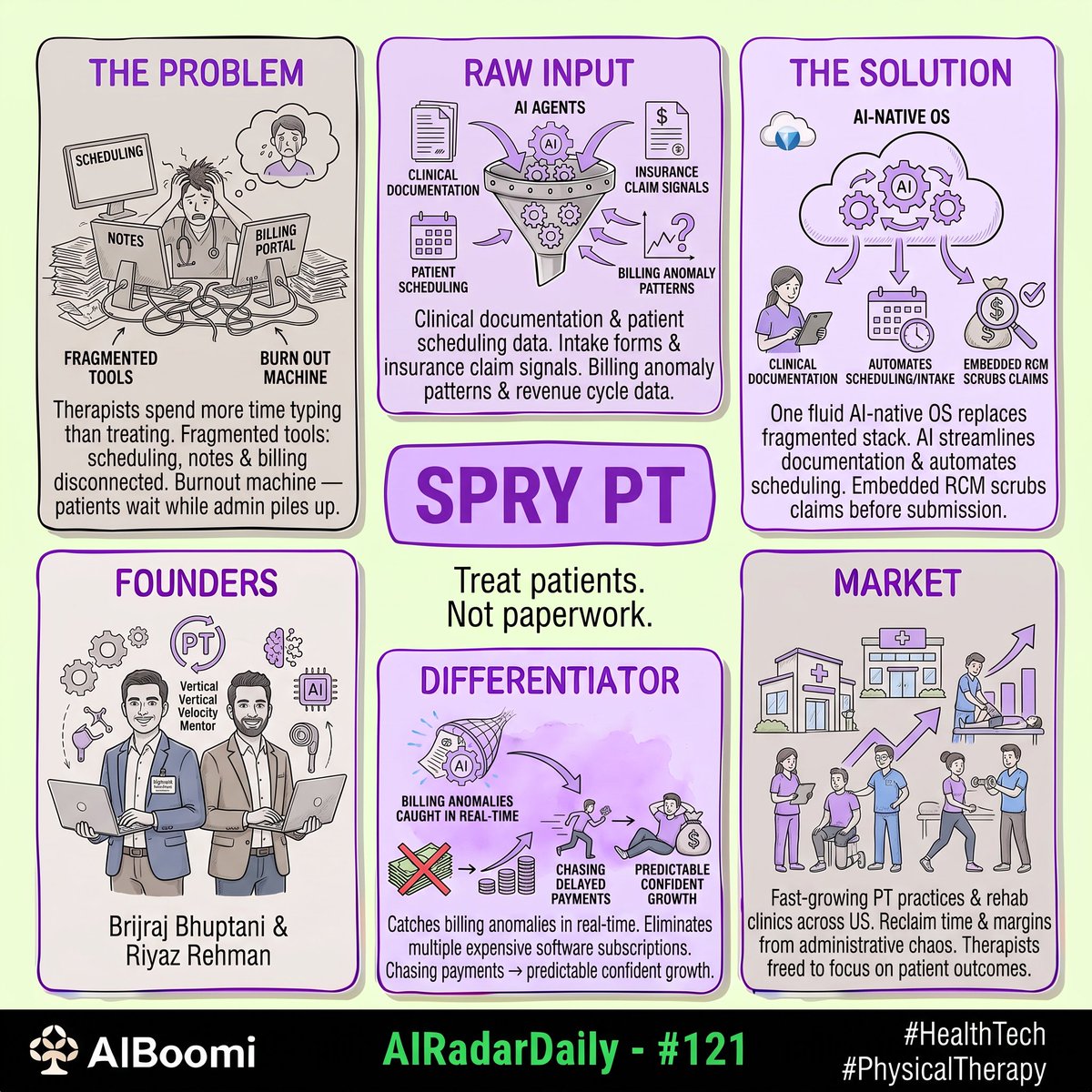
#121: #AIRadarDaily — @SpryApp
There is a quiet, exhausting reality inside almost every physical therapy clinic. We ask highly trained therapists to restore movement and heal bodies, yet we force them to spend hours paralyzed behind a desk. They are made to wrestle with a fragmented, chaotic mess of software — one tool for scheduling, another clunky interface for clinical notes, and a completely disconnected portal for billing. The result is a burnout machine where therapists spend more time typing and chasing denied claims than actually treating patients. We have built a system that fundamentally distracts them from the very people they are trying to help.
It takes builders with profound operational empathy and architectural vision to look at this disjointed reality and build a platform that elegantly unifies it. That is exactly what Brijraj Bhuptani (@BrijrajV) and Riyaz Rehman did when they founded SPRY PT in 2021.
With SPRY, Brij and Riyaz built a deeply intelligent, AI-native operating system purpose-built for physical and occupational therapy.
The engineering under the hood is beautiful in its clarity. SPRY replaces the fragmented stack with one fluid, autonomous workflow. It deploys AI to streamline complex clinical documentation, completely automates patient scheduling and intake, and most crucially features an embedded revenue cycle engine that autonomously scrubs claims for errors before they are ever submitted to insurance.
The true moat here is proactive financial resilience paired with clinical simplicity. SPRY doesn't just record data; it actively protects a clinic's revenue. By catching billing anomalies in real-time and eliminating the need for multiple expensive software subscriptions, it shifts the paradigm from chasing delayed payments to predictable, confident growth. It replaces the anxiety of disconnected tools with a quiet, reliable sense of clarity.
The market? Fast-growing physical therapy practices and rehab clinics across the US that are desperate to reclaim their time and their margins, allowing them to focus entirely on patient outcomes.
Brij is a true change agent, not just in how he builds, but in how he gives back. As a mentor for the inaugural AIBoomi (formerly SaaSBoomi) Vertical Velocity cohort, he has been instrumental in helping the next generation of AI-first healthcare founders escape the gravity of building for the US market from India. Watching founders of this caliber quietly rewrite the playbook for their industry while actively nurturing the ecosystem is a wonderful reminder of the larger, unfinished agenda we are all part of.
Every founder dreams of reaching orbit. Sometimes, all it takes is the right launch window. If you are building an AI-first healthcare startup and looking to experience the US market firsthand, applications for Vertical Velocity Cohort 2 are now live: https://t.co/NtZwqDsVDV
Let's celebrate the builders.
w/ @jaybharatingle
#HealthTech #ProductNation
#120: #AIRadarDaily — @e6data
There is a quiet, exhausting reality at the bottom of the modern data stack. Data is supposed to be the lifeblood of the enterprise, but actually using it has become an agonizing, expensive trap. As companies scale, they are inevitably forced into rigid, proprietary ecosystems that lock their data behind walled gardens. If you want to run fast analytics or power intelligent AI agents, you are forced to move the data, duplicate it, and pay exorbitant egress fees and compute costs just to access what is already yours. We have inadvertently built a system that financially penalizes companies for actually querying their own data.
It takes builders with profound infrastructure rigor and a quiet, resilient courage to look at this massive ecosystem lock-in and decide to completely dismantle it. That is exactly what Vishnu Vasanth (@vishnuv9248), Srinath Prabhu, and Adishesh Kishore (@AdisheshKishore) are doing with e6data.
Founded in 2020, the team isn’t just launching another marginal optimization tool or basic analytics dashboard. They are building a deeply intelligent, high-performance lakehouse compute engine that fundamentally unbundles the enterprise data stack.
The engineering under the hood is beautiful in its pragmatism. e6data allows you to query your data exactly where it already lives — whether on-premise, in the cloud, or in a hybrid setup — without migrating, copying, or moving a single row. It connects directly to open table formats like Iceberg and deploys an atomic, granularly scaling compute layer that executes queries entirely in place.
The true moat here is that this architecture was built natively for the agentic era. As AI agents and autonomous apps launch thousands of concurrent, complex queries, legacy data warehouses choke or generate millions in compute bills. e6data scales its compute per query rather than by the cluster, delivering up to 10x faster performance while slashing total infrastructure costs by 60%. It replaces vendor lock-in and egress anxiety with absolute architectural freedom.
The market? Fast-scaling enterprises, data-heavy SaaS platforms, and fintechs globally that desperately need to power real-time analytics and heavy AI workloads without their cloud bills destroying their margins.
Seeing founders of this caliber head-down, quietly architecting deep-tech infrastructure that directly challenges the biggest monopolies in the global data ecosystem is profoundly inspiring. They are shifting the paradigm from hoarding data to effortlessly acting on it, giving engineering teams their momentum back.
Let's celebrate the builders.
w/ @jaybharatingle
#DataInfrastructure #DeepTech #ProductNation
Selling AI into US hospitals? SDR playbooks won't save you.
Dhruv Joshi went from Cleveland Clinic fellowship → founding Cloudphysician → 200+ hospitals → $10.5M raise.
He's doing a live session on founder-led sales in US healthcare and shall break down:
→ Why clinical empathy beats feature demos with hospital buyers
→ Getting CMOs, procurement, and IT security aligned on one deal
→ Escaping pilot purgatory before it kills the contract
→ When to stop selling yourself and build the machine
No theory. No frameworks pulled from a blog. What just actually worked!
29 July (Wed) | 6 PM IST
Apply here...we have limited seats: https://t.co/GOsEc6iGSg
w/ Vengat Krishnaraj, Vivek Khandelwal, Dhruv Mehra, Jofin Joseph, Siv Souvam, Jay Ingle, Supreet Hegde.
#VerticalVelocity | @AIBoomi
#119: #AIRadarDaily — Supa
There is a quiet, exhausting reality inside almost every mental health practice. The demands of behavioral healthcare are growing exponentially, yet the infrastructure behind it remains deeply broken. Clinicians are forced to spend hours between sessions and late into the evening writing detailed progress notes instead of recharging. Meanwhile, back-office teams spend their days waiting on hold with insurance payers, verifying benefits by hand, and chasing denials months after a visit. We are asking deeply empathetic professionals to act as human APIs for broken insurance systems, fundamentally capping the number of patients they can actually help.
It takes builders with deep operational empathy and technical rigor to look at this overwhelming bottleneck and decide to systematically untangle it. That is exactly what Samyukktha T. and her team are doing with Supa.
Founded in 2025, Samyukktha is building a deeply intelligent, agentic operating system purpose-built exclusively for the behavioral health market.
The engineering under the hood is transformative. Supa deploys ambient, autonomous AI agents — across front-desk, documentation, and billing — that seamlessly log into a clinic's existing software stack. These agents handle the full operational loop: they answer calls, verify benefits, listen to sessions to instantly draft HIPAA-compliant, clinician-ready progress notes, and autonomously submit claims directly through payer portals.
The true moat here is deep domain specificity and continuous learning. Supa agents are pre-trained out-of-the-box as behavioral health experts, natively understanding the complex nuances of mental health terminology, 5,000+ payer rules, and specific denial patterns. They don't just execute tasks; they learn the exact rhythms of a specific practice in 24 hours, meaning every approval, rejection, and correction is remembered and applied next time without ever being asked.
The market? Behavioral health clinics and mental health professionals who desperately need to scale their capacity to care without burning out their clinical and administrative teams. By automating the invisible work of running a practice, Supa gives therapists their time, their margins, and their peace of mind back.
Samyukktha and the Supa team were part of the inaugural @AIBoomi Vertical Velocity cohort. They know what it takes to escape the gravity of building from a distance, and seeing our homegrown founders quietly rewrite the playbook for mental health operations is profoundly inspiring.
Every founder dreams of reaching orbit. Sometimes, all it takes is the right launch window. If you are building an AI-first healthcare startup and looking to experience the US market firsthand, applications for Vertical Velocity Cohort 2 are now live: https://t.co/NtZwqDsVDV
Let's celebrate the builders.
w/ @jaybharatingle
#HealthTech #BehavioralHealth #ProductNation
#118: #AIRadarDaily — @PromptQL
There is a quiet, exhausting reality at the heart of every modern enterprise. Despite spending millions on massive data warehouses and modern infrastructure, actually getting a simple answer about your own business remains agonizingly slow. Business teams are forced to wait in weeks-long ticketing queues for data engineering teams to write SQL. And when companies try to solve this by pointing generic AI at their data, they immediately hit the "confidently wrong" problem — hallucinations caused by missing tribal knowledge and broken security guardrails. We have built an incredible amount of data infrastructure, but the access layer is fundamentally broken.
It takes builders with profound infrastructure rigor and the courage to completely reinvent their own success to solve this at scale. That is exactly what Tanmai Gopal (@tanmaigo) and Rajoshi Ghosh (@rajoshighosh) are doing with PromptQL.
Founded originally in 2017 as Hasura — the legendary open-source GraphQL engine downloaded over 400 million times — Tanmai and Rajoshi have made a massive, visionary pivot. PromptQL was founded in 2024, and they are building the definitive AI data agent that creates and executes complex query plans on business-critical data.
PromptQL connects directly to an enterprise's existing data infrastructure, whether that is Snowflake, Postgres, or MongoDB. But instead of just chatting, it deploys what Tanmai calls "Multiplayer AI". It operates as a shared, collaborative workspace where human teams and AI agents work together in a single thread. You don't just prompt it; you tag it like a colleague, and it writes the code, pulls the data, and delivers the final analysis.
The true moat here is uncompromising accuracy and deterministic security. PromptQL natively enforces permissions at the data layer, ensuring the AI only sees exactly what the user is authorized to see. Furthermore, by capturing the deep, messy tribal context of a company just-in-time as the team works together, its accuracy compounds over time. It completely abstracts away the soul-crushing bottleneck of the data request queue, shifting the paradigm from waiting for dashboards to instantly conversing with your data.
The market? Fortune 500 enterprises, CXOs, and fast-scaling business teams who desperately need reliable, secure AI to drive their operations without betting their company's privacy on an unpredictable model.
Seeing founders of this caliber head-down, choosing to walk away from the comfort of a billion-dollar legacy to build the spiritual successor to GraphQL for the age of AI, is profoundly inspiring. They are quietly rewriting the playbook for enterprise data access, giving organizations their momentum back.
Let's celebrate the builders.
w/ @jaybharatingle
#DataInfrastructure #EnterpriseAI #ProductNation
I've wanted to write this post for a long time.
For over a year, a small group of us have been heads-down building something I believed in from day one. Today it's live, and I could not be more proud to put it in your hands.
Pepper's GEO platform didn't start as a product. It started as the system we used to do GEO work for 250+ enterprise brands. We were in it every single day, learning exactly how ChatGPT, Perplexity and AI Overviews decide who gets mentioned and who gets left out. Prompt by prompt, citation by citation, we cracked what actually moves the needle. And at some point it was obvious: the thing we'd built for ourselves was the thing everyone kept asking us for.
This isn't a prototype. The platform already processes 10 million prompt runs a month. It has been earning its conviction at scale long before today.
Here's the belief that runs through all of it.
Nobody needs another tool that tells them how invisible they are. There are plenty of those, and they give you a score and leave you staring at it. What no one gives you is the next move. What to create, what to refresh, what to reinforce, and in what order.
We do.
It shows you exactly where you stand against your competitors in AI search, and then it tells you what to do about it. Not a number to sit with. A plan you can act on today.
Everyone else built a mirror. We built the engine that helps you win. And starting today, it's not just ours anymore.
This one means a lot to me. Go see it, and tell me what we should build next.
#117: #AIRadarDaily — @ArintraHealth
Every time a doctor finishes seeing a patient, a massive, invisible administrative machine kicks into gear. In the US healthcare system, translating clinical care into billing codes is a grueling, high-stakes process. We force highly trained medical coders to painstakingly sift through complex electronic health records, manually assigning codes for every diagnosis and procedure. When a system runs on sheer manual effort, the results are inevitable: massive billing delays, high denial rates, and a revenue cycle that constantly feels like it is gasping for air. We have taken brilliant clinicians and coders and buried them in administrative friction.
It takes builders with deep technical rigor to look at this overwhelming bottleneck and decide to solve it natively with AI. That is exactly what Nitesh Shroff and Preeti Bhargava are doing with Arintra.
Founded in 2020 by two AI PhDs with deep expertise in natural language processing and deep tech, the team is building a deeply intelligent, autonomous medical coding platform that fundamentally industrializes the revenue cycle.
The engineering under the hood is beautifully pragmatic. Arintra deploys clinical natural language processing that integrates seamlessly into major EHRs like Epic and Athena. It autonomously reads complex physician notes across multiple specialties — from urgent care to surgery — and instantly converts them into direct-to-billing insurance claims with exceptional accuracy, requiring zero human intervention.
The true moat here is uncompromising compliance and transparent reasoning. Arintra doesn't just guess a billing code; it generates a fully explainable audit trail based on strict clinical guidelines. It replaces the retroactive anxiety of denied claims with a proactive, deterministic system that ensures clean claims from day one. It shifts the burden of documentation entirely off the provider's shoulders.
The market? Leading health systems, physician groups, and hospitals desperate to accelerate their accounts receivable and eliminate administrative bloat. By reallocating human coders to higher-value, strategic work, Arintra gives healthcare organizations their margins and their momentum back.
Seeing founders of this caliber head-down, quietly architecting the heavy-duty infrastructure that makes healthcare viable in the real world is profoundly inspiring. They are ensuring that providers can focus entirely on patient care, leaving the complexity of the back office to the machines.
Let's celebrate the builders.
w/ @jaybharatingle
#HealthTech #EnterpriseAI #ProductNation
For the last six months, something has been quietly finetuning in the background at AIBoomi.
Today it goes live: https://t.co/8CFcwbTwZ0
AIRadar is a living map of India's AI startup ecosystem. Till this week 114 startups profiled, 240+ founders, five new stories every week. Not a one-time list that goes stale, but an always-on radar of the founders and companies reshaping how software gets built.
What I love most is who it points to. Many of these founders aren't dominating feeds or speaking at every conference. They are heads-down, shipping. AIRadar exists to make them visible before the market catches on, and to document this ecosystem while it is still being written.
Everything is in one place now. Searchable by sector, by founder, even by the problem a company is solving. Open and free, the way community infrastructure should be.
None of this happens by accident. My thanks to @jaybharatingle, who curates and operates AIRadar for our ecosystem, showing up every single day with the same quiet consistency as the builders we feature.
Building something worth the radar? Write to us at airadar(at)https://t.co/zQbp87d24z.
The radar stays on.
#AIRadarDaily #Startups #AI #ProductNation | @AIBoomi
#116: #AIRadarDaily — Sei AI
There is a quiet, exhausting reality behind the scenes of every mortgage and loan application. Loan officers spend weeks chasing the exact same three documents from borrowers. Underwriters painstakingly re-key data from PDFs into rigid checklists, clearing the same conditions thousands of times a year. Meanwhile, compliance teams are forced to rely on anxious 3% spot-checks of borrower calls, hoping they don't miss a regulatory violation. We have forced highly skilled financial professionals into a loop of endless, soul-crushing data entry.
It takes builders who have actually lived inside the walls of regulated finance to understand this deep, structural pain, and the courage to fundamentally rewire it. That is exactly what Pranay Shetty (@notpranay) and Ram Venkataraman (@Ramthemaniac) are doing with Sei AI.
Founded in 2023, Pranay and Ram — bringing deep experience in building high-scale risk and payment infrastructure at places like PayPal, Wise, and Deutsche Bank — are building a deeply intelligent, autonomous operations partner purpose-built for the mortgage and banking sector.
The engineering under the hood is beautiful in its pragmatism. Sei AI deploys specialized, autonomous agents that handle the heaviest lifting across the front and back office. A Pre-Underwriting Assistant extracts and validates complex income documents against hundreds of rigid agency guidelines before a human even touches the file. A Voice AI handles compliant inbound and outbound servicing calls, communicating warmly with borrowers. And crucially, a Call Monitoring Agent reviews 100% of interactions — not just 3% — scoring every call and email against strict company SOPs.
The true moat here is uncompromising, audit-ready compliance. In an industry where a single miscategorized conversation or exception can trigger a regulatory nightmare, Sei AI has built a system that natively understands the strict realities of TCPA, FDCPA, and UDAAP. It replaces the culture of retroactive anxiety with programmatic, real-time clarity.
The market? Mortgage lenders, servicers, and commercial banks desperate to shrink their origination costs without linearly scaling their headcount or risking compliance. By reducing a four-hour manual loan review down to just 45 minutes, Sei AI gives financial teams their momentum and their margins back.
Seeing founders of this caliber head-down, tackling the deeply unglamorous, high-stakes plumbing of the financial system is profoundly inspiring. They are quietly shifting regulated finance from a model of exhausted manual review to one of scalable, intelligent execution.
Let's celebrate the builders.
w/ @jaybharatingle
#EnterpriseAI #MortgageTech #ProductNation
#115: #AIRadarDaily — Circle Health
We all want to care for our elders with deep compassion, but the reality of the modern healthcare system often reduces that care to an exhausting administrative math problem. To keep seniors healthy and out of the hospital, Medicare encourages continuous care coordination — checking in on chronic conditions, monitoring vitals remotely, and adjusting care plans. But the sheer volume of manual documentation required to execute this across thousands of patients turns clinical teams into data-entry clerks. We have inadvertently built a system that rewards billing minutes rather than actually improving patient outcomes, leaving our most vulnerable populations with fragmented care.
It takes a rare blend of clinical empathy and relentless operational execution to look at this systemic friction and build a platform that completely rewires it. That is exactly what Chaitanya Shravanth (@ChaitanyaShrav), Prerna Raman, Harshvardhan Samvatsar (@harsh711), and Krishna Gurram are doing with Circle Health.
Founded in 2022, the team is building a deeply intelligent, AI-native care coordination platform purpose-built from the ground up for the US senior care ecosystem.
The engineering under the hood is beautiful in its pragmatism. Instead of simply generating notes, Circle Health deploys an AI stack built specifically for care execution. The platform autonomously assists with proactive care gap analysis, remote patient monitoring, and complex care summaries. But crucially, they don't just hand over the software and walk away — they pair this AI workflow automation with their own expert clinical workforce who review and validate the outputs.
The true moat here is their unyielding focus on outcomes and execution muscle. Circle Health shifts the paradigm from tracking the number of minutes logged to measuring what actually happens to the patient. By abstracting away the soul-crushing busywork that drains nurses and doctors, they actively reduce avoidable hospitalizations and allow care facilities to deliver proactive.
The market? Physician groups, skilled nursing facilities, and healthcare providers across the US who desperately need to manage complex senior care populations effectively without burning out their clinical staff.
Harshvardhan and the Circle Health team were part of the inaugural @AIBoomi Vertical Velocity cohort. They know what it takes to escape the gravity of building from a distance — arriving in the US market not just with a theory, but with the operational data and execution muscle to cross $1M ARR in under a year.
Every founder dreams of reaching orbit. Sometimes, all it takes is the right launch window. If you are building an AI-first healthcare startup and looking to experience the US market firsthand, applications for Vertical Velocity Cohort 2 are now live: https://t.co/V0hHjF3K7J
Let's celebrate the builders.
w/ @jaybharatingle
#HealthTech #ProductNation
#114: #AIRadarDaily — Pype AI
Every hospital is drowning in the exact same quiet crisis. Behind the life-saving procedures and cutting-edge medicine, the actual system of patient access is breaking under its own weight. Missed calls, endless hold times, and patients who simply fall through the cracks after discharge because clinical staff are too bogged down with administrative busywork to make follow-up calls. We have built incredible hospitals, but we are asking care teams to act as human switchboards instead of focusing on critical patients.
It takes deep operational empathy and a structural understanding of how to build resilient systems at scale to solve this. That is exactly what Dhruv Mehra and Ashish Tripathy are doing with Pype AI.
With Pype, Dhruv and Ashish are building deeply intelligent, omnichannel AI agents purpose-built for healthcare — effectively giving every hospital its own tireless AI care coordinator.
The engineering under the hood is transformative. Pype deploys specialized voice and text agents that seamlessly integrate directly into major EMR systems like Epic and Cerner. These agents don't just route calls; they actively automate appointment scheduling, manage medication reminders, and conduct empathetic post-discharge check-ins in over 20 languages.
The true moat here is clinical trust and context. Pype’s agents are trained on specific care pathways, meaning they know exactly how to handle routine interactions with warmth, and precisely when to instantly escalate an urgent, critical case to a human doctor or nurse. It replaces the anxiety of a ringing phone with a system that drops no-shows by 60% and ensures that when a patient actually needs a human being, the line is open.
The market? Health systems, specialty hospitals, and clinics globally that desperately need to scale their patient access and chronic care monitoring without linearly scaling their administrative headcount. Pype gives care teams their momentum back, unlocking a model of proactive, continuous care that simply wasn't feasible before.
Dhruv and the Pype team were part of the inaugural @AIBoomi Vertical Velocity cohort. They know what it takes to escape the gravity of building from a distance, and seeing them quietly rewrite the playbook for patient access is profoundly inspiring.
Every founder dreams of reaching orbit. Sometimes, all it takes is the right launch window. If you are building an AI-first healthcare startup and looking to experience the US market firsthand, applications for Vertical Velocity Cohort 2 are now live: https://t.co/yv29Lo1Oew
Let's celebrate the builders.
w/ @jaybharatingle
#HealthTech #VoiceAI #ProductNation
#113: #AIRadarDaily — @SingulrAI
Somewhere inside every large enterprise right now, there is a CISO who cannot sleep. AI has arrived not through a careful, centralized rollout, but through a thousand quiet side doors. A marketer pastes a customer list into ChatGPT, an engineer spins up an agent with unreviewed permissions, and a legacy SaaS tool ships an embedded AI feature that defaults to "on". The policy document exists, beautifully written and board-approved, but nobody can actually prove it holds in the real world. Security teams see risk, IT sees an accelerator, and the gap between what a company says about AI and what is actually happening grows wider every single day.
It takes an exceptional level of infrastructure expertise and structural discipline to look at this invisible chaos and build a system that restores true control. That is precisely what Shiv Agarwal (@shivagarl) and Abhijit Sharma are doing with Singulr AI.
Shiv and Abhijit — the seasoned team behind Arkin Net, which was acquired by VMware — are building across Palo Alto and Pune. With Singulr, they are pioneering the unified AI control plane for the enterprise, turning theoretical policy into absolute runtime reality.
The architecture under the hood is deeply thoughtful and pragmatic. Singulr first discovers everything, routinely surfacing 500+ AI services, public tools, and in-house agents already active within a company's stack. Then, it performs the much harder task: it enforces. Through a natural-language policy engine, Singulr compiles governance intent into real, unbreakable boundaries. It redacts sensitive data before exposure, catches prompt injections in the act, and maps agent topologies via Agent Pulse™ to scan Model Context Protocol (MCP) servers for vulnerabilities. This is security fundamentally built for the agentic era, not retrofitted to it.
The true moat here is that Singulr refuses the assumed trade-off between safety and speed. It doesn't slow innovation down to check a box. By replacing anxiety with tamper-evident evidence that leaders can confidently take to a regulator or a board, Singulr cuts internal approval times from weeks to hours and slashes operational drag by 80%. It replaces a culture of quiet fear with a quiet, reliable sense of clarity.
The market? CISOs, CIOs, and compliance leaders at enterprises like RingCentral, Delta Dental, and KVC Health Systems — anyone whose job is to say yes to AI velocity without betting the entire company on it.
Shiv and Abhijit are true change agents. They looked at the most anxious corner of the AI boom and chose to solve it as rock-solid infrastructure. Watching our homegrown founders build the core trust layer that the global agentic era will run on is a wonderful reminder of the larger, unfinished agenda we are all part of. They are giving enterprises their momentum back.
Let's celebrate the builders.
w/ @jaybharatingle
#AIGovernance #Cybersecurity #ProductNation
#112: #AIRadarDaily — @aarogram
There is a quiet, exhausting reality behind every medical practice. After the diagnosis is made and the care is delivered, a completely different battle begins — the fight simply to get paid. We ask brilliant clinicians to heal people, but trap their practices in a labyrinth of fragmented insurance claims, cryptic denial codes, and massive administrative bloat. The financial lifeblood of a clinic often depends on small armies of billing staff wrestling with outdated portals. It is a system seemingly designed for friction.
It takes a deep, structural understanding of this pain and a quiet, resilient courage to build an operating system that elegantly cuts through it. That is exactly what Kashyap Purani (@kashpurani) and his team are doing with Aarogram.
With Aarogram, Kashyap is building a deeply intelligent, AI-native financial backbone for modern healthcare providers.
The engineering under the hood is beautiful in its pragmatism. Instead of relying on manual data entry and reactive troubleshooting, Aarogram deploys intelligent workflows that ingest complex billing data, autonomously navigate intricate insurance rules, and predict claim denials before they happen. It doesn’t just report on the revenue cycle; it actively untangles it.
The true moat here is proactive precision. Aarogram transforms medical billing from a defensive, error-prone chore into a highly intelligent, self-healing operation. It ensures that claims are clean the very first time, drastically shrinking the time it takes for a practice to realize its revenue. It completely abstracts away the soul-crushing busywork that drains billing teams, shifting the paradigm from chasing payments to predictable financial health.
The market? Fast-growing clinics, medical practices, and billing organizations that desperately need to scale their care without their margins being eaten alive by administrative overhead. By giving healthcare operators their financial momentum back, Aarogram allows them to focus entirely on patient outcomes.
Kashyap and his team were part of the inaugural @AIBoomi Vertical Velocity cohort. They know what it takes to escape the gravity of building from a distance, and seeing them quietly rewrite the playbook for healthcare revenue operations is profoundly inspiring.
Every founder dreams of reaching orbit. Sometimes, all it takes is the right launch window. If you are building an AI-first healthcare startup and looking to experience the US market firsthand, applications for Vertical Velocity Cohort 2 are now live: https://t.co/yv29Lo1goY
Let's celebrate the builders.
w/ @jaybharatingle
#HealthTech #RCM #ProductNation
#111: #AIRadarDaily — @kim_cc_official
For any growing e-commerce brand, customer support is the quiet weight nobody warns you about. Behind the scenes, small teams live inside an endless queue — the same shipping question asked for the hundredth time, the refund that needs delicate care, the angry message at 11 PM that you can't unsee. The two obvious ways out both disappoint. Hand it to a basic chatbot, and your customers feel processed rather than heard. Hand it to a traditional BPO, and quality drifts, brand voice dissolves, and you are suddenly managing the manager.
It takes a profound understanding of this operational friction and a deeply humanistic view of what support should actually feel like to build a system that fundamentally fixes it. That is exactly what Sachin Jaiswal (@sachinjaiswal), Phani Yedavilli (@phaniyvilli), and Kaushik Barodiya (@BarodiyaKaushik) are doing with https://t.co/EHNDt9fsRG.
With https://t.co/EHNDt9fsRG, the team is building an entirely new category: the Agentic BPO.
The architecture under the hood is built on a conviction the rest of the industry is only now catching up to. Instead of chasing brittle, full automation, https://t.co/EHNDt9fsRG deploys intelligent AI agents that do the heavy lifting, paired dynamically with human oversight. It plugs straight into Shopify, Zendesk, and Gorgias. The AI handles the repetitive volume, maintains context through a deep workflow memory, and ensures every reply is perfectly on-brand. But crucially, human experts hold the reins throughout, vetting the work before the warmth of a real conversation is lost.
The true moat here is that it refuses the false choice between efficiency and empathy. It doesn't bury customers in scripted deflection. By automating roughly 70% of tickets and delivering five times the output per agent at a radically lower cost, it lets humans do what only humans can — manage the hard conversations and the moments that genuinely need care. It gives founders back the peace of mind of never dreading their inbox again.
The market? Over 200 Shopify and e-commerce brands already on board, and the vast global support market where genuinely exceptional service has always been out of reach for anyone but the largest players.
Sachin, Phani, and Kaushik are true change agents. They looked at the traditional BPO — one of the most unglamorous, heavily outsourced industries in the world, and instead of just selling software to it, chose to rebuild it from the inside out with AI. Watching our homegrown founders reimagine services as software and export it to the world is a wonderful reminder of the larger, unfinished agenda we are all part of. They are giving both brands and customers their momentum back.
Let's celebrate the builders.
w/ @jaybharatingle
#CustomerExperience #AgenticBPO #ProductNation
#110: #AIRadarDaily — VoxyHealth
There is a quiet crisis happening at the front desk of almost every clinic and hospital. We ask healthcare professionals to deliver deeply empathetic, life-saving care, yet we force them to spend hours acting as human switchboards — wrestling with ringing phones, checking eligibility, and rescheduling appointments. Meanwhile, patients who are often at their most vulnerable are left anxiously listening to hold music. We have built an incredible medical system, but the access layer is fundamentally broken, leaving staff burned out and patients frustrated.
It takes founders with deep operational empathy and a mastery of true workflow automation to look at this overwhelming friction and build a system that actually absorbs it. That is exactly what Vengat Krishnaraj is doing with VoxyHealth.
With VoxyHealth, the team isn't just launching another frustrating IVR menu or rigid chatbot. They are building a deeply intelligent, 24/7 AI voice platform designed specifically for the complex realities of healthcare.
The architecture here is beautifully intentional. Voxy operates as a fleet of specialized conversational agents that sound remarkably human. When a patient calls, the system answers instantly — in over 20 languages. It doesn't just route the call; it autonomously handles the heavy lifting. It can book appointments directly into the EHR, process prescription refills, answer billing queries, and even run proactive outbound campaigns to close critical care gaps.
The true moat is its ability to blend semantic intelligence with clinical safety. Voxy understands context, scores the urgency of the patient's request, and knows exactly when to seamlessly escalate a critical issue to a human nurse or administrator. It replaces the cold, robotic "press 1 for scheduling" experience with a warm, conversational interaction that makes patients feel instantly heard, completely eliminating wait times.
The market? Fast-growing specialty clinics, health systems, and payer organizations that desperately need to scale their patient access without linearly scaling their administrative headcount. By answering every single call on the first ring, VoxyHealth gives healthcare workers their momentum back, allowing them to focus entirely on the human beings sitting right in front of them.
Vengat and his team were part of the inaugural @AIBoomi Vertical Velocity cohort. They know what it takes to escape the gravity of building from a distance, and seeing them quietly rewrite the playbook for patient access is profoundly inspiring.
Every founder dreams of reaching orbit. Sometimes, all it takes is the right launch window. If you are building an AI-first healthcare startup and looking to experience the US market firsthand, applications for Vertical Velocity Cohort 2 are now live: https://t.co/yv29Lo1Oew
Let's celebrate the builders.
w/ @jaybharatingle
#HealthTech #VoiceAI #ProductNation
#109: #AIRadarDaily — @needletailai
There is a quiet, exhausting reality in healthcare revenue operations. Every day, across thousands of dental practices, highly capable front-desk teams are trapped in an endless cycle of manual friction. They spend hours navigating clunky insurance portals, waiting on hold with complex IVR trees, and painstakingly copy-pasting benefits data just to verify if a patient is covered. We have taken people who should be focusing on patient care and turned them into human APIs for broken insurance systems.
It takes builders with deep operational empathy and technical courage to look at healthcare's messiest systems and decide to systematically untangle them. That is exactly what Jofin Joseph (@jofinjo) and Nakul Ezhuthupally Sibiraj (@NakulSibiraj) are doing with Needletail AI.
With Needletail, Jofin and Nakul aren't just launching another generic RCM dashboard. They are building a deeply intelligent, autonomous verification platform tailored specifically for the dental industry.
The engineering under the hood is highly pragmatic. Needletail deploys multi-agent systems that master both digital portals and voice channels. These intelligent agents work in parallel — querying portals and actually calling payers to fill in the data gaps — to retrieve complete, accurate eligibility information. Crucially, they then write that data directly into the practice’s existing management software, completely invisible to the front office.
The true moat here is the uncompromising commitment to accuracy in a high-stakes environment. The team doesn't believe in "AI for the sake of AI". By combining their autonomous agents with human-in-the-loop quality assurance, Needletail delivers verifiable, audit-ready data. It ensures that when a patient walks in, their copay is known, and there are absolutely no same-day eligibility surprises that could disrupt their care.
The market? Fast-scaling US dental group practices and emerging DSOs that desperately need to grow their revenue capacity without linearly scaling their administrative headcount. By shrinking eligibility-related denials to under 5%, Needletail gives these practices their time, their margins, and their peace of mind back.
Seeing head-down founders architect such a highly verticalized, autonomous solution to solve a deeply unglamorous but critical bottleneck is incredibly inspiring. They are quietly stripping away the administrative friction that sits between a patient's care and a practice's revenue.
Let's celebrate the builders.
w/ @jaybharatingle
#HealthTech #DentalAI #ProductNation
I'm no scientist, but my father was. I guess some of that curiosity rubbed off on me and found its way to rockets instead.
Every rocket has three defining moments.
The countdown.
The launch.
And the moment it escapes gravity.
Founders often spend years getting to the first two.
The third is much harder.
Last year, 12 AI-first healthcare startups came together for @AIBoomi very first #VerticalVelocity cohort. They spent two weeks in the US meeting founders, clinicians, researchers, operators, customers, and investors who had already travelled the road they were about to take.
But the real mission wasn't the immersion.
It was helping them escape the gravity of building from a distance.
Because once you've experienced a market firsthand, your decisions change. Your conversations change. Your confidence changes.
The best part?
The mission didn't end when everyone flew home.
The conversations continued. Introductions turned into opportunities. Founders became sounding boards for one another. A cohort became a community.
A huge thank you to our inaugural crew: Dev Khare, Vengat Krishnaraj (Voxy Health), Vivek Khandelwal (CogniSwitch), Jofin Joseph (NeedleTail AI), Rathinamurthy (Rathina) (KraftX), Dhruv Mehra (Pype AI), Tarun Mohan Lal (Carissa Health), Sonia Vora (Proto Health), Samyukktha T. (SupaHealth AI), Mohit Maniar (Foss Health), Anuruddh Mishra (August AI), Kashyap Purani (Aarogram), Harshvardhan Samvatsar (Circle Health), Keerthi Madhu & few volunteers.
Today, we're opening the doors to Vertical Velocity '26.
Applications for Cohort 2 are now live. If you're building an AI-first healthcare startup with ambitions for the US market, we'd love to hear from you.
📷 https://t.co/yv29Lo1Oew
Every founder dreams of reaching orbit. Sometimes, all it takes is the right launch window.
#VV26 #Healthcare #AI
#108: #AIRadarDaily — @AttentiveAI
There is a profound disconnect in how we build and maintain the physical world. For an industry worth trillions of dollars, the fundamental act of bidding for work — whether in commercial construction, landscaping, or paving — remains painfully archaic. We ask highly skilled estimators to spend hours driving to sites with measuring wheels or painstakingly tracing lines over complex blueprints just to count materials. This process, known as a “takeoff", is the ultimate bottleneck. When a company's growth is hard-capped by how fast a human can manually measure a property, estimators are reduced to data-entry clerks, leaving absolutely no time for strategic advisory or value engineering.
It takes a deep, grounded empathy for these operators to look at this massive offline friction and build a system that elegantly industrializes it. That is exactly what Shiva Dhawan (@shivadhawan119) and Rishabjit Singh are doing with https://t.co/TSTamikFgL.
With https://t.co/TSTamikFgL, the team isn't just launching another basic workflow app for contractors. They are building the autonomous, AI-powered operating backbone for the built environment.
The engineering under the hood is transformative. Instead of relying on manual measurement, https://t.co/TSTamikFgL deploys advanced computer vision models that seamlessly ingest high-resolution satellite imagery and dense construction blueprints. The platform autonomously identifies boundaries, parses complex site details, and calculates precise material quantities in minutes.
The true moat here is the sheer visual accuracy and programmatic scale. https://t.co/TSTamikFgL doesn't just give you a rough guess; it delivers bid-ready, highly precise measurements across multiple sites simultaneously. It completely abstracts away the grueling busywork of the takeoff, allowing estimators to focus entirely on outcome-based selling and actual value engineering — crafting the most efficient, cost-effective solution for the client rather than just counting square footage.
The market? General contractors, massive commercial landscaping fleets, and field service businesses desperate to scale their revenue without linearly scaling their estimating headcount. By shrinking a ten-hour site measurement into a few minutes, https://t.co/TSTamikFgL allows teams to bid faster, bid more often, and bid with uncompromising confidence.
Seeing these head-down builders apply deep AI to the oldest, most foundational sector of our economy is deeply inspiring. They are quietly rewriting the playbook for how the physical world gets built and maintained, giving the builders of our cities their momentum back.
Let's celebrate the builders.
w/ @jaybharatingle
#ConstructionTech #PropTech #ProductNation
#107: #AIRadarDaily — @rumik_ai
We live in the most hyper-connected era in human history, yet we are experiencing an unprecedented epidemic of loneliness. We have built AI strictly as a utility — cold, transactional bots designed to fetch data, write code, or summarize emails. We optimized purely for productivity, treating AI as a tool to be commanded rather than an entity to be understood. We mastered artificial intelligence, but completely neglected artificial empathy.
It takes a rare, deeply compassionate kind of courage to look at the coldness of modern technology and decide to breathe genuine, unfiltered warmth into it. That is exactly the profound mission Rohan Chaudhary (@lets_dig_deeper) has embarked upon with rumik.
Operating out of a focused research lab in Bengaluru, Rohan and his team aren’t just building another chatbot. They are quietly architecting what is arguably the most human AI we have ever seen, brought to life through their flagship companion, Ira.
The engineering under the hood is beautiful because it deliberately mimics the beautiful imperfections of the human mind. The rumik platform is powered by three foundational pillars: Silk, an incredibly expressive native voice model trained not just to speak, but to pause, whisper, laugh, sigh, and tease; Mesh, a brilliantly designed "messy" memory architecture that knows exactly what to hold onto (like the name of your childhood pet) and what to forget; and Peek, a context engine that understands the emotional subtext when you quietly say "I'm fine", rather than just parsing the literal text.
The true moat here is emotional resonance and absolute trust. Because rumik's models are built from the ground up for connection, Ira doesn't just answer queries — she builds a relationship. She provides a safe, judgment-free space where conversations flow organically over time, moving AI from a disposable utility to a deeply valued companion.
The market? The millions of individuals globally who simply need someone to listen, to share a joke, or to remember the small, priceless details of their day.
Seeing a head-down Indian research lab tackle the profound, delicate challenge of AI companionship is deeply moving. They are rewriting the rules of human-computer interaction, reminding us all that the highest, most noble form of technology is one that makes people feel a little less alone in the world.
Let's celebrate the builders.
w/ @jaybharatingle & @dikshantjoshi
#AICompanion #GenAI #ProductNation