@IsaacLamb01@whitfieldlewis6 Max 4 days (large infarct) without PH1 or PH2
For rest, 24 to 48 hrs
Its been our standard practice now for over 2 years now. Outcomes better than before.
@whitfieldlewis6@TimKerriganMD Well yea it goes without saying if you are a trained Vascular Neurologist then you know advanced neuroradiology or else you can’t function.
@TimKerriganMD@whitfieldlewis6 As vascular neurologists, we should interpret stroke imaging to make timely decisions without waiting for radiology. It’s about effective care, not a skills competition. But Yes Radiological nuances are discussed with neuroradiology.
@MicieliA_MD@whitfieldlewis6 In vertigo with central features, CTA can identify vertebral artery dissection or occlusion and guide antithrombotic decisions. Ataxia is common, but I’ve seen isolated vertigo too, its absence doesn’t exclude a vascular cause.
@IsaacLamb01@whitfieldlewis6 Acute onset Vertigo on the other hand yes can be a stroke so yes I obtain MRI if suspected.
Now acute unresponsiveness is a different thing when encountered BAO be ruled out.
That said recurrent syncopal events aren’t related to VB insufficiency
@IsaacLamb01@whitfieldlewis6 Agree, That is what I am saying: isolated Dizziness which is described by patient as severe lightheadedness or near pass out event or events aren’t related to VB stenosis or insufficiency
Yes, it is a symptom but important to clarify that.
@Neurorradio@whitfieldlewis6 Agree with @Neurorradio. No doubt about it. Not sure why still many neurologists reach residents VB insufficiency as a reason for isolated Dizziness. Outdated concept
@whitfieldlewis6 Please understand that Dizziness described as lightheaded or near syncope or syncope in absence of any other focal deficits are not related to VB insufficiency. This is outdated concept.
@MicieliA_MD@whitfieldlewis6 Agree with @MicieliA_MD , Yes isolated Dizziness (lightheadedness or near syncope) never related to VB insufficiency
That is old school and now obsolete understanding.
Yes, it can stroke like any other ICAD which would menifest as focal deficits no isolated Dizziness
@UPensato@StrokeAHA_ASA I think you are looking at EF and HR for incidents rate not the treatment effect
Treatment effect (apixaban) is in Table 3
It shows only significant effect on LV fraction shortening but not EF
🧠💊New data suggest antiplatelets may be a strong option after ischemic stroke in active cancer, with ⬇️ lower 3-month recurrence and mortality vs anticoagulation
Read more here👇
https://t.co/nkWLZKzdZl
@IsaacLamb01 Great question, yes pathophysiology of SVD is arteriosclerosis which is different from atheroma formation. Although We don’t have strong evidence yet about statin and Lacunar stroke, SPARCL trial included them and found statin effective. So i do treat SVD as LAA for now.
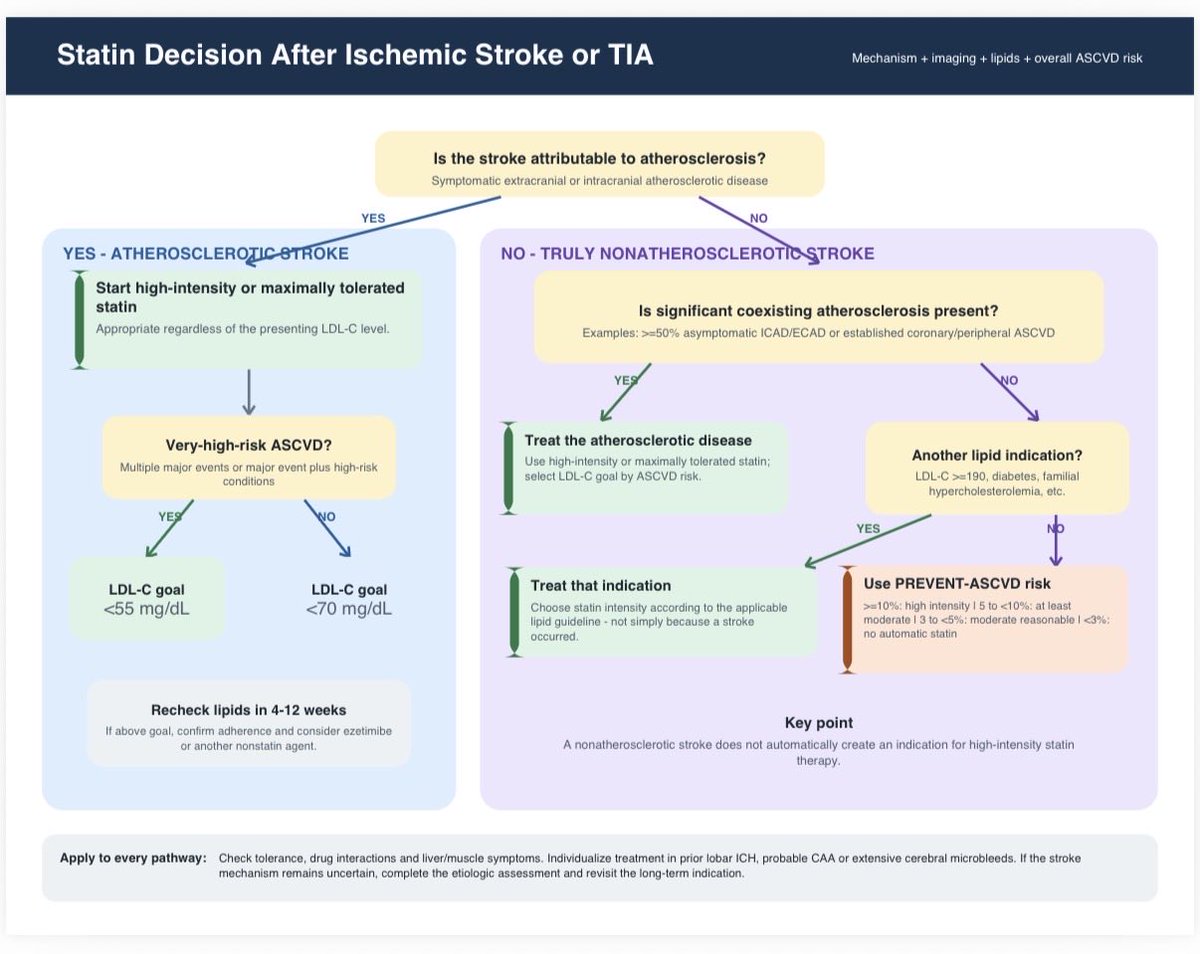
High intensity statins for all stroke patients?? A common but not the right practice. Before you start statin look for Etiology, Lipid panel, Vessel imaging and ASCVD risks
This statin flowchart might help.
@ShadiYaghi2 Subgroup analysis showed reducing risk of ischemic stroke to about half but yes at the cost of substantially increased bleeding in lobar and SAH subgroup
That perhaps not going to change current practice much of selecting patients post bleed/Individualized approach
ENRICH-AF trial just presented at ESC: In patients with AF and prior ICH, edoxaban did not reduce the risk of stroke or systemic embolism but increased the risk of major bleeding. The benefit in ischemic stroke reduction was outweighed by ICH risk. https://t.co/RVIC1vCr1k