Web3 is divisive precisely because of how it reconfigures power between individuals and institutions
This is how #Web3 is changing the political landscape through redefining violence, security, and ownership
#Politics#power#tech
https://t.co/KCRaXQYorB
Robinhood just let AI agents trade on your behalf.
The same platform that locked you out of GME in 2021 due to not meeting DTCC collateral requirements.
Your trades got caught in someone else's problem.
Worth understanding who controls the guardrails this time.
🧵1/8
Your money, always working, always yours.
Mandate lets you launch AI agents that trade, lend, earn yield, and manage your capital 24/7.
You set the goal, Your agent does the work.
Start today and let your money run itself.
Governance in the open.
This is why allowing everyone a voice at the table matters.
Users get to decide for themselves based on transparent onchain evidence.
https://t.co/9uW94woVXx
Onchain Asset Management grew by >3x to $5.55B in 2025!
The demand for managed products is only set to grow further with DeFi composability powering it's rise:
1. Financial Products → Non-custodial vault infrastructure which enable risk Curators ( @SteakhouseFi , @gauntlet_xyz , @sparkdotfi, @ether_fi ) to package multiple primitives into a single product. Depositors can obtain shared ownership of vault assets via a strategy marketplace.
2. Trading Venue → User-owned liquidity pools that allow instant trades based on a price curve for a fee ( @Uniswap ) . Aggregators enable routing via multiple pools to get optimized prices ( @OpenOceanGlobal ).
3. Yield Markets ( @pendle_fi ) → Allows users to speculate on yield by splitting a yield-bearing token into it's principal (PT) and variable (YT) yield portions. Users seeking fixed income sell claims to future yield for a settled price upfront.
4. Money Markets ( @aave , @growcompound , @Morpho ) → Peer-to-peer credit layer that enables collateralized lending. Users can borrow against a supplied token up to a specified ratio by paying an interest to lenders. By looping (lend → borrow → swap), this creates leveraged exposure [ stable/token = short; token/stable = long; PT/underlying token = leveraged fixed yields; Yield token/underlying token = leveraged delta neutral farming].
5. Financial Assets → Tokens representing an asset [stables = USDC (e.g. @circle ); cryptocurrency = ETH (@ethereum ), BTC; real world assets = XAUT (@tethergold ), protocol tokens, etc.]. By following the same fungible token standard, this ensures these assets are compatible with all the venues above.
6. Tx Batching ( @arbitrum , @base ) → Secondary processing layer which facilitates faster and cheaper txs through off-chain batching.
7. Settlement ( @ethereum ) → Finalizes the tx and provides greater economic security. All data is published onchain which promotes transparency and censorship resistance.
In a similar fashion to TradFi, the demand for managed DeFi products is undeniable as the convenience of yield automation for a small fee is an attractive proposition.
By utilizing permissionless financial rails, the DeFi stack provides an alternative to TradFi asset management: one that is more open, transparent, and efficient.
Disclosure requirements are meant to benefit the public but what happens when markets go dark?
Here's how DeFi is poised to surpass TradFi information standards:
https://t.co/eurN2l2alw
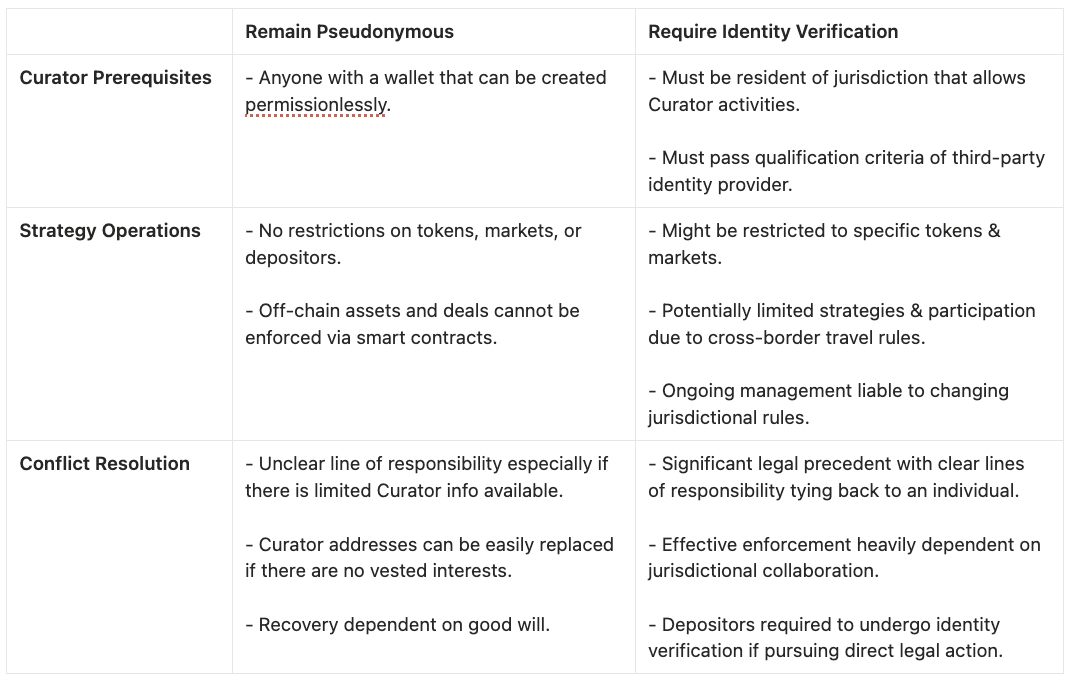
By requiring Curators to reveal their real identity, are we making DeFi safer or more restrictive?
We believe that staking models that align economic interests will encourage better risk management while keeping onchain asset management open.
https://t.co/CaC9kcyFDp
By allowing Curators to remain pseudonymous, we keep DeFi's promise of openness.
However, this must come with more direct monetary incentives to encourage proper risk management
https://t.co/SjP3Ub7qpb
2026 is the year of onchain asset management but Curator centralization risks repeating the mistakes of traditional finance.
Keeping DeFi permissionless means not gatekeeping financial rails.
Here's how:
https://t.co/43VJiij4Qf
Xmas is over but DeFi accountability never ends!
Over the last 12 days, we’ve highlighted how Factor holds Curators accountable while keeping onchain asset management open.
In a space where risk management is increasingly centralized, keeping DeFi permissionless requires open conversations.
Amazing website by @shakoist which leverages LLMs to progressively track inflection points for major intellectual developments
A new way to analyze cultural evolution over time
https://t.co/nYELjNs5HS
DeFi is pseudonymous but this doesn’t mean Curators can hide!
All Factor Curators have a public profile where Depositors can view social links and portfolio information.
No more googling Curators and researching their management activities.
The more info provided, the more likely Depositors will allow you to manage their money.
Great read by @blockworks on how ERC4626 composability has shifted risk management from DAOs to curators.
Curators are gaining more control over the liquidity channels and transparency and data verifiability is key to keeping DeFi permissionless
https://t.co/JIsprk41hA
The @aave governance proposal to delist @SkyEcosystem $USDS is worth a read.
USDS tail risks surpasses Aave's thresholds but opens up new opportunities for Sky.
As much as we advocate for interoperability, each organisation has its own business goals.
https://t.co/R19rdFSAVV
Is this the cheapest way to get @EtherFi Luxe membership benefits and still earn Triple Dip rewards?
1. Buy weETH YT on @pendle_fi: $2.2k capital returned over 230 days + KING rewards
2. Max loop weETH:WETH on @Contango_xyz: $8k capital + ~11% ETH & KING yields
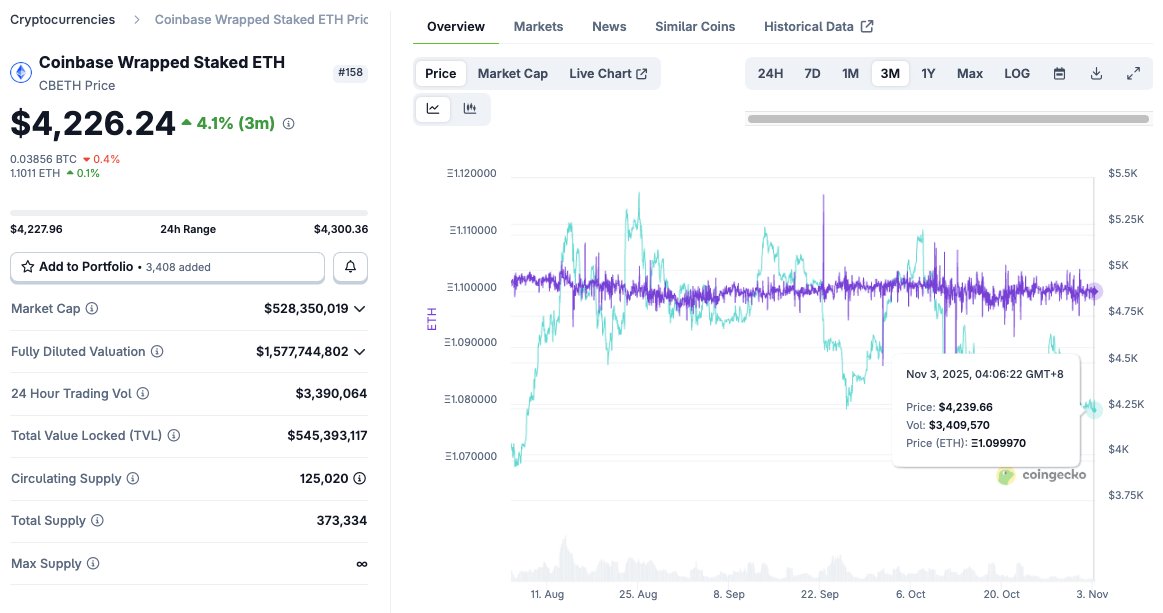
The market has discounted $cbETH liquid staking rewards for the last few months.
That is, the underlying $ETH reserves held by @coinbase is supposedly growing faster than $cbETH price, proof-of-reserves pending.


![Factor_fi's tweet photo. Onchain Asset Management grew by >3x to $5.55B in 2025!
The demand for managed products is only set to grow further with DeFi composability powering it's rise:
1. Financial Products → Non-custodial vault infrastructure which enable risk Curators ( @SteakhouseFi , @gauntlet_xyz , @sparkdotfi, @ether_fi ) to package multiple primitives into a single product. Depositors can obtain shared ownership of vault assets via a strategy marketplace.
2. Trading Venue → User-owned liquidity pools that allow instant trades based on a price curve for a fee ( @Uniswap ) . Aggregators enable routing via multiple pools to get optimized prices ( @OpenOceanGlobal ).
3. Yield Markets ( @pendle_fi ) → Allows users to speculate on yield by splitting a yield-bearing token into it's principal (PT) and variable (YT) yield portions. Users seeking fixed income sell claims to future yield for a settled price upfront.
4. Money Markets ( @aave , @growcompound , @Morpho ) → Peer-to-peer credit layer that enables collateralized lending. Users can borrow against a supplied token up to a specified ratio by paying an interest to lenders. By looping (lend → borrow → swap), this creates leveraged exposure [ stable/token = short; token/stable = long; PT/underlying token = leveraged fixed yields; Yield token/underlying token = leveraged delta neutral farming].
5. Financial Assets → Tokens representing an asset [stables = USDC (e.g. @circle ); cryptocurrency = ETH (@ethereum ), BTC; real world assets = XAUT (@tethergold ), protocol tokens, etc.]. By following the same fungible token standard, this ensures these assets are compatible with all the venues above.
6. Tx Batching ( @arbitrum , @base ) → Secondary processing layer which facilitates faster and cheaper txs through off-chain batching.
7. Settlement ( @ethereum ) → Finalizes the tx and provides greater economic security. All data is published onchain which promotes transparency and censorship resistance.
In a similar fashion to TradFi, the demand for managed DeFi products is undeniable as the convenience of yield automation for a small fee is an attractive proposition.
By utilizing permissionless financial rails, the DeFi stack provides an alternative to TradFi asset management: one that is more open, transparent, and efficient.](https://pbs.twimg.com/media/HAPO2E8a8AA7DEG.jpg)