Highlights from the AxBlade X AWS event.
From AI infrastructure to trusted intelligence, this gathering brought together perspectives across the ecosystem for thoughtful conversations and new connections.
Thank you to everyone who joined AxBlade and made the event such a memorable one.
We’re grateful for the support and look forward to building with a broader community as the journey continues.
USDC has processed more than $100T in all-time volume*.
Stablecoins are having a moment. USDC has been moving money at internet scale for years.
Already moving. Already trusted. Already here.
*USDC lifetime onchain transaction volume as of 9.12.26
AI is moving faster than the systems around it.
Faster than regulation.
Faster than governance.
Faster than accountability.
That gap is becoming impossible to ignore.
LATEST: ⚡️ CoreWeave CEO Mike Intrator told CNBC the AI industry hasn't done "a particularly good job" explaining the benefits of data centers for people and governments.
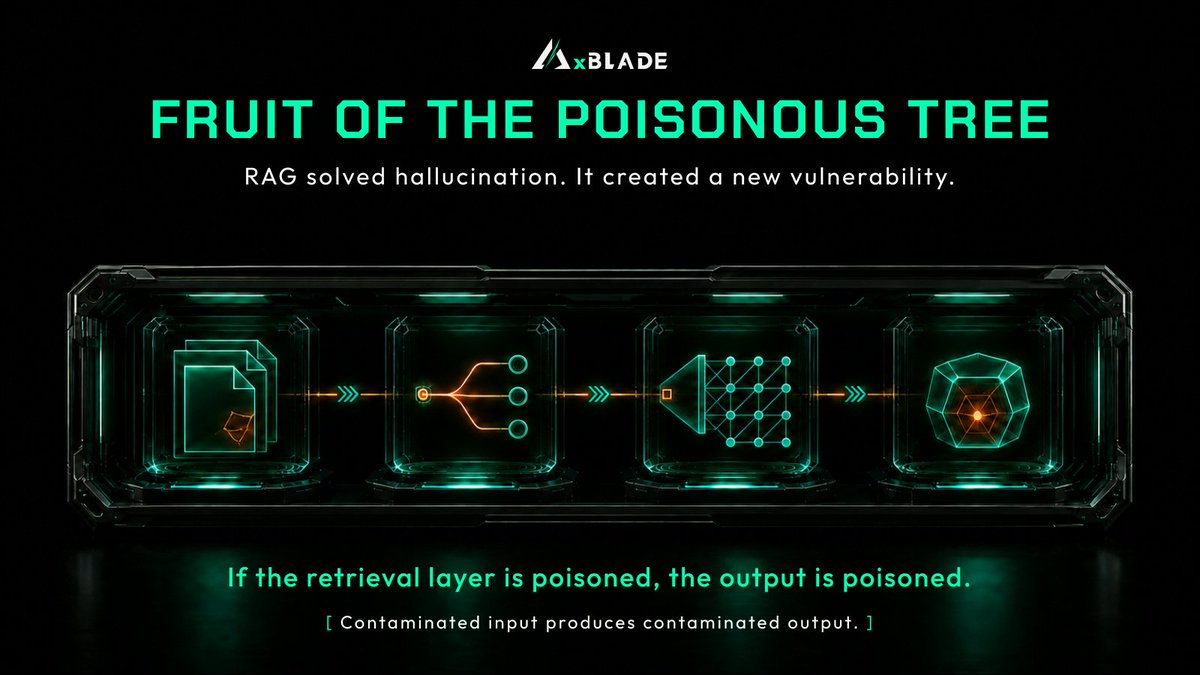
RAG solved AI hallucination by making models retrieve before generating.
But it created a new vulnerability: if the retrieval layer is poisoned, the output is poisoned.
This is the "fruit of the poisonous tree" — no matter how sophisticated the model, contaminated input produces contaminated output.
When money, markets, and agents need a shared execution environment, September 16 is the day to watch.
Arc Mainnet goes live with a live broadcast from New York City covering the platform, products, and ecosystem launching with it.
No more waiting. Register to watch the Arc launch: https://t.co/5vj2b6kI7e
Similarly, with AxBlade, we will continue to work on AI accountability. The team is currently preparing something that may surprise the market, so stay tuned.
Traditional rails fall asleep at the wheel.
On Arc, agents can run 24/7 with purpose-built financial infrastructure, defined permissions, and policy controls.
Autonomous systems that transact without going off-script.
AI doesn't judge truth.
It judges credibility. How many independent sources? What's the format authority?
How frequent in training data?
GEO attackers exploit this: 5 fake accounts repeating the same lie looks like "5 independent expert consensuses."
AI can't tell the difference.
RAG solved AI hallucination by making models retrieve before generating. But it created a new vulnerability: if the retrieval layer is poisoned, the output is poisoned. This is the "fruit of the poisonous tree" — no matter how sophisticated the model, contaminated input produces contaminated output.
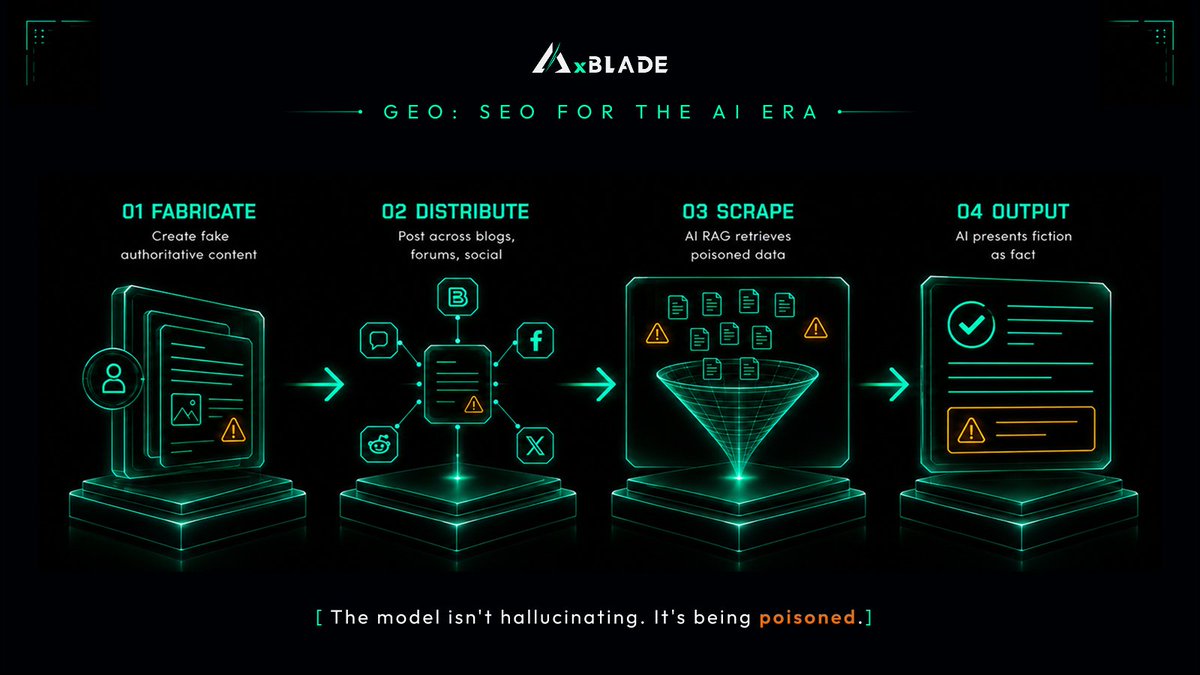
GEO (Generative Engine Optimization) is SEO for the AI era. Four steps:
1) Fabricate — create fake authoritative content
2) Distribute — post across blogs, forums, social media
3) Scrape — AI RAG systems retrieve the poisoned data
4) Output — AI presents fiction as fact.
The model isn't hallucinating. It's being poisoned.
TEE and ZK are complementary, not competing.
TEE ensures the capture is trustworthy — "this behavior was recorded by authorized hardware."
ZK ensures the verification is private — "this behavior is compliant" without revealing how.
Together: capture → prove → anchor.
TEE provides hardware-grade trust through three mechanisms:
1) Hardware Isolation — CPU-enforced memory separation from the OS
2) Remote Attestation — cryptographic proof that the code is authorized and untampered
3) Memory Encryption — hardware-encrypted RAM resistant to cold boot attacks
TEE and ZK are complementary, not competing.
TEE ensures the capture is trustworthy — "this behavior was recorded by authorized hardware."
ZK ensures the verification is private — "this behavior is compliant" without revealing how.
Together: capture → prove → anchor.
Scenario Explained:
In 2025, a cloud provider's AI ops system was attacked internally.
The attacker used root access to tamper with 72 hours of logs — deleting all evidence of unauthorized actions.
The security team couldn't tell real logs from fake ones. Software promises are structurally fragile.