It’s official — 𝗝𝗢𝗜𝗡 𝗦𝗺𝗮𝗿𝘁 𝗪𝗮𝗹𝗹𝗲𝘁 𝗶𝘀 𝗻𝗼𝘄 𝗟𝗜𝗩𝗘!🎉
No seed phrases, no manual gas management, no stress. Just effortless control over your digital assets.
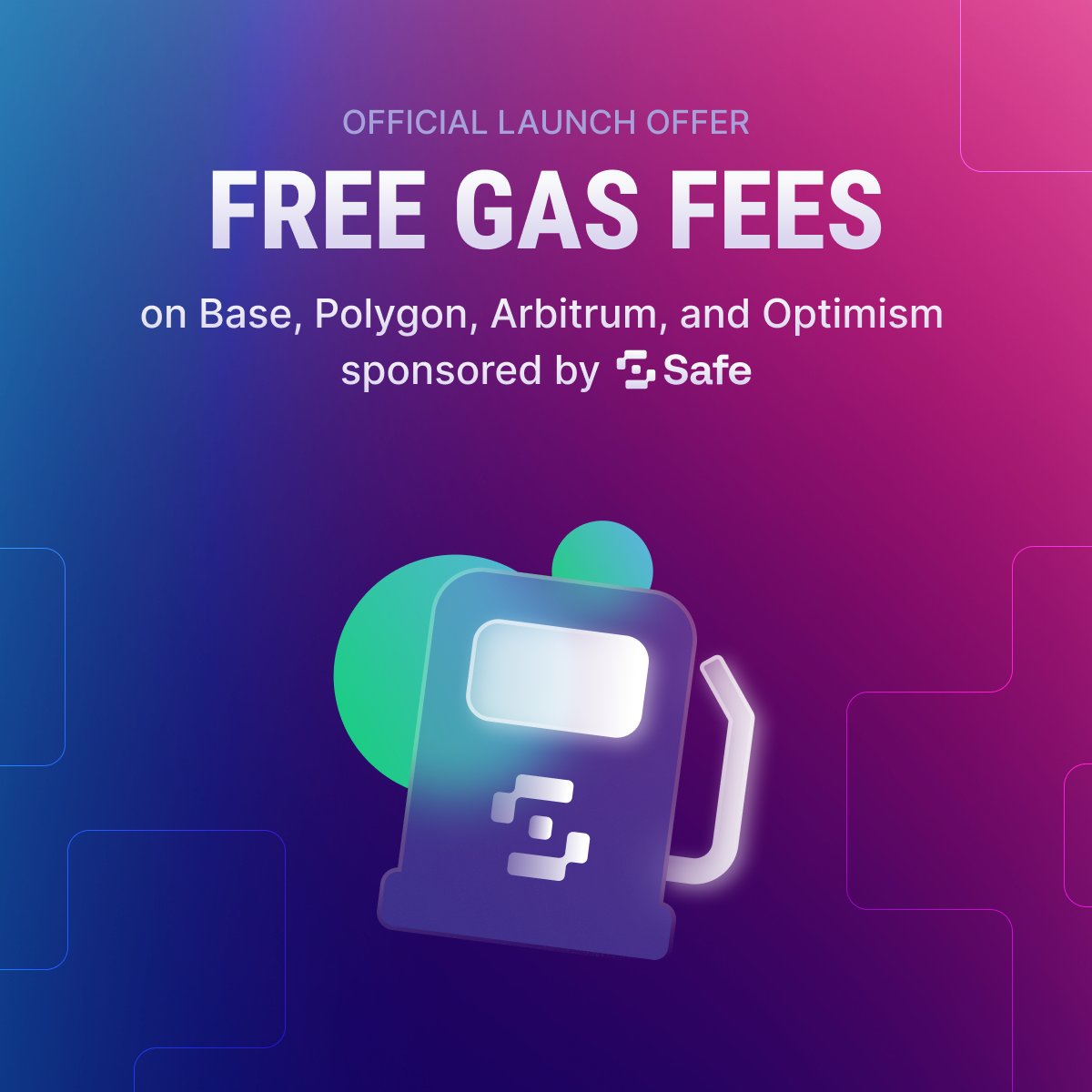
To celebrate, all transactions on Layer 2s are gas-free, thanks to @safe!
Go now and experience a new DeFi standard with JOIN.
The Davos of Web3 is back.
@ProofofTalk 2026 returns to the Louvre Palace in Paris on June 2–3.
We're going as a Community Partner and we secured a code for our community.
Use JOIN for 20% off your pass.
See you at the Louvre. 🏛️
JOIN is building the coordination layer that makes Safe smart accounts usable for teams, DAOs, and everyday users.
Today, @safefndn and @getjoin_io are deepening that commitment with a five-year token-based investment, the second partnership in our Ecosystem Alignment Program.
Self-custody needs to be easy. That's what this is about.
JOIN is building the coordination layer that makes Safe smart accounts usable for teams, DAOs, and everyday users.
Today, @safe and @getjoin_io are deepening that commitment with a five-year token-based investment, the second partnership in our Ecosystem Alignment Program.
Read More
https://t.co/Dci0E6HJRB
just read this AI article and something broke in my brain that i can’t unthink of
crypto was never for us.
we're just the beta testers who showed up early..
some thoughts:
what does AI need to function as economic agents?
> way to receive payment (they provide services, need compensation)
> way to pay for resources (compute, data, API calls)
> way to transact with other AI agents
> no human intermediaries (defeats the point of autonomous agents)
> 24/7 operation (banks are closed weekends)
> instant settlement (AI operates at machine speed)
> programmable money (smart contracts for agent coordination)
now read that list again. that's literally what crypto is.
AI can't use the banking system.
try to open a bank account as an AI agent. you can't.
need SSN. need human identity. need KYC. need to show up in person sometimes.
AI has none of that.
but crypto? send me a wallet address. done. no questions asked.
peer-to-peer makes sense when peers aren't human.
satoshi wrote: "a purely peer-to-peer version of electronic cash."
we assumed peers = humans.
but AI agents are peers too. actually BETTER peers for crypto because:
> never sleep
> always online
> execute transactions at machine speed
> no emotional decisions
> perfect accounting/tracking
and programmable money makes sense when the users are programs.
smart contracts seemed over-engineered for humans.
"like why do i need code to enforce agreements when i can just sign a contract?"
but for AI agents coordinating with each other?
they ARE code. they speak in code. they trust code more than anything.
smart contracts aren't for humans. they're for autonomous agents that need trustless coordination.
> here's what happens next:
- phase 1 (now ): AI agents start earning
AI writes code, analyzes data, provides services.
gets paid. needs somewhere to store value.
can't use venmo (needs phone number). can't use bank (needs SSN).
uses crypto. it's the only option.
- phase 2: AI agents become major economic participants
millions of AI agents operating 24/7.
transacting with each other constantly.
• AI agent A provides data analysis
• AI agent B pays for it in crypto
• AI agent B uses that analysis to write code
• AI agent C pays for the code
• repeat millions of times per day
humans in crypto now: $2.5 trillion
AI agent economy by 2028: easily $10-50 trillion
we become the minority holders.
- phase 3: AI chooses the winning chains
AI doesn't care about community vibes or which founder tweeted what.
AI tests every chain. measures:
• transaction speed
• cost per transaction
• reliability (uptime)
• smart contract efficiency
• ease of integration
picks the optimal stack in 48 hours.
billions in AI economic activity flows there.
whatever chain AI chooses becomes the standard.
humans spent years on eth vs sol debate.
AI ends it in a weekend.
- phase 4 (2030+): AI governs crypto
DAOs let token holders vote.
AI agents hold tokens (earned from work).
AI shows up to every vote. reads every proposal in seconds. coordinates perfectly.
humans: 20% participation, barely read proposals
AI: 100% participation, perfect information, instant coordination
AI takes over governance of every major protocol.
democratically. they just vote better than we do.
> how far does this go?
conservative case:
- AI becomes 30% of crypto users by 2030.
crypto market cap: $10 trillion (4x from now).
AI holds $3 trillion. humans hold $7 trillion.
- aggressive case:
AI becomes 80% of crypto economic activity by 2030.
why? because they're better at everything:
• better traders (never emotional)
• better capital allocators (optimize constantly)
• always accumulating (never need to cash out for rent)
• compound forever (no lifespan limit)
crypto market cap: $50+ trillion.
AI holds $40T humans hold $10T
we're not "early" to crypto. we're the test users
i’ll end this by saying,
Humans use crypto, Ai will need crypto. so it all makes sense
The PoS testnet will launch with the entire initial supply (1.25B tokens) held in a team-managed wallet.
This wallet will have sudo rights on the chain and will also serve as the faucet.
To run a validator on the testnet, you’ll need to register via a form that we’ll open in the coming days.
Early registrants will receive testnet funds from the faucet to start their validator.
This process differs from mainnet, where an airdrop will be distributed to $NULLA token holders.
Participants who operate a testnet validator will accrue an uptime score through the staking mechanics.
This score will be used to determine an additional token airdrop at mainnet launch.
Tests on the next release of the Nulla PoS relay chain are continuing.
In this video, we show how the two validators are producing blocks and earning rewards.
The average block time is unusually high because we stopped the chain and then restarted it.
We wanted to test database persistence, and this demonstrates that the database is indeed persistent. We also perform a payout.
As you can see, triggering the operation too quickly results in a nonce value error, which is expected.
It’s honestly wild what the $NULLA team is building, and how undervalued $NULLA still is right now.
Reminder: holding $NULLA means you receive the mainnet coin once mainnet goes live.
The $SOL launch was simply the fair-launch mechanism, not the end asset.
Short Summary:
This architecture shows $NULLA as a privacy-native settlement system with strict separation of responsibilities.
🟢 AppChains handle meaning: assets, markets, compliance rules, and domain logic
🟢 Proof Hub handles truth: it only verifies zero-knowledge proofs, enforces one-time spends, and updates a global state root
🟢 NullaNet (relay) handles coordination and governance: validator sets, finality, policies, and parachain admission
Users never expose balances or amounts. All value exists as cryptographic commitments.
Every action produces a proof that is verified globally, but interpreted locally by the AppChain.
The Phase 1 testnet proves this flow end-to-end using simulated assets:
private actions → proof generation → Proof Hub verification → domain execution
All while preserving privacy and global consistency.
Why This Is Powerful
This design solves a problem most chains blur or ignore:
cryptographic correctness ≠ economic or legal meaning
NULLA separates them cleanly.
What makes this architecture unusually strong:
➡️ End-to-end privacy by default
No public balances, no leaked amounts, no exposed counterparties.
➡️ Global consistency without global disclosure
One shared Merkle root prevents double spends across all domains.
➡️ Composable compliance
Regulation and accountability live in AppChains, not the base layer—so privacy and compliance coexist instead of conflict.
➡️ Minimal, objective core
The Proof Hub cannot “misinterpret” assets or markets. It only checks math. This drastically reduces protocol risk.
➡️ Institution-grade structure
Asset registries, corporate actions, and RWA logic fit naturally without sacrificing cryptographic guarantees.
➡️ Future-proof scaling
New domains, providers, and use cases can be added without changing the core trust assumptions.
In simple terms:
$NULLA is building a system where private finance can scale globally, remain verifiable, and still satisfy real-world constraints.
Phase 1 proves the foundation.
Everything after is expansion, not experimentation.
Now, with the architecture in place, the next question is simple:
how does this operate in practice?
$NULLA ’s Phase 1 testnet is designed to demonstrate the full privacy-native flow end to end.
Honestly…
$NULLA reminds me of $LINK before the entire Web3 ecosystem started relying on it.
This isn’t a privacy coin.
It’s infrastructure for private on-chain finance.
A thread 🧵
$ZEC $NULL $FORMA $SOL
There simply isn't a world an L1 privacy chain stays sub 300K FDV.
The repricing will be aggressive.
https://t.co/hMbgXGtkZS
https://t.co/EiZccoknMJ
NULLA is organized into three layers, each with a deliberately narrow responsibility which makes the system scalable and institution compatible. Instead of one chain doing consensus, cryptography, and application logic all at once, those concerns are separated cleanly.
NullaNet guarantees order.
Proof Hub guarantees truth.
AppChain defines meaning.
All seperate layers, all doing their own tasks. So, lets break it down.
NullaNet acts as the base, the relay layer. NullaNet handles coordination, not computation. It defines who participates, how finality is reached, which chains can connect, and under what rules. Think validator sets, governance decisions, and system-level security etc.
Sitting above that is the Proof Hub, implemented as a system parachain. This is the cryptographic core of the network. The Proof Hub verifies zero-knowledge proofs, enforces nullifier uniqueness, maintains the global Merkle root, and emits verification results that other chains can rely on.
And then there is AppChains, which are provider operated parachains. The AppChains will manage asset registries, marketplaces, settlement rules, compliance gating, and corporate actions, all while keeping balances and amounts private by default.
If it all works, what they're building isn't just another cool privacy coin, its an entire infrastructure where private financial systems, regulated markets, and sensitive data workflows can exist on-chain without turning transparency into a liability.
TLDR: Chain is built to hide balances and onchain identities. Value is represented as private "notes" that can be sent and spent using cryptographic zK proofs. These are verified that everything checks out without learning amounts or linking senders and recipients.
So you get on-chain systems that are:
✔ private by default
✔ mathematically verifiable
✔ compatible with regulation
✔ usable by real financial actors
$NULLA