Viksit Bharat Cannot Run on Good Weather
India's real GDP grew 7.7% in FY2025-26, per the National Statistical Office.
Investment was the strongest driver, growing 8.2% for the year and accelerating to 10.8% in the final quarter, per Deloitte's latest outlook. It looked like a number that makes 2047 feel close.
𝗚𝗿𝗼𝘄𝘁𝗵 𝗯𝘂𝗶𝗹𝘁 𝗼𝗻 𝘁𝗿𝗮𝗱𝗲 𝘄𝗶����𝗱𝘀 𝗯𝗲𝗻𝗱𝘀 𝘄𝗵𝗲𝗻 𝘁𝗵𝗲 𝘄𝗶𝗻𝗱 𝗰𝗵𝗮𝗻𝗴𝗲𝘀, 𝗮𝗻𝗱 𝘁𝗵𝗶𝘀 𝘆𝗲𝗮𝗿 𝗽𝗿𝗼𝘃𝗲𝗱 𝗵𝗼𝘄 𝗳𝗮𝘀𝘁 𝘁𝗵𝗮𝘁 𝗵𝗮𝗽𝗽𝗲𝗻𝘀.
Growth built on how efficiently capital moves inside India's own economy does not depend on external conditions. This is a small, specific example of what we work on daily.
A large share of 𝗠𝗦𝗠𝗘 𝘄𝗼𝗿𝗸𝗶𝗻𝗴 𝗰𝗮𝗽𝗶𝘁𝗮𝗹 𝘀𝗶𝘁𝘀 𝗹𝗼𝗰𝗸𝗲𝗱 𝗮𝘀 𝗰𝗮𝘀𝗵 𝗺𝗮𝗿𝗴𝗶𝗻 against a bank guarantee, not because the business lacks demand, but because the instrument demands it. Freeing that capital depends entirely on India's own financial system.
A question we get often: what does a surety bond actually cost?
The short answer is 1% to 3% of the bond amount, paid once. For bid bonds, it can go as low as 0.25%. That is the rate at which NHAI accepted India's first surety bond for the TOT Bundle 14 bid security, issued by SBI General without any margin money.
To put that in real numbers: a Rs 10 crore contract typically requires 5% performance security, so a Rs 50 lakh bond. At 2%, that bond costs Rs 1 lakh for the full duration of the contract. Not per year. Once.
Where exactly within that 1-3% band a contractor lands depends on their financial profile, project track record, the type of bond, the sector, and the contract duration. A contractor with a clean decade of infrastructure delivery prices differently from a first-time applicant. The premium reflects the actual risk, not a flat rate applied uniformly.
That one-time structure is what makes the comparison with bank guarantees meaningful. A 2% BG commission on a three-year contract is 6% in fees alone, before you account for the cash margin requirement, the NFB limit it consumes, and the opportunity cost of capital that sits locked in an FD for the duration.
Read the full breakdown in our blog: https://t.co/MUnSSjLkWz
#InsuranceSuretyBonds #MSME #Surety #IRDAI #axiTrust
For three years, the question around insurance surety bonds in India was whether the regulation could actually support them at scale.
That question has narrowed considerably, but it has not closed, and the distinction matters.
IRDAI's original 2022 guidelines carried three real constraints.
- A 30 percent cap on how much of a contract's value a single bond could cover.
- A solvency requirement of 1.25 times the control level.
- And a premium ceiling of 10 percent of GWP or ₹500 crore, whichever was lower, applying to every insurer regardless of how focused they were on surety.
What changed since then was specific.
In January 2023, the premium cap was removed, but only for monoline insurers, those writing surety as their primary line. Multi-line insurers still sit under the original ceiling today.
In May 2023, two changes landed together, and they had to.
The 30 percent exposure cap was removed, so a bond no longer had to stop short of full contract value.
But that alone would have made large-ticket underwriting possible on paper and impractical in capital terms, so the solvency requirement was reduced in the same circular, from 1.25 times the control level down to the control level itself.
By June 2024, both were folded into a Master Circular that also widened where surety applies, extending it to commercial contracts generally rather than just government and infrastructure.
The underwriting framework has moved a long way in a short time.
We have written a blog on what it took to get here, and what is still being worked through around it, laid out in full.
@irdaindia
Read the blog from the link in the comments below.
#axiTrust #InsuranceSuretyBond #IRDAI #SuretyRegulation
One of the most common questions we get from MSME contractors is straightforward: how do I actually get an insurance surety bond?
The process is more accessible than most contractors expect. There are no branch visits, no fixed deposits to block, and no dependency on existing banking limits. The underwriting is based on business health and execution track record, not collateral size.
We have put together a detailed walkthrough covering everything from bond types and costs to documentation requirements and what to realistically expect at each stage. If you are an MSME contractor who has hit the bank guarantee ceiling on a growing order book, or if you are evaluating surety bonds for the first time, this is a practical end-to-end guide.
Read the full article from the link here: https://t.co/0IOhnV9oc8
@irdaindia
#InsuranceSuretyBonds #MSME #Surety #IRDAI #axiTrust
We were asked what metrics matter most in insurance surety underwriting. The conversation split immediately between the individual bond and the book as a whole.
Individual bond decisions follow a reasonably well-understood framework: financial ratios, technical capacity, and indemnity quality. Most underwriters have a process for this.
Portfolio-level discipline is a different problem entirely.
In India, where surety loss history is still short and reinsurance capacity is actively being built, how you manage the book is what determines how it holds under stress. Not the individual bond decisions.
Seven portfolio-level metrics every Chief Underwriting Officer building an insurance surety book in India needs to be actively tracking.
#InsuranceSuretyBonds #Surety #IRDAI #axiTrust
What metrics do you actually prioritise when managing a surety book versus making an individual bond decision?
The short answer: they operate on completely different logic.
At the individual bond level, the underwriting decision is largely captured once.
Contractor financials, bond penalty relative to net worth, indemnity quality, project track record, beneficiary type, bureau and banking signals.
These metrics are observable at the point of underwriting. They do not tell you what happens after the bond is issued.
At the portfolio level, every new bond written changes the book's risk profile.
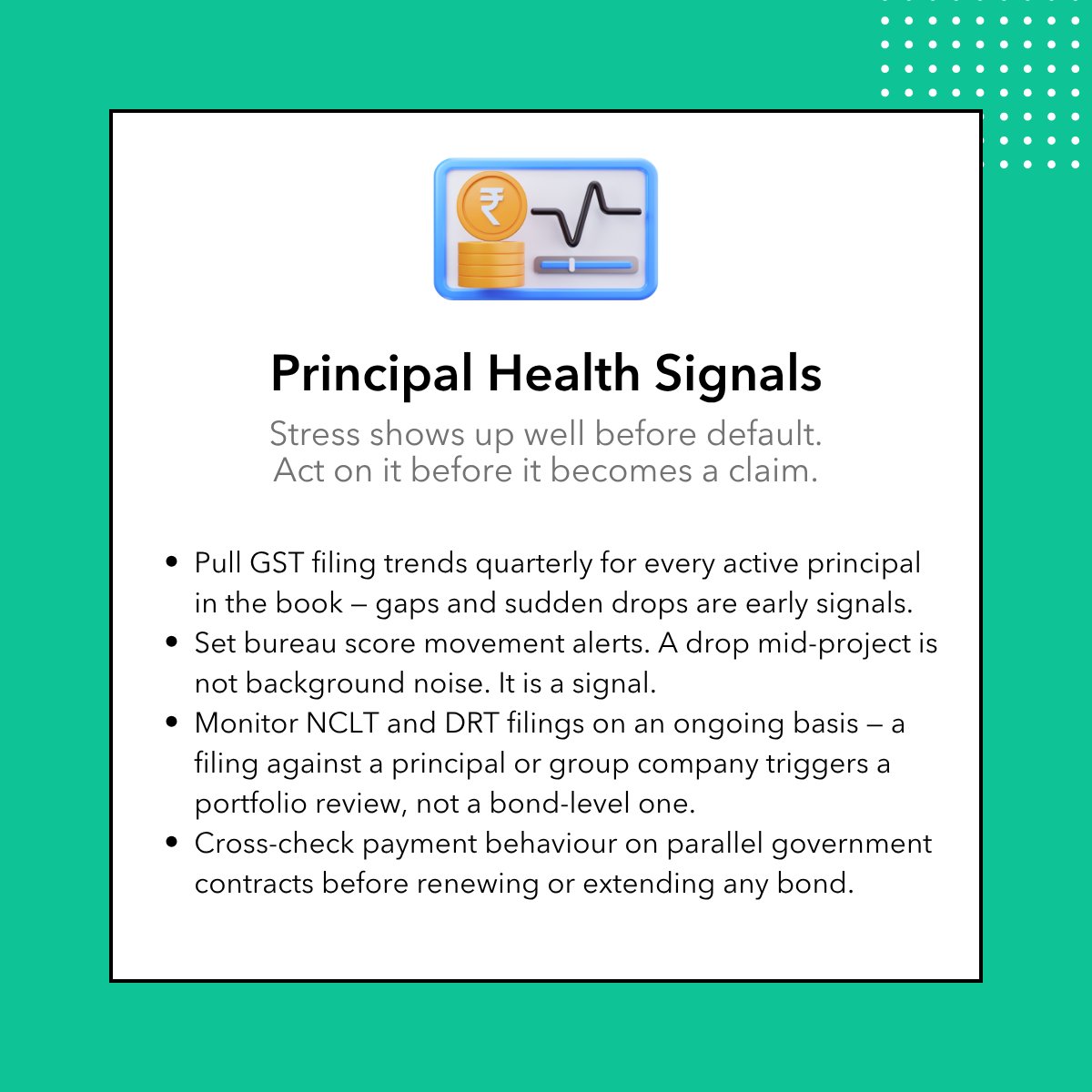
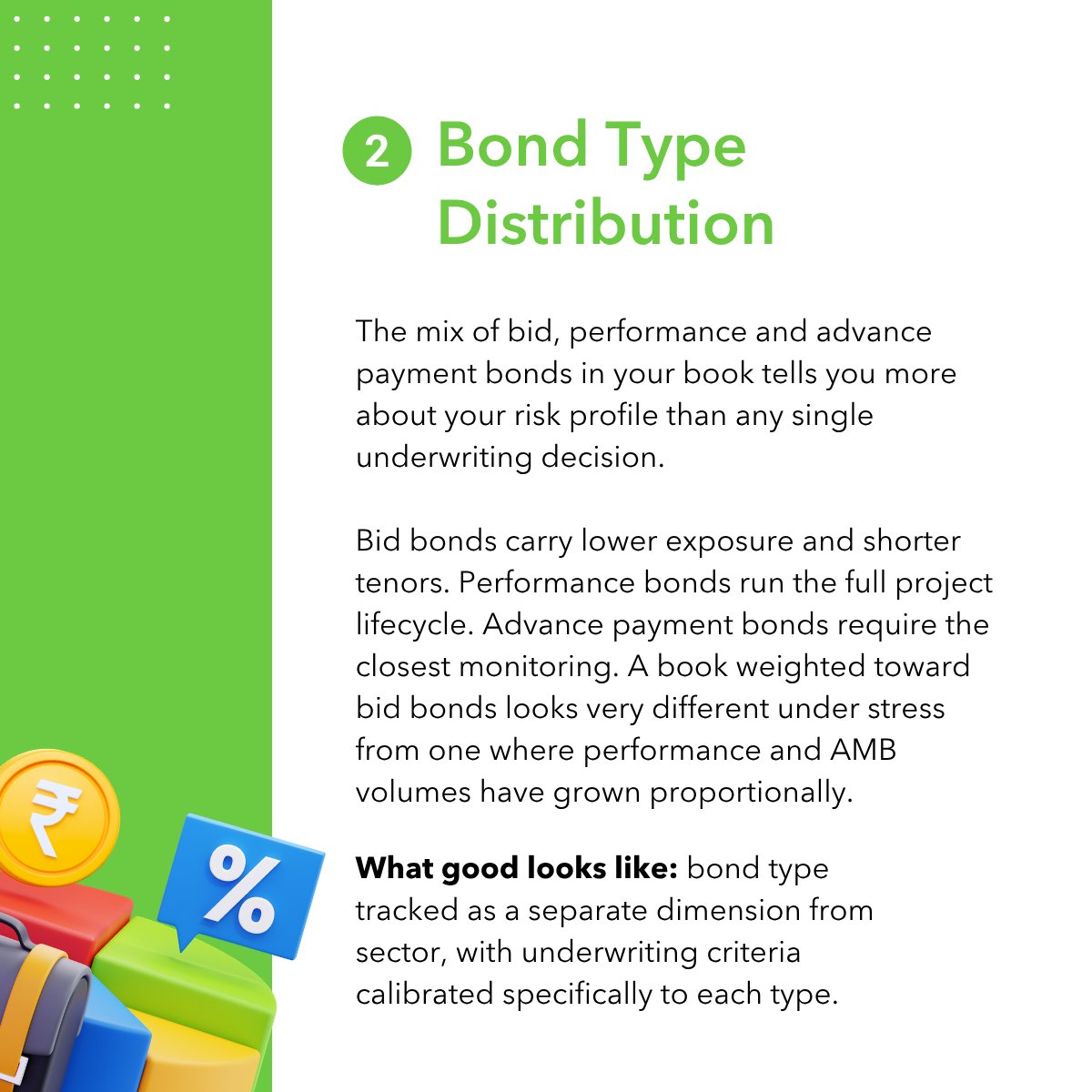
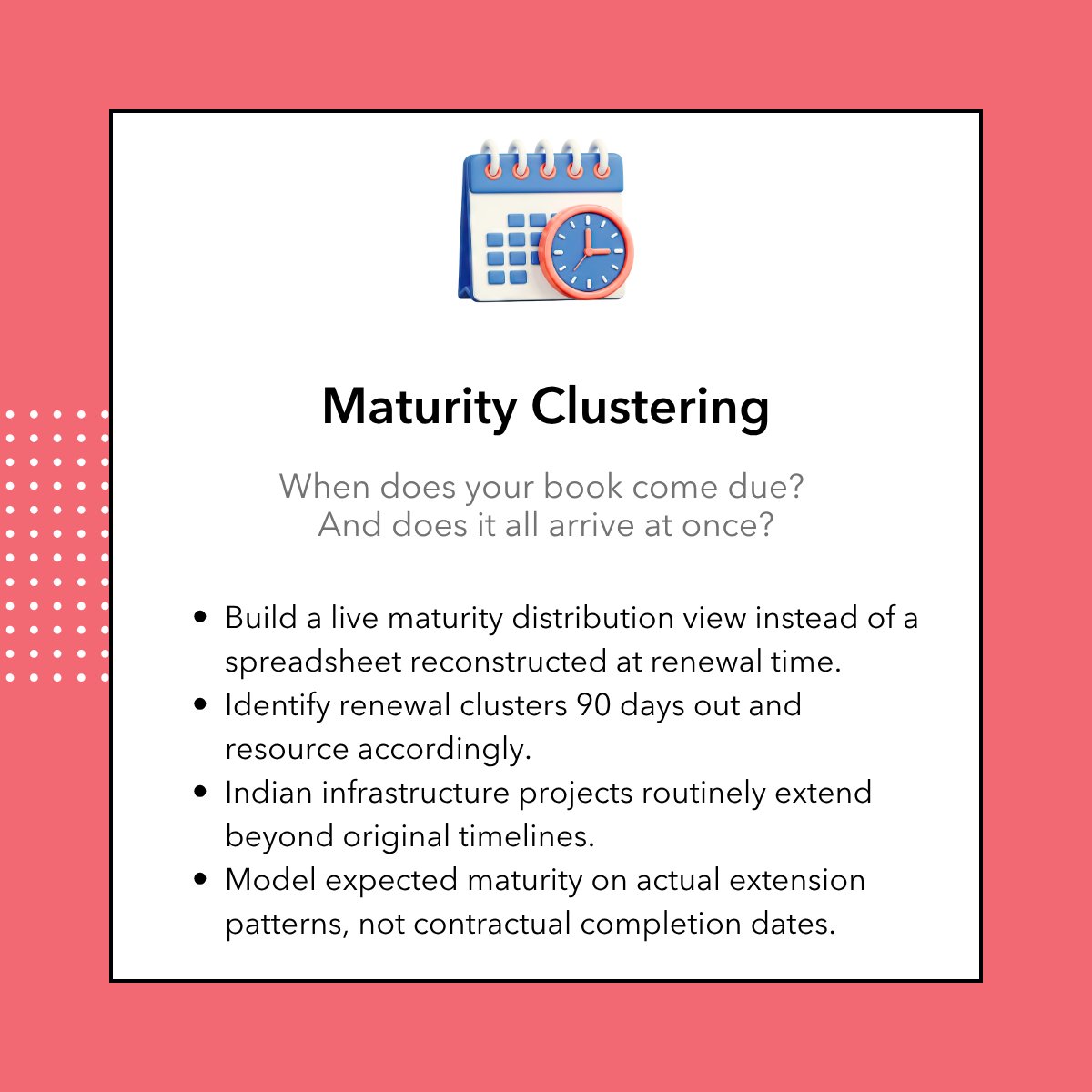
Sector concentration, single-name exposure limits, bond type distribution, maturity clustering, reinsurance treaty headroom, and ongoing principal health signals all need to be tracked continuously, not filed away after issuance.
In India specifically, where loss history across the surety segment is still short and reinsurers are actively calibrating their appetite, the book that builds this discipline now is the one whose risk profile is legible when stress eventually arrives.
Portfolio metrics are not administrative. They are what converts a collection of individually sound underwriting decisions into a managed book.
#InsuranceSuretyBonds #Surety #IRDAI #axiTrust
The ET Air and Defence Summit made it clear that India’s aerospace and defence ambitions over the next decade will be shaped by infrastructure, defence corridors, aerospace SEZs, aerocities, and integrated ecosystems.
The vision is the right one. What it implies, without stating it directly, is a sharp scaling of the MSME and supplier base expected to operate inside these ecosystems.
Defence corridors work when the manufacturers and suppliers within them can take on the contracts. That needs more than industrial parks and logistics connectivity.
It needs the financial infrastructure that lets a mid-sized manufacturer or a defence startup furnish the performance guarantees required to win and deliver those contracts.
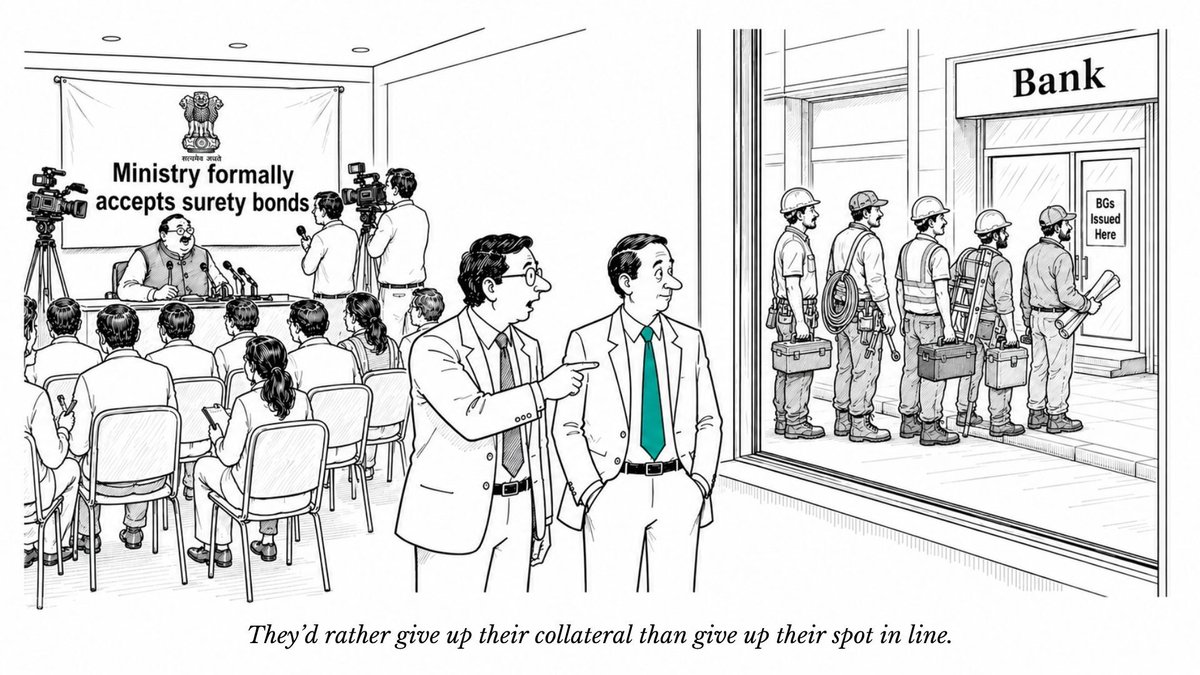
For most of these businesses, that guarantee today means a bank guarantee, which ties up the same banking limits they need to buy material and run the project.
An Insurance Surety Bond is a collateral-free alternative. It is DAP compliant and accepted under the Defence Acquisition Procedure, so the limit stays free for execution.
India has around 16,000 MSMEs active in defence today. As corridors scale and procurement volumes grow, that base has to grow with them. The guarantee infrastructure those businesses depend on has to be ready for that expansion.
The physical infrastructure conversation is well underway. The financial readiness conversation is the one that has to follow.
Here's the article:
https://t.co/NPRXoIugkj
#InsuranceSuretyBonds #Defence #axiTrust
There is a structural friction being created in contractor-procurer relationships upon project delivery.
It goes like this:
When a contractor hands over a completed project, the procurer withholds 5 to 10 per cent of the contract value as retention money, held as security against defects during the warranty period.
This is the defect liability period, and it's written into every Government contract.
The logic is sound - the procurer needs assurance that if defects emerge, there is financial recourse to get them fixed. That protection is legitimate and necessary.
However, the way financial security here is structured puts extreme pressure on te contractor and locks their ability to pursue new projects.
Holding cash is the most familiar way to provide that assurance.
Typically, this amount is 5-10% of the contract value
On a ₹20 crore project, that is ₹2 crore sitting with the procurer for up to 24 months after the work is done. Run three projects simultaneously and the aggregate retention can amount to ₹6 crore sitting outside the business. The capital is already earned, but it is not yet accessible.
When a project ends, a growing contractor needs capital to mobilise for the next job, to replenish equipment and to pay down short-term obligations.
This is the problem that insurance surety bond-based retention money bonds are designed to solve.
A retention money bond releases the held-back cash to the contractor at project handover while giving the procurer equivalent protection for the full defect liability period.
The contractor receives capital they have already earned.
The procurer retains the same assurance they would have had by holding the cash.
Neither party loses anything except the inefficiency of locking capital that did not need to be locked.
The retention money bond is a type of insurance surety bond recognised by Insurance Regulatory and Development Authority of India. It sits alongside bid bonds, performance bonds and advance payment bonds as the fourth instrument available across the full project lifecycle.
However, it is consistently the least understood and least used of the four.
We are trying to spread awareness of this bond type to help improve contractor-procurer relations. As part of this, we have done a complete deep dive into retention money bonds as part of our latest article: Types of insurance surety bonds in India.
Read the full blog here - https://t.co/O31qIKwxzo
#InsuranceSuretyBonds #MSME #WorkingCapital #Contractors #IndianEconomy #axiTrust
Most conversations about Insurance Surety Bonds focus on the individual bond.
The underwriting decision, the contractor profile and the premium. These are the right questions at the application stage.
An insurer building a book of Insurance Surety Bonds does more than make individual underwriting decisions. They construct a portfolio, and portfolio-level thinking is a different discipline entirely.
Here is what a well-constructed surety book actually looks like.
#InsuranceSuretyBonds #Insurance #IRDAI #axiTrust
@NHAI_Official did not accept Insurance Surety Bonds overnight.
They started with EPC contracts in 2023, updating standard bidding documents across EPC, HAM and BOT projects to allow Insurance Surety Bonds alongside bank guarantees.
In January 2025, Policy Circular No. 3.1.41/2025 extended acceptance to mobilisation advance in EPC contracts. In July 2025, Policy Circular No. 18.105/2025 expanded the scope to consultancy contracts, including Authority Engineers and Independent Engineers.
Each circular built on the last. One contract category at a time, tested at each stage and expanded as confidence grew.
That incremental approach is what ₹10,000 crore in Insurance Surety Bond issuance looks like from the inside. Not a single policy decision. A process built deliberately.
Every procurement organisation evaluating Insurance Surety Bonds today faces the same choice NHAI faced in 2023: wait until everything is figured out before accepting a single bond, or start somewhere and build from there.
The organisations that move first shape what the market looks like for everyone who follows.
Sources in the tread below.
@MORTHIndia
#InsuranceSuretyBonds #NHAI #Procurement #axiTrust
India's $5 trillion ambition requires every rupee of productive capital deployed efficiently. Yet 4.5% of GDP, roughly ₹15 lakh crore, sits immobilised in bank guarantee collateral.
Our research shows that replacing eligible bank guarantees with Insurance Surety Bonds frees ₹1.13 lakh crore of MSME liquidity immediately, translating into ₹2.02 lakh crore of additional annual GDP. Over the next decade, expanded Insurance Surety Bond capacity enables ₹8.6 lakh crore in incremental projects every year. The total GDP uplift is nearly 1%.
Atmanirbhar Bharat is also a capital efficiency problem, and Insurance Surety Bonds are a meaningful part of the solution.
#InsuranceSuretyBonds #axiTrust
https://t.co/9bvnMdPahC
Everything a contractor or MSME needs to know about Insurance Surety Bonds, in one place.
How they work. What they cost. Who qualifies. How they map across the project lifecycle. Where the regulation stands. What to do when a tendering authority does not accept one.
We wrote it so you do not have to gather it from ten different sources.
Read the full blog: https://t.co/3aRKxQCSrr
#InsuranceSuretyBonds #MSME #Contractors #axiTrust
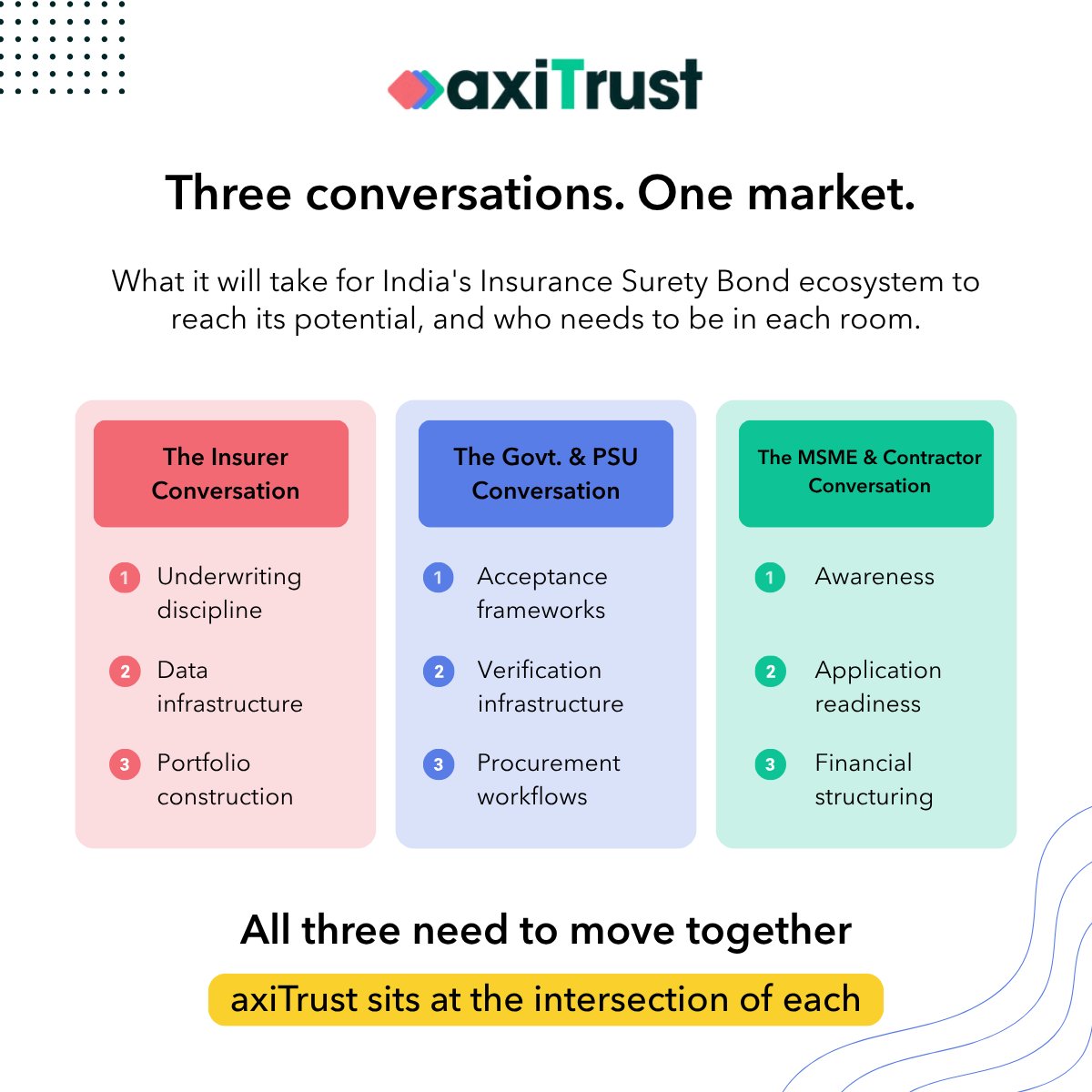
India's surety market is not being held back by a missing regulation or a missing instrument. Both exist.
What is missing is the simultaneous progress of three conversations that are largely happening in isolation from each other. Insurers building underwriting capability without beneficiaries ready to accept at scale.
Beneficiaries building acceptance infrastructure without enough contractor applications flowing through. Contractors becoming aware of surety without always finding an insurer ready to back their profile.
Each conversation is real and each is advancing. The market scales when all three are advanced enough that a qualified contractor can walk into a tender, offer a surety bond, have it accepted without friction and get it underwritten with confidence.
That moment is closer than most people think.
But it requires the right people in each room and the awareness that these are not three separate problems. They are one problem looked at from three different angles.
#SuretyBonds #InsuranceSuretyBonds #Procurement #axiTrust