Abuja is sinking.
The planned capital of Nigeria, one of three purpose-built capitals in West Africa and the newest there, was never meant to flood. Standards were high and every detail was considered in the master plan.
But today Katampe, Wuse, Gariki, Lugbe, Galadimawa and others are flooding. What is going on? What happened to Abuja?
Major drainages are blocked, sewage spills out daily, canals have been narrowed for estates, and green areas sold to estate companies by this government.
This is the story of the capital that was never meant to flood.
Most teams only reach for traces to follow one problematic request, but spans can do a lot more than that.
A trace is just one view of your data. It's the story of a single request, reconstructed by grouping spans that share a trace ID.
But those same spans are also a dataset. Query them across thousands of requests and you can find patterns no single trace would ever show you.
We wrote a piece that walks you through how that distinction changes how you debug.
Read the guide here: https://t.co/4WJlJi7Akm
Go has always been the odd one out for OpenTelemetry auto-instrumentation.
Other languages get zero-code instrumentation where an agent attaches at runtime. But Go compiles to a native binary with no VM or bytecode to hook into, so your options were an eBPF agent or manual instrumentation.
That changed this month with the v1 release of otelc, a tool that instruments traces, metrics, and log correlation at compile time.
We wrote a guide that walks through it end to end:
1. How otelc works and inspecting the resulting telemetry
2. The current list of supported libraries
3. Pinning instrumentation dependencies for reproducible builds
4. Security considerations for treating otelc as part of your trusted toolchain
If your Go services still ship without visibility because instrumentation felt like too much work, this guide is for you.
Link to the full guide in the comments! 👇
Meet our next speaker! 🎤
Ayooluwa Isaiah (@ayisaiah) is joining the API Conf Lagos 2026 stage!
Ayo is the Technical Content Manager at @dash0hq, where he works on OpenTelemetry-native observability tooling.
He'll be leading a hands-on workshop: Monitoring APIs with OpenTelemetry. Ayo will instrument a real API live, ship telemetry through the OTel Collector, and build the trace views that pinpoint exactly where latency hides. You'll walk out knowing how to set this up for your own APIs, whatever your stack.
If you're a backend engineer, SRE, or platform engineer tired of jumping between logs during incidents, this one's for you.
Date: July 24–25, 2026
Register now: https://t.co/RYptRB2zoZ
Secure your workshop ticket: https://t.co/k9vI5mFbwh
#APIConfLagos26 #APIs #Developers #TechEvents
You can’t outwork the whole world. There’s always going to be someone somewhere willing to work as hard as you. Someone just as hungry. Or hungrier.
Assuming you can work harder and longer than someone else is giving yourself too much credit for your effort and not enough for theirs. Putting in 1,001 hours to someone else’s 1,000 isn’t going to tip the scale in your favor.
What’s worse is when management holds up certain people as having a great “work ethic” because they’re always around, always available, always working. That’s a terrible example of a work ethic and a great example of someone who’s overworked.
A great work ethic isn’t about working whenever you’re called upon. It’s about doing what you say you’re going to do, putting in a fair day’s work, respecting the work, respecting the customer, respecting coworkers, not wasting time, not creating unnecessary work for other people, and not being a bottleneck. Work ethic is about being a fundamentally good person that others can count on and enjoy working with.
So how do people get ahead if it’s not about outworking everyone else?
People make it because they’re talented, they’re lucky, they’re in the right place at the right time, they know how to work with other people, they know how to sell an idea, they know what moves people, they can tell a story, they know which details matter and which don’t, they can see the big and small pictures in every situation, and they know how to do something with an opportunity. And for so many other reasons.
So get the outwork myth out of your head. Stop equating work ethic with excessive work hours. Neither is going to get you ahead or help you find calm.
[The Outwork Myth — It Doesn't Have To Be Crazy At Work, 2018]
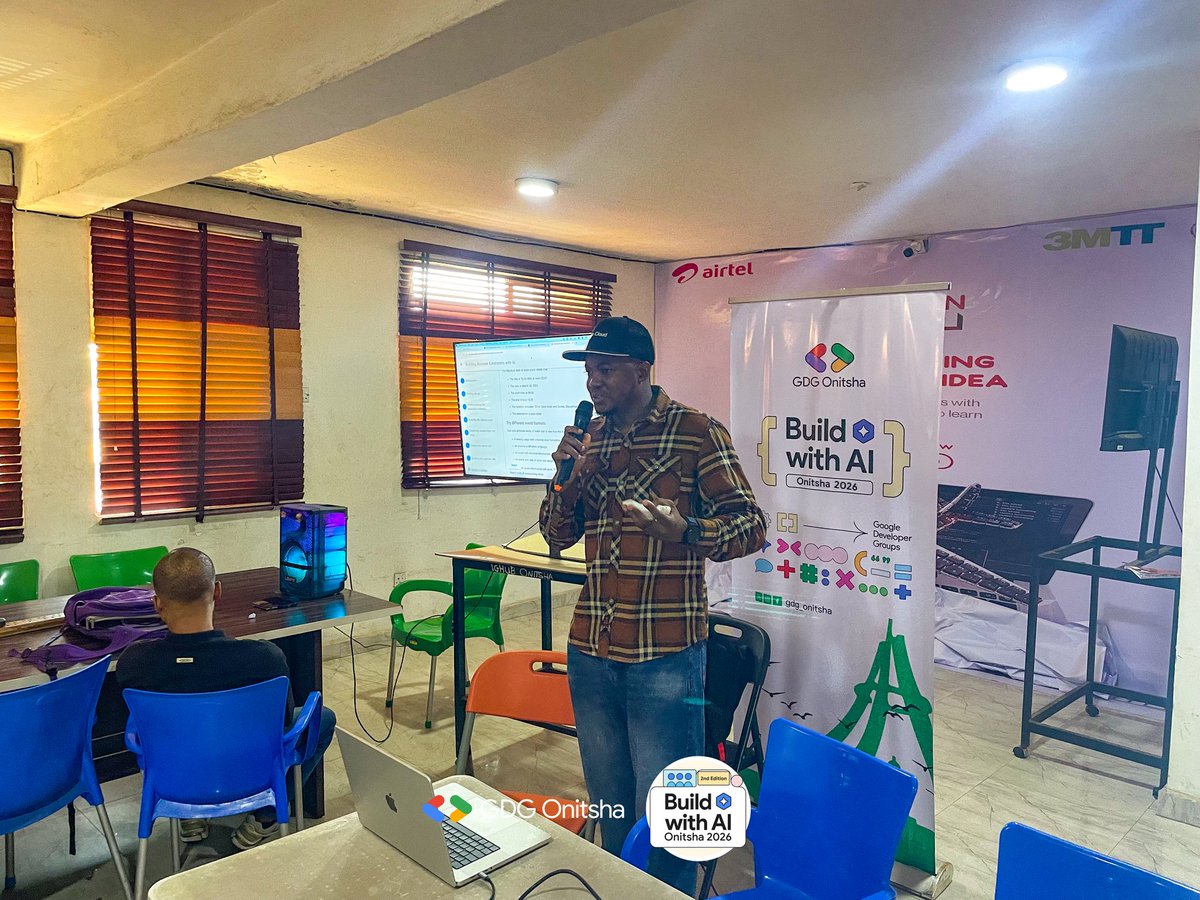
Thank you to everyone who attended Build with AI Onitsha 2nd Edition.
To our speakers, @zubfaruq , @ayisaiah , @Chiduluomuno , @NwabuezeNwite, organizers,and attendees, we truly appreciate your time, energy and support.
New article: Slices, Maps, and Channels 🔥
A look at the three most ordinary Go types and the not-so-ordinary structures behind them.
↔ slice headers and the doubling/1.25× growth rule
↔ Swiss tables, H1/H2, and local growth
↔ hchan, sudogs, and direct goroutine handoff
👉 https://t.co/KqHc0T07TK
#golang #go
We have been making steady progress with the Light-Up Lagos project. Across major roads and highways in the state, our teams have been installing streetlights and replacing old, unreliable fittings.
You may have seen the work happening recently, both on the Mainland and the Island.
Good lighting helps people move around more safely and improves security along our roads, whether you are heading home late from work or starting your day before dawn.
This work is ongoing, and we will continue expanding it across the state, one street at a time.