The ongoing controversy over the alleged fake Federal Government agency can be resolved without speculation or endless public arguments. There is already a clear and established process for determining the truth.
In banking, there is a globally accepted principle known as Know Your Customer (KYC). Every regulated financial institution is required to verify the identity, legal status, ownership, and authority of every customer before opening an account. It is the first line of defence against fraud, money laundering, identity theft, and other financial crimes.
While serving in one of Nigeria's leading financial institutions, I was privileged to be a Category A signatory with the Central Bank of Nigeria. That experience gave me firsthand knowledge of the rigorous procedures involved in opening institutional accounts. An account for an entity claiming to be a Federal Government agency cannot be opened casually. It requires extensive documentation, multiple layers of verification, regulatory approvals, and clearly defined account mandates. It bears no resemblance to the simplified account opening procedures offered by fintech platforms.
If the goal is to uncover the truth rather than prolong a public blame game, then investigators already know where to start.
Simply trace the account opening process.
If it is true that an alleged fake Federal Government agency opened both Naira and domiciliary accounts, then the answers lie in the KYC records. Investigators should establish:
• What documents were presented?
• Who verified and approved them?
• Who authorized the accounts?
• Who are the account signatories?
• What mandates were filed?
That evidentiary trail will reveal whether due process was followed, where any failure occurred, and who should be held accountable.
The facts are in the records. Let investigators follow them, establish the truth, hold those responsible accountable, and allow the country to move on to the many other pressing issues demanding our collective attention.
In matters like this, facts, not speculation, remain the surest path to justice and accountability.
The Lone Refiner & Reformer.
“One courageous man, standing firm, can turn decades of failure into a future of possibility.” CEDO 2025
For nearly 30 years, Nigeria’s refineries stood as symbols of failure. Our state owned refineries stopped producing for almost a decade before Dangote’s breakthrough. They were crippled by fraudulent turnaround maintenance that consumed hundreds of billions of naira and delivered nothing. That deep rooted systemic fleecing is now under investigation.
Many tried to fix the system. Most walked away. Aliko Dangote stayed.
After buying the Port Harcourt refinery under Obasanjo and having it reversed under Yar’Adua, Dangote chose a harder path. He invested over 20 billion dollars of his own money to build a world class refinery from scratch.
What followed was resistance at every turn. Regulatory attacks later disproved. Crude oil supply denied, forcing imports from the United States. Union pressure driven by old rent seeking habits. Strikes. Even alleged sabotage. The project was tested repeatedly.
Presidential intervention later ensured crude supply in naira, but challenges continued. Dangote adapted. He acquired thousands of CNG tankers, restructured operations, and pushed the refinery to full production.
Today, the refinery produces petrol, diesel, aviation fuel and petrochemicals. It exports to Africa, Asia and the United States, earning vital foreign exchange for Nigeria.
This success did not happen in isolation. It reflects an enabling environment under the APC led administration, strong and fast tracked support from the Lagos State Government, and timely intervention by Mr President when it mattered most.
It also rests on the discipline of refinery staff who keep the system running, the patriotic investments of Dangote, BUA and others who chose Nigeria, and citizens who continue to stand for what is right.
The choice before us is simple. Support local value creation. Stop systemic sabotage. Let those fighting Nigeria’s economic battles finish the job.
Aliko Dangote’s commitment of ₦100 billion yearly to education is a landmark act of private philanthropy. Over 10 years, that becomes ₦1 trillion invested directly into the future of over a million Nigerian students.
By supporting STEM learners, vocational and technical trainees, and the girl child in secondary schools, the Dangote Foundation is unlocking opportunities that can reshape a generation. This is the kind of leadership that accelerates national growth.
Nigeria is blessed with many successful private individuals and corporations, and this gesture shows how powerful their impact can be when directed toward education. Dangote has set an admirable pace. Others can join in lifting the dreams of our young people and our nation’s future.
@ed_onoja Appointments and insecurity are nuanced issues that require multiple perspectives. Let's focus on issues that unite us not those that divide us.
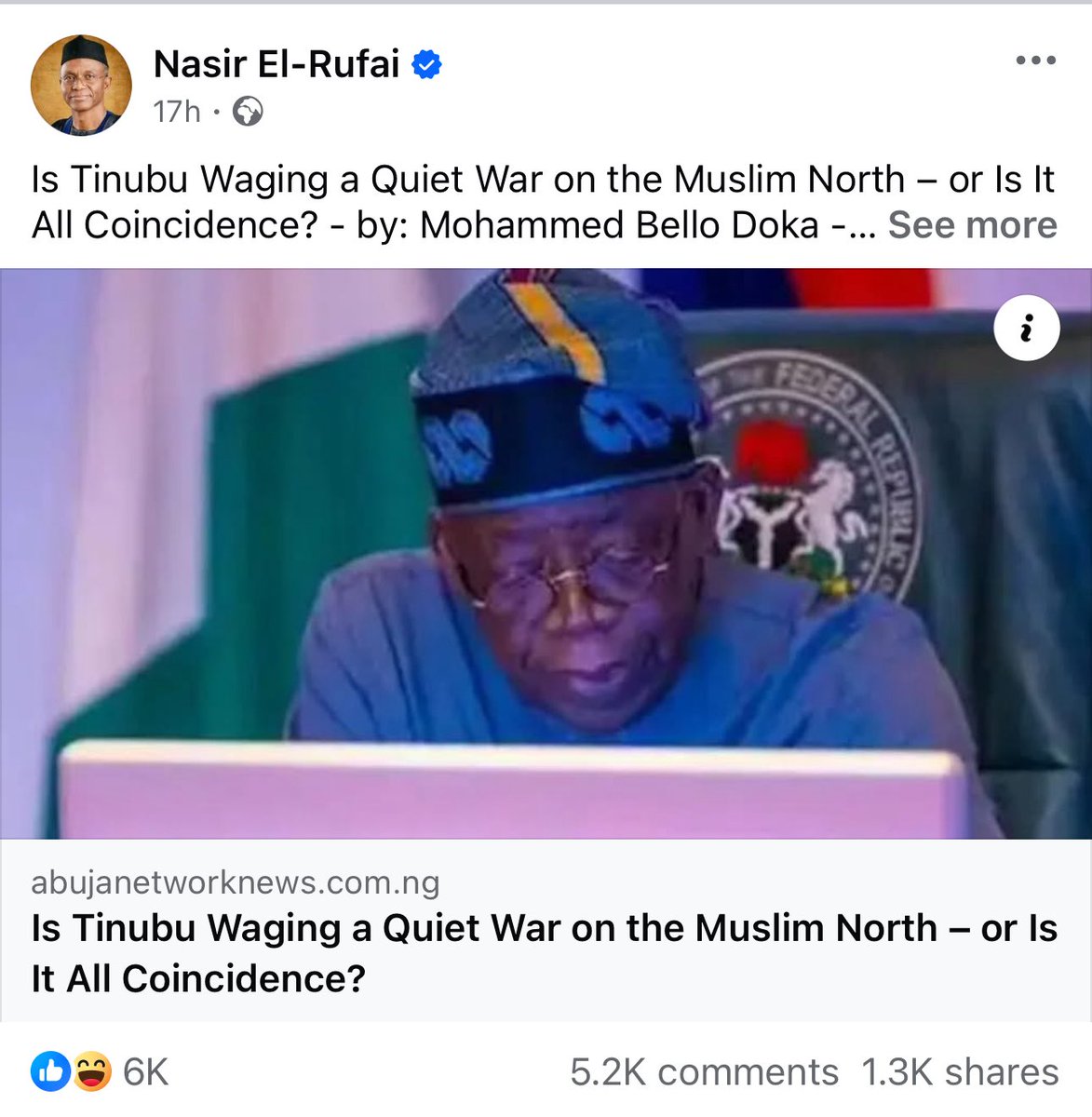
The writeup raises serious questions, but many of its claims rely more on suspicion than on facts. It links unrelated political transitions and frames them as a deliberate pattern, when these same transitions happen in every administration.
The idea that the “Muslim North” is being sidelined is misleading. The North has never been a religious bloc. Christians and Muslims across Borno, Katsina, Gombe, Bauchi, Niger, Kano, Kaduna, Plateau, Benue, Taraba, Adamawa, Nasarawa, Kogi and others have always been Northerners together. They have lived, traded and shaped the regions politics despite differences. Turning the region into rigid religious blocs is dangerous. We must see ourselves as Nigerians and Northerners first, before Muslim or Christian.
The claim that certain groups “make kings” also distorts reality. No region or religion determines power. People mobilise and vote, but leadership ultimately comes from God. Reducing politics to religious lines misrepresents our history and our faith.
On appointments, the idea of calculated displacement does not align with facts. When Kemi Adeosun resigned under Buhari, she was replaced by Zainab Ahmed from Kaduna. No one linked it to religion. When Adams Oshiomhole left as APC Chairman, Mai Mala Buni from Yobe replaced him without controversy. Even Gandujes exit simply returned the office to North Central where it was originally zoned. That was the fair and balanced thing to do. These are normal political corrections, not signs of a quiet war.
On insecurity, every region faces its own challenges. Yet defence and security now take the largest share of the national budget at about twelve percent, almost double the seven percent average of past administrations. That contradicts the narrative of a lukewarm posture toward Northern insecurity.
The Lagos Calabar coastal highway is also misrepresented. It is not a Lagos road. It spans eight states including Lagos, Ogun, Ondo, Delta, Bayelsa, Rivers, Akwa Ibom and Cross River. Many of these are oil producing states that remain the economic backbone of the country. Investing in infrastructure along this corridor is logical, just as increasing defence spending is logical given national insecurity. Both priorities can coexist.
Negotiations with bandits did not begin today. Northern governors have adopted similar approaches in previous years. Presenting this as a new federal agenda against the North ignores that record.
As for foreign pressure or online rhetoric, Nigeria is governed by its constitution, not by tweets or external commentary. Supporters posting provocative views do not represent government policy. And no President seeking re election can ignore Northern votes, both Christian and Muslim. Every serious political actor understands this.
What is most concerning is how the narrative encourages Northerners to distrust one another. It tells Christians they are outsiders and tells Muslims they are victims, quietly fracturing a region that is strongest when united in purpose even with internal differences. This does not defend the North. It weakens it.
Nigeria needs less religion in politics and more focus on building a cohesive nation. At this point in our national life, leaders, stakeholders and citizens must push through both words and actions for national integration, peace and unity for the sake of the country regardless of region, religion or political leaning.
Thank you, Mr President, for your continued commitment to strengthening our national security.
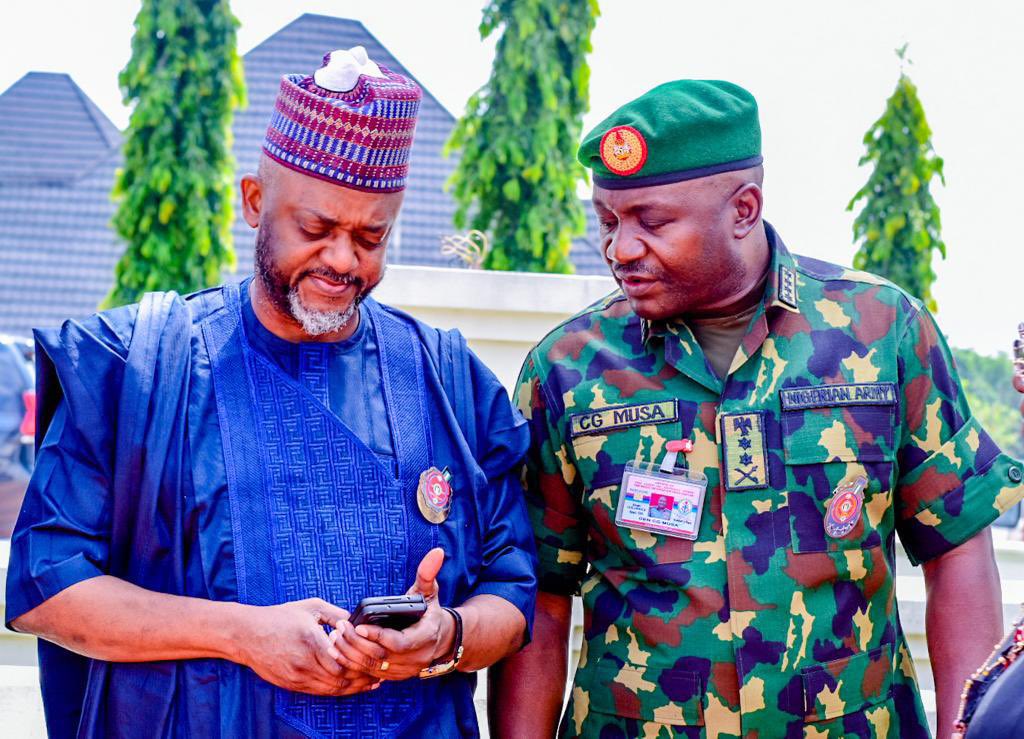
Congratulations, General Christopher Gwabin Musa, on your nomination as Minister of Defence. Your record of disciplined service and unwavering commitment to Nigeria’s unity has earned the trust placed in you once again.
As you step into this role, I wish you strength and success. Nigeria looks forward to your leadership.
Congratulations, General. The nation salutes your service.
@ed_onoja Exactly! The root cause of the problem is being ignored, and we're just treating the symptoms. It's time to go after the kingpins.
And the peace and progress we crave and pray for will be come a reality
Mr President, the real breakthrough will not come from only chasing gunmen. It will come from chasing the people who feed them. Nigeria already knows the truth. The violence survives because powerful hands keep it alive.
This is your moment to end it. Pull the plug on the sponsors and watch the fear industry collapse. Pull out the root and watch the branches and leaves wither. The nation is ready. The world is waiting. Lead the charge. Godspeed.
While in Jos, I had a brief but insightful engagement with the leadership of the G-NEXT Network.
It was a familiarization and strategic session in alignment with our collective commitment to advancing the Renewed Hope agenda of our principal, President Bola Ahmed Tinubu.