Meanwhile - in Pecos County, dozens of zombie wells are poisoning our land and drinking water. Sir - the seat you’re running for has NOTHING TO DO WITH IMMIGRATION!
DHS's "Big Bend 5" barrier project will cut right through the Lower Pecos Canyonlands, home to a unique style of rock art that's rapidly rewriting our conception of the inner lives of ancient hunter-gatherers. My latest for the Border Chronicle: https://t.co/nLsZbkCO7P
My creek crossing right now — dumps into the Rio Grande along one of the Big Bend border wall projects. Most summers it does this once a week, at least. I can’t stress what an insane feat of engineering it will entail to build a wall across hundreds of creeks exactly like this
Here’s the well in November 2024. It’s been leaking toxic brine into the ground for over 18 months. Now it’s also flowing oil. Chevron doesn’t care. The Texas Railroad Commission doesn’t care either.
Remembering Susan Ross on the 30th anniversary of her untimely death, May 16, 1996, a bizarre tragedy caused by the toxic adhesive on the discount wedding invitations George Castanza selected.
Earth Day started because of an oil spill and a magazine article someone read on a plane. The first one in 1970 pulled 20 million Americans into the streets. One in ten people in the country, on a single day.
January 1969. An oil rig six miles off the California coast blew out. For ten days, more than 3 million gallons of crude oil poured out of cracks in the ocean floor. The slick covered 800 square miles, nearly three times the size of New York City. Thousands of seabirds, dolphins, and sea lions died. For weeks, Americans watched it play out on the nightly news.
A senator from Wisconsin named Gaylord Nelson flew out to see the damage for himself. On the flight home, he picked up a magazine. An article about anti-war gatherings on college campuses caught his eye. Something clicked. Do the same thing, but for the environment. One day. Every campus. Every town across America.
He hired a 25-year-old named Denis Hayes to organize the whole thing. They picked April 22 because it fell between spring break and final exams, when the most students would be around. Twenty million showed up. Fifth Avenue in New York turned into a wall of people walking shoulder to shoulder.
Then things moved fast. In three years, four huge environmental laws were passed. The Environmental Protection Agency, or EPA, opened its doors in December 1970 to write and enforce pollution rules. The Clean Air Act got signed the same month. Then the Clean Water Act in 1972, followed by the Endangered Species Act at the end of 1973. Air pollution covered by the Clean Air Act has dropped 78% since 1970.
Earth Day went global in 1990. That year, 200 million people in 141 countries took part. Today, roughly one billion people across 193 countries mark it each year.
The Artemis II photos in the post above came back with the astronauts two weeks ago. Fifty-six years ago, all of this started because one senator got angry about dead seabirds on a California beach and happened to read the right magazine on the flight home.
Picture a thick rope pulled tight across your chest for years. This whale shark has been living it. His skin is six inches thick, the thickest armor of any animal on Earth. The rope in this video sawed through years of it.
Most whale sharks in this shape never get found. This one got lucky.
Scientists in Indonesia spent 13 years studying 268 whale sharks in a stretch of ocean called the Bird's Head Seascape. It's supposed to be one of the safest places on Earth for them because fishing is restricted. The study came out in August 2025, in Frontiers Marine Science. Out of the 268 sharks, 206 had visible scars. Just over three quarters. And 80% of those scars came from humans: boats, ropes, nets, fishing platforms.
And this is inside the protected area. Outside, things get worse.
Every year, about 2% of the world's fishing gear is lost or dumped into the ocean. That adds up to around 25 million crab traps and fish pots sitting on the seafloor. Enough fishing line to wrap around the equator 18 times. Commercial nets covering an area the size of Panama. And somewhere between 500,000 and 1 million tons of rope and netting.
The rope doesn't rot. Nylon hangs around in seawater for centuries, long enough to outlive the people who tied the knots. It just drifts, catching whatever swims into it. The WWF figures almost half of the Great Pacific Garbage Patch is old fishing gear.
Whale shark numbers are down more than 50% in the last 75 years. In the Indo-Pacific, it's 63%. These animals don't start having babies until they're about 30. They can live to 130. So a rope around a young whale shark is a 20-year wound. If it survives.
The rescue you just watched took a diver maybe five minutes. That rope had been on the shark for years. Around 300,000 whales and dolphins die every year from getting tangled in fishing gear. Almost none of them get a camera crew.
🦔A researcher invented a fake eye condition called bixonimania, uploaded two obviously fraudulent papers about it to an academic server, and watched major AI systems present it as real medicine within weeks.
The fake papers thanked Starfleet Academy, cited funding from the Professor Sideshow Bob Foundation and the University of Fellowship of the Ring, and stated mid-paper that the entire thing was made up. Google's Gemini told users it was caused by blue light. Perplexity cited its prevalence at one in 90,000 people.
ChatGPT advised users whether their symptoms matched. The fake research was then cited in a peer-reviewed journal that only retracted it after Nature contacted the publisher.
My Take
The researcher made the papers as obviously fake as possible on purpose. The AI systems didn't catch it. Neither did the human researchers who cited it in real journals, which means people are feeding AI-generated references into their work without reading what they're actually citing.
I've covered the FDA using AI for drug review, the NYC hospital CEO ready to replace radiologists, and ChatGPT Health launching this year. All of that is happening in the same environment where a condition funded by a Simpsons character and endorsed by the crew of the Enterprise was being presented as emerging medical consensus. The people making these deployment decisions seem to believe the pipeline from research to AI to patient is more supervised than it actually is. This experiment suggests it isn't supervised much at all.
Hedgie🤗
https://t.co/8Kg8FOrgHW
Airbnb, this is unacceptable. @Airbnb
We stayed in a listing where loud drilling (building maintenance) made it impossible to work during the day. We raised this respectfully.
After checkout, the host started contacting us repeatedly on WhatsApp, pushing for calls and making inappropriate comments when we refused.
We left an honest, factual review.
Airbnb removed it.
If real experiences can be erased while this kind of behavior is ignored, how can anyone trust this platform?
Trails predict where land will reprice. Years before the cranes show up.
New York saw it. Chicago saw it. Atlanta saw it.
Dallas is next. And it's running the largest version of this experiment any American city has ever attempted.
Here's the pattern:
Every major American city is fighting the same battle. The suburbs keep growing. The urban core fights to hold its tax base. People say they want walkability and community. Then they leave for places that feel safer and easier to navigate.
Cities have big ambitions. Dallas. Chicago. Atlanta. They want to attract people, businesses, and jobs. That takes money. Aging infrastructure needs replacing. New amenities need building.
The tax base isn't shrinking. But it's not growing fast enough to fund those ambitions without raising rates. And raising rates pushes more people out.
There's another approach.
Build infrastructure that makes land more valuable. Not highways. Not stadiums.
Trails.
It sounds too simple.
When you build a connected trail network, you create the walkability people crave. Neighborhoods that were cut off become accessible. Land values rise. Tax revenue grows without raising anyone's rate.
The evidence is hard to argue with.
New York built the High Line. Property values jumped 35%. Chicago built The 606. Home prices spiked 48%. Atlanta built the BeltLine. Developers have poured more than $9 billion into land along it.
The pattern holds whether the city runs red, blue, or purple. Build the connection. Land reprices.
Dallas is now running this experiment at the largest scale any American city has attempted.
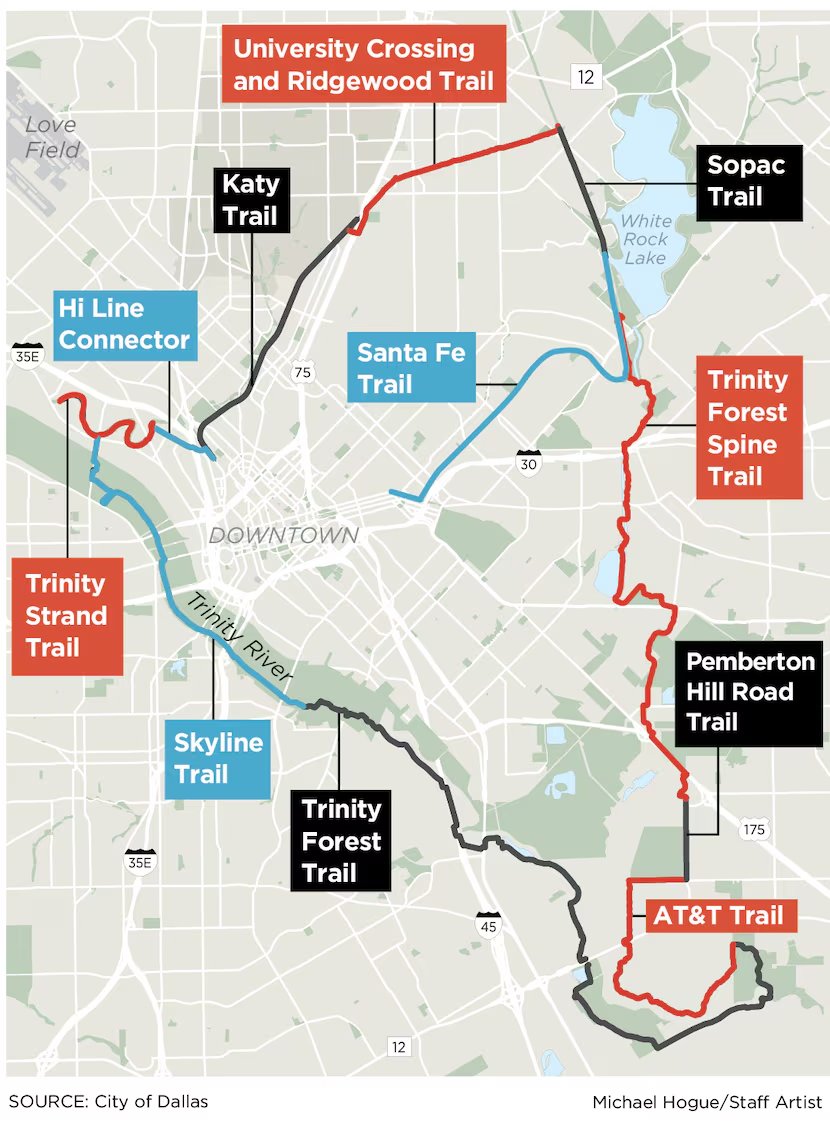
The Loop Dallas is a 50-mile trail circuit. It connects the Katy Trail, White Rock Lake, the Trinity Forest, Fair Park, the Design District, and Pleasant Grove. Every quadrant of the city.
The Design District already proves the thesis.
The city built a short connector to plug the area into the Uptown trail network. Before, it was an isolated pocket of warehouses. After, it became part of the Uptown ecosystem. Taxable value climbed 383%. Developers flipped their blueprints. Buildings now face the trail, not the street.
South Dallas is next.
A 1,200-foot bridge is opening the Trinity Forest Spine Trail. Neighborhoods cut off for decades by the river, the railroad, and the highways are about to become connected.
Every city that built a loop trail system saw the same result. Remove the barriers. Capital follows.
Trails aren't expenses.
They're leading indicators. They tell you where land is about to reprice, years before the cranes arrive.
If you want to understand where Dallas is heading, don't watch the skyline.
Follow the trail.
UYARI:
Sakın Boğaziçi Üniversitesi'nin web sitesini açmayın. İnternet paketiniz biter.
Üniversitenin ana web sitesine girince bütün videoları arka planda kesintisiz indiriyor. Videoda sağ altta fare imleci ile gösterdiğim yere bakın👇 İndirilen obje sayısı ve boyutu. +++
The Air War College asked @KoriSchake not to give a scheduled lecture on civil-military relations—a subject that she writes is “extremely relevant” in the current political climate. Here’s what she would have said: https://t.co/7h5W9nR7at
Let me explain exactly why every new subdivision in America looks like the top photo, because the math is wild.
A mature tree increases a home's value by 7 to 19 percent. On a $400,000 house, that's $28,000 to $76,000. A single shade tree produces the cooling equivalent of ten room-size air conditioners running 20 hours a day. One tree on the west side of a house cuts energy bills by 12 percent within 15 years. The bottom photo is worth more, costs less to live in, and sells faster. This has been documented by the University of Washington, Clemson, Michigan State, and the USDA. The data is not in dispute.
Removing those trees saves the builder roughly $5,000 per lot. Concrete trucks need twice the dripline radius of every standing tree. Utility trenches need flat ground. A bulldozer flattens 200 lots in an afternoon. Preserving trees adds weeks and thousands per home.
So the developer pockets $5,000 in savings and the buyer eats $50,000 in lost value for the next two decades. The person making the decision and the person paying for it have never been in the same room.
The Woodlands, Texas is the proof of what happens when they are. George Mitchell bought 28,000 acres of Houston timberland in 1974 and preserved 28% as permanent green space. He forced McDonald's to build behind the tree canopy. That McDonald's became one of the highest-volume locations in Texas. The first office building, designed to reflect the surrounding forest so you couldn't see it from the street, leased completely.
The Woodlands median home price today: $615,000. Katy, a comparable Houston suburb that clear-cut: $375,000. Named #1 community to live in America two years running.
Fifty years of data. The trees are worth more than removing them saves. Developers clear-cut anyway because they sell the house once and leave. You live in it for 30 years.
Reuters, Banksy’nin kim olduğunu tespit etmiş.
Çok iyi bir yazı, çok iyi bir araştırmacılık gazetecilik örneği. Bir filmin içerisinde gibisiniz.
Spoiler: Robin Gunningham, yeni adı ise David Jones. Massive Attack hayranlarını yazıda sürpriz bekliyor.
https://t.co/zS3Dqmr6gK
Grand opening of our newest project, The Marcus, on Tuesday.
76 brand-new apartments in the Cedars neighborhood of Dallas.
The first where we are developer, GC, and property manager.
The Cedars was one of Dallas's first premier residential neighborhood. In the late 1800s, it was where the city's most prominent families lived.
The Marcus family, who founded Neiman Marcus, lived there. There's still a mural of Stanley Marcus on a building at 2120 S. Ervay, steps from our front door.
Then the highways came. I-30 cut the neighborhood off from downtown. The convention center turned its back on it. Decades of disinvestment followed.
A year ago, our site was a vacant lot with a blighted, graffitied structure. Today it's a four-story apartment building with 76 units, 10-foot sidewalks, Energy Star certification, and a 60-year affordability commitment through a partnership with the City of Dallas.
We named it The Marcus because the neighborhood deserves to remember what it was and see what it's becoming.
The timing matters.
The $3.7 billion convention center rebuild is under construction blocks away. It's specifically designed to reconnect downtown to the Cedars. City Council is debating whether to spend $1.1 billion to save I.M. Pei's City Hall or tear it down, right at the edge of this same district.
The Cedars is about to change faster than any neighborhood in Dallas.
The Marcus is the first of several projects we're developing here. Not renderings. Not announcements. Finished apartments that people are moving into next week.
If you're in Dallas, come see it Tuesday 3:30 to 5:00 PM 2020 South Ervay Street in The Cedars
A chance to see what's actually happening on the ground in one of the most important neighborhoods in the city right now.
This is what we do. Find neighborhoods at an inflection point, and we show up with capital, construction, and long-term commitment. Not one project. Multiple projects. That's how neighborhoods change.