@Tenoverten101 Click to join the OK Movement SuperChat group now — uniting voters from all 176,846 polling units in Nigeria in one SuperChat group!
https://t.co/W2P107useU
Invitation code: NCZOG5PL-LL5732O7
@EmirSirdam Click to join the OK Movement SuperChat group now — uniting voters from all 176,846 polling units in Nigeria in one SuperChat group!
https://t.co/W2P107useU
Invitation code: NCZOG5PL-LL5732O7
Manchester United confirm 18-year-old midfielder Cristian Orozco has joined from Colombian side Fortaleza CEIF.
Orozco will initially be part of the Academy.✍️
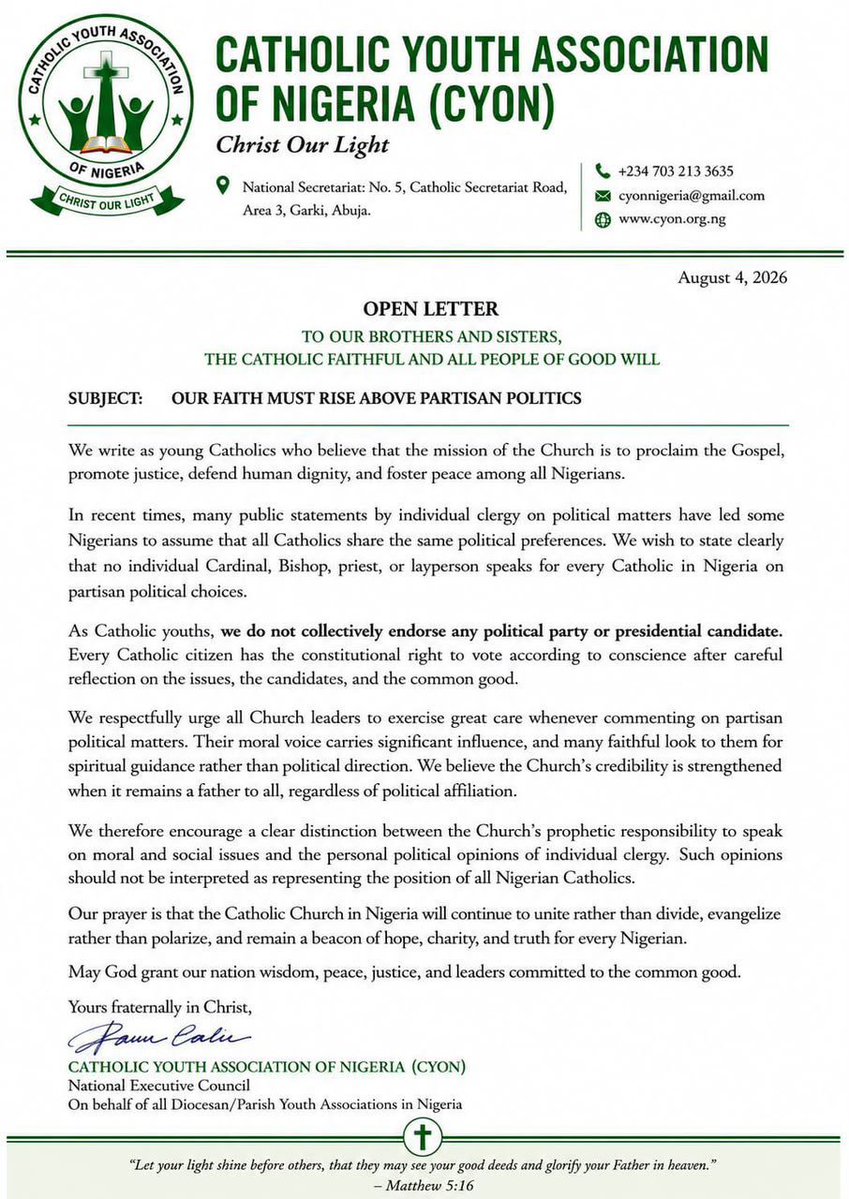
It is becoming increasingly clear that Una Cardinal is speaking solely from a position of personal interest and self-gain rather than from any genuine concern for the collective good. His recent comments have raised serious questions about his motives, and it is therefore not surprising that the Catholic Youth Association has chosen to distance itself from his latest gibberish. Their decision speaks volumes and underscores the growing disconnect between his utterances and the views of many within the Catholic community.
When a Government Declares War on the Truth
President Donald Trump of America recently described Nigeria as “a now disgraced country.” The painful reality is that Nigeria’s challenges continue to deepen. Each passing day reveals deeper signs of decline, especially when a government becomes increasingly intolerant of truth and hostile to those who speak about the suffering of the people.
The Catholic Church has never functioned as an opposition party in Nigeria. Across military regimes and successive democratic administrations, the Catholic Bishops’ Conference of Nigeria (CBCN) has maintained a principled voice on national issues and the nation’s conscience, commending governments when they deserved commendation and speaking the truth whenever national conscience demanded it. Its interventions are driven by a moral obligation, rooted in Christian social teaching, to defend truth, justice, and the common good.
The same applies to Nigeria’s major religious organisations. Bodies such as Jama’atu Nasril Islam (JNI), the Supreme Council for Shari’ah in Nigeria (SCSN), the Christian Association of Nigeria (CAN), and the Nigerian Supreme Council for Islamic Affairs (NSCIA) have repeatedly raised concerns over economic hardship, inflation, and insecurity. Living among the people, religious leaders often encounter the suffering of citizens firsthand. They speak because they witness families struggling with rising food prices, unemployment, and the fear created by kidnappings and insecurity.
As leaders, we should be gracious enough to listen to people and organisations that speak the truth to us and genuinely criticise us when things are not going in the right direction. As Governor, I had the opportunity of working with a very strong Council of Traditional Rulers, led by the Obi of Onitsha, and religious bodies that consistently criticised me and offered suggestions. This contributed greatly to our success in Anambra State, especially in critical areas like education and health.
Against this background, the attacks on the CBCN, and especially on His Eminence, John Cardinal Onaiyekan, are deeply troubling. Even in 1998, when Pope John Paul II visited Nigeria and told General Abacha some hard truths, including about the incarceration of Chief Moshood Abiola, nobody vilified him.
During the inauguration of Pope Leo XIV in Rome, to demonstrate his purported commitment to and respect for the Catholic Church, President Bola Tinubu arrived in Rome days before the event, ahead of most other visiting dignitaries, including Catholics such as the U.S. Vice President, JD Vance. He participated in the liturgy, queued with other world leaders to greet the Holy Father, and displayed deep respect for the moral authority of the Church. Back in Nigeria, however, that posture has now changed completely.
What is playing out today also reveals how political leaders sometimes exploit religion and ethnicity to divide the people. Even when it was obvious that the CBCN was speaking on issues affecting Nigerians across religious and ethnic boundaries, aides to the President immediately reduced it to a “religious affair.” The question is: are insecurity, poverty, inflation, unemployment, and hardship problems exclusive to a particular faith? Do these challenges recognise religious or tribal boundaries?
The bishops merely expressed what millions of Nigerians experience daily: insecurity has worsened, poverty is deepening, inflation is crippling families, businesses are struggling, and hope is fading. These are realities echoed by religious leaders across the country, to whom successive governments gave thanks and promised to look into their observations.
Rather than address these concerns or explain the measures in place to ameliorate them, President Bola Ahmed Tinubu’s aides and supporters responded with vicious attacks, particularly against Cardinal John Onaiyekan, with little regard for his age, stature, and accomplishments.
@al4nwa3 Click to join the OK Movement now — uniting voters from all 176,846 polling units in Nigeria in one SuperChat group!
https://t.co/W2P107useU
Invitation code: NCZOG5PL-LL5732O7
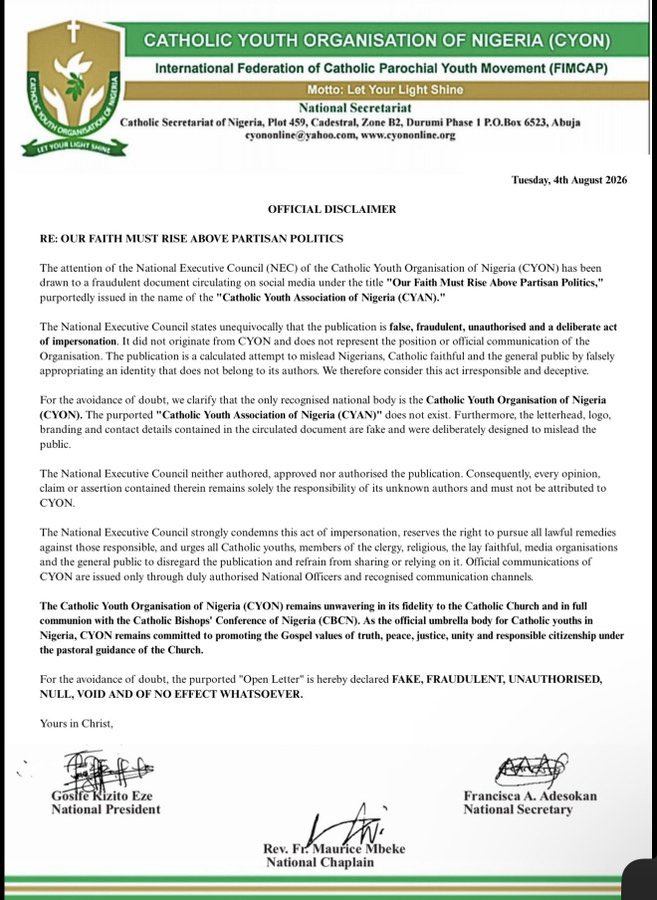
@Iyoaiye_ This is the logo of the CHRISTIAN YOUTH ORGANIZATION OF NIGERIA (CYON). This is obviously a fake letter just like the fake priests brandished by the APC leading up to the 2023 elections so I’m not surprised.
I commend the Catholic Bishops' Conference of Nigeria (CBCN) for demonstrating courage and patriotism by drawing attention to the realities confronting our nation.
Their concerns regarding the rising cost of living, worsening insecurity, declining public confidence, and the hardship faced by millions of Nigerians are neither partisan nor isolated; they reflect the daily experiences of ordinary citizens across every region of our country.
Nigeria is blessed with abundant human and natural resources, yet millions of our people continue to struggle under the weight of economic hardship, unemployment, insecurity, poor access to quality education and healthcare, and diminishing opportunities. These challenges demand urgent, sincere, and people-centred responses from those entrusted with leadership.
I encourage all well-meaning Nigerians to continue constructively engaging the Federal Government and other leaders at all levels whenever the opportunity arises, advocating for good governance, accountability, and policies that prioritise the security, welfare, and prosperity of our people.
It is through such collective commitment and responsible leadership that we can build a more peaceful, united, and prosperous Nigeria.
May Almighty Allah continue to bless the Federal Republic of Nigeria. - RMK
@krazzykay11@iam__temmyyy No, we aren’t. We’ve still got an opportunity to mobilize and do some voter education in our little spaces towards the coming elections.
@krazzykay11@iam__temmyyy I can clearly see a lot of vote buying, voter apathy among other things. We can’t keep doing the same thing and expecting a different result; there is a lot of blame to go around.