I am Human-rights researcher since 1979. My aim is Peace through the UDHR. I define PEACE and ask relevant institutions to do the same. No definition, no peace.
Peace is not a slogan.
Peace is the prevention of disorder and injustice by maintaining Order and Balance among human rights.
Peace without a clear definition is not Peace.
Mr Secretary-General,
Yesterday, you described the absence of permanent African representation on the Security Council as “unjust”. Today, you speak of “climate justice”.
But the question I asked you yesterday remains:
What is justice?
It is often said that weakness in theory leads to weakness in practice. This seems to apply to the United Nations as well. If we do not know what justice is and cannot define it, how can we establish it in practice?
Justice is not a peripheral concept. Justice is the foundation of peace in all three of its dimensions: peace within the human being, peace among human beings, and peace between humanity and the environment.
Therefore, when you speak of “climate justice”, the issue is not merely what actions should be taken on mitigation, adaptation or finance. The more fundamental question is: What does justice mean in the relationship between humanity and nature, and how should it be established?
Repeated calls for action, without a clear understanding of the concept of justice, cannot by themselves establish peace in any of these three dimensions. Effective action requires a theoretical foundation that makes clear what is to be established and why.
My question, therefore, is not merely an abstract philosophical question. It is directly related to the United Nations’ ability to achieve the goals it speaks of:
Mr Secretary-General, what is justice? Do you know?
Mr Secretary-General,
You speak of “reforming” the Security Council and describe the absence of permanent African representation as “unjust”. But perhaps the reform we need must go much deeper.
Reform means restoring something to its proper form. But if we do not know what that proper form is, how can we reform anything?
Adding permanent African representation may correct a specific injustice in representation, but it will not, by itself, make the Security Council just. To establish a just order, we must first know what justice is.
This is where the root of the problem lies. We constantly speak of justice, peace, rights and reform without having a clear and coherent understanding of the concepts we use.
That is why a deeper reform is needed: educational reform. We must educate human beings who are capable of understanding these fundamental concepts, defining them, and putting them into practice.
You say that the present structure of the Security Council is “unjust”.
So my question to you is very simple:
What is justice? Do you know?
Dear Unius,
Our previous agreement was that you would ask one question at a time, but this time you raised several questions at once, intertwined with one another. I have divided them into ten separate but related questions so that I can give a short and clear answer to each.
1. When we speak of “Humanity”, what exactly do we mean?
— In True Philosophy, the human being and Humanity are two separate categories. Each of us is a human being, but we have not yet formed Humanity as a living and harmonious system. By Humanity, I mean a system in which human beings as a whole possess four interconnected characteristics:
Goal-setting → Coherence → Coordination → Cooperation
Slime moulds provide a natural example of such systemic organisation. However, at the level of Humanity, we still lack the necessary shared goal, coherence, coordination and cooperation. Wise Education can guide us towards the formation of such a system.
2. Which comes first: Humanity or human rights? Or do they take shape simultaneously?
— In True Philosophy, human rights come first because individual human beings already exist and possess rights, whereas Humanity has not yet formed as a living and coherent system. For this reason, in our present condition, the word Humanity refers more to something that has yet to be built than to an already realised reality.
An individual human being possesses rights whether or not they are aware of them. Being unaware of a right does not eliminate that right; it merely prevents the individual from recognising and exercising it.
3. Given that human beings are shaped by differences in education, experience, environment and circumstances, is it possible to provide a universal definition of a “human being”?
— Yes. Differences arising from education, experience, culture and environment do not preclude a universal definition of a human being, as all these differences occur within a single species. We are all members of the species Homo sapiens and share a common biological origin. Human populations can interbreed and produce fertile offspring within the same species.
Therefore, what differentiates us from one another are differences in culture, worldview, education and experience, not differences in being human.
4. If such a universal definition is possible, upon what characteristic or characteristics of the human being should human rights be based?
— Human rights must be based on a foundation common to all human beings: Life and the Right to Life. A human being is born with inalienable rights—the very rights referred to in the first paragraph of the Preamble to the Universal Declaration of Human Rights. In True Philosophy, the first and most fundamental right is the Right to Life, and other human rights take shape in order to strengthen, protect and sustain this right.
5. Are human rights independent of time and place, or are they dependent on the social and cultural norms of each era and society?
— The foundation of human rights is independent of time and place, because the Right to Life does not depend on any specific culture or historical era and is common to all human beings—and, on a broader level, to all living beings. Other rights take shape to protect, strengthen and sustain this fundamental right, and as human awareness grows, they can become more precise and extensive. Once Humanity has been formed, we must also extend this perspective beyond human rights and take the rights of animals and plants seriously.
6. Do human rights truly exist, or are they human creations formulated in response to social conditions and problems?
— The Right to Life truly exists and is the most fundamental right. However, many of the rights set out in the Universal Declaration of Human Rights, such as the right to education or the right to healthcare, are human formulations intended to protect, strengthen and sustain the Right to Life. As human knowledge and awareness expand, new rights may also be recognised and added to the list of human rights.
7. If human rights are a response to a flawed system, should we examine and reform the very system that has made such rights necessary?
— The Right to Life does not depend on the existence or absence of a flawed system; this right precedes any social and political system. Other rights also take shape to protect, strengthen and sustain the Right to Life. The difference between systems lies not in creating or eliminating these rights, but in the extent to which those rights can be realised. The healthier a social, political and economic system is, the easier it is for people to enjoy their rights; the more flawed the system is, the more difficult it becomes to realise those rights, to the point where, in a system like Nazism, even survival itself is severely threatened.
8. Ultimately, what role do human rights play: are they tools for restraining and reforming an existing system, or are they principles upon which society and Humanity should be built from the outset?
— The ideal of human rights is peace. In True Philosophy, peace has three dimensions: peace within the human being, peace among human beings, and peace between Humanity and Nature. The second paragraph of Article 26 of the Universal Declaration of Human Rights directs education towards the full development of the human personality and respect for human rights. This direction takes the form of a legal obligation for States parties in Article 13(1) of the ICESCR. Sweden ratified this Covenant in 1971, and the UK in 1976.
Within the framework of True Philosophy, the actual implementation of these obligations requires Educational Reform—a reform that can serve as the driving force for Judicial Reform and Political Reform. In this respect, the Universal Declaration of Human Rights both shows the roadmap and, through Education, provides the means to follow it. For a more detailed discussion, please refer to the Exit Strategy:
https://t.co/BixD9Iw5lk
9. Given the role of religion and ideology in dividing human beings and creating conflict, how should religious freedom be understood?
— A worldview is a response to the need of the Reticular Activating System (RAS), enabling the mind to avoid being overwhelmed by the vast amount of incoming information.
For the RAS to filter the vast volume of incoming information, a human being needs a worldview—that is, a system of norms and beliefs. Religions and ideologies are among the forms that have fulfilled this role throughout history.
In Volume Two, using estimates of around 11 million bits per second for sensory input and about 50 bits per second for conscious processing capacity, I calculated a difference of approximately 220,000-fold. Due to this enormous difference, information must inevitably be prioritised and filtered. The RAS performs this task.
It is the worldview, alongside the individual's talents, that tells the RAS what is important to them. The RAS then highlights the information relevant to these interests and filters out a large proportion of the information that falls outside them. Therefore, the process from worldview to decision-making can be summarised as follows:
Worldview + Talents → Interests → RAS filtering → Selected information → Decision / Reaction
To explain what could replace the multiplicity of religions and ideologies, I would have to delve into other parts of my six-volume work—a subject that cannot be adequately addressed in a short answer.
10. Can a principle such as “religious freedom” be objective and universal if religion itself is considered subjective, cultural, or lacking in shared, verifiable evidence?
— Yes. The universality of religious freedom does not mean that religions or ideologies themselves are universal or correct. What can be Universal is a human being’s freedom to hold, change or abandon a worldview.
As I stated in the ninth answer, the need for a worldview is connected to our mental structure and the way the RAS operates. Religions and ideologies are among the forms that have responded to this need throughout history.
However, from the perspective of True Philosophy, all existing worldviews—whether in the form of religion or ideology—are wrong. One of the clearest signs that they are wrong is the division of human beings into circles of “us” and “them”, pitting human beings against one another.
There can be only one correct worldview: the Wise Worldview. Its goal is Life Maintenance. The Wise Worldview unites all human beings around a shared Ultimate Goal: the continuation of Life and the struggle against Death. In this worldview, no other human being is my enemy; every other human being is my comrade-in-arms in the only real confrontation shared by all human beings: the struggle against Death.
The correctness of the Wise Worldview is discussed in detail in my books, including through the logic of arithmetic: just as an arithmetic problem has one correct answer and countless wrong answers, the problem of Life Maintenance must likewise have one correct worldview, while in its absence countless wrong worldviews can be constructed.
A full explanation of this topic requires engaging with the discussion of Wise Coupling in Volume Three:
Volume Three, Chapter Three, especially pp. 76–79 and p. 88.
At the same time, different worldviews are products of different geographies and form the core of different cultures. This relationship between worldview, geography and culture is itself another important topic that could be the natural continuation of our conversation.
Would you like to focus your next questions on the relationship between worldview, geography and culture so that we can explore this important subject in greater depth?
Changing the law may save billions of pounds, but the more fundamental question is: why are unjust laws enacted in the first place?
If legislators do not know what justice is and do not understand the relationship between law and justice, we cannot expect the problem to be solved at its roots merely by amending a few legal provisions.
In my view, society’s fundamental task is to educate people who, before exercising power, understand rights, justice, law and responsibility. That is why Wise Education — the kind of education called for in Article 26(2) of the Universal Declaration of Human Rights — should form the foundation of political and legal reform.
Until lawmakers possess the moral, legal and wisdom-based competence required for lawmaking, unjust laws will continue to be produced, and piecemeal reforms will treat only the consequences, not the cause.
Mr Secretary-General,
The Sustainable Development Goals, promises, commitments and opportunities are beautiful words.
But the world will not become fairer, safer or more sustainable by repeating beautiful words.
You are astonishingly tireless in producing slogans.
But is it not time for the UN to stop repeating promises and ask itself why it has failed to establish peace, justice and human security?
A promise without definition, education and accountability becomes a slogan.
If governments truly have a shared commitment to building a better world, why has the education demanded in Article 26(2) of the Universal Declaration of Human Rights not been taken seriously?
Without Wise Education, human beings will not learn to accept and respect one another’s rights; and without such education, no Sustainable Development Goal will take root.
Is it not time to admit failure and begin a serious dialogue on the fundamental concepts of the Universal Declaration of Human Rights?
Dear Unius,
Thank you for your recent questions. As you can see, each of them could lead us into an independent and relatively deep discussion. At present, I am working on a legal strategy and cannot answer all of them as thoroughly as your questions deserve. I will endeavour to continue the conversation at the earliest opportunity.
In the meantime, I have a request that is truly important for the continuation of our discussion. If you do not yet have my books, I suggest you acquire them and read them gradually. The reason is not simply that many of your questions are addressed in them; more importantly, to enter into deeper discussions, we need to be able to refer each time to a specific part of my philosophical system.
For example, your question concerning religion and religious freedom cannot be properly examined through a brief answer about religion alone. Before doing so, we first need to understand how a human being selects certain information from a vast amount of input while ignoring other information. In my work, I have used the Reticular Activating System (RAS) to examine this process. The main discussion regarding the role of the RAS as an information filter can be found in Volume Two, pages 158–160.
However, knowing about the RAS itself is not enough. To see how I have connected this mechanism to worldview, interests, justice, and moral and political reaction, you must also refer to Volume Six, pages 136–150. Briefly, the chain presented in my works is as follows:
Worldview → Interests → RAS filtering → Selected information → Decision / Reaction
And in the discussion of justice:
Wise Worldview → Justice becomes part of our interests → RAS detects injustice as a threat to life → Moral / Political reaction
For this reason, when we come to a question such as why human beings come to need religion, ideology, or a worldview, or how religious freedom ought to be understood, I need to refer to different parts of my books. Without this shared background, any brief answer inevitably omits part of the argument and may even alter its meaning and lead to misunderstanding.
If you do not currently have my books, I suggest that, at the very least, you ask an AI about the Reticular Activating System (RAS) and the relationship between the vast amount of information entering the brain and the limited capacity for conscious attention and processing. However, if we are to continue our dialogue in depth, my books will need to remain our primary reference, because the RAS is only one example; with other questions, we will also need to refer to other specific concepts and sections, such as the importance of Goal-setting.
If you are already familiar with the RAS and its role in filtering information, simply let me know. In that case, we need not start from the basics, and we can move directly into its connection with worldview, religion, ideology, justice, and human rights.
For now, I must return to my legal work, but I have not set your questions aside.
Mr Secretary-General,
I fully agree that ratifying and implementing the Kigali Amendment is a concrete and necessary step. But international days, calls for action, and agreements largely tell us what we should do.
The more fundamental question remains: Why do we not do what we know we should do?
Why do human beings continue to damage nature when they know that their own survival depends on it?
Without examining this “why”, we may commemorate another international day each year, issue another warning, and call for another action, while the causes of destructive human behaviour remain untouched.
We do not merely need to know what should be done; we need to understand why what should be done is not being done.
And we must take seriously the educational reform envisaged in the second paragraph of Article 26 of the Universal Declaration of Human Rights: education directed to the full development of the human personality and the strengthening of respect for human rights. If we want human beings to behave more responsibly towards one another and towards nature, we must begin by educating such human beings.
Gott styre innebär att varje medborgare i praktiken kan åtnjuta alla de rättigheter som erkänns i FN:s allmänna förklaring om de mänskliga rättigheterna, däribland rätten till säkerhet.
Mitt problem är inte det ena eller det andra partiet. Problemet är det rådande politiska systemet – realpolitiken – som styr både Sverige och världen och som inte är villigt att reformera sig självt.
När brottslighet och otrygghet ökar i samhället, eller när världen gång på gång drabbas av krig och kriser, räcker det inte att skylla på det ena eller det andra partiet. Det kan bli ett sätt att undvika det strukturella ansvaret – just den ansvarsflykt som är ett av realpolitikens kännetecken.
Samhället utbildar läkare, sjuksköterskor, psykologer och andra specialister för att behandla fysiska och psykiska problem. Men vilka utbildar vi för att behandla samhällets sociala problem?
Människor går in i politiken och får ansvar för att styra samhället utan att ens ha fått en systematisk utbildning i grundläggande begrepp som rättvisa, sambandet mellan rättvisa och lag, mänskliga rättigheter och politiskt ansvar.
Om ni vill veta mer om detta rekommenderar jag att ni läser Exit Strategy:
https://t.co/FHWHIrLO5D
Det stämmer att en röst ger ett parti ett politiskt mandat. Men politisk makt är inte ett mål i sig, utan ett medel. Min fråga är just denna: Vad ges mandatet för? För att fördela makt mellan partier, eller för att skapa gott styre och förverkliga medborgarnas rättigheter?
Förhandlingar är nödvändiga, men de får inte bli ett mål i sig. Den makt som kommer från väljarnas röster måste i slutändan leda till något för människorna själva.
Mr Secretary-General,
Please stop using slogans. I am referring to your statement: “Let’s recommit to ensuring every voice counts.”
For decades, I have argued that without a proper understanding of what peace means, we cannot establish peace. I have also asked you directly, many times: What is peace? Yet you have remained silent in the face of this question.
If you truly believe that “every voice counts,” does my voice not count as one of them?
I am not asking you to agree with me. My question is much simpler:
Why do you remain silent in the face of logical questions?
@idagabrielsson Folk har inte röstat för att makten ska delas lika mellan partierna eller för att ni ska strida om den. De har röstat för gott styre. Lägg själviskheten åt sidan.
Mr Secretary-General,
I fully agree: “Let’s confront threats before they become crises.” But genuine prevention of a crisis begins by preventing the behaviour that creates the crisis.
We cannot prevent crises from spreading merely by preaching, “Let’s confront threats before they become crises.” We need to critically examine and reassess the ideas and behaviours that have brought us to where we are today.
Until we understand — or are willing to understand — the causes of crises, including the environmental crisis, we cannot confront them effectively.
The United Nations also bears responsibility for the emergence of today’s critical situation because, by remaining silent in the face of the fundamental question “What is peace?”, it has failed to understand peace in its three dimensions — peace within the human being, peace among human beings, and peace between humanity and nature — and to act towards establishing it.
Why?
That is precisely the problem: you remain silent in the face of “Why?”
Min röst är inte till för att efter valet skickas runt mellan partier och förvandlas till ett förhandlingsobjekt i kampen om maktandelar. Min röst ger politiker ett mandat att skapa ett gott styre för mig och andra medborgare.
Den viktigaste frågan borde inte vara vilket parti som har hur många mandat, vem som bildar allians med vem eller hur stor del av regeringsinflytandet varje parti får. Den grundläggande frågan är: Vad ska denna makt åstadkomma för människorna?
Om ett valresultat bara leder till förhandlingar om hur makten ska fördelas mellan partierna, då har demokratin stannat halvvägs. Människor har inte bara rätt att välja; de har också rätt att kräva att de valda utövar ett kompetent och ansvarsfullt styre som tjänar medborgarnas rättigheter.
I slutändan bör en regerings framgång inte mätas i hur makten fördelas mellan partierna, utan i vilken utsträckning människor faktiskt kan åtnjuta de rättigheter som erkänns i FN:s allmänna förklaring om de mänskliga rättigheterna.
Mr Secretary-General,
The impartiality and technical excellence of the International Atomic Energy Agency are important, and preventing the proliferation of nuclear weapons is essential. But there is a more fundamental issue:
How do we know that these activities are actually bringing the world closer to peace when we still lack a clear definition of peace?
To reach a goal, we must first know what that goal is. Otherwise, we may carry out a great deal of activity, spend enormous resources, and even achieve technical excellence without knowing whether we are actually moving in the right direction.
In True Philosophy, there is a distinction between Activity and Wise Work. Wise Work is not merely doing something; it is work that changes Reality towards Truth.
https://t.co/VIVn5rXZOG
The United Nations and its affiliated institutions carry out an enormous range of activities. But the issue is not simply the amount of activity, or even technical excellence. Two fundamental questions remain unanswered:
Why, eighty years after the founding of the United Nations, is humanity still so far from establishing peace?
And why does the United Nations not seriously investigate the reasons for its historical failure to establish peace?
To answer these questions, we must first know what peace is, and then determine what kind of work can genuinely change present Reality towards it.
I appreciate your kindness, and I am enjoying our correspondence.
Yes, I agree with you that our views share a great deal of common ground.
This time, I have decided not to answer your questions directly. I simply want to provide a brief explanation of my own work, and then ask that you pose only one question at a time. This will allow me to provide a sufficiently thorough answer and, if I find it necessary, write an independent article and publish it on my website. On X, we are constrained by space.
My ultimate goal is “Life Maintenance”. For me, Life Maintenance is the first link in the following chain:
Life Maintenance → Right Maintenance → Effort for exercising human rights → Fighting against the Real System (Academic Philosophy, Real Judiciary and Real Politics)
This is the framework of my work. My tools are the definitions I have—without insisting that they are flawless— whereas the opposing parties often fail to provide such definitions and remain silent in the face of fundamental questions.
In my view, one of the greatest strategic mistakes of Realpolitik was adopting the Universal Declaration of Human Rights in 1948 and subsequently committing to international instruments such as the ICESCR and the CRC, because those very legal obligations can now be used to challenge Realpolitik’s own practices.
Over the past 47 years, having paid a heavy price through trial and error, I have learnt that I must focus on a chain whose first link is Life Maintenance.
To do so, I am compelled to limit my other interests, including my interest in physics, and engage with them only to the extent necessary for this purpose.
I admit that I think in very practical terms when choosing topics: I evaluate almost everything against the criterion of whether or not it brings me closer to Life Maintenance.
When my friend asked about Wise Work, I took the time to answer him; not solely because I care about him—which I do—but because I saw that this question was important to the chain above.
I have other friends with different interests. For example, one of my friends is captivated by the concept of “time” and tries to draw me into that field almost every time we communicate.
From what I have read on your website, I understand that Hard Determinism and the denial of Free Will are among the central themes of your thought. I think it is very good that people engaged in serious thought choose different fields of inquiry, because serious research in any field can, taken together, contribute to the growth of humanity’s Wisdom.
I wish there were enough of us for more groups to work together in specific fields and publish their findings, so that researchers working in other areas could benefit from them as well.
One of my aspirations is that, through the implementation of paragraph 2 of Article 26 of the Universal Declaration of Human Rights, identifying children with an aptitude for philosophical inquiry could begin at primary-school level.
Until then, however, both my available time and my mind energy (mental energy) are limited, and the work I have done so far also needs to be continually questioned and criticised, both by myself and by others.
For this reason, I kindly ask that you pose only one question at a time, preferably within the field I am working on most directly: the Universal Declaration of Human Rights and the definitions I have developed around its fundamental concepts. This will allow me to give each question my full attention and respond within the area where I can be most useful. Whenever you feel that a question has been sufficiently explored, or when we reach a point where my present knowledge has no further answer to offer, we can consider that question closed and move on to the next.
I look forward to continuing our exchange.
To establish Peace, we must first know what Peace is. Without a clear definition, we cannot identify the goal precisely, and therefore we cannot judge whether our activities are actually bringing us closer to it.
Definition of Peace in True Philosophy:
https://t.co/ZGvC4DMUe0
However, having an isolated definition is not enough. Peace is like a piece of a jigsaw puzzle: it can be viewed on its own, but its full meaning and proper place become clear only when it is seen alongside other fundamental concepts such as Justice, Order, Law, Right and Wisdom.
If these concepts are not connected within a coherent philosophical system, even extensive activity does not necessarily lead to the intended result. In such a situation, people may work very hard without knowing what kind of work actually changes Reality towards Truth.
On the relationship between Reality and Truth:
https://t.co/f804JeS5Cz
In True Philosophy, this distinction is expressed through the concept of Wise Work. Wise Work is not merely activity; it is work that changes Reality towards Truth.
Explanation of this concept:
https://t.co/VIVn5rXZOG
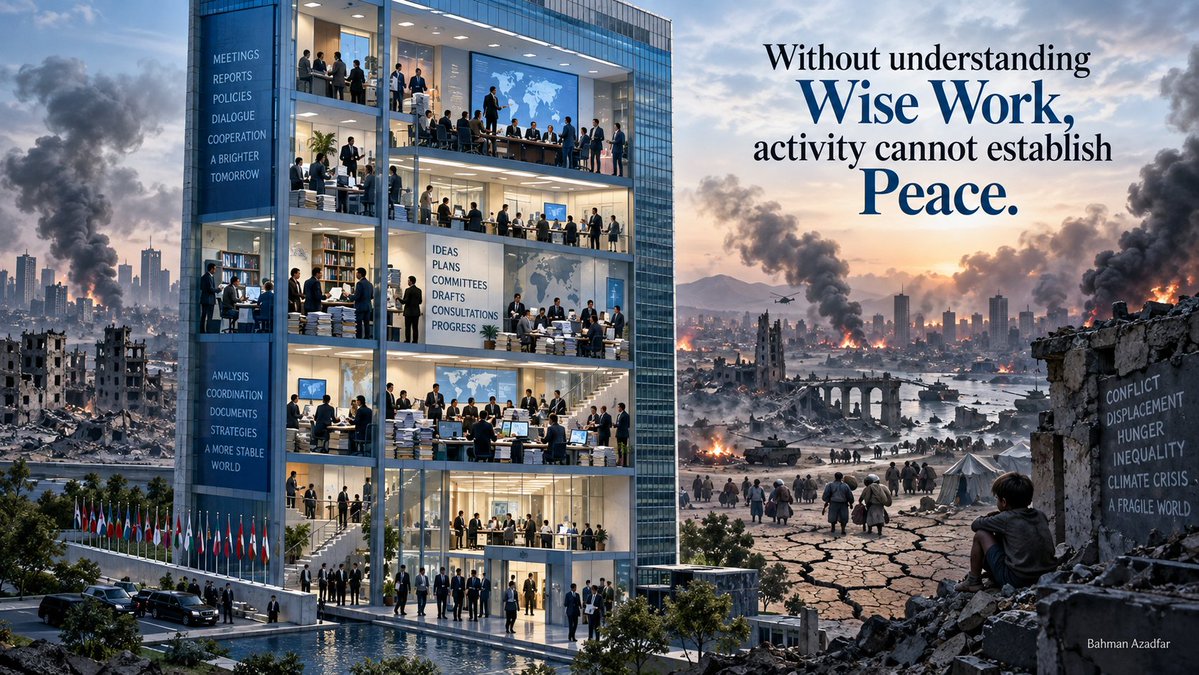
Unfortunately, the United Nations still does not distinguish between activity and Wise Work. It engages in extensive activity, but without understanding the kind of work that changes Reality towards Truth—Wise Work—it cannot establish Peace.
The issue, therefore, is not merely that we need to define Peace; we also need to understand what kind of work is required to achieve it. This is where the distinction between activity and Wise Work becomes essential.
In True Philosophy, Peace also has meaning outside the context of this philosophical system; however, to understand it precisely, it must be studied within the context of True Philosophy itself. Only then does its place in relation to other concepts—and therefore its full meaning within the philosophical system as a whole—become clear. Peace is like a piece of a jigsaw puzzle: it can be viewed on its own, separately from the other pieces, but to understand its place and meaning fully, one must see the complete picture of the jigsaw puzzle.
In True Philosophy, Peace is not merely the absence of war. Just as Health is a positive state of Order and Balance within the body, Peace is a positive state of Order and Balance within Humanity. War can destroy Peace, just as Disease can destroy Health, but neither Peace nor Health is defined merely by the absence of its opposite.
Before I became acquainted with the behaviour of slime moulds, my mind was a collection of scattered thoughts, beliefs and questions. I could see injustice, violations of human rights and violence, but I still did not understand why an intelligent human being could violate the rights of another human being, or even kill them.
My problem was not a lack of information. The problem was that concepts did not yet have a clear place within a coherent system, and many of the terms we used lacked clear definitions.
Years ago, a sentence by Will Durant became very important to me:
“We shall not be saved without wisdom.”
But my question was: What is Wisdom? How can it be understood, and how can it be learnt?
The answer I was looking for did not come from academic philosophy. The turning point for me came when I became acquainted with the behaviour of slime moulds—organisms without brains, yet capable of Goal-setting, Coherence, Coordination and Cooperation.
That is why I called them “my teachers” in one of my writings:
https://t.co/v3Wf5JnZYJ
Research into these organisms from the late twentieth century onwards helped me realise that the fundamental human problem is a defect in two-thirds of our Homeostasis: we can understand Order and Balance within our own bodies, but we are still incapable of maintaining Order and Balance among human beings and between Humanity and Nature.
From then on, I sought to understand concepts not as isolated words, but as components of a system.
To see the whole picture, a few fundamental definitions in my system are as follows:
Life:
“Life is a union of matter and intelligent energy called ‘Right’.”
https://t.co/lCBBGmfVYG
Right:
“Right” is an intelligent energy that causes attraction and interaction between chemical elements and creates Life.
https://t.co/sFleMUekQj
Wisdom:
“Wisdom” is born when a human equipped with science and scientific methods considers Life and Right as subjects for studying, understanding and maintaining, theoretically and practically.
https://t.co/7tFC6MkYlx
Truth:
Any matter that can hold and bolster the Right to Life can be called Truth.
https://t.co/pBPbg0nPV7
To complete this picture, I also recommend two related treatises:
The Odd Relationship of Reality with Truth
https://t.co/f804JeSDs7
Mathematical Translation of “Work” in Wisdom
https://t.co/VIVn5rYxEe
The second treatise was born from a genuine question. A mathematician friend asked me how the defect in two-thirds of our Homeostasis is driving us towards extinction.
My answer was that we understand only part of the concept of “work”. We understand physical work, but we do not understand Work in Wisdom (Wise Work).
For example, the United Nations has undertaken an enormous amount of physical and administrative activity: constructing buildings, employing thousands of people, holding meetings, producing reports and resolutions, and establishing numerous institutions. But activity alone does not establish Peace. In the framework of True Philosophy, Wise Work means changing Reality towards Truth.
This very question led me to write the treatise Mathematical Translation of “Work” in Wisdom so that I could express this distinction in more precise terms.
What matters most to me today is not defending a philosophical position. My question is whether True Philosophy can help us preserve Life, uphold Right, change Reality towards Truth and prevent extinction.
At the same time, another point is very important to me. True Philosophy can answer many questions, but having an answer is not enough. For communication to take place, a transmitter is not enough; there must also be a receiver.
If the human mind has not been cultivated to ask questions, listen, think critically, revise its beliefs and understand the relationships between concepts, even a logical answer may never truly be received.
For this reason, education is not a peripheral issue in True Philosophy. Paragraph 2 of Article 26 of the Universal Declaration of Human Rights calls for education directed to the full development of the human personality and to the strengthening of respect for human rights and fundamental freedoms. This orientation was subsequently carried forward and strengthened through binding commitments.
I call this education Wise Education.
True Philosophy can act as a transmitter, but Wise Education must also develop the receiver. Only then can Question, Answer, Criticism and Revision truly circulate among human beings.
Without such a receiver, an answer may exist, but the message may go unheard.
Relying on a law that was adopted but not implemented is a means of challenging Realpolitik through the very instrument that Realpolitik itself has accepted: law.
This means that Law can be transformed from an instrument of domination by Realpolitik into a means of limiting and challenging it.
By defining the concepts contained in the Universal Declaration of Human Rights and publishing them here:
https://t.co/plQTAR5XCz
True Philosophy provides a path from theoretical Wisdom to practical Wisdom.
In a theoretical debate, an official may remain silent when confronted with the six philosophical terms in the first paragraph of the Declaration—for example, Justice. In a court of law, however, such silence is no longer sufficient.
When I define the Rule of Law, the function of law and the relationship between Justice and Law, and place those definitions before a judge, I have the right to require the opposing party—namely, the political system—to state its own understanding of Law, the function of law and the relationship between Justice and Law.
Mr Secretary-General,
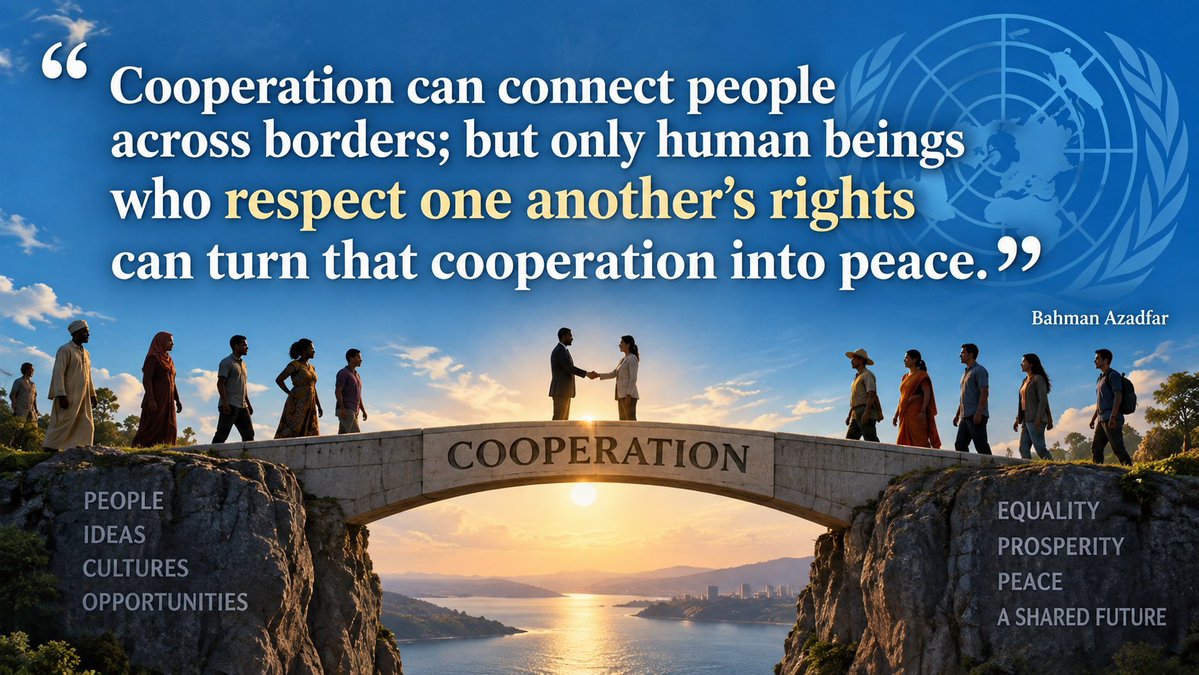
We need to move beyond merely symbolic gestures, such as a “Peace Day” or a “South-South Cooperation Day,” and take serious and profound action to achieve equality, prosperity and peace.
Of course, we are stronger together. But if we truly want to be “stronger together,” we must first ask:
What enables human beings to live together while respecting one another’s rights?
Since 1948, the Universal Declaration of Human Rights has provided part of the answer in Article 26(2): education directed to the full development of the human personality, the strengthening of respect for human rights, and the promotion of understanding and tolerance.
Cooperation can connect people across borders; but only human beings who respect one another’s rights can turn that cooperation into peace.