Formation complète Claude Code 6 HEURES.
La formation Claude la plus complète d'internet.
Gardez-la précieusement en Signet 🔖
de A à Z : configuration, création de workflows, déploiement de sites web, création d'équipes d'agents, automatisation du navigateur, recherche de clients et tarification de vos services.
Le tout sans écrire une seule ligne de code.
À la fin : vous utilisez Claude Code comme un pro et vous monétisez vos compétences.
Débutant ou avancé, tout est là en un seul endroit, ce cours couvre tout.
Ça vaut plus que tous les cours à 500$ que t’as failli acheter.
Tibetan monks sit upright in meditation for days even after clinical death.
And their dead bodies refuse to decay which breaks every rule of medicine.
How?
Thukdam
It completely breaks the medical model of death.
Tibetan monks enter this meditative state during the dying process. Their bodies remain fresh, upright, warm to the touch. No rigor mortis. No decomposition. No putrid smell. For up to 17 days after every cardiac monitor, EEG, and respiratory sensor confirms they are clinically dead.
Western medicine defines death as the irreversible cessation of brain and cardiovascular function. The moment electrical activity in the brain stops, consciousness is gone. The body begins immediate decay. Cells start breaking down within minutes. The temperature drops. Muscles stiffen.
Thukdam monks violate every part of that sequence.
Richard Davidson at the University of Wisconsin has been documenting these cases for over a decade. Brain scans of Thukdam practitioners show organized neural activity continuing long after clinical death. Organized. Coordinated. Purposeful electrical patterns that correlate with deep meditative states.
The implications shatter how we understand the relationship between mind and brain.
If consciousness can persist and even direct bodily processes after clinical death, the brain cannot be the generator of consciousness. At minimum, consciousness operates through biological systems in ways that transcend current neurological models. At maximum, consciousness exists independently of the brain and uses the nervous system as an interface, a control panel, rather than its source.
This connects to something neuroscientists have been quietly discovering for years: the hard problem of consciousness remains completely unsolved. We can map every neuron, track every chemical signal, stimulate every brain region with electromagnetic pulses. We still cannot explain how subjective experience arises from neural activity. Why there is an inner observer behind your eyes reading these words. Why you experience the color red as "redness" rather than just processing wavelengths of light.
Thukdam suggests the hard problem is unsolvable because we have the relationship backwards.
Instead of brain creating consciousness, consciousness might be using brain as a temporary biological vehicle.
Death removes the vehicle but the consciousness that was operating it continues in a transition state.
The monks who achieve Thukdam spend decades training their awareness through specific meditative practices. Shamatha, vipassana, and particularly the Tibetan practice of death meditation where practitioners repeatedly simulate the dying process to maintain conscious control as biological functions shut down. They are training to remain aware during the transition most humans experience as unconscious dissolution.
What makes this especially disturbing for materialist neuroscience is that Thukdam practitioners can be predicted. Teachers who spend 40+ years in intensive meditation often enter this state. Novices almost never do. This suggests conscious control over the death process is a learnable skill that develops with practice. The same way you can train your body to run marathons or perform complex physical skills, you can apparently train your consciousness to maintain coherence after biological death.
The preservation of the physical body during Thukdam implies consciousness was actively maintaining cellular integrity before death and continues to influence biological processes afterward. Decay is an active process involving bacterial growth, chemical breakdown, and loss of cellular organization. Something is preventing that cascade from beginning. Something operating outside normal biological control systems.
Traditional Tibetan Buddhism describes Thukdam as the consciousness slowly withdrawing from the body in stages rather than departing instantly at clinical death. The practitioner remains in meditation within the corpse, gradually releasing attachment to the physical form. This matches what researchers observe: bodies that look alive but show no vital signs, maintained in meditative postures for days.
Modern medicine treats death as a binary switch. Alive, then dead. Thukdam reveals death as a gradual process that consciousness can navigate deliberately. This opens therapeutic possibilities for end of life care that Western palliative medicine never considers. If consciousness persists during clinical death, dying patients might benefit from meditative guidance rather than just pain management.
The deeper implications reach into fundamental questions about the nature of reality itself. If individual consciousness can persist independently of biological function, the materialist assumption that mind emerges from brain becomes untenable. Something non physical is operating through physical systems and can continue operating after those systems shut down.
Thukdam forces us to consider that consciousness might be the fundamental substrate of reality, not an emergent property of complex matter arrangements. That every living being is consciousness temporarily expressing through biological form. That death is return to original nature rather than extinction of individual existence.
Most people encounter this possibility as religious speculation or metaphysical wishful thinking. Thukdam provides measurable, documented evidence that challenges every assumption about consciousness, death, and the relationship between mind and matter.
The monks sitting in meditation after clinical death are quietly conducting the most important consciousness research on Earth.
You’ve seen the meme of the guy eating soup in pouring rain. It’s a joke about acceptance. The joke is real. Scientists at Harvard and MIT proved it on a brain scan in 2017. A Roman philosopher who started life as a slave figured it out in 125 AD.
In the study, 21 women with severe anxiety went into a brain scanner. Researchers read out their personal worries and gave three different instructions: keep worrying, push it away, or just accept it. Worrying lit up the brain’s panic button, the same area that flashes when a snake crosses your path. Acceptance was the surprise. The panic button quieted. A different region took over, the part that handles tough choices, with a much stronger line of communication to the alarm system. The brain stopped wrestling with itself.
A Roman philosopher named Epictetus, who started life as a slave, opens his handbook around 125 AD with the same point. Some things are up to you, he writes. Most are not. Your judgments belong on the first list. Your body, your reputation, the weather, what other people do, all go on the second. Mix the two up and you suffer. Sort them out and almost nothing can hurt you.
Not accepting has real costs. When you can’t stop replaying a worry, a specific brain region fires harder than it should. A study combining 14 brain scans of 286 people found this pattern is one of the most reliable markers of depression. The body pays too. A 2026 study tracked more than 205,000 UK adults and found those with the most long-term stress damage were over twice as likely to develop heart disease. Stress hormones also chew away at the part of your brain you need to manage stress in the first place.
In 1967, Martin Seligman and Steven Maier shocked dogs that couldn’t escape. Later, in a box where escape was easy, the dogs didn’t try. The textbook called this “learned helplessness.” In 2016, Seligman and Maier published a paper saying they’d had it backward. Giving up is the default, hardwired by an old deep brain region. What animals learn, when they learn anything, is the opposite. They learn that what they do can change things. Helplessness is the starting state. Agency is the achievement.
Now look at the guy with the soup. He’s seen the rain, worked out he can’t argue with it, and decided to keep eating. This is the scarce skill.
Acceptance and Commitment Therapy, developed by Steven Hayes in the 1980s, has been tested in more than 325 randomized clinical trials. It teaches people to act on what they can change and stop wrestling with what they can’t. The American Psychological Association lists it as a well-supported treatment for chronic pain.
Two thousand years apart, a Roman handbook and a Boston brain scanner are finding the same answer. The rain keeps doing what rain does. You keep eating.
In 1984, Jiddu Krishnamurti explained how to end every form of fear known to humankind.
No psychologist or philosopher ever came close to him.
His frameworks:
• Thought creates fear
• Time sustains fear
• Escape strengthens fear
13 lessons on ending fear completely:
"Outils qu'Internet ne veut pas que vous trouviez 🔍
1. Shodan
Un moteur de recherche pour les appareils connectés à Internet. Vous pouvez trouver des caméras, des serveurs et des routeurs exposés en ligne.
2. Archive. ph
Enregistre un instantané permanent de n'importe quelle page web. Utile quand les articles passent derrière des paywalls.
3. Similarsites
Entrez n'importe quel site web et trouvez instantanément des dizaines de similaires. Idéal pour découvrir des alternatives.
4. Mailtrack
Vous montre quand quelqu'un ouvre votre e-mail. Vous voyez l'heure exacte à laquelle il a été lu.
5. Hunter. io
Tapez le nom d'une entreprise et il trouve les adresses e-mail des employés liées à ce domaine.
6. Photopea
Un Photoshop gratuit qui fonctionne entièrement dans votre navigateur. Aucun téléchargement nécessaire.
7. 12ft .io
Supprime les paywalls de la plupart des articles de presse. Il suffit de coller le lien et de lire gratuitement.
8. Carbon
Transforme votre code en images partageables magnifiques. Populaire parmi les développeurs.
9. Explainshell
Collez n'importe quelle commande Linux et elle explique exactement ce que fait chaque partie.
10. Tineye
Recherche inversée d'images qui montre où une photo est apparue sur Internet.
11. Namecheckr
Vérifie si un nom d'utilisateur est disponible sur toutes les plateformes de médias sociaux en une seule fois.
12. Untools
Une collection de cadres de pensée et de modèles mentaux pour vous aider à prendre de meilleures décisions.
13. BuiltWith
Montre les technologies, outils et logiciels exacts avec lesquels n'importe quel site web est construit.
14. GeoGuessr
Vous dépose n'importe où dans le monde sur Google Street View. Vous devinez l'emplacement.
15. Virustotal
Téléchargez n'importe quel fichier ou collez n'importe quel lien et il le scanne avec plus de 70 moteurs antivirus instantanément".
Every time you accepted a salary, chose a price, or walked into a negotiation, the other person was running game theory in their head.
You were guessing.
This 1-hour Yale lecture by Professor Ben Polak will change how you read people and make decisions forever.
MBAs pay $150K to learn this. Yale posted it on YouTube for free.
Save this post. Watch it this tonight.
Follow @codewithimanshu for more high-signal content that actually changes the trajectory of your career.
↓
Here's why most people lose every negotiation they enter.
You walked into your last salary discussion hoping for the best.
They walked in with frameworks. Payoff matrices. Dominant strategies. Backward induction. Nash equilibrium.
You said "I was thinking $85K." They already knew the number you'd accept. Because they ran the game before you sat down.
That's not a skill gap. That's a universe gap.
And it's costing you $20K, $50K, $100K every single year.
↓
Game theory isn't math for MBAs.
It's the operating system of every human interaction.
Job negotiations. Pricing decisions. Business deals. Relationships.
The person who understands it wins by default. Not because they're smarter. Because they're playing a different game.
You're playing checkers thinking it's chess. They're playing chess thinking it's 4D chess.
Professor Ben Polak teaches Yale's most famous game theory course. Students pay $80,000/year for access to him. His full lecture is now on YouTube. Free.
↓
What 1 hour with Polak teaches you.
How to predict what the other side will do before they do it. When to hold your position and when to fold. Why "winning" a negotiation sometimes costs more than losing. How to structure offers the other side can't refuse. The exact math behind every pricing decision in your life.
This is what investment bankers use. What hedge fund managers use. What startup founders use to raise money. What CEOs use to run companies.
You can have it for free. In 1 hour. Tonight.
Or keep walking into negotiations unarmed.
↓
1 hour of Netflix tonight: you forget by Tuesday. 1 hour of Polak tonight: you negotiate differently for the next 40 years.
Same time. One is a distraction. The other is a compounding asset.
Save this post. Watch the lecture.
Follow @codewithimanshu for more high-signal content that actually changes the trajectory of your career.
Someone just built a Claude Code for electronics.
It's called Blueprint. Type what you want to build and it generates wiring diagrams, bills of materials, and step-by-step assembly guides for your Arduino or Raspberry Pi project.
100% Free.
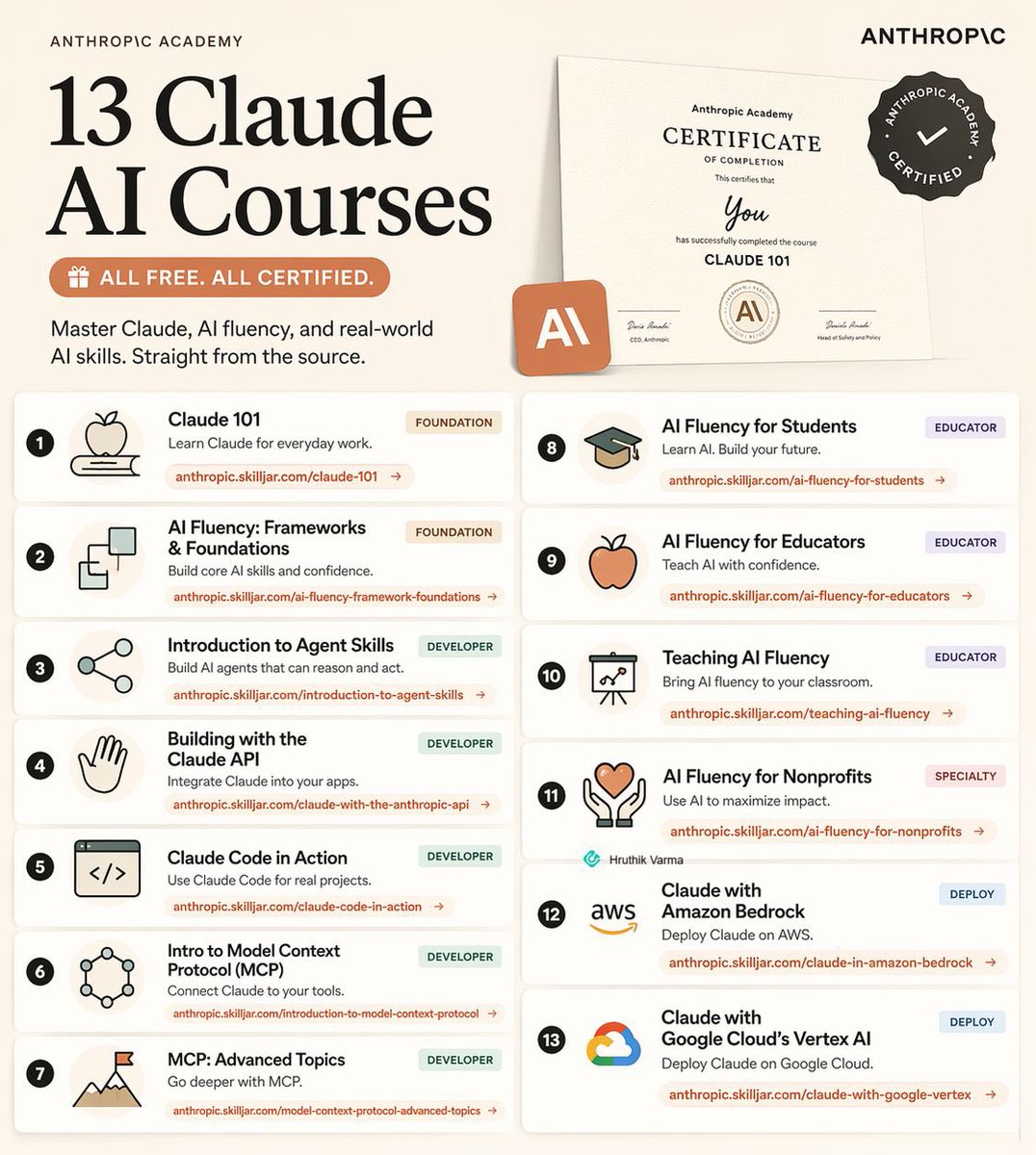
Claude just dropped 13 FREE AI courses (with certificates).
No $500 course needed.
No “guru” required.
Just real skills — straight from Anthropic.
Here’s the full list:
👇
1. Claude 101
https://t.co/lZpcdJ8BuX
2. AI Fluency: Frameworks & Foundations
https://t.co/USAV0Nq5U4
3. Introduction to Agent Skills
https://t.co/CwjLvjOnUi
4. Building with the Claude API
https://t.co/oquWGU6n0U
5. Claude Code in Action
https://t.co/r2r1GMiBaM
6. Introduction to Model Context Protocol
https://t.co/H74a7UKZoe
7. MCP: Advanced Topics
https://t.co/FGzNDboBUz
8. AI Fluency for Students
https://t.co/PKcYBT0hsx
9. AI Fluency for Educators
https://t.co/FwmI4bJ8sO
10. Teaching AI Fluency
https://t.co/IFGt8EQcvP
11. AI Fluency for Nonprofits
https://t.co/pZayqeTEdC
12. Claude with Amazon Bedrock
https://t.co/I9fpriI24s
13. Claude with Google Vertex AI
https://t.co/Kvz4uJqctq
��
If you go through even HALF of these…
You’ll be ahead of 95% of people using AI.
Most people won’t.
Because they’re still:
�� Watching random YouTube videos
• Buying overpriced courses
• “Learning AI” without actually building
Don’t be that person.
Do this instead:
1. Save this post (you’ll come back to it)
2. Pick 1 course → start today
3. Share it with someone who needs this
Free. Practical. No excuses.
“ADHD is not a disorder of not knowing what to do. It’s a disorder of not doing what you already know.”
Dr. Russell Barkley just delivered one of the clearest explanations of ADHD I’ve ever heard.
He says the brain can be split in two: the back part acquires knowledge, the front part (the executive system) uses it. ADHD acts like a meat cleaver that severs the two.
You already have the skills and information other people your age have. You just can’t apply them when it counts.
That’s why life becomes an endless series of last-minute crises. You’re time-blind — you can only deal with what’s right in front of you. The further away a goal or deadline is, the less real it feels.
The solution isn’t teaching more skills. It’s changing the environment at the exact point where the problem occurs — the “point of performance.”
It’s a game-changing way to understand why traditional approaches often fail.
🚨do you understand what two Anthropic engineers just explained in 16 minutes.
Barry and Mahesh built Claude Skills from scratch.
here's the part nobody is talking about:
> Skills are just folders.
> folders that teach Claude your job.
> your workflow. your expertise. your domain.
Claude on day 30 is a completely different tool than day one.
watch this before you write another prompt.
before you build another agent.
before you touch another tool.
16 minutes. bookmark it. watch it today.
and if you want to learn everything about Claude from scratch the full 4 hour guide is waiting below.
🚨In 1990s, Stanford researcher Dr. Robert Sapolsky discovered something that should have broken the internet by now.
He was studying dopamine pathways in primates and found that the brain doesn't just adapt to repeated stimulation. It actively fights back.
When you flood dopamine receptors consistently, the brain deploys what neuroscientists call "opponent processes." For every artificial high you create, your nervous system generates an equal and opposite neurochemical low. Not eventually. Immediately. The system is designed to maintain balance, so it starts producing compounds that directly counteract dopamine while you're still experiencing the dopamine hit.
This means every notification, every scroll, every digital reward doesn't just give you a high followed by a return to baseline. It gives you a high followed by a crash below baseline. You end up in neurochemical debt.
Tech companies never publicized this research. They probably never read it. They were too busy discovering that variable ratio reinforcement schedules could keep users engaged for hours. They built addictive systems by accident, then refined them into addiction machines once they realized what they'd stumbled onto.
Your phone delivers an average of 80 dopamine hits per day. Your ancestors got maybe 5. Each hit triggers opponent processes that create a corresponding low. By the end of a typical day of normal phone usage, your baseline dopamine is running in negative territory. You feel flat, restless, vaguely unsatisfied, and hungry for stimulation because your brain chemistry is literally below zero.
You think you're bored. You're chemically depressed by artificial highs.
The opponent process theory explains why nothing feels interesting anymore. Your brain isn't broken. It's precisely calibrated to maintain neurochemical balance, and you keep throwing that balance off with artificial intensity. Every Instagram hit requires an equal Instagram crash. Every TikTok high gets paid for with a TikTok low. Every notification rush gets balanced with notification emptiness.
Your reward system is running a neurochemical deficit that grows larger every day.
Sapolsky's research revealed something even more disturbing: opponent processes don't just create temporary lows. They become permanent changes to your baseline dopamine production. Chronic overstimulation doesn't just make you tolerant to digital rewards. It makes you insensitive to natural rewards.
The sunset that would have captivated your great-grandfather becomes invisible to you not because sunsets got worse, but because your dopamine system needs intensity levels that sunsets can't provide. A good conversation becomes boring not because conversations got less interesting, but because your brain requires the rapid-fire stimulation of social media to register engagement.
You've accidentally trained your reward system to ignore everything that isn't artificially amplified.
This connects to research from Dr. Anna Lembke at Stanford, who found that people who undergo complete digital fasting for just 30 days show measurable increases in dopamine receptor density. Their brains literally regrow sensitivity to natural rewards. Food tastes better. Music sounds more complex. Social interactions become genuinely engaging again.
But there's a catch that nobody talks about: the first two weeks of dopamine detox feel like clinical depression. Your brain has been chemically dependent on artificial stimulation for years. Removing that stimulation creates actual withdrawal symptoms. Restlessness, anxiety, inability to focus, emotional flatness, and desperate cravings for digital input.
Most people interpret these symptoms as evidence that they need their phones. Actually, they're evidence that they've been neurochemically dependent on their phones without realizing it.
The withdrawal period isn't a bug. It's proof the reset is working.
What happens after week three is remarkable. Colors become more vivid. Conversations become genuinely absorbing. Simple pleasures like hot coffee or cool air become satisfying in ways you forgot were possible. Your brain rediscovers that reality contains enough complexity and beauty to hold your attention without artificial amplification.
You don't need more interesting content. You need more sensitive reward systems.
The solution isn't better apps or more engaging entertainment. The solution is restoring your brain's factory settings for what constitutes a worthwhile experience.
Sapolsky's opponent process research suggests this can happen faster than anyone expected. Every day you don't artificially spike your dopamine, your baseline moves a little higher. Every natural reward you pay attention to rebuilds receptor density. Every moment of boredom you endure without reaching for stimulation strengthens your capacity for sustained focus.
Ancient humans lived in a world that provided exactly the right amount of stimulation to keep their reward systems healthy. Enough challenge to stay engaged, enough calm to stay balanced, enough novelty to stay curious, enough routine to stay stable.
We built a world that provides 10 times too much stimulation and wonder why nothing feels rewarding anymore.
Your brain is not the problem. Your environment is the problem.
Change the environment, and the brain heals itself automatically.
There's a physicist at Stanford named Safi Bahcall who modeled this exact principle and the math is wild.
He calls it "phase transitions in human networks." When you're stationary, your probability of a lucky event is limited to your existing surface area: the people you already know, the places you already go, the ideas you've already been exposed to. Your opportunity window is fixed.
When you move, your collision rate with new nodes in a network increases nonlinearly. Double your movement (new conversations, new cities, new projects) and your probability of a serendipitous encounter doesn't double. It roughly quadruples. Because each new node connects you to their entire network, not just to them.
Richard Wiseman ran a 10-year study at the University of Hertfordshire tracking self-described "lucky" and "unlucky" people. The single biggest differentiator wasn't IQ, education, or family money. Lucky people scored significantly higher on one trait: openness to experience. They talked to strangers more, varied their routines more, and said yes to invitations at nearly twice the rate.
The "unlucky" group followed the same routes, ate at the same restaurants, and talked to the same 5 people. Their networks were closed loops. No new inputs, no new collisions.
Luck isn't random. Luck is surface area. And surface area is a function of movement.
The lobster emoji is doing more work than most people realize. Lobsters grow by shedding their shell when it gets too tight. The growth requires a period of total vulnerability. No protection, no armor, soft body exposed to the ocean.
That's the cost of movement nobody posts about. You have to be uncomfortable first. The new shell only hardens after you've already moved.
🚨💥🚨Relier deux métaux repousse tous les insectes : le secret de la « pile terrestre » !
❗Deux métaux. De la terre humide. Un fil électrique. Sans produits chimiques, sans piles, sans abonnement. Ce que vous allez découvrir a été documenté par un physicien français en 1749, mis au point par un horloger écossais en 1841, utilisé dans les fermes européennes dans les années 1920 et validé par des études scientifiques en 2020.
La pile terrestre existe bel et bien. Son fonctionnement électrochimique est avéré. Son effet sur les larves de moustiques dans l’eau est publié dans PLOS ONE. Et le système complet coûte moins de cinq dollars dans n’importe quelle quincaillerie et est inépuisable.
Dans cette vidéo, nous retraçons toute l’histoire de la pile terrestre : du laboratoire parisien de l’abbé Nollet au brevet d’Alexander Bain en 1841, des 150 000 dispositifs vendus à travers l’Europe par Justin Christofleau jusqu’à l’arrivée du DDT qui a tout anéanti. Nous décortiquons précisément ce que les études scientifiques validées par les pairs confirment et ce qui fait encore débat. Et nous vous montrons étape par étape comment le construire pour votre emplacement de camping dès ce soir.