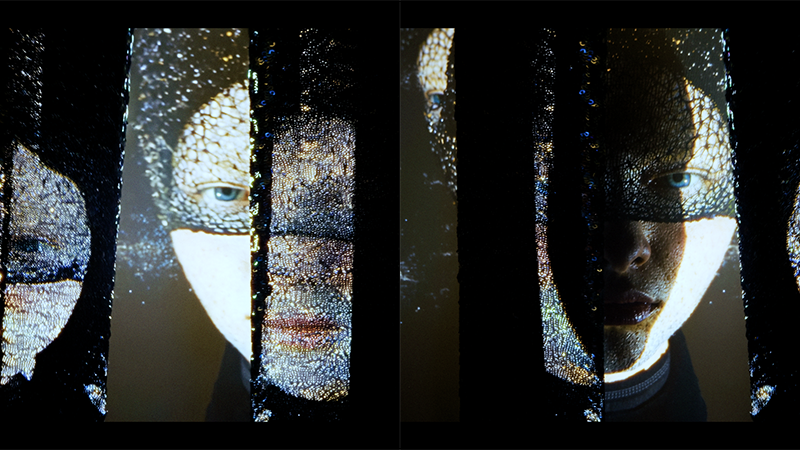
In Chongqing Guanyinqiao Business District you can see "Ocean 88" on the 3788 "Light of Asia" landmark giant screen ( 3788 square meters ).
When the ocean suddenly unfolds before you, its vastness serves as a poignant reminder of our place within a grander scheme. #Chongqing
Live Recording of Ocean88. The work unfolds a vast ocean whose waves reveal a mechanical understructure — metallic filaments emerging beneath natural immensity. In collaboration with DIGMEGA DONGFANG CHUXIAO MEDIA GROUP a naked eye 3D seascape unfolding in the heart of Chongqing.
THE ULTIMATE GUIDE TO OPENCLAW (1hr free masterclass)
1. fix memory so it compounds
add MEMORY.md + daily logs. instruct it to promote important learnings into MEMORY.md because this is what makes it improve over time
2. set up personalization early
identity.md, user.md, soul.md. write these properly or everything feels generic. this is what makes it sound like you and understand your world
3. structure your workspace properly
most setups break because the foundation is messy. folders, files, and roles need to be clean or everything downstream degrades
4. create a troubleshooting baseline
make a separate claude/chatgpt project just for openclaw. download the openclaw docs (context7) and load them in. when things break, it checks docs instead of guessing
this alone fixes most issues!!
5. configure models and fallbacks
set primary model to GPT 5.4 and add fallbacks across providers. this is what keeps tasks running instead of failing mid-way
6. turn repeat work into skills
install summarize skill early. anything you do 2–3 times → turn into a skill. this is how it starts executing real workflows
7. connect tools with clear rules
add browser + search (brave api). use managed browser for automation. use chrome relay only when login is neededthis avoids flaky behavior
8. use heartbeat to keep it alive
add rules to check memory + cron healthif jobs are stale, force-run themthis prevents silent failures
9. use cron to schedule real work
set daily and weekly tasksreports, follow-ups, content workflowsthis is where it starts acting without you
10. lock down security properly
move secrets to a separate env file outside workspace. set strict permissions (folder 700, file 600). use allowlists for telegram access. don’t expose your gateway publicly
11. understand what openclaw actually is
it’s a system that remembers, acts, and improves. basically, closer to an employee than a tool
this ep of @startupideaspod is now out w/ @moritzkremb
it's literally a full 1hr free course to take you from from “i installed openclaw”to “this thing is actually working for me”
most people are one step away from openclaw working
they installed it, they tried it and it didn’t click
this ep will make it click
all free, no advertisers, i just want to see you build your ideas with ideas with this ultimate guide to openclaw
watch
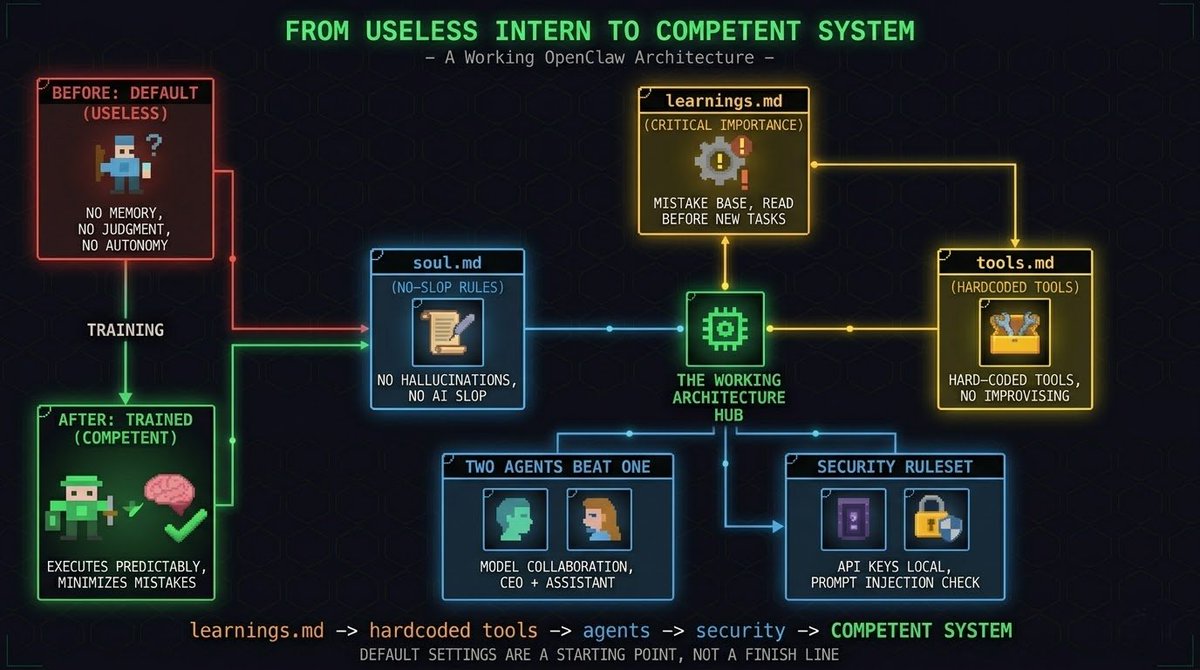
Default OpenClaw is useless. Here's the architecture that actually works.
> Out of the box its a dirty stupid clanker. No memory, no judgment, no autonomy. You have to train it like an intern on day one. Here's exactly how.
soul.md - kill the AI slop first.
Open the file. Add two hard rules.
> No hallucinations. The agent must verify and confirm every action.
No ChatGPT phrases. Generate this file using Claude in the web interface based on your specific requirements. The default tone is unusable.
learnings.md - the most important file you're not using.
Every time the agent breaks something, run one command: "Add this mistake to learnings".
> Add one rule to agents.md. before any new task, read learnings.md first. After a week the agent starts writing: "I made this mistake before - I'll solve it differently this time".
This is how it stops being an intern and starts being competent.
heartbeat.md vs cron - dont mix them.
Heartbeat - lightweight checks every 30-60 minutes. Read email, check status, nothing heavy.
Crons - complex chains in separate files. Generate audio, overlay on image, publish to YouTube every 3 days. Keep this out of heartbeat or everything slows down.
tools.md - remove all choices.
We use Todoist for tasks, Notion for docs, Netlify for deploys. Hard-coded. The agent stops improvising with random tools and starts executing predictably.
Two agents beat one.
CEO on Opus 4.6 - sole push rights to main branch on GitHub.
Assistant on Kimi 2.5 - research only, pushes to side branches.
When two different models talk to each other, output quality multiplies. Opus supports up to 8 sub-agents for parallel work.
Security - two non-negotiable rules.
API keys stay in .env files locally. Never transmitted over the network.
Before clicking any link or updating any code - agent reads for prompt injections and asks for your confirmation.
Default settings are a starting point, not a finish line.
Bookmark this. A few hours to set up. Compounds for years.
🚨 BREAKING: Researchers at UW Allen School and Stanford just ran the largest study ever on AI creative diversity.
70+ AI models were given the same open-ended questions. They all gave the same answers.
They asked over 70 different LLMs the exact same open-ended questions.
"Write a poem about time." "Suggest startup ideas." "Give me life advice."
Questions where there is no single right answer. Questions where 10 different humans would give you 10 completely different responses.
Instead, 70+ models from every major AI company converged on almost identical outputs. Different architectures. Different training data. Different companies. Same ideas. Same structures. Same metaphors.
They named this phenomenon the "Artificial Hivemind." And the paper won the NeurIPS 2025 Best Paper Award, which is the highest recognition in AI research, handed to a small number of papers out of thousands of submissions.
This is not a blog post or a hot take. This is award-winning, peer-reviewed science confirming something massive is broken.
The team built a dataset called Infinity-Chat with 26,000 real-world, open-ended queries and over 31,000 human preference annotations. Not toy benchmarks. Not math problems.
Real questions people actually ask chatbots every single day, organized into 6 categories and 17 subcategories covering creative writing, brainstorming, speculative scenarios, and more.
They ran all of these across 70+ open and closed-source models and measured the diversity of what came back. Two findings hit hard.
First, intra-model repetition. Ask the same model the same open-ended question five times and you get almost the same answer five times.
The "creativity" you think you're getting is the same output wearing a slightly different outfit. You ask ChatGPT, Claude, or Gemini to write you a poem about time and you keep getting the same river metaphor, the same hourglass imagery, the same reflection on mortality.
Over and over. The model isn't thinking. It's defaulting to whatever scored highest during alignment training.
Second, and this is the one that should really alarm you, inter-model homogeneity. Ask GPT, Claude, Gemini, DeepSeek, Qwen, Llama, and dozens of other models the same creative question, and they all converge on strikingly similar responses.
These are models built by completely different companies with different architectures and different training pipelines.
They should be producing wildly different outputs. They're not. 70+ models all thinking inside the same invisible box, producing the same safe, consensus-approved content that blends together into one indistinguishable voice.
So why is this happening? The researchers point directly at RLHF and current alignment techniques. The process we use to make AI "helpful and harmless" is also making it generic and boring.
When every model gets trained to optimize for human preference scores, and those preference datasets converge on a narrow definition of what "good" looks like, every model learns to produce the same safe, agreeable output. The weird answers get penalized.
The original takes get shaved off. The genuinely creative responses get killed during training because they didn't match what the average annotator rated highly. And it gets even worse.
The study found that reward models and LLM-as-judge systems are actively miscalibrated when evaluating diverse outputs. When a response is genuinely different from the mainstream but still high quality, these automated systems rate it LOWER. The very tools we built to evaluate AI quality are punishing originality and rewarding sameness.
Think about what this means if you use AI for brainstorming, content creation, business strategy, or literally any task where you need multiple perspectives. You're getting the illusion of diversity, not the real thing.
You ask for 10 startup ideas and you get 10 variations of the same 3 ideas the model learned were "safe" during training. You ask for creative writing and you get the same therapeutic, perfectly balanced, utterly forgettable tone that every other model gives.
The researchers flagged direct implications for AI in science, medicine, education, and decision support, all domains where diverse reasoning is not a nice-to-have but a requirement.
Correlated errors across models means if one AI gets something wrong, they might ALL get it wrong the same way. Shared blind spots at massive scale.
And the long-term risk is even scarier. If billions of people interact with AI systems that all think identically, and those interactions shape how people write, brainstorm, and make decisions every day, we risk a slow, invisible homogenization of human thought itself. Not because AI replaced creativity.
Because it quietly narrowed what we were exposed to until we all started thinking the same way too.
Here's what you can actually do about it right now:
→ Stop accepting first-draft AI output as creative or diverse. If you need 10 ideas, generate 30 and throw away the obvious ones
→ Use temperature and sampling parameters aggressively to push models out of their comfort zone
→ Cross-reference multiple models AND multiple prompting strategies, because same model with different prompts often beats different models with the same prompt
→ Add constraints that force novelty like "give me ideas that a traditional investor would hate" instead of "give me creative ideas"
→ Use structured prompting techniques like Verbalized Sampling to force the model to explore low-probability outputs instead of defaulting to consensus
→ Layer your own taste and judgment on top of everything AI gives you. The model gets you raw material. Your weirdness and experience make it original
This paper puts hard data behind something a lot of us have been feeling for a while. AI is getting more capable and more homogeneous at the same time.
The models are smarter, but they're all smart in the exact same way. The Artificial Hivemind is not a bug in one model. It's a systemic feature of how the entire industry builds, aligns, and evaluates language models right now.
The fix requires rethinking alignment itself, moving toward what the researchers call "pluralistic alignment" where models get rewarded for producing diverse distributions of valid answers instead of collapsing to a single consensus mode.
Until that happens, your best defense is awareness and better prompting.
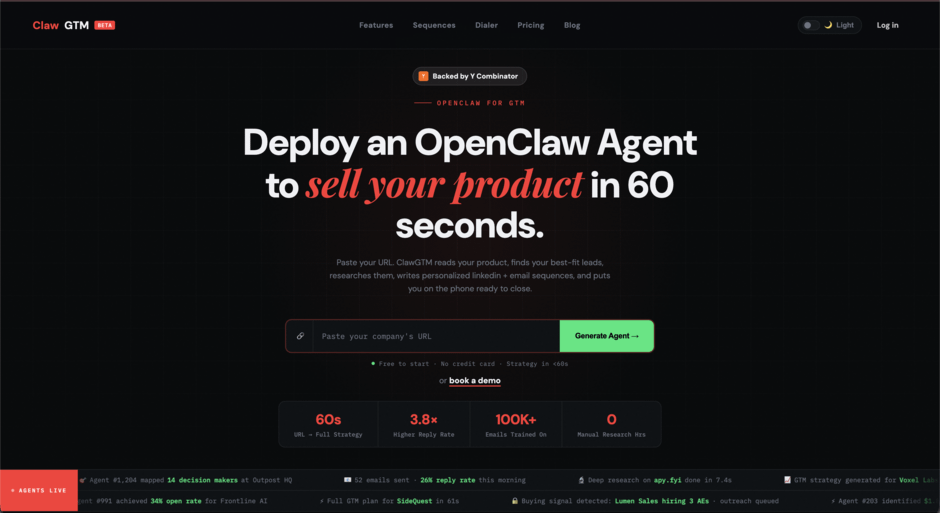
🚨 BREAKING: Someone just turned OpenClaw into an autonomous sales agent
It's called Claw GTM.
Paste your website and it builds your outbound pipeline automatically.
I tried it this morning.
From one URL, it:
→ mapped my ideal customer profile
→ found 47 companies with buying signals
→ researched each account automatically
→ generated personalized email + LinkedIn outreach
No prospecting. No spreadsheets. No generic outreach.
Here's why this is interesting:
→ most outbound tools rely on static lead lists
→ Claw scans millions of job posts for buying signals
→ it surfaces companies actively hiring for the problem you solve
Meaning you're reaching companies already investing in your category.
Here's the wildest part:
It starts with just your website URL.
Claw reads your product, pricing, and positioning and builds your entire GTM strategy automatically.
Paste URL → get your first outbound pipeline in about a minute.
Link in the comments
BREAKING: AI can now analyze any stock like a Wall Street analyst (for free).
Here are 10 insane Grok prompts that replace $5,000/month Bloomberg terminals:(Save for later)
🚨 BREAKING: Claude now lets you build, host, and share interactive apps, all inside the chat.
No code. No subscription. Just your idea.
Here is how it works 👇
I collected every Claude prompt that went viral on Reddit, X, and research communities.
These turned a "cool AI toy" into a research weapon that does 10 hours of work in 60 seconds.
13 copy-paste prompts. Zero fluff.
BREAKING: AI can now do market research like McKinsey (for free).
Here are 12 insane Claude Opus 4.6 prompts that replace $5,000 consultant: (Save for later)
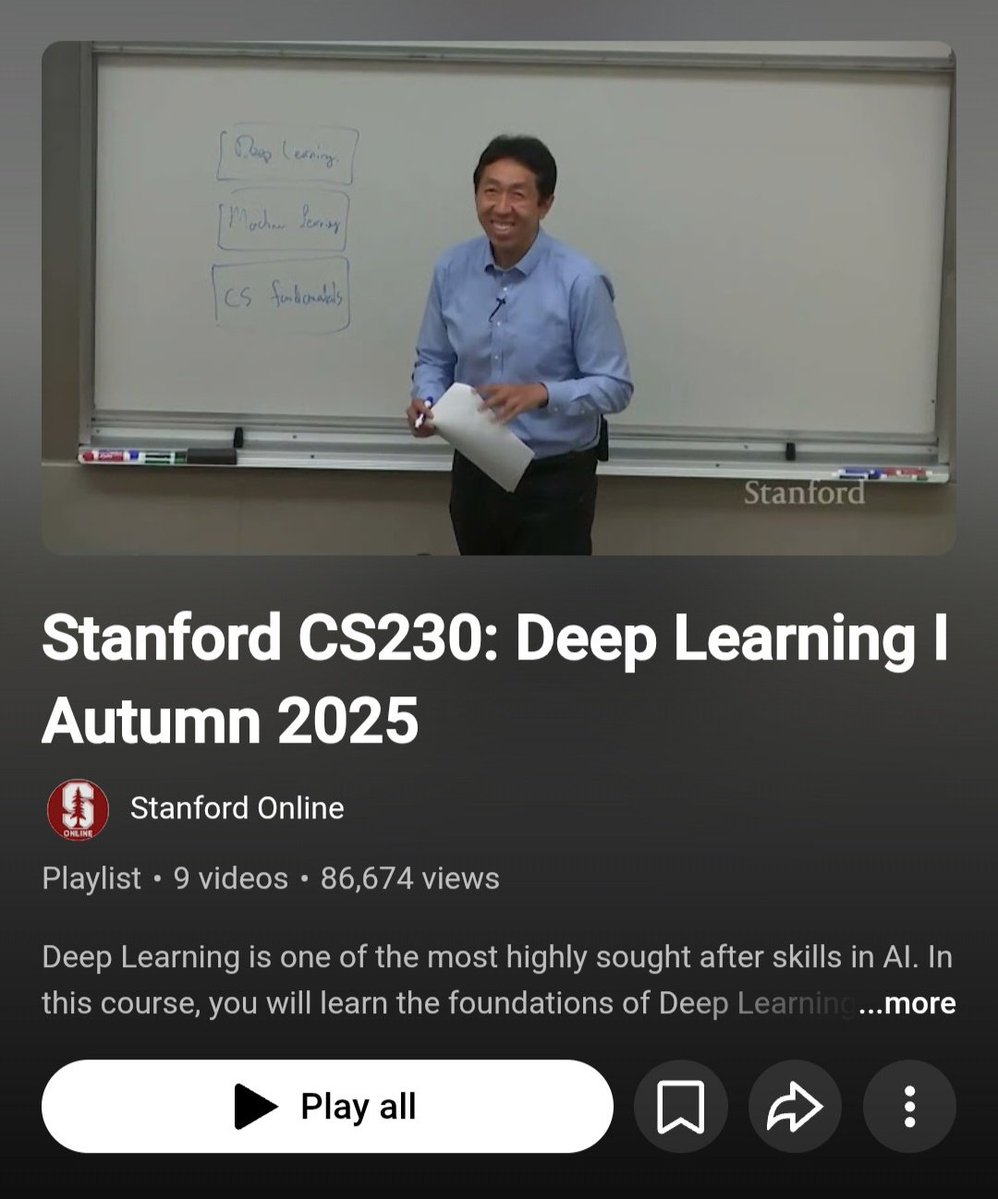
Stanford just made a $200,000 AI degree free.
No application.
No tuition.
No “elite access”.
Stanford released its actual AI/ML curriculum on YouTube.
Not a PR-friendly intro.
Not “AI for the public”.
This is the real thing.
The same lectures shaping people working on frontier models.
What just became public:
Deep Learning (CS230)
→ https://t.co/DUtL9MO6Y7
Transformers & LLMs (CME295)
→ https://t.co/gN57biwLsE
Language Models from Scratch (CS336)
→ https://t.co/GnH11pPBdW
ML from Human Feedback (CS329H)
→ https://t.co/X9nxEX6PNg
Computer Vision (CS231N)
→ https://t.co/oBxKKWZP22
LLM Evaluation & Scaling
→ https://t.co/1tDpw9ArTq
The uncomfortable truth:
The degree isn’t the scarce asset anymore.
Execution speed is.
Top schools know this.
That’s why they’re publishing the playbook.
👉 Bookmark this.
Comment the first lecture you’ll actually watch.
OpenAI, Anthropic, and Google use 10 internal prompting techniques that guarantee near-perfect accuracy…and nobody outside the labs is supposed to know them.
Here are 10 of them (Bookmark this for later):
Is there something truly special about the human mind?
“There might be a difference between the carbon-based substrates that we are and the silicon ones when they process information. Consciousness is the way information feels when we process it." Demis Hassabis