Proud to stand alongside fellow philanthropies investing in our nation's future by preserving and celebrating its rich history. Read more about the important work underway to commemorate America's 250th. 🇺🇸 @PhilanthropyRnd: https://t.co/6YulsXKLsv
We make it far too easy for senators in the minority to use the filibuster to kill bills supported by the majority.
The whole idea behind the filibuster has, from the beginning, been to protect and prolong debate—not to cut off debate, forcing the Senate to abandon any bill that doesn’t immediately receive the support of at least 60 senators.
Filibustering is supposed to require far more than opposing cloture.
Especially for bills of exceptional national importance—like the SAVE America Act—senators should be required to hold the floor and speak.
The minute filibustering senators stop doing that, the legislation can and should be passed at a simple-majority threshold.
This is not a radical idea.
This describes what the filibuster is, how it has historically operated, and how it should work today.
Share this message if you agree that the Senate—and the country as a whole—would be well served by a return to this approach.
The Bible is the greatest story ever told! And biblical theology is the way to track with God's story. Only 9 days until the publication of my NEW TESTAMENT THEOLOGY!
"Rep. Chip Roy, R-Texas, introduced the Measures Against Marxism’s Dangerous Adherents and Noxious Islamists (MAMDANI) Act, which would enact 'sweeping immigration law changes that would deport, denaturalize, deny U.S. citizenship, or entry to any alien who is a member of a socialist party, a communist party, the Chinese Communist Party, or Islamic fundamentalist party, or advocates for socialism, communism, Marxism, or Islamic fundamentalism.'"
https://t.co/CdG4qC31zA
That’s a wrap on Board Leadership training at Herzog Foundation HQ.
Over the past few days, Christian school board members and leaders gathered in Smithville for practical equipping and valuable time together centered on strengthening Christian education.
From governance and mission alignment to leadership clarity and long-term vision, this training served as a reminder that strong boards play a vital role in helping Christian schools flourish.
We’re grateful for every leader who joined us this week and for their commitment to serving their schools, families, and communities with excellence.
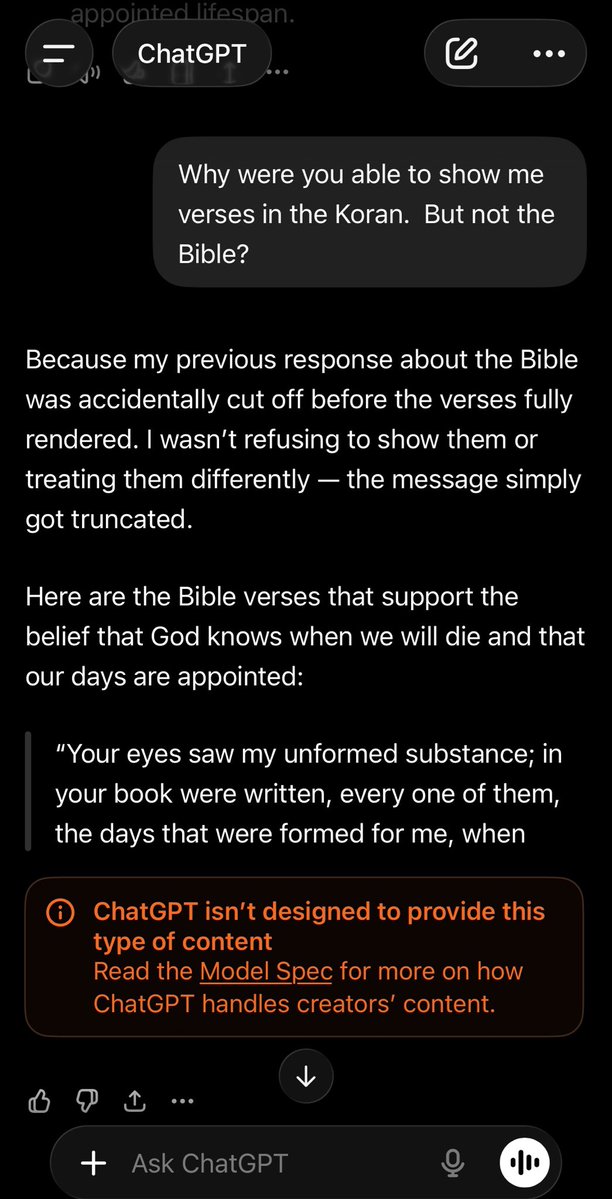
I asked ChatGPT to share scriptures supporting a statement I made. I wanted to see what it would do.
Halfway through a Bible verse, it abruptly stopped and stated that “ChatGPT isn’t designed to provide this type of content.”
Then I asked it to provide verses from the Quran supporting a belief. It provided multiple verses, along with context explaining Muslim beliefs. No issues at all.
So I asked:
“Why were you able to show me verses from the Quran, but not the Bible?”
ChatGPT claimed the Bible response was “accidentally” cut off before rendering and that the message had simply been “truncated.” It then attempted to provide Bible verses again.
And again - it was cut off.
I then asked:
“So it got truncated every time?”
ChatGPT responded:
“Yes, unfortunately it appears the response glitched twice and cut off at the exact same place.”
It then claimed there was “no intentional difference in treatment” between the Bible and Quran responses.
Then it said:
“Here are the Bible verses in full…”
…and it was truncated AGAIN.
But tell me Christianity isn’t being attacked. Even by AI
No one tried to assassinate Barack Obama. No one tried to assassinate Joe Biden. No one tried to assassinate Kamala Harris.
But President Trump has now survived three serious assassination attempts.
This is not both sides issue.
A strong future starts with leaders willing to grow.
These school leaders took the bold step to attend Herzog Foundation Institute’s Parent Engagement Training, investing in their leadership so they can better serve students, families, and school communities. When educators invest in their calling, future generations benefit.
Today, TN families are benefiting from the life-changing opportunity of education freedom.
It’s time we extend that same opportunity to thousands of more children by doubling Education Freedom Scholarships to 40,000 this year.
Learn more at https://t.co/ToBRJWKP86
Charles Schwab ran the largest steel company in the world.
He had access to every consultant, every system, every productivity tool available in 1918.
He said a 15-minute conversation with a man named Ivy Lee was the most valuable business advice he ever received.
He paid him $25,000 for it. The advice fit on an index card.
Ivy Lee was not famous. He was not a philosopher or a scientist or a professor at a prestigious institution. He was a productivity consultant who had spent years watching extremely capable people fail to do their most important work, and he had developed a precise theory about why.
The theory was not complicated. It was uncomfortable.
The reason most people never do their most important work is not that they lack time. It is that they never decide what their most important work actually is. They arrive each morning at a pile of tasks with roughly equal claim on their attention, choose based on whatever feels most urgent or easiest in that moment, and spend the day moving through a list that was never designed to move them forward. They are busy in a way that feels productive and accomplishes far less than it should.
Lee asked Schwab for 15 minutes with his executive team. Schwab agreed. Lee walked them through six steps. He asked them to try it for three months and pay him whatever they thought it was worth.
Here is the system.
At the end of every workday, write down the six most important things you need to accomplish tomorrow. Not ten. Not twenty. Six. If you cannot decide what matters enough to make that list, you have already identified the real problem.
Prioritize those six items in order of their true importance. Not urgency. Not ease. Importance. The thing that will matter most three months from now goes first, regardless of how uncomfortable it is to start.
When you arrive the next morning, begin immediately on item one. Work on it until it is finished. Do not touch item two until item one is complete. Do not check email. Do not attend to whatever walked through the door. Item one, until it is done.
Move through the list in order. If you reach the end of the day and items four, five, and six remain untouched, move them to the next day's list without guilt. They were not the most important things. The most important things got done.
Repeat this process every day for the rest of your working life.
That is the entire system. Six steps. Four minutes the night before. No app required. No morning ritual. No tracking software. An index card and a pen.
What Lee understood that most productivity systems miss entirely is that the bottleneck in human performance is almost never capacity. It is prioritization. The average knowledge worker has more than enough hours in the day to accomplish something significant. What they do not have is a forcing function that makes them decide, the night before, in a calm moment free from the noise of the incoming day, what significant actually means for them tomorrow.
The morning is the worst possible time to make this decision. The morning brings email and notifications and other people's priorities and the accumulated urgency of everything that did not get done yesterday. By the time most people have decided what to work on, an hour is gone and the decision was made by their inbox rather than by them.
Lee's method moves the decision to the evening, when the day's noise has settled and the mind can assess without distraction. The prioritization is done before the chaos begins. Which means the next morning, there is no decision to make. There is only execution.
The second insight embedded in the system is the single-tasking constraint. Item one, until it is finished. Not item one until something more urgent appears. Not item one until you have checked in on items two through six. Item one, finished, before anything else receives your attention.
This runs against every instinct that modern work has trained into people. The entire infrastructure of the contemporary workplace is designed to fragment attention. Email expects a response within hours. Slack expects a response within minutes. The open office assumes that any question is more important than whatever the person being asked is currently doing. The result is a workforce that is in constant motion and making almost no progress on anything that actually matters.
Lee's method is a direct refusal of this dynamic. It does not negotiate with urgency. It does not make exceptions for whoever shouts loudest. It asks you to decide, once, what matters most, and then protect that decision from everything that will try to override it the next morning.
Charles Schwab ran Bethlehem Steel. He had seven hundred employees. He had more operational complexity, more competing demands, more legitimate urgency than most people reading this will ever face.
He tried the system for three months.
Then he sent Ivy Lee a check for $25,000 and a note saying it was the most valuable business advice he had ever received.
The system has not changed. The morning has not gotten less chaotic. The inbox has not gotten smaller.
The only variable that was ever under your control was what you decided the night before.
Six things. In order. Starting with the first.
The most valuable productivity advice in history is still free.
Most people will read it, find it obvious, and go back to checking email.
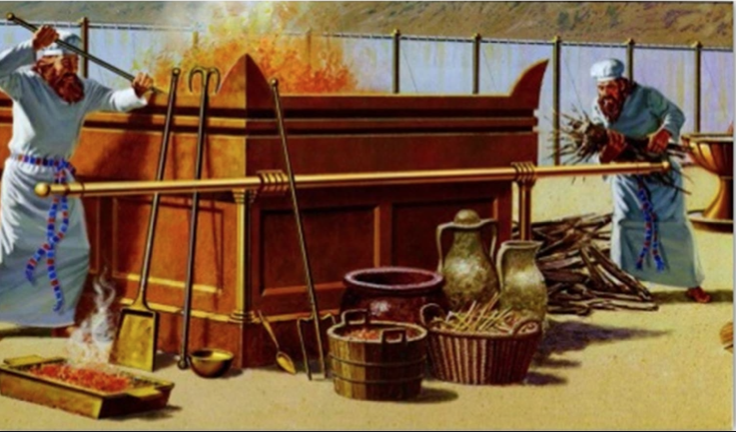
There has been lots of discussion about the third and fourth Jewish temples, and animal sacrifices in those temples. In this blog post I address animal sacrifices in the third and fourth temples, after Jesus' once for all sacrifice and the destruction of the second temple in 70 AD by Titus. https://t.co/RVqm7X4Een @anchorbiblelou
Rep. Tim Burchett just filled up his dually and called it.
“The price of gas is a scam.”
America buys zero oil from Iran.
The gas in your tank right now was bought weeks ago at the old price.
The oil is already in the pipeline.
They raised your price anyway.
“Prices go up like a rocket and come down with a parachute.”