@BCHSwitzerland is also very much looking forward to faster and more reliable block confirmations on Bitcoin Cash. We are endorsing CHIP-2025-03 Faster Blocks for Bitcoin Cash !
Endorsement of CHIP-2025-03 Faster Blocks for Bitcoin Cash
Bliss is an annual conference for builders and enthusiasts in the Bitcoin Cash ecosystem to celebrate upgrades and work done in the Bitcoin Cash ecosystem. We use the blockchain extensively for various things, such as selling our tickets and running tools and services to improve and make the event more useful and enjoyable to the participants.
Faster and more reliable block confirmations is helpful to reduce friction and keep the event running smoothly, so we are looking forward to this CHIP reaching consensus and activating on the Bitcoin Cash mainnet as soon as possible.
CashTokens isn't a smart contract layer bolted on top of BCH. It's a protocol-level change that gave every UTXO a native slot to carry token data — validated by miners, not by application logic.
The practical difference: on Ethereum, a token is a smart contract that maintains a ledger of balances. The contract can have bugs. The token standard can be implemented incorrectly. You're trusting the contract code, not the base layer.
On $BCH with CashTokens, fungible tokens work exactly like BCH itself — split, combine, transfer, all at the UTXO level. An NFT carries a 40-byte commitment directly in the output. There's no separate contract to audit for correctness on the token mechanics. The base layer enforces it.
Two token types shipped in May 2023:
Fungible tokens — divisible and mergeable, like BCH itself. Used for shares, loyalty points, pegged assets, governance votes. The supply is set at genesis and can't be inflated without the issuer's explicit authorization.
NFTs with byte-string commitments — arbitrary 40-byte data attached to a UTXO. The commitment can hold a merkle root, a vote count, a receipt hash, an ownership certificate. Contracts can read and validate that commitment natively.
The second type is what makes covenants interesting. A contract can issue an NFT that carries state — a counter, a price, a collateral ratio — and the next transaction in the chain can read that state and enforce rules based on it. This is how AnyHedge builds non-custodial hedging contracts. This is how Cauldron DEX tracks liquidity pool state. The commitment is the memory.
Fee for any of this: a fraction of a cent. The token mechanics don't add meaningful cost because they're part of the base transaction, not a separate gas market.
Bitcoin was built as peer-to-peer cash, not Wall Street’s “digital gold.”
This piece traces how it was deliberately hijacked by using money, influence, and insiders, revealed through Epstein files and public records.
Bitcoin Cash is the real Bitcoin.
https://t.co/W1uayuoKZ0
BCH Explorer v3 is OUT! 🎉
Massive upgrades to backend + frontend → smoother, faster, prettier 😎
New killer features: • Filter ANY transaction on mempool & mined blocks
• Full CashToken support
• Tons of new graphs + columns
• Many bugs squashed
👉 https://t.co/5qABm8ALz6
#BitcoinCash #BCH #CashTokens
As we continue teaching students and teachers about blockchain, I feel increasingly obliged to correct some of the overly simplistic definitions that keep getting repeated—even by well-meaning “thought leaders.”
One common line you’ll hear is:
“Blockchain is just a transparent, distributed, append-only ledger.”
This definition is not wrong…
but it is so incomplete that it becomes misleading.
Blockchain is not just a distributed ledger.
The real breakthrough is that blockchain lets us tokenize value—money, identity, ownership, access rights, even digital collectibles—and lets people hold and transfer that value directly without needing custodians acting as intermediaries.
For the first time in digital history:
- You control your own assets
- No one can freeze or block your transactions
- You don’t need permission to participate in the economy
That’s the part that changes society—not the distribution or transparency of the ledger.
-----
Another popular oversimplification:
“Blockchain is secure because it’s public and the majority will catch any attempt to tamper with it.”
Again… partly true, but deeply incomplete.
Blockchains are secure because of incentives, not just transparency.
What protects the system is cryptoeconomics—a design where:
- Honesty is rewarded
- Dishonesty is extremely costly
- The rational choice is to follow the rules
It’s not a popularity contest.
It’s not “majority vote.”
It’s game theory embedded in code.
This is the genius of Satoshi’s design:
A system that lets strangers anywhere in the world coordinate, exchange value, and enforce rules without relying on institutions — because the cryptographic guarantees and economic incentives make honest participation the most profitable and rational strategy.
-----
If we want people to appreciate blockchain’s potential, we need to teach it accurately.
It’s not just a distributed ledger.
It’s not just about transparency.
It's much more powerful.
I support the four chips proposed by @bitjson, Scheduled to be in 2026 upgrade.
It's reducing limits as we get access to better hardware.
And it introduces functions, Contract devs will be able to construct complex systems in BCH, A highly scalable UTXO model,Promoting use!
...
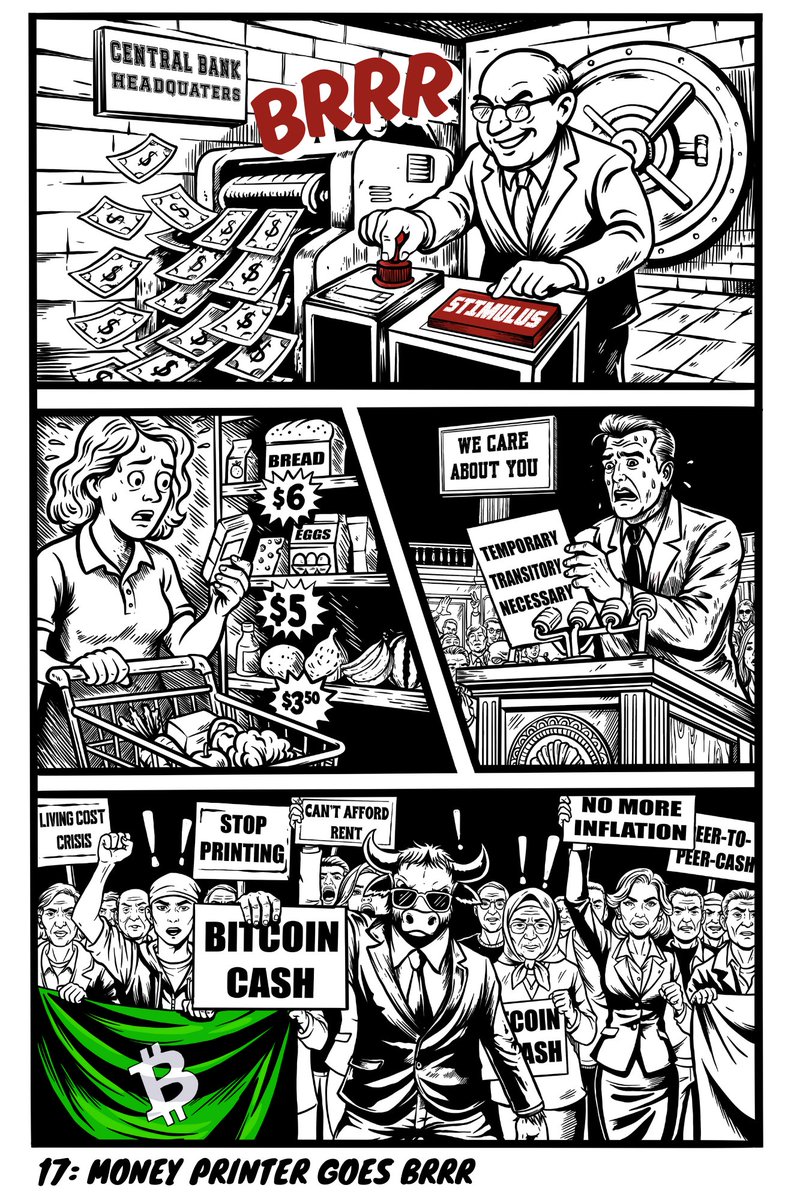
The money printer goes brrr, prices soar, and promises fall flat. People are waking up, they want real money.
Bitcoin Cash is the answer: fast, scalable, peer-to-peer money that no one can print out of thin air.
Bitcoin Cash and Mesh Network pave the way for a novel parallel economy, facilitating decentralized and uncensorable Peer-to-Peer transactions with minimal fees.
#BCH#BitcoinCash