Mathematics researcher at RIMS Kyoto • News of the AHGT France-Japan International Research Network • Arithmetic geometer in many flavours • 驚いた practitioner
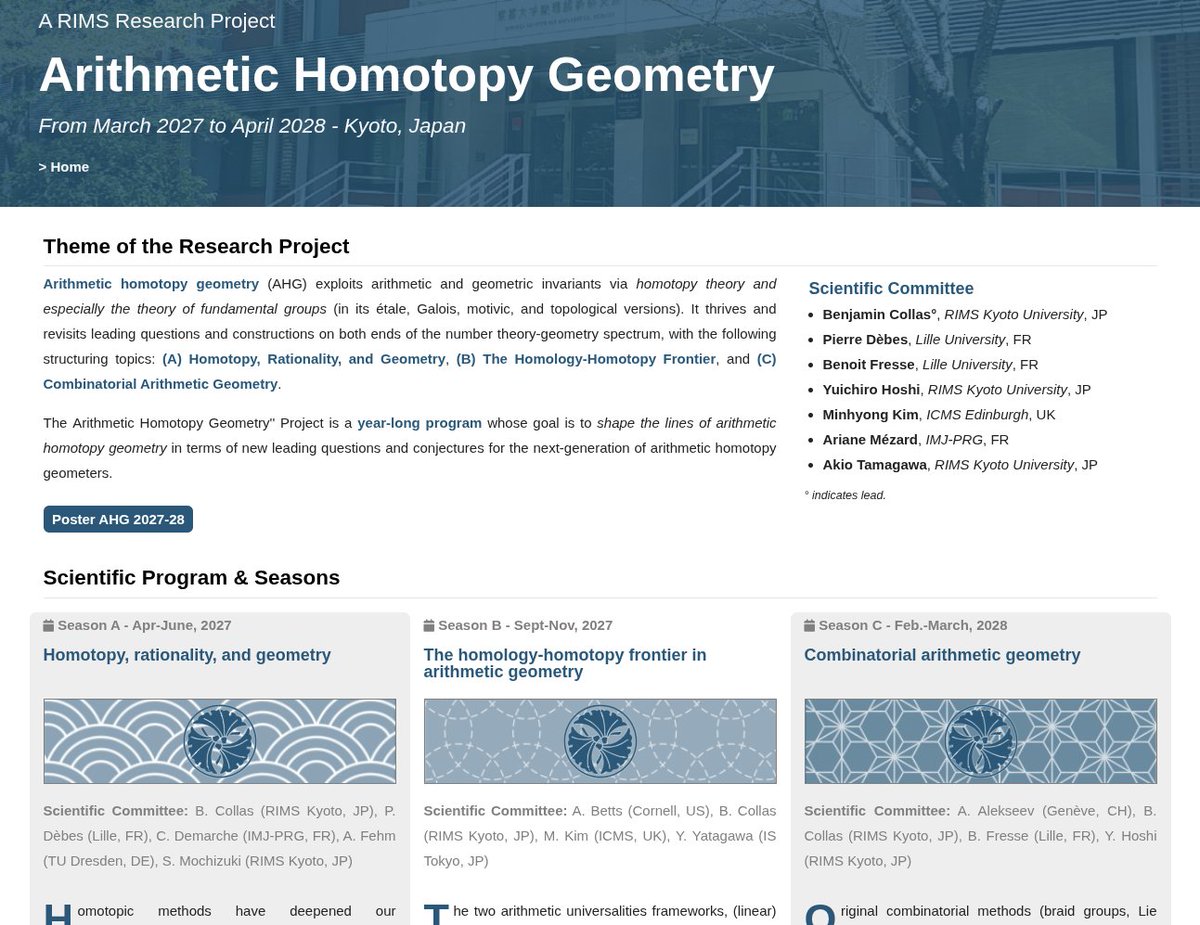
Arithmetic Homotopy Geometry
International research year at RIMS Kyoto
04/2027-03/2028
* Homotopy, rationality, and geometry
* The homology-homotopy frontier in arithmetic geometry
* Combinatorial arithmetic geometry
Conf x3; Courses: x7; Workshop: x7
https://t.co/xBnPm47LEU
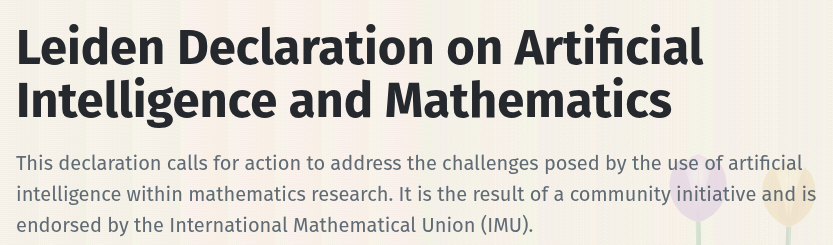
Leiden Declaration on AI and Mathematics.
https://t.co/UtJrD6OkeM
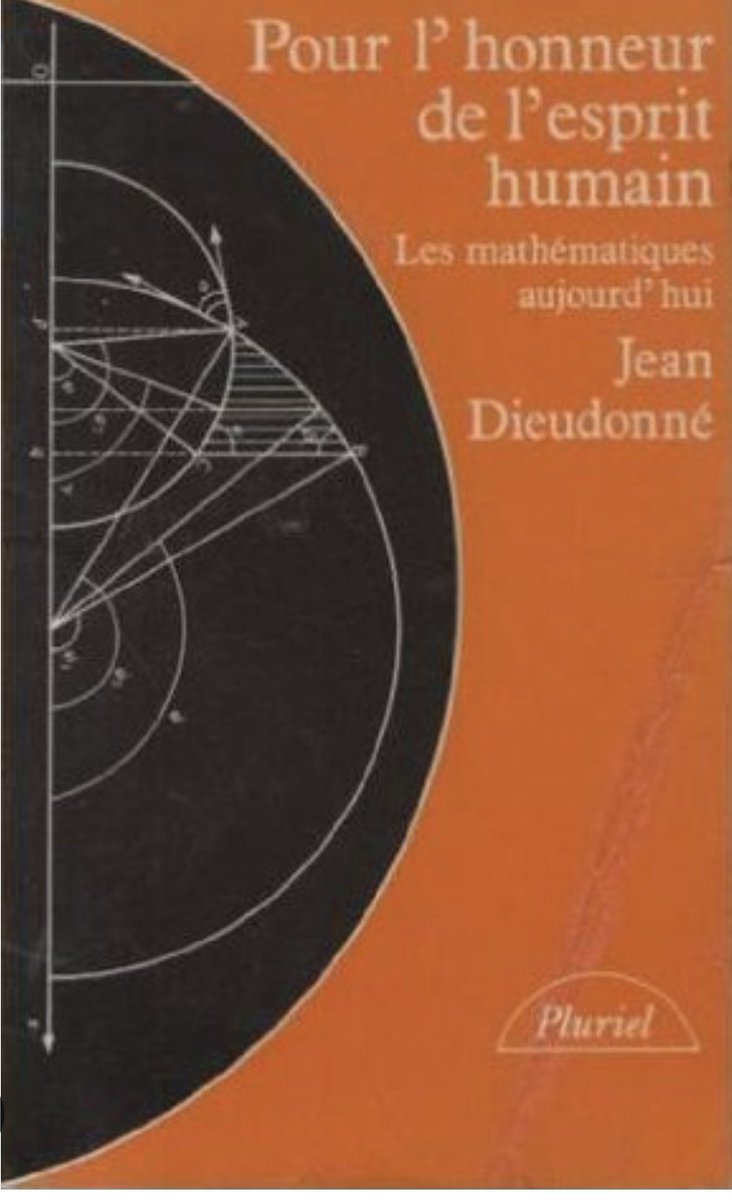
A glimpse of what is mathematics by those who practice mathematics.
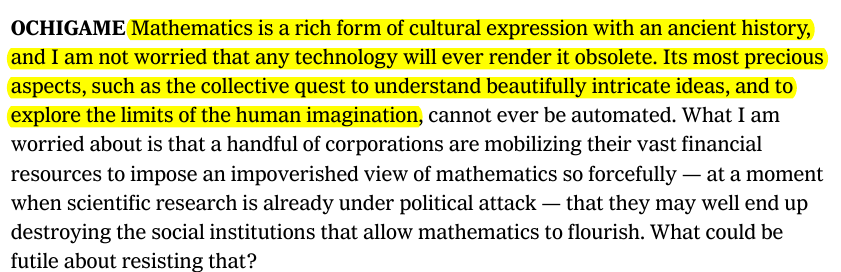
Excerpts from the NYT (by Harris, Ochigame, and Martin).
https://t.co/O3lWs3jU7L
@Konrad_LV Math is open to anyone. Just like any skill, trained ability, or art, it is built on the practice of a certain way of doing. Ignoring that lead to low quality "outcome" or... Just not science. Compared to end-game domain, outcome misses direct immediate evaluation criterion 🙏
@Gaur2005Ritika A PhD in math develops more than technical expertise; it builds a way of thinking that helps navigate a complex world, including in industry (see German social model). In that sense, is coding one of the modern levers turning analytical ability into real-world impact?
@Starcourse Arguments against Augmented Intelligence? None.
A reminder that pursuit of human knowledge has no end game; it requires approaches intrinsic to academic culture; innovation with private sector should build new interfaces for collaboration (not erode academic values and culture.)
With the X-Clacks-Overhead, certainly not!
Servers around the world secretly relay Pratchett signal
https://t.co/qlcmZtc4cf
Plugin: https://t.co/xs21F3Dc1f
More big news from Mathlib:
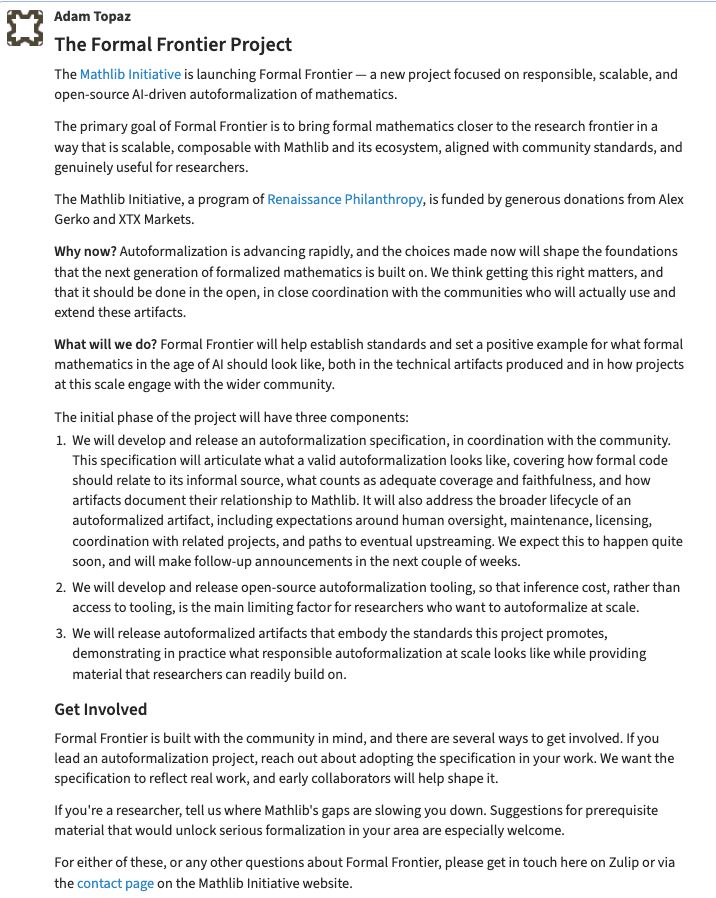
# The Formal Frontier Project
The Mathlib Initiative is launching Formal Frontier — a new project focused on responsible, scalable, and open-source AI-driven autoformalization of mathematics.
The primary goal of Formal Frontier is to bring formal mathematics closer to the research frontier in a way that is scalable, composable with Mathlib and its ecosystem, aligned with community standards, and genuinely useful for researchers.
The Mathlib Initiative, a program of Renaissance Philanthropy, is funded by generous donations from Alex Gerko and XTX Markets.
Why now? Autoformalization is advancing rapidly, and the choices made now will shape the foundations that the next generation of formalized mathematics is built on. We think getting this right matters, and that it should be done in the open, in close coordination with the communities who will actually use and extend these artifacts.
What will we do? Formal Frontier will help establish standards and set a positive example for what formal mathematics in the age of AI should look like, both in the technical artifacts produced and in how projects at this scale engage with the wider community.
The initial phase of the project will have three components:
We will develop and release an autoformalization specification, in coordination with the community. This specification will articulate what a valid autoformalization looks like, covering how formal code should relate to its informal source, what counts as adequate coverage and faithfulness, and how artifacts document their relationship to Mathlib. It will also address the broader lifecycle of an autoformalized artifact, including expectations around human oversight, maintenance, licensing, coordination with related projects, and paths to eventual upstreaming. We expect this to happen quite soon, and will make follow-up announcements in the next couple of weeks.
We will develop and release open-source autoformalization tooling, so that inference cost, rather than access to tooling, is the main limiting factor for researchers who want to autoformalize at scale.
We will release autoformalized artifacts that embody the standards this project promotes, demonstrating in practice what responsible autoformalization at scale looks like while providing material that researchers can readily build on.
@AdrienZabat@antoineducros [3/3] Conclusion: reste dans le cadre X/Qp, définit des invariants anabéliens discrets I, déforme X^an et regarde le changement sur I...
... c'est déjà suffisamment riche (et IUT-free) ;)
@AdrienZabat@antoineducros [2/3] (iii) Une variation analytique de X déforme les monoides p-adiques et on peut traquer ces effets sur K.
C'est mis en place pour X courbe elliptique et fonction théta dans les papiers IUT.
@AdrienZabat@antoineducros Info sans provoc': Les propriétés arith-geo des espaces modelées par des monoides au lieu d'anneaux, c'est justement ce que propose la géométrie anabelienne depuis 2008 avec [abstop1, 2,3] 😁
Pas d'infini cat, et pour certaines courbes... Et il faut aimer les grps profinis 🙏
Have you updated your MathSciNet author profile recently? Search your name and click “Login to edit” in the top right corner of the profile. Authors may update their own author profiles with the native script version of their name, a personal photo, personal email, and URL!
#MathSciNetMonday #MathSciNet30 #MathSciNet
Learn more. Link in comments.
@Dhivya691 Thank you for your interest! Participation will be in-person* only; registration will open 6 months ahead.
* so as to favor proper mathematics dissemination; the AHGT project has other hybrid/online events, though. 🙏
Arithmetic Homotopy Geometry
International research year at RIMS Kyoto
04/2027-03/2028
* Homotopy, rationality, and geometry
* The homology-homotopy frontier in arithmetic geometry
* Combinatorial arithmetic geometry
Conf x3; Courses: x7; Workshop: x7
https://t.co/xBnPm47LEU





![BCollasMath's tweet photo. * TedXKyotoUniversity - Asymmetry 2026.6.7
望月の遠アーベル幾何学は、『私たちがまだ見ぬ新しい秩序と進化の可能性を見出しうる“不均衡な揺らぎ”』を活用しているのかもしれない 」☺️
https://t.co/ll8FBjMid0
@tedx_kyotou
[Entrance fees payable with vegetables for students] https://t.co/5vI7SdxtKO](https://pbs.twimg.com/media/HIU4wEdbEAAxi4C.png)







![BCollasMath's tweet photo. * TedXKyotoUniversity - Asymmetry 2026.6.7
望月の遠アーベル幾何学は、『私たちがまだ見ぬ新しい秩序と進化の可能性を見出しうる“不均衡な揺らぎ”』を活用しているのかもしれない 」☺️
https://t.co/ll8FBjMid0
@tedx_kyotou
[Entrance fees payable with vegetables for students] https://t.co/5vI7SdxtKO](https://pbs.twimg.com/media/HIU6NZTbUAALWgq.png)





